
What if the lack of a storefront isn’t what’s keeping local customers from finding you? Marketing a business with no storefront starts with making it clear what you do, where you work, and how customers can reach you. If you run a home-based or service-area business, you may wonder whether you can appear on Google Maps or build trust when customers can’t walk through your door.
You don’t need a public shopfront to build a credible local presence. You do need accurate business information, clear service-area details, and genuine proof that helps potential customers feel confident contacting you. Google Business Profile eligibility and address-display rules depend on how your business operates, so check Google’s current guidance before creating or updating a listing.
This guide walks you through practical steps to describe and promote your business accurately, strengthen your visibility in search, and make it easy for customers to enquire. You’ll also learn how to prioritize manageable marketing tasks and track which ones lead to relevant enquiries, without relying on a walk-in location.
Key Takeaways
- Marketing a business with no storefront starts with identifying your business model and explaining where and how you serve customers.
- Check Google Business Profile eligibility and current address rules before setting up a listing, then keep your business details consistent.
- Choose channels that fit your audience and available time. Start with a practical step instead of trying to do everything at once.
- Use clear service descriptions, genuine project examples, and honest customer reviews to help prospective customers feel confident reaching out.
- Track qualified enquiries, calls, form submissions, and relevant search visibility so you can assess results and adjust your approach.
How to market a business with no storefront: start with what customers need
Plenty of small businesses serve customers without inviting the public into a shop. A cleaner works at customers’ homes, a mobile repair provider travels to the job, and a consultant may meet clients remotely or by appointment. These businesses can still build local visibility. Make it easy for potential customers to understand what you offer, where you operate, and how to contact you.
People may search for a service and a place together, or use a search that signals local intent without naming a location. This is the basic idea behind local search. Your marketing should reflect how customers find and receive your service. Don’t imply that you have a walk-in shop if you don’t.
What counts as a business with no storefront?
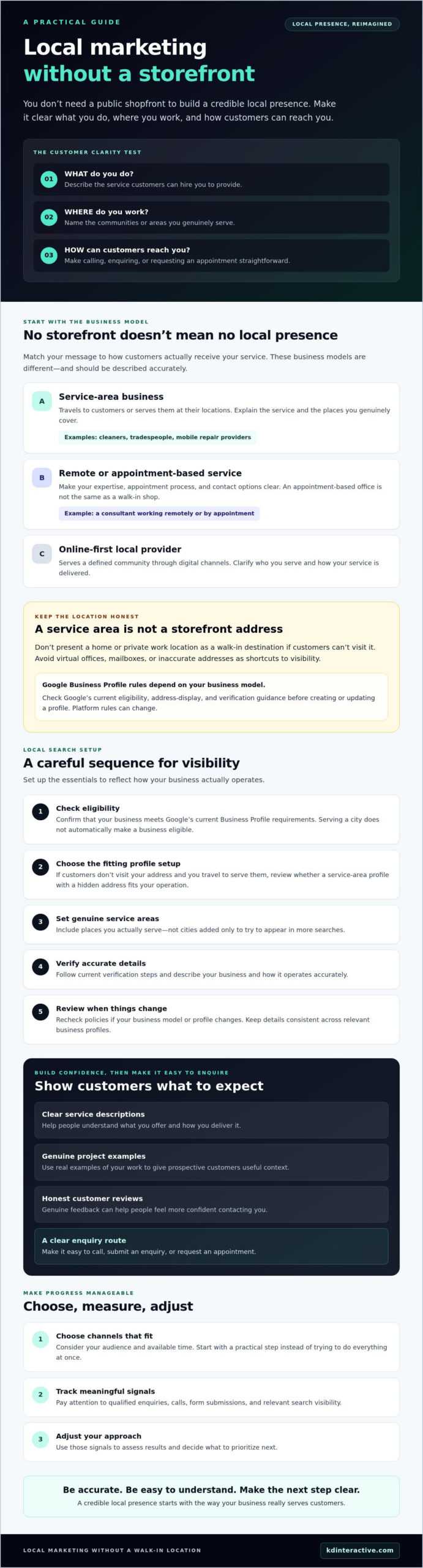
A storefront-free business serves customers without operating a public walk-in location. A service-area business travels to customers or serves them at their locations. Examples include cleaners, tradespeople, and mobile repair providers. Consultants may work remotely or meet by appointment, while an online-first local provider may serve a defined community through digital channels.
These models aren’t interchangeable. An appointment-based office may have a location where clients meet, while an online-only business may not serve customers in person. The right marketing mix depends on where your customers are and how you deliver your service. A mobile provider should explain its coverage and travel-based service. A consultant should make its expertise, appointment process, and contact options clear.
A service-area business serves customers at their locations within a defined area; a walk-in storefront serves customers at a public business location.
Does a business need a public address to market locally?
No public-facing address doesn’t automatically rule out local marketing. A service area and a public address describe different things. State the places you serve clearly on your website and other relevant business profiles. Don’t present a home or private work location as a walk-in destination if customers can’t visit it.
For Google Business Profile, eligibility and address-display options depend on the platform’s current rules and your business model. Check Google’s latest guidance before creating or changing a profile. Don’t use a virtual office, mailbox, or inaccurate address as a shortcut to visibility. An incorrect location can confuse customers and undermine trust.
- Say what customers can hire you to do.
- Name the communities or areas you genuinely serve.
- Give customers a clear way to call, submit an enquiry, or request an appointment.
These basics help customers understand your business and shape marketing a business with no storefront around their needs, rather than around a location you don’t have.
Set up local search visibility without displaying a storefront address
A service-area business can build local visibility without presenting its home or work location as a place customers can visit. The setup should reflect how the business operates. Google Business Profile eligibility and address-display rules depend on the business model, and platform guidance can change. Check Google’s current policies before creating or updating a profile.
Use this sequence to get the essentials in order:
- Check eligibility. Confirm that your business meets Google’s current requirements for a Business Profile. Serving a city doesn’t automatically make a business eligible.
- Choose the right profile setup. If customers don’t visit your address and you travel to serve them, review whether a service-area profile with a hidden address fits your operation.
- Set genuine service areas. Include places you actually serve. Don’t add cities solely to try to appear in more searches. A longer list won’t make your service there real.
- Verify your details. Follow Google’s current verification steps and provide accurate information about your business and how it operates.
- Review policies regularly. Recheck the rules if your business model or profile changes. Don’t use an inaccurate address as a visibility shortcut.
How should a service-area business handle its Google Business Profile?
If you serve customers at their locations rather than welcoming them at your business address, Google may allow you to hide the address and show service areas instead. Google sets the eligibility and display requirements, so confirm them in the current Business Profile policies. Your service area should describe where you genuinely work, not list places you hope to rank in.
Which local listings and business details should you prioritize?
Start with your website and eligible profiles on platforms relevant to your customers. Keep your business name, phone number, website, service descriptions, and operating hours accurate and consistent wherever they appear. Update your hours if they change, and remove areas you no longer serve. Clear details help customers confirm they’ve found the right business and understand how to reach you.
Local citations, or mentions of your business details on directories and other websites, can support a consistent online presence. Treat them as supporting information, not a guaranteed ranking shortcut. Prioritize accurate listings that your customers are likely to use.
If you need a practical walkthrough for creating a profile, see this Google Business Profile setup guide. A careful setup gives marketing a business with no storefront a reliable local-search foundation without suggesting that customers can visit a public storefront.
Choose marketing channels that fit a business without a physical location
The right channel depends on how customers look for your service and how much time you can spend maintaining your marketing. A local contractor may benefit from search visibility when someone needs a nearby repair. A consultant might rely more on referrals and useful expertise online. Start with a small, manageable mix, then expand if it brings relevant enquiries.
| Channel | Purpose and best fit | Practical first step |
|---|---|---|
| Local organic search | Reach people actively looking for services in a defined area. Useful for service-area businesses and local consultants. | Create a clear page for each core service, describing the areas you genuinely cover. |
| Referrals | Build on trust and personal recommendations. A natural fit for relationship-based and appointment-led services. | Make it easy for satisfied customers to share your contact details. |
| Social media | Show your work, share helpful updates, and stay visible to a community. Best when customers use platforms you can maintain. | Choose one relevant platform and plan a simple, consistent posting rhythm. |
| Keep in touch with people who have chosen to hear from you. It can suit businesses with repeat customers or longer decision cycles. | Decide what useful updates you could send and how people can choose to receive them. | |
| Paid promotion | Put an offer in front of a selected audience. It may suit businesses ready to test messaging and monitor enquiries. | Set a clear objective and decide how you’ll assess results before launching. |
When should a storefront-free business prioritize local SEO?
Prioritize local SEO when prospective customers search for the service you offer in places you genuinely serve. Build useful service pages that explain what you do, who you help, and where you operate. Avoid thin pages that simply repeat city names. For broader channel planning, read this digital marketing starter guide, or explore the local SEO services guide for more on local search fundamentals.
How can content, social media, and referrals reinforce each other?
Start with a question customers often ask and answer it clearly on your website. Then share a useful takeaway on social media. That content gives customers and referral partners something relevant to pass along. Reviews can add credibility when they reflect honest customer experiences, but they can’t guarantee new business.
For marketing a business with no storefront, consistency is more useful than spreading yourself thin across every channel. Choose the few you can update reliably, then note which ones lead to relevant conversations. If you need support shaping a local visibility plan, explore local SEO support as one possible next step.
Build trust and turn local attention into qualified enquiries
Customers who can’t visit your business need other ways to judge whether it’s a good fit. Clear service descriptions, real examples of completed work, and visible contact options answer practical questions before someone reaches out. Be specific about what you do, where you work, and what happens after an enquiry. Clear expectations can help attract better-qualified prospects and reduce uncertainty on both sides.
What makes customers trust a business they cannot visit?
Use proof that reflects your actual work and is current. With permission where needed, share relevant project photos, authentic testimonials, and staff information that helps customers understand who they’ll be dealing with. Mention credentials only when they’re genuine and relevant. State service boundaries plainly, including the areas you cover and any work you don’t provide.
Invite customers to leave honest reviews without pressure or incentives, and don’t ask them to use scripted wording. Respond professionally to positive and critical feedback. A thoughtful response shows that you take customer experiences seriously. A clear enquiry process gives new prospects a straightforward next step.
- Services: Can visitors tell what you do and who you serve?
- Proof: Are project examples and testimonials genuine and up to date?
- Coverage: Are your service areas and boundaries easy to understand?
- Contact: Can visitors quickly find a phone number or enquiry form?
- Next steps: Do they know what information to provide and what to expect?
How should a business make its website convert local visitors?
Put your core services, locations served, and contact methods where visitors can find them easily. Use a specific invitation such as “Request an estimate” or “Schedule a consultation” only if it matches how your business works. Explain what happens after someone submits a form or calls, and ask only for information you need to respond.
Connect each service page to useful proof, such as a relevant project example or customer review. Then make it easy to reach the contact page. This creates a simple path from a visitor’s need, to evidence that you can help, to an enquiry. For marketing a business with no storefront, those details can make your online presence feel more personal and dependable.
Once these basics are in place, a tailored local visibility strategy can help strengthen how customers find and assess your business. Explore local SEO support from KD Interactive, a Wisconsin-focused agency serving small businesses.
Measure results and grow a storefront-free business one step at a time
Marketing works best as a practical cycle: record where you’re starting, track a few useful measures, review them consistently, then adjust one activity. You don’t need a complicated dashboard. You need enough information to see whether your marketing is reaching the right people and generating relevant enquiries.
Which marketing metrics matter when you have no storefront?
Separate visibility from action. Search impressions and profile views can show whether people are encountering your business, but they don’t prove those people became customers. Calls, form submissions, bookings, and qualified leads are closer to the outcome that matters. Review customer reviews too, where that information is available.
Use analytics and platform reporting to collect what you can, but first check that tracking is set up correctly. For example, confirm that form submissions are recorded and that calls are attributed consistently. Then follow a simple sequence:
- Set a baseline: Record your current visibility and enquiry levels before making a change.
- Choose a small set of measures: Track qualified enquiries, calls, form submissions, relevant search visibility, and review trends where available.
- Review consistently: Compare similar periods, and note seasonal changes or operational factors that may affect demand.
- Adjust one activity: If a service page gets attention but few enquiries, check whether its information and next step are clear before changing several channels at once.
Clicks and impressions can help explain what’s happening, but interpret them alongside business context. A rise in views may be useful, yet it doesn’t show whether visitors were in your service area or needed the service you provide. Look for patterns between visibility and qualified enquiries rather than treating any single metric as proof of revenue impact.
When should you manage marketing yourself or get expert help?
Managing marketing yourself can work well if you have time to keep your information accurate, publish useful content, and review results. If planning, content creation, or performance analysis starts to exceed your capacity, professional support may help make the work more manageable. Choose support based on the specific gap, not pressure to add more channels.
For businesses focused on Wisconsin, KD Interactive offers local SEO and content creation for small businesses. Its local SEO services include keyword research, on-page optimization, link building, analytics tracking, and reputation management. This support can help with a tailored visibility strategy without promising particular rankings or revenue. Marketing a business with no storefront doesn’t require doing everything at once. Start with clear measures, learn from the results, and build on what fits your business.
Build local visibility with a clear next step
A business doesn’t need a walk-in location to earn local attention. Marketing a business with no storefront works best when customers can quickly understand what you offer, where you serve them, and how to get in touch. Keep your business information accurate, choose channels you can maintain, and build confidence with genuine proof of your work.
Then measure what matters. Search visibility can show whether people are finding you, while qualified enquiries, calls, and form submissions help reveal whether your marketing is reaching potential customers. Review results regularly and make one practical adjustment at a time.
KD Interactive provides Wisconsin-focused digital marketing support for small businesses, including local SEO and content creation. Its local SEO work can also include analytics tracking and reputation management, helping you make informed decisions about your online presence.
Explore local SEO support for your business and take the next step toward a clearer, more credible presence. Start with what your customers need, then build steadily from there.
Frequently Asked Questions
Can a business without a storefront have a Google Business Profile?
Yes, some businesses without storefronts can have a Google Business Profile, but eligibility depends on how they serve customers and Google’s current policies. A service-area business that meets the requirements may be able to show its service area without displaying its address. An online-only business may not qualify. Check Google’s latest eligibility and verification guidance before creating a profile, and describe your business accurately.
How do I market a service-area business online?
Start by explaining what you do, where you genuinely serve customers, and how they can contact you. Create website content for your core services, keep eligible business profiles accurate, and ask customers for honest reviews. Choose channels your customers use and that you can maintain, such as local search, referrals, or social media. Track calls and qualified enquiries to learn which activities are useful.
Should I hide my address on Google if I work from home?
If customers don’t visit your home and you travel to serve them, you may be able to hide your address and display service areas instead, provided your business meets Google’s current eligibility requirements. Don’t list a home address publicly if it isn’t a customer-facing location. Check the latest Google Business Profile rules before making changes, since eligibility and address-display requirements depend on your business setup.
What is the best marketing strategy for a business with no physical location?
The best strategy is the one that matches how customers find your service and that you can sustain. For a local service provider, a useful starting point is clear service pages, accurate eligible profiles, and a straightforward way to enquire. Add referrals or social media if they fit your audience and capacity. For marketing a business with no storefront, measure relevant enquiries, not just online attention.
Can a home-based business rank in local search results?
Yes, a home-based business may appear in local search results if it meets the relevant platform’s eligibility rules and provides clear, accurate information about its services and genuine coverage area. Visibility isn’t guaranteed, and a public address isn’t the only consideration. Make your website and eligible profiles useful to local customers, and review current Google guidance before setting up or updating a Business Profile.
How can customers trust a business they cannot visit?
Give potential customers verifiable reasons to feel confident contacting you. Describe your services and boundaries clearly, share genuine examples of your work, and make your contact details and next steps easy to find. Ask customers for honest reviews without incentives or scripted wording, and respond professionally to feedback. Current staff details or relevant credentials can also help, provided the information is accurate and shared appropriately.
Do I need a website to market a business without a storefront?
A website isn’t the only way to promote a business, but it gives you a central place to explain your services, coverage, and contact process. It can also help customers assess your business before getting in touch. If you don’t have one yet, keep eligible profiles accurate and make your contact information easy to find elsewhere. Build a website when it fits your goals and capacity.