
Enrollment growth starts before a family is ready to apply. Effective marketing for private schools locally makes a school’s distinctive strengths easy to find, builds trust with clear, useful information, and uses suitable channels to reach nearby families. The goal is a steady path from discovery to inquiry, not a last-minute enrollment push.
Families need more than a promotional message to choose a school. They want to understand its programs, teaching approach, community, and admissions process, and feel confident in what they find online. A proactive plan answers those questions consistently and gives families a clear next step.
This article explains how to make a school website a useful resource, strengthen online trust, and choose channels that fit local enrollment goals. It also covers how to build a repeatable marketing routine and where focused agency support can help improve local visibility while preserving what makes the school community distinct.
Key Takeaways
- Make program details, admissions steps, tuition information, and school calendars easy for families to find on your website.
- Build online trust by showing how your school’s values and community experience shape the family experience.
- Choose digital advertising channels based on the way local families discover and research schools, then track which channels generate meaningful inquiries.
- Use a consistent, locally focused marketing plan to reach families before enrollment decisions become urgent.
1. School website articles and information marketing
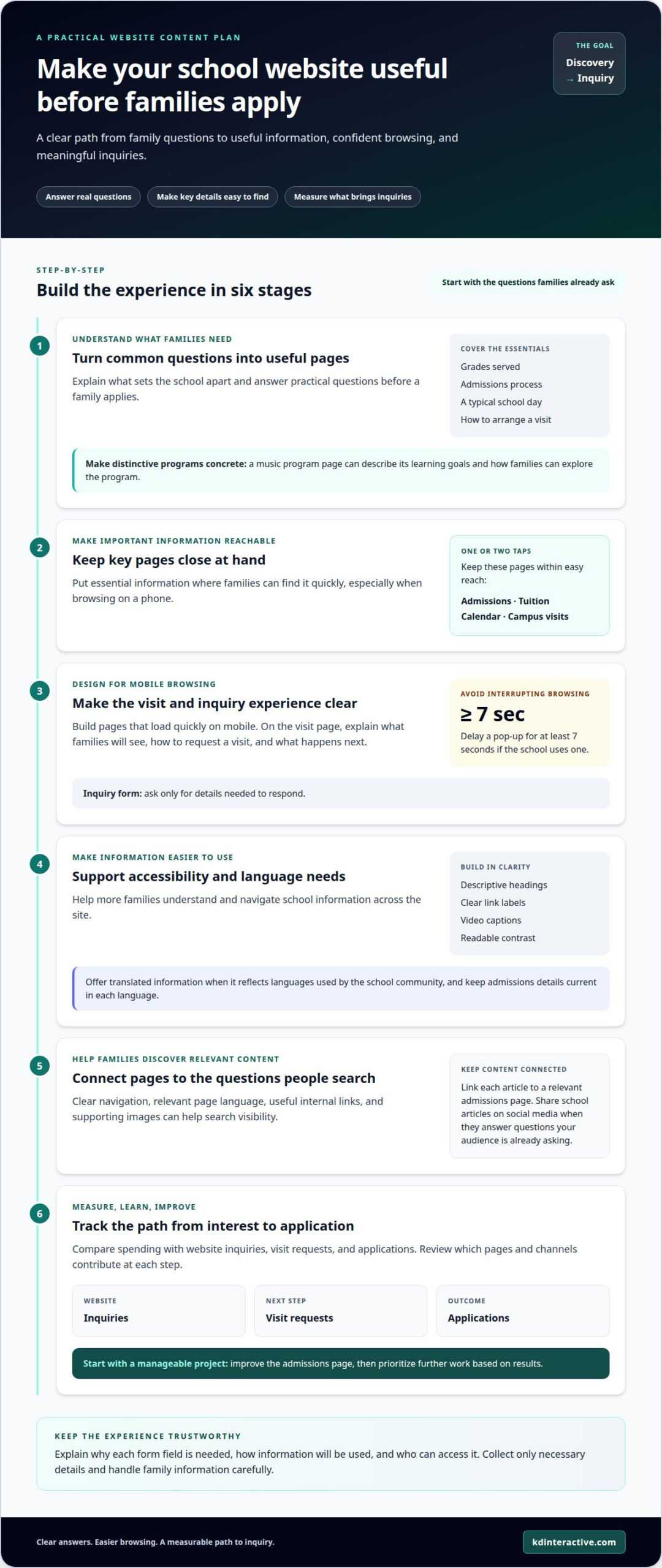
Use the school website to explain what sets its programs, teaching approach, and campus apart. A practical content strategy answers parents’ questions before they apply: which grades the school serves, how admissions work, what a typical school day includes, and how to arrange a visit. For example, a music program page can explain its learning goals and how families can explore the program. Link each article to a relevant admissions page so interested readers have a clear next step.
Make essential pages easy to reach on a phone. Keep admissions, tuition, calendar, and campus visit information within one or two taps, and build pages that load quickly on mobile devices. A visit page should state what families will see, how to request a visit, and what happens next. If the school uses a pop-up, delay it for at least 7 seconds so it doesn’t interrupt the first moments of browsing. A mobile-friendly form should ask only for details needed to respond to the inquiry.
Accessible, well-translated information helps more families use the site. Add descriptive headings, clear link labels, video captions, and readable contrast. Offer translated information when it reflects the languages used by the school community, and keep admissions details current in each language. Clear navigation, relevant page language, useful internal links, and supporting images can also help search visibility. Share school articles on social media when they answer questions your audience is already asking.
How much should a private school budget for local marketing? Set a budget based on enrollment goals, staff capacity, and the work required across the website, content, and promotion. Start with a manageable project, such as improving the admissions page, then prioritize further work based on results.
How can a private school measure the cost and effectiveness of local marketing? Track spending alongside website inquiries, visit requests, and applications. Compare which pages and channels contribute at each step. What privacy and consent risks should schools consider when collecting prospective-family leads? Explain why each form field is needed, how information will be used, and who can access it. Collect only necessary details and handle family information carefully.
2. How can schools build trust with families online?
Trust starts with messaging that reflects the families a school hopes to serve. Independent schools can emphasize academic approach, religious schools can explain their traditions, and specialty schools can spotlight programs such as arts or athletics. Define the ideal family by needs, values, and student interests, then show how campus life supports them. A school’s positioning should distinguish it from options within a 20-minute drive.
Research nearby neighborhoods by reviewing community priorities, family questions, and local search terms. Compare how nearby schools describe tuition, programs, and student outcomes, then identify what your school can explain more clearly. Use those insights to create useful local SEO content, not to copy another school’s messaging. Families should understand why your school may suit their needs.
Alumni and current families can share firsthand experiences as ambassadors. Invite them to describe a student’s transition, a campus tradition, or a learning milestone, while keeping participation voluntary. Ask for honest reviews without offering rewards or pressuring families to leave positive comments. Personal recommendations are most effective when stories feel genuine and reflect varied experiences.
A branded mobile app can support consistent family communication through event calendars, mobile-friendly forms, digital hall passes, and push notifications. Pair these tools with messaging focused on outcomes: explain what students learn, how they participate, and what families can expect. For example, a science program update might describe a project’s learning goals rather than promise a particular result.
For U.S. school marketing, keep claims accurate and make promotional messages clear. Use age-appropriate language and collect only prospective-family information needed for a stated purpose. Privacy requirements depend on the information collected and the audience, so use transparent practices in forms and follow-up.
Build local relationships through introductions to preschools, community groups, and businesses. Host a campus open house, student showcase, or 30-minute virtual information session for prospective families. A parent ambassador program can begin with five to ten enthusiastic families. If your school needs stronger local visibility, local SEO support can help connect its message with nearby searches.
3. Digital advertising channel selection
Marketing for private schools locally works best when channels support the same enrollment goal. Search engine advertising can reach parents actively looking for a school, while social media can introduce campus life to families who haven’t started searching. Google is a key consideration: 87% of consumers use it to evaluate local businesses. Pair paid search with engine optimization so useful school pages can also attract organic discovery.
Search visibility matters because families often focus on the first results. The first organic result receives about half of search clicks, and the top three results account for nearly 75%. Build relevant pages for admissions, grade levels, and distinctive programs. Paid search can support visibility for specific queries, while SEO builds a longer-term foundation. Track inquiry forms and visit requests to learn which searches bring families closer to action.
Social advertising can introduce local parents to campus updates, events, or program highlights. It costs less per click than search engine marketing, but those clicks may be less likely to lead to inquiries or enrollment. Use social as an awareness channel and direct interested families to a clear landing page. Compare engaged visits and completed forms, not clicks alone.
Choose platforms for their strengths. Facebook and Instagram can feature photos, family stories, and open-house details. YouTube can host longer explanations of programs or student experiences for prospective families. Keep messages consistent across channels, but tailor each format to how families use it.
Start with a focused test: choose one local audience, one message, and one conversion action, such as requesting an admissions visit. Review the results before expanding. If families click but don’t inquire, improve the landing page or message. Effective marketing for private schools locally connects advertising with organic search and useful content, then uses inquiry data to guide the next campaign.
4. What local marketing strategies work best for private schools?
Effective marketing for private schools locally starts with a clear picture of the community a school serves. Most private schools primarily serve families within a 10–20 mile radius, so map nearby neighborhoods, community events, and organizations families already trust. A family’s decision can take 12 to 36 months, making steady community engagement more useful than relying only on last-minute enrollment campaigns.
Build a 12-month calendar around the school’s enrollment cycle. Include application milestones, open houses, seasonal programs, and relevant local events. Plan each communication to give families a useful next step, such as registering for a campus tour or learning about a grade-level program. Coordinate the calendar with admissions staff so event details and enrollment messages stay current.
Build partnerships through genuine participation. A school can share family resources with local preschools, youth organizations, and community groups, or invite them to a student showcase. Make each collaboration relevant to the partner’s audience instead of treating it as a promotion. Record which activities lead to conversations, event attendance, or inquiries to inform future outreach.
Keep social media active with authentic updates that reflect school life. Plan seasonal themes and share classroom projects, student achievements, and community involvement two to three times per week on Facebook and Instagram. Regular posts help families recognize the school’s voice and see its values in practice. Invite appropriate staff to contribute and follow clear approval practices for student-related content.
Review the plan regularly using local search visibility, inquiries, event attendance, and application activity. A practical way to strengthen marketing for private schools locally is to connect each activity to a measurable next step, then adjust based on family response. If you need a stronger local search strategy, strengthen your school’s local visibility with a focused plan.
KD Interactive: Local SEO Services
KD Interactive can help private schools improve local visibility when families struggle to find relevant admissions and program information online. Its Local SEO Services and SEO Keyword Analysis can identify search opportunities and help align school content with nearby families’ questions. Content Creation supports useful pages and articles about programs, campus life, and enrollment steps. Press Release Distribution can share school news with a wider local audience.
This support can suit schools with a clear enrollment goal that need a more consistent approach to improving search visibility and publishing useful content. Discuss your school’s priorities with KD Interactive to identify a practical next step for local marketing support.
Make your next enrollment move a focused one
Proactive growth starts with a clear priority. Identify where families need more support, such as finding your school in local search, understanding a program, or hearing about a campus event. Then align your next marketing steps with that need and track how families respond. A steady approach to marketing for private schools locally can build recognition before enrollment decisions become urgent.
KD Interactive offers Local SEO Services, Content Creation, and Press Release Distribution to support schools seeking greater local visibility and useful communications. These services can help when your team has a clear enrollment goal but needs support turning it into focused digital marketing work. The right starting point depends on the school’s priorities, existing content, and local audience.
Explore your next enrollment-focused marketing steps with KD Interactive. Keep building on what your community values, and make each next step easier for families to take.
Frequently Asked Questions
How can private schools move from a reactive to a proactive growth model?
Build a recurring enrollment review around leading indicators, not just final application totals. Track inquiry sources, campus visit requests, and follow-up completion in a shared admissions report. Assign an owner to each task, then review the report with school leadership regularly. This helps staff spot slowdowns early and adjust outreach or information before enrollment decisions peak.
How can schools build trust with families online?
Make claims specific, current, and easy to verify. If the school describes its learning approach, for example, link that statement to a curriculum explanation or sample student project. Keep staff biographies, admissions contacts, and school policies consistent across platforms. Conflicting details can make families hesitate, so assign a staff member to check key public information as school details change.
How does organic search drive enrolment?
Organic search helps families looking for educational options discover a school and explore whether it fits before contacting admissions. A page answering a specific query, such as how the school supports new students, can attract relevant visitors beyond branded searches. Review search performance alongside inquiry records to see which topics lead to meaningful conversations, then create related content that answers the next family question.
What are the main obstacles in K-12 marketing?
Common challenges include limited staff time, competing school priorities, and difficulty connecting marketing activity with enrollment outcomes. A small admissions team may handle events, family questions, and communications as well as promotion. Keep the work manageable: choose one priority, such as improving inquiry follow-up, assign a clear owner, and record each inquiry’s source. This provides a practical basis for deciding what to improve next.
What digital marketing tactics are most effective?
The right channel mix depends on the school’s audience and enrollment objective. Organic search can support discovery, paid search can reach people actively researching schools, and social media can show everyday campus life. Give each channel a distinct purpose and use a landing page relevant to its message. Compare qualified inquiries and visit requests across channels rather than judging performance by impressions or clicks alone.
How can private schools improve local SEO and Google Business Profile visibility?
Keep the school’s public business details accurate and consistent, including its name, location, contact information, and hours. Choose the most relevant profile category, add current campus photos, and respond professionally to reviews without disclosing private student or family information. On the website, use location-specific language naturally and link local pages to admissions information. Review profile interactions alongside inquiry records to assess their usefulness.