
A daycare’s local visibility depends on more than having a website. Effective daycare SEO services help your center appear in relevant local searches through an accurate Google Business Profile, useful childcare content, consistent directory listings, and search performance tracking. The aim is to help nearby families find and understand your programs.
It’s natural to focus on rankings, but visibility matters most when it connects parents with clear, helpful information about your center. A strong approach brings local search details and parent-focused content together, then measures whether that work is attracting relevant visits and inquiries.
This guide covers the main parts of a daycare SEO strategy, from profile management and program pages to listings and performance measurement. You’ll see how the pieces fit together and how to assess whether they support your center’s local growth.
Key Takeaways
- Assess whether a center’s Google Business Profile presents accurate, useful information and makes it easy for families to understand its programs.
- Build childcare content around the distinct programs and questions parents are researching, rather than relying on one general page.
- Keep the center’s name, address, and phone number consistent across online directories to strengthen local visibility.
- Track relevant search terms alongside website visits and family inquiries to see whether SEO work is reaching the right audience.
1. Does this include my Google Business Profile and reviews?
Yes. Local SEO helps a daycare appear in Google results when nearby families search for care. A complete Google Business Profile supports local visibility by showing your center’s name, address, phone number, hours, photos, and programs. Keep these details current, choose an accurate category, and describe the services families can access. On relevant website pages, use location-focused phrases such as “infant daycare in Madison” or “preschool near downtown.” This connects local keyword targeting with clear information for parents.
Google’s local 3-pack can make a center more visible near the top of search results. Rankings are only one measure, though. Track profile views, website visits, calls, and direction requests alongside review volume and responses. Reviews offer parents firsthand perspectives; invite honest feedback and respond calmly without sharing private family details. A monthly review of these metrics can show whether profile optimization is bringing useful attention, not just impressions.
How do daycare SEO agencies compare with DIY SEO or general marketing agencies? DIY work gives you direct control, while a daycare-focused strategy applies local keyword research to childcare programs and parent searches. General marketing agencies may cover broader channels, so compare their work against concrete tasks such as profile updates, local pages, and reporting. What SEO rules apply to daycare websites, including children’s privacy and advertising claims? Protect children’s identifying details in photos, reviews, and page content. Keep claims about care, qualifications, and programs accurate and supportable.
Parents also expect a website that works smoothly on mobile. Use readable text, simple navigation, and clear paths to program details and contact information. A parent searching “toddler care in Milwaukee” should quickly find the relevant program and a way to inquire. Technical optimization supports that experience, while Google Business Profile and website data can help connect local visibility with visits and calls.
2. Childcare content strategy and topical authority
Useful childcare content answers questions parents ask before choosing care. Create separate pages for infant care, toddler programs, preschool, pre-K, and before- or after-school care. Each page should explain the age group, daily experience, and next step for families. Daycare SEO services are more effective when program pages match distinct searches instead of one general page trying to cover every offering.
Trust depends on clear, specific information. Describe your curriculum and care philosophy with practical examples, such as how a preschool day balances guided activities and play. Accurately explain licensing status, accreditation, staff-to-child ratios, background check policies, emergency procedures, and facility safety standards. Keep claims supportable and make important details easy for parents to find. This information helps families assess whether your center fits their needs.
Content can also help parents planning ahead. Create useful pages about enrollment timelines, waitlists, tour availability, and what families can expect during a visit. Explain how to arrange a tour and what parents will see. Photo galleries or virtual tours can help families understand the setting beforehand. Use a clear next step, such as an inquiry form or tour request, to connect research with action.
Topical authority grows when pages work together. Link program pages to related resources, such as a preschool page to an article about preparing for the transition. Use local examples naturally, and write for parents first rather than repeating keywords. Local daycare blog posts can exceed 1,000 words when that length helps answer a specific question thoroughly. Review each page when programs or enrollment details change.
Competitive authority for program-specific and curriculum-specific searches typically takes five to eight months of consistent optimization and content work. When daycare SEO services are built around parent needs, local searches, and clear enrollment steps, a focused childcare content strategy can help organize those pages.
3. Directory listings and consistent business information
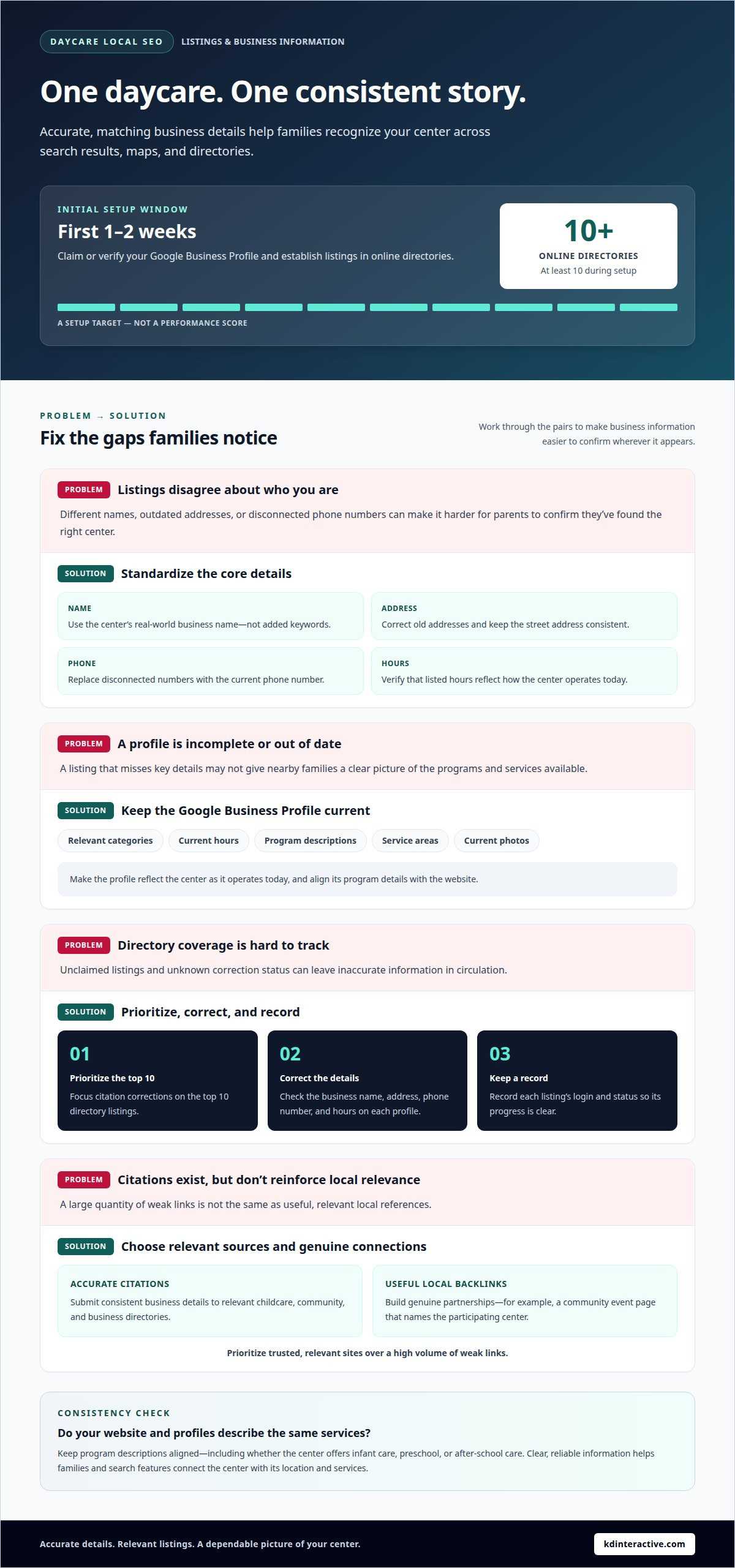
Consistent listings help families recognize the same daycare in search results, maps, and directories. Verify the business name, street address, phone number, and hours on each profile. Use the center’s real-world name rather than adding keywords, and correct old addresses or disconnected phone numbers. Even small differences can make it harder for parents to confirm they’ve found the right location.
For setup, claim or verify the Google Business Profile and at least 10 online directories during the first 1–2 weeks. Prioritize the top 10 directory listings when correcting citations, then record each listing’s login and status. On Google, select relevant categories, keep hours current, describe programs and service areas, and add current photos. Review activity also matters: invite families to share honest feedback and respond helpfully without disclosing private information. The profile should reflect the center as it operates today.
How can daycare businesses earn local backlinks and citations? Submit accurate business details to relevant childcare, community, and business directories. Earn useful local backlinks through genuine partnerships, such as a community event page that names the participating center. Prioritize trusted, relevant sites over a high volume of weak links.
Consistent details also support visibility beyond a single listing. Search engines and AI-powered search features need clear, reliable information to connect a center’s name with its location and services. Keep program descriptions aligned across your website and profiles, including whether the center offers infant care, preschool, or after-school care. This consistency gives families a dependable picture wherever they find your business.
Measure the effect by tracking profile actions, calls, direction requests, website traffic, and review patterns. Compare results over time and note which directories or profile updates coincide with changes. Don’t treat listing volume alone as success: accurate contact details and relevant presence matter more than duplicate or outdated entries. Clean, consistent listings are easier to maintain and help nearby families find your center.
4. How To Measure My Daycare SEO Success?
Measure success by connecting keyword visibility with meaningful actions, such as calls, tour requests, and enrollment inquiries. Start with SEO keyword research for the services families seek, including infant care, preschool, and after-school care. Add local phrases that reflect your location, such as “preschool in Madison” or “daycare near [neighborhood].” These searches help show whether your local SEO targets match your programs and service area.
Long-tail keywords contain three or more words and often signal clearer search intent. For example, “toddler daycare with summer openings” suggests a different need from “childcare options.” Map each phrase to a useful page instead of forcing every term onto the homepage. Search engines can then match relevant pages to family questions, while parents find details suited to their decision.
Track 20–30 priority keywords, including program, location, and enrollment terms. Compare rankings and organic traffic over time, then look at whether visits lead to inquiries. Google Analytics and Search Console can show website activity and search performance. Record calls, tour requests, and enrollment inquiries alongside those figures. A rise in visits matters most when the center also receives more relevant family interest.
Use competitor research to identify gaps, not to copy another school’s pages. Review search results for a target phrase and note which programs, locations, and parent questions appear. If nearby centers have a dedicated pre-K page and yours doesn’t, consider whether families need that information. Create a page only when it reflects a real program or answers a genuine parent question.
Meaningful local keyword ranking shifts typically appear within 60–90 days, while measurable enrollment-inquiry increases from local SEO typically take three to five months. Review results monthly, compare the same measures, and refine keywords when search intent or program details change. For a structured review of daycare keywords and search intent, request SEO keyword analysis and use the findings to focus your next optimization steps.
KD Interactive: Local SEO Services
KD Interactive can help your center coordinate local visibility, childcare content, and keyword priorities. Its Local SEO Services help businesses strengthen their presence in relevant local searches. SEO Keyword Analysis can identify search terms connected to your programs and service area, while Content Creation develops useful pages for families researching care.
Press Release Distribution can support announcements about center news or community involvement. The right next step depends on the gap you’ve identified: strengthen local search foundations, clarify program pages, or focus your keyword strategy. These services connect the practical work above with a focused approach to visibility and measurement.
Contact KD Interactive to discuss your center’s local SEO needs.
Make your next SEO decision count
Choose one clear objective for your center, such as reaching families in a nearby community or improving visibility for a specific program. A focused priority makes daycare SEO services easier to evaluate against real parent inquiries. Keep the goal tied to enrollment needs and the families your center is equipped to serve.
Then decide who will manage the work, how you’ll review progress, and which adjustments matter most. KD Interactive can help shape a practical way forward, whether you’re building a stronger local presence or refining how your center reaches families online. A steady, informed approach gives your team a clearer basis for future decisions.
Contact KD Interactive about daycare SEO to discuss a next step for your center. Your local visibility can grow through focused choices and consistent attention.
Frequently Asked Questions
What Is SEO For Daycare Centers?
SEO for daycare centers helps nearby families find a center through unpaid search results. It combines relevant website pages, accurate business information, and content that answers parent questions. For example, a center serving infants and preschoolers can make each program easy to find and understand. The goal is to connect a family’s search with a useful next step, such as exploring the right program.
Can I do SEO for my daycare myself?
Yes, you can manage practical SEO tasks yourself if you can maintain them consistently. Start by checking that your website names each current program and gives parents a clear way to inquire. Then review the search terms families use, update outdated details, and note which pages attract inquiries. If research, content updates, and performance tracking compete with center operations, outside support can help organize the work.
Do you optimize for mobile and ‘near me’ searches?
Mobile usability and local intent belong in a daycare search strategy. Make the phone number easy to tap, keep navigation simple, and ensure parents can find program details without pinching or zooming. For a “near me” search, a page should clearly identify your center’s location and actual care options. A parent searching on a phone should be able to assess the fit and contact your center easily.
Does this include my Google Business Profile and reviews?
Google Business Profile management and review activity can be part of local SEO work. Assign the profile a clear owner, keep its hours aligned with the center’s schedule, and look for duplicate or outdated listings. Make it easy for families to share honest feedback, and reply professionally to reviews. A response should address the concern without revealing a child’s identity or private family details.
How To Measure My Daycare SEO Success?
Measure SEO by tracking whether search visibility leads to useful actions from families. Report calls, tour requests, and inquiry-form submissions separately, so a busy channel doesn’t hide another. Compare the pages and search terms behind each inquiry, then note which programs generated interest. This helps you decide whether to improve a page, target a different parent question, or clarify an enrollment step.
How is child care SEO different from general SEO?
Childcare SEO should reflect how parents evaluate a sensitive, local decision. General SEO principles still apply, but a daycare site should answer specific questions about its programs, daily approach, and family experience. A parent comparing infant care needs different information from someone seeking after-school care. Clear, accurate details help connect each search with the right service and build confidence before an inquiry.