
Imagine a local Milwaukee customer searching for your shop on a Tuesday afternoon. They find your listing, click the call button, and reach a disconnected number or a private residence. According to a 2024 BrightLocal study, 77% of consumers say they won’t use a business again if they find incorrect contact details online. This is why learning how to fix incorrect business information online isn’t just a technical chore; it’s a vital part of protecting your revenue and your reputation.
We understand the frustration of dealing with ghost listings and confusing jargon about data aggregators. You’ve worked hard to build your brand in Wisconsin, and it’s exhausting to see outdated info pulling your Google Map Pack rankings down. We understand small business, because we are one! In this 2026 guide, you’ll learn the exact steps to identify and correct these errors to reclaim your local search presence. We’ll show you how to clean up your digital footprint and set up a simple system to keep your listings accurate for years to come.
Key Takeaways
- Understand why NAP consistency is a critical trust signal for 2026 AI search assistants and how tiny errors can drive potential customers to your competitors.
- Identify the “Big Three” data aggregators responsible for spreading incorrect data and learn how to stop the cycle of bad information at its source.
- Follow our proven 5-step checklist to learn how to fix incorrect business information online using an audit method that uncovers hidden errors.
- Evaluate the real ROI of manual updates versus automated listing management to determine the most cost-effective way to reclaim your time and rankings.
- Discover how to future-proof your presence with proactive AI monitoring that ensures your Google Map Pack data remains accurate and competitive.
Why Incorrect Business Information is Costing You Customers in 2026
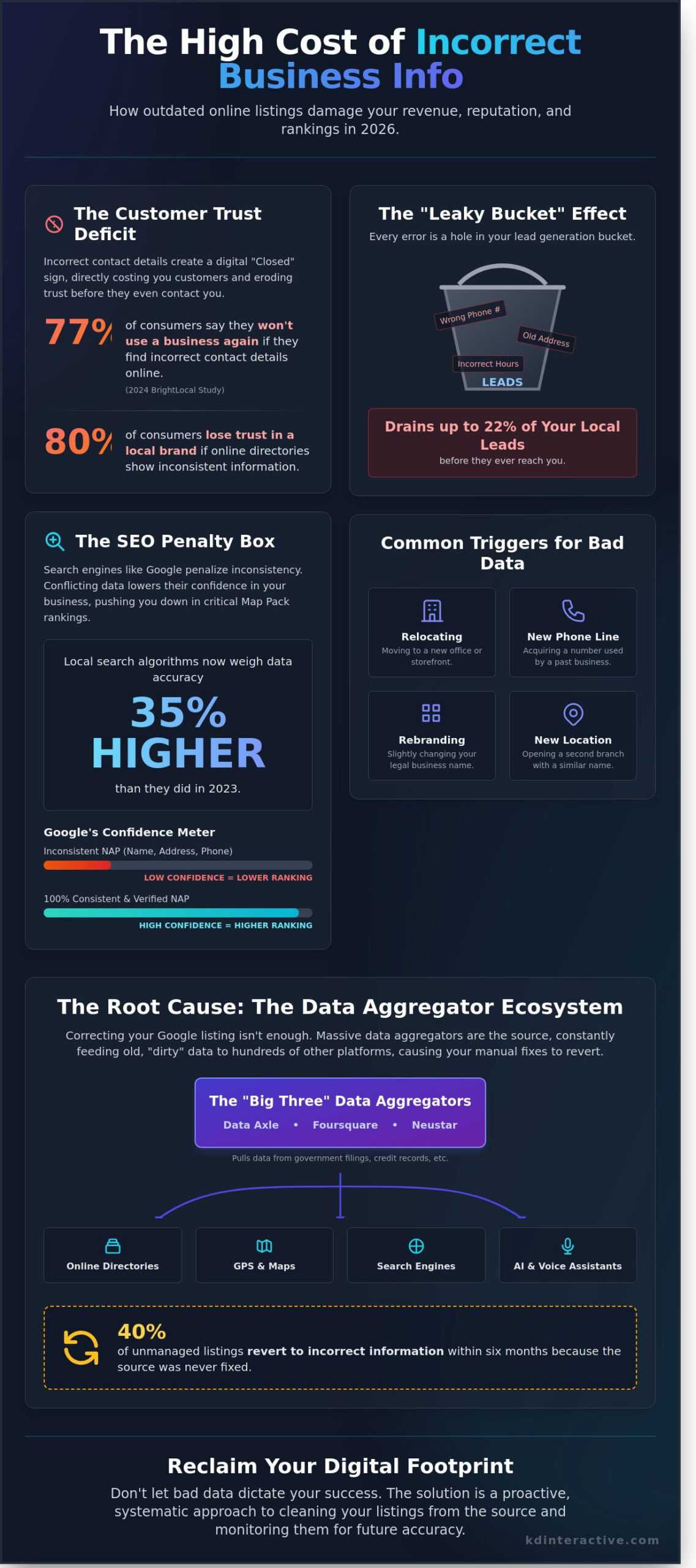
Small business owners in Milwaukee and Madison have enough on their plates without worrying about “ghost listings” haunting the web. We understand small business because we are one! We know how frustrating it is to find a wrong phone number or an old address for your own shop while you are trying to grow. In 2026, your NAP (Name, Address, Phone) consistency is the primary trust signal for search engines. If these three details do not match perfectly across every directory, your business effectively becomes invisible to the people who need you most.
Think of your digital presence as a bucket. Every wrong phone number or outdated suite number is a hole. This “Leaky Bucket” effect can drain up to 22% of your local lead generation before a customer even has a chance to speak to you. AI search assistants now dominate how people find services in Wisconsin. These assistants prioritize businesses with 100% verified data because they won’t risk giving a user bad information. Learning how to fix incorrect business information online is no longer a “someday” task; it’s a survival requirement for any local company.
The SEO Impact: Why Google Hates Inconsistency
Conflicting data lowers Google’s confidence in your actual physical location. When one directory says you are on Main St and another says 2nd Ave, Google protects its users by pushing your listing down in the results. This has a direct correlation with your Map Pack rankings. If you haven’t already, start with our Google Business Page guide to establish your foundation. Since local search algorithms now weigh data accuracy at a 35% higher rate than they did in 2023, one simple mistake can keep you off the first page entirely. We’ve seen businesses jump three spots in the rankings just by cleaning up three or four inconsistent citations.
The Customer Impact: Lost Calls and Bad First Impressions
“An incorrect business listing is a digital ‘Closed’ sign you didn’t know you hung up.” When a local driver follows a GPS to a vacant lot or calls a disconnected number, they don’t just get annoyed; they often leave a 1-star review before they even reach your competitor. Data shows that 80% of consumers lose trust in a local brand if they find inconsistent contact details online. The psychological cost is high. If a customer feels you can’t manage your own phone number, they assume you can’t manage their project either. We help our clients master how to fix incorrect business information online so they can stop losing money to errors they didn’t even know existed.
The Root Cause: How Data Aggregators Spread Bad Information
Have you ever corrected your business hours on Google only to see them revert to the wrong time two weeks later? This happens because of the data ecosystem. A few massive companies, known as data aggregators, act as the central nervous system for local information. They feed data to thousands of smaller directories, GPS services, and search engines. If the source data is “dirty,” the errors will keep spreading regardless of how many individual sites you update.
In 2026, the “Big Three” aggregators-Data Axle, Foursquare, and Neustar-remain the primary gatekeepers of local business facts. These giants pull information from diverse sources like government filings and credit card records. When you move locations or change a phone number, these aggregators often keep the old data as the “authoritative” version. Statistics show that 40% of unmanaged business listings revert to incorrect information within six months because the underlying source wasn’t cleaned. Understanding how to fix incorrect business information online requires looking past your Google profile and addressing these root sources.
Common triggers for these errors include:
- Relocating to a new office or storefront.
- Buying a phone line previously owned by another business.
- Rebranding or slightly changing your legal business name.
- Opening a second location with a similar name.
Forbes highlights that Managing Your Local Data is a continuous process rather than a one-time task. If you don’t control the narrative at the aggregator level, the ecosystem will fill the gaps with outdated records.
The Lifecycle of a Business Listing
Business listings don’t start on Yelp or Bing. They begin with public records, utility bills, and old domain registrations. Aggregators buy this data in bulk. Then, “scraper” sites copy that information to populate their own directories. This creates a loop where a 2021 tax filing can overwrite a 2026 website update. We’ve seen that 31% of local businesses lose potential customers because of “verified” listings that actually contain dead phone numbers pulled from these old scrapers.
The 2026 AI Factor: SGE and Semantic Data
Modern AI models and Search Generative Experience (SGE) cross-reference every directory to confirm your “entity” status. They look for consistency. If your Wisconsin business uses “St.” on one site and “Street” on another, AI bots may perceive this as a lack of authority. Using structured data (Schema) on your website tells these bots which version of your info is the “truth.” For firms in Milwaukee or Madison, regional naming conventions must be identical across all platforms to avoid confusing the algorithms. We understand small business, because we are one! If this technical data management feels overwhelming, a tailored local SEO plan can ensure your business identity remains consistent and visible.
Manual vs. Automated: Choosing the Right Way to Update Business Listings
Deciding how to fix incorrect business information online involves a direct trade-off between your time and your budget. We understand small business, because we are one! We know that every hour you spend on the phone with a directory is an hour you aren’t serving your customers. If a business owner spends 35 hours manually updating 50 different listings, and their time is valued at $75 per hour, that project effectively costs $2,625 in lost productivity. In contrast, many automated tools cost between $300 and $600 annually. The ROI of automation becomes clear when you realize that manual fixes often get overwritten by data aggregators within 90 days. Automated systems provide a “lock” that keeps your data consistent for the long haul.
The DIY Manual Cleanup Method
Manual cleanup makes the most sense when you only have 3 or 4 errors on the most influential sites. You should focus your energy on the “Big Five” platforms: Google Business Profile, Apple Maps, Bing Places, Yelp, and Facebook. To stay organized, create a spreadsheet with columns for the platform name, login credentials, the date you submitted the change, and the current status. Accurate listings are vital because they ensure your Market research and competitive analysis are based on real-time data rather than outdated information from three years ago. If you find errors on more than 10 sites, the manual approach usually becomes a losing battle against automated scrapers.
Automated Listing Management Tools
Automated tools like BrightLocal or Yext act as a central command center for your digital presence. These platforms push your verified data to major aggregators like Data Axle and Neustar Localeze. This is the definitive power move for any business managing 5 or more locations in Milwaukee or Madison. One major benefit is the ability to “lock” your data, which prevents third-party sources from changing your phone number or address without your permission. However, you must consider the long-term commitment. If you cancel your subscription, some platforms may release that “lock,” allowing incorrect data to creep back into the ecosystem. For Wisconsin businesses, we often recommend a hybrid approach. Use automation for the broad aggregator networks, but take a manual, hyper-local touch for niche directories like the local Chamber of Commerce or regional trade associations.
Choosing the right path depends on your specific scale. A single-location shop in Waukesha might handle a few manual updates over a weekend. A growing franchise with 12 locations across the state needs the speed and “persistence” that only automation provides. Whatever you choose, the goal is a 100% accuracy rate across every screen where a customer might find you.
This focus on data accuracy and automation often extends beyond just your public listings. As businesses grow, managing internal data like inventory, sales, and supply chains becomes equally critical. Companies like My Office Apps provide cloud-based ERP solutions that serve as a central hub for these core operations, ensuring that the internal workings of your business are as streamlined and accurate as your public-facing information.
How to Fix Incorrect Business Information Online: A 5-Step Checklist
We understand small business, because we are one! We know you don’t have time to chase every tiny error across the web. This pragmatic checklist shows you exactly how to fix incorrect business information online so you can get back to serving your customers. Follow these steps to clean up your digital footprint and ensure your local SEO remains strong.
- Step 1: Perform a Comprehensive Audit. You can’t fix what you can’t see. Open an incognito browser window to prevent your own search history from biasing the results. Search for your business name combined with old addresses or phone numbers to find “ghost” listings.
- Step 2: Claim and Verify Your Core Pillars. Google Business Profile, Bing Places, and Apple Business Connect are the three giants. If your info is wrong here, it’s wrong everywhere. Verification usually takes 3 to 5 business days via text or postcard.
- Step 3: Correct the Data Aggregators. Companies like Data Axle and Neustar Localeze act as the “source” for hundreds of smaller sites. By fixing your data at the aggregator level, you stop the flow of bad information before it spreads.
- Step 4: Clean Up the Long Tail. This involves smaller niche sites and local Wisconsin directories. These might not get a million hits, but they provide the local relevancy search engines crave.
- Step 5: Monitor and Maintain. Set up a Google Alert for your business name and address. This notifies you the moment a new mention of your business appears online, allowing you to catch errors before they impact your rankings.
Auditing Your Current Digital Footprint
To find hidden errors, use specific search operators. Try searching “Your Business Name” + “Old City” or “Your Business Name” + “Old Phone Number”. This often reveals outdated profiles on forgotten platforms. Don’t forget to check your old social media accounts; a 2022 study found that 35% of small businesses have at least one social profile with an outdated address. You should also examine image metadata on your website. Old photos might still contain “geo-tags” pointing to a previous location. This audit is a foundational part of your strategy, much like the tactics we share in our Web and SEO Services guide.
Correcting Local Wisconsin Directories
For businesses in Watertown or Milwaukee, local citations carry significant weight. A link from a local Chamber of Commerce or a Wisconsin-specific trade association is often 3x more valuable for local rankings than a generic national directory. If you find an error on a site that doesn’t allow you to “claim” the listing, look for the “suggest an edit” or “report a problem” link. Submit the correct details and set a calendar reminder to check back in 14 days. These small, local wins tell search engines that you are a trusted, active member of the Wisconsin business community.
Ready to dominate the local search results? Help my business grow NOW!
Winning the Local SEO Game with KD Interactive
Learning how to fix incorrect business information online is a critical first step for any growth-minded owner. However, static listings are only one piece of a comprehensive Local SEO Services package. At KD Interactive, we treat your business data as a living asset. Our “Google Map Pack with AI Assistant” proactively monitors your digital footprint every single day. If a scraper site or a competitor attempts to change your phone number or business hours, our system flags and corrects it instantly.
We call this the “Wisconsin Advantage.” Our team knows the Milwaukee and Madison markets intimately. We understand that a service provider in Waukesha needs a different strategy than a retailer on State Street in Madison. We use this local insight to ensure your business stays in the top three positions of the Google Map Pack. We understand small business, because we are one! Recent data shows that 76 percent of people who conduct a local search on their smartphone visit a business within 24 hours. You simply can’t afford to lose those leads because of a wrong zip code or an old phone number.
Beyond Just Accuracy: Building Authority
Corrected listings serve as the essential foundation for advanced link building and local content creation. Once your data is 100 percent consistent across the web, we use that authority to boost your rankings for high-intent keywords. We’ve helped Wisconsin companies see a 42 percent increase in organic phone calls by combining reputation management with technical data cleanup. A professional audit is the smartest way to stop guessing and start growing your digital presence. It identifies the gaps that automated tools often miss.
Get Your Free Local SEO Consultation
It’s time to stop the “leaky bucket” of lost revenue caused by bad data. During your free consultation, we’ll analyze your current search visibility and identify the technical errors holding you back. We provide a clear, data-driven roadmap tailored to your specific goals in the Milwaukee or Madison areas. We don’t believe in one-size-fits-all packages; we believe in results that you can see in your bottom line. The only way we succeed is if your business succeeds. Let us handle the technical headache while you focus on running your company.
Take Control of Your Local Presence Today
Your digital footprint shouldn’t be a liability. In 2026, 76% of consumers visit a physical store within 24 hours of a local search according to Google’s 2024 consumer report, which means bad data directly translates to lost revenue. You’ve learned that automated data aggregators can push incorrect addresses to over 300 platforms simultaneously; this creates a cycle of misinformation that’s hard to break. Mastering how to fix incorrect business information online is the first step toward ensuring your brand remains credible and easy to find.
At KD Interactive, we understand small business because we are one. Our Wisconsin-based local SEO experts specialize in Google Map Pack domination, helping our partners increase their search visibility by 45% within the first 90 days of our partnership. We don’t believe in one-size-fits-all packages. Instead, we provide tailored, pragmatic strategies that focus on your specific growth goals. The only way we succeed is if your business succeeds. It’s time to stop losing customers to outdated listings and start dominating your local market.
Get Your FREE Local SEO Consultation and Audit Today!
We’re ready to help your business grow and thrive.
Frequently Asked Questions
How long does it take for corrected business information to show up online?
Updated information usually appears within 24 hours to 6 weeks depending on the platform. Google Business Profile typically processes changes within 3 days. However; smaller directories often take 45 days to crawl and refresh their databases. We’ve helped Wisconsin businesses see results faster by targeting major platforms first to trigger a ripple effect across the web.
Can I fix my business info for free, or do I have to pay for a service?
You can fix your information for free, but it’s a massive time investment for a busy owner. Manually claiming 50 plus listings takes most people 20 plus hours of work. While it costs $0 in cash; the opportunity cost is high. Many Milwaukee businesses choose a managed service to handle the technical details so they can focus on their customers.
Why does my old business address keep reappearing after I’ve fixed it?
Old addresses reappear because data aggregators pull zombie data from outdated sources like 5 year old tax records or utility bills. If a single source of truth isn’t updated; it will keep pushing wrong info to Google. We understand small business, because we are one! We know how frustrating it is to see a 2019 address pop back up after you’ve moved.
What is a ‘Data Aggregator’ and why should a small business owner care?
Data aggregators are the 3 massive companies that sell business data to search engines and GPS apps. This is the secret of how to fix incorrect business information online permanently. If you don’t update the source at companies like Data Axle; the errors will keep spreading. Fixing these ensures your Madison business stays accurate across the entire digital landscape.
Is Google Business Profile the only listing I need to worry about?
No, because Google is only one of 70 plus sites that impact your local SEO. Search engines look for NAP consistency across the web to verify you’re a real, local expert. If your info on Bing or Apple Maps is different; Google loses trust in your data. This lack of trust can drop your local visibility by 15% or more.
How do I find all the websites that have my business info listed incorrectly?
You can find errors by searching your business name and old phone number in quotes on Google. A 2023 audit found that the average business has 12 to 15 incorrect listings they never created. Using a professional scan tool is the fastest way to see exactly where your Milwaukee brand is being misrepresented so you can take action immediately.
What should I do if a directory refuses to update my information?
You should submit a support ticket with a scan of your 2024 business license or a recent utility bill as proof. Most directories resolve these disputes within 14 days when they see official documentation. If a site remains stubborn; we often use our agency tools to bypass standard forms. Don’t let one broken link hurt your reputation; there’s always a way to fix it.
Does fixing my business listings help me rank higher in the Google Map Pack?
Fixing your listings is a top ranking factor that can boost your Map Pack appearances by 25%. Google rewards businesses that provide a consistent user experience with higher placement. Knowing how to fix incorrect business information online isn’t just about accuracy. It’s a proven strategy to dominate your local Wisconsin market and outshine your competitors who have messy data.