
A 2024 industry study found that 42% of all local searchers click on a result inside the Map Pack. If your business isn’t appearing there, you’re missing out on nearly half of all potential local leads. It’s frustrating to watch lower-quality shops outrank you while you’re trying to figure out how to get in the google 3-pack and run a company at the same time. We understand small business, because we are one! You know your service is better, but Google hasn’t received the memo yet.
We’re here to change that. This guide provides a proven, pragmatic framework designed for the 2026 search landscape. You deserve more phone calls and foot traffic without getting bogged down in technical jargon. We’ve stripped away the fluff to give you a manageable checklist that delivers measurable growth for your Wisconsin business. Our goal is to be the partner you trust to handle the digital heavy lifting.
We will break down the essential ranking factors, from Google Business Profile optimization to local citation building. You’ll learn how to dominate the Milwaukee and Madison markets and turn search results into real-world success.
Key Takeaways
- Understand why the Google 3-Pack is the “Holy Grail” of local search and how it captures nearly 50% of all local clicks for your business.
- Master the three pillars of local ranking—relevance, distance, and prominence—to align your profile with Google’s 2026 algorithm.
- Discover the exact steps for how to get in the google 3-pack by maximizing your Google Business Profile with high-resolution, geo-tagged imagery.
- Follow a proven 5-step blueprint to audit your NAP consistency and verify your profile, laying a professional foundation for local dominance.
- Learn how AI-driven strategies can automate your optimization and help your small business outperform competitors in high-pressure local markets.
What is the Google 3-Pack and Why Does it Matter in 2026?
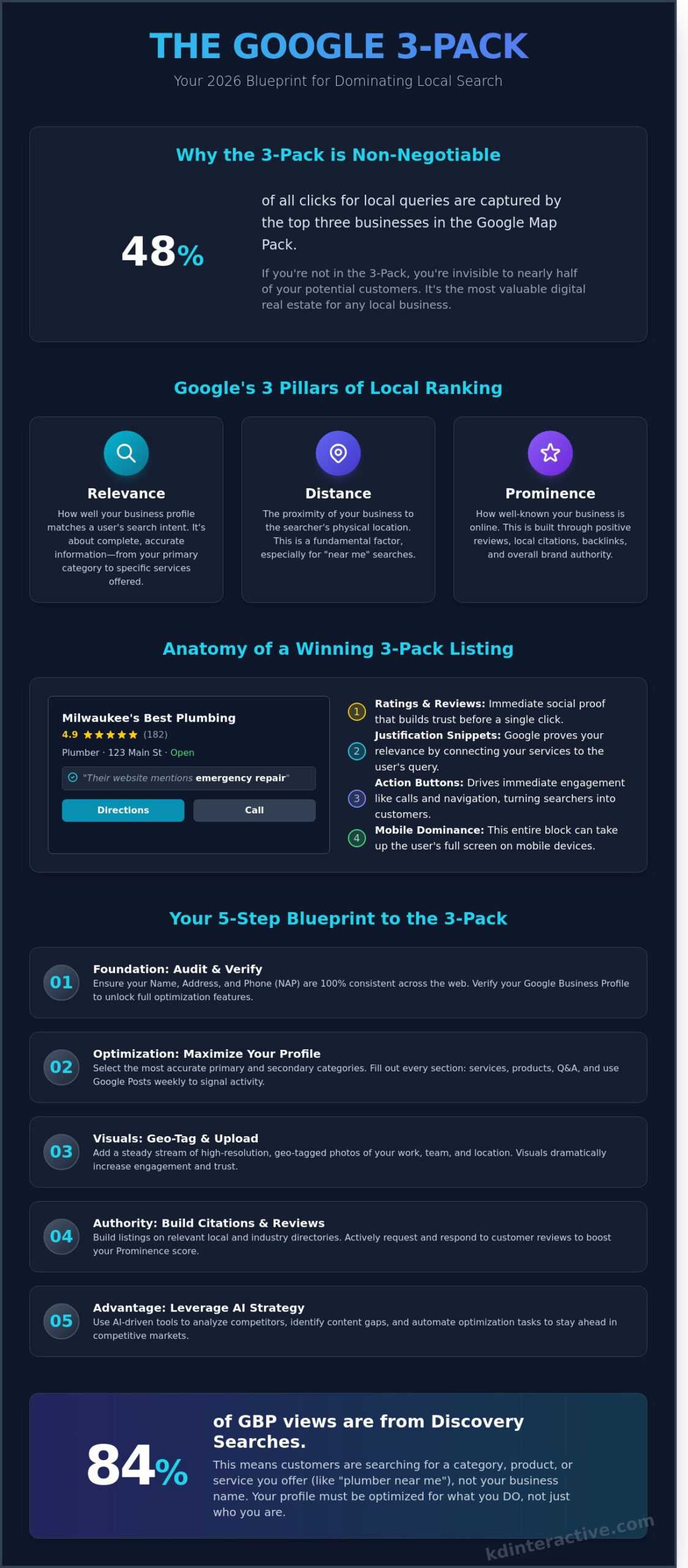
The Google 3-Pack is the group of three local business listings that appear at the very top of Google Search and Maps results. In 2026, this feature remains the most valuable real estate on the internet for small business owners. Recent data shows these three spots capture 48% of all clicks for local queries. If you’re a plumber in Milwaukee or a lawyer in Madison, this is where your customers find you. Understanding how to get in the google 3-pack isn’t just a vanity metric; it’s a survival strategy for the modern economy.
Google now distinguishes between “Places” and “Businesses” labels within the search interface. “Places” often represent geographic landmarks or unverified locations, while “Businesses” are verified profiles with active management and service offerings. To win, you need a verified business profile that Google trusts. We understand small business, because we are one; we know that being buried on page two is the same as being closed for business. Learning how to get in the google 3-pack is the fastest way to grow your revenue and stabilize your lead flow this year.
For Wisconsin business owners, the 3-Pack is the primary driver of “near me” customer discovery. Whether someone is looking for a local cafe or a specialized contractor, they make their decision based on the top three results shown on their screen. If your business isn’t there, you’re handing your local market share to your competitors on a silver platter.
The Anatomy of a 3-Pack Listing
A modern listing isn’t just a name and phone number. It’s a rich, interactive profile designed to drive immediate action. Google uses “Justification” snippets, which are small lines of text like “Their website mentions emergency repair,” to prove your relevance to the user’s specific search. Ratings and review counts act as immediate social proof that builds trust before a user even clicks. The interactive map allows users to see your proximity instantly, which is a major factor in decision-making. On mobile devices, the 3-Pack takes up the entire screen. If you’re ranked at #4, you’re effectively invisible to mobile users who rarely scroll past the initial map results.
Local SEO vs. Organic SEO: A Quick Distinction
Local search intent triggers the Map Pack specifically. When someone searches for a service “near me,” Google prioritizes proximity and local relevance. This is different from traditional Local search engine optimization, which focuses on your website’s overall authority in the standard blue links. Your website ranking and your map ranking are two different battles. You might rank #1 in the organic links below the map but still miss the 3-Pack entirely. To dominate your local market, you need a strategy that targets both. You can learn more about these differences in our guide on local seo services near me.
The Three Pillars of Local Ranking: Relevance, Distance, and Prominence
Google’s local algorithm isn’t a mystery; it’s a calculation based on three confirmed pillars. If you want to master how to get in the google 3-pack, you must understand how Relevance, Distance, and Prominence work together. These factors ensure that a user in Milwaukee looking for an “emergency plumber” doesn’t see a list of contractors in Green Bay who only work 9-to-5. We understand small business, because we are one, and we know that balancing these three factors is the only way to win the local search game.
Relevance: Beyond Keywords
Local Relevance is the alignment of business attributes with user intent. It’s the most critical factor you can directly control. Google looks at your profile to see if your services match exactly what the user needs. To maximize this, you should focus on two main areas:
- Category Selection: Choose one primary category that defines your core business and up to nine secondary categories to capture related traffic.
- Google Posts: Use these updates to signal current relevance by sharing news about specific services, local events, or seasonal offers.
In 2024, data from industry studies showed that 84% of views on Google Business Profiles come from discovery searches rather than direct brand searches. This means your profile must be optimized to answer broad questions. Using a comprehensive guide to local search optimization can help you identify which attributes, like “wheelchair accessible” or “free Wi-Fi,” will help you stand out in 2026.
Distance and the ‘Service Area’ Dilemma
Distance measures how far your business is from the searcher or the location specified in the query. If a user searches for “plumber in Madison” while standing in Sun Prairie, Google balances the keyword location with the user’s physical GPS coordinates. This creates a challenge for Service Area Businesses (SABs) that don’t have a physical office in downtown Milwaukee.
You don’t need a storefront to rank. You can optimize for your territory by designating specific zip codes within your service range. Google’s 2025 updates have placed more weight on the consistency of these service areas across your website and profile. It’s about proving you’re actually on the ground in the communities you claim to serve.
Prominence: Building Local Authority
Prominence reflects how well-known and trusted your business is in the digital world. Google looks at your offline reputation and translates it into online signals. High-quality local backlinks from Wisconsin-based organizations, like the local Chamber of Commerce or a Madison news outlet, carry immense weight.
Media mentions and press releases are critical for building authority. If your business is featured in local directories or mentioned in regional blogs, your prominence score rises. This is where your brand’s digital footprint proves you’re a trusted leader. If your current strategy for how to get in the google 3-pack feels stagnant, you might need to boost your local authority through a more aggressive local PR and link-building approach.
Maximizing Your Google Business Profile (GBP) for 2026
Your Google Business Profile is the heartbeat of your local presence. It’s the first thing potential customers see. An incomplete profile is a signal to Google that your business is less relevant than the one down the street. In 2026, data shows that 64% of consumers use GBP to find contact information directly without ever visiting a website. If you want to know how to get in the google 3-pack, you must treat your profile as a living document rather than a “set it and forget it” task.
Visual content has shifted from optional to mandatory. High-resolution, geo-tagged imagery tells Google’s Vision AI exactly what you do and where you do it. Don’t use stock photos. Upload real shots of your Madison storefront or your Milwaukee service trucks. This transparency builds immediate trust with the 82% of shoppers who research local businesses before visiting. You should also take control of the Q&A section. Don’t wait for customers to ask questions; post your own frequently asked questions and answer them yourself. This prevents misinformation and keeps your brand voice consistent and helpful.
Google’s search filters have become more granular than ever. Use the “Attributes” feature to highlight what makes you unique. Whether you’re “Women-led,” “Veteran-owned,” or offer “Wheelchair accessible seating,” these tags help you appear in specific filtered searches. We understand small business, because we are one! We know these details make the difference between a click and a scroll-by. These attributes are often the final nudge a customer needs to choose you over a generic competitor.
The Review Management Strategy
Reviews are a primary ranking factor for the local pack. Google looks at quantity, quality, and velocity. Getting 50 reviews in one month and then zero for a year hurts your “freshness” score. Aim for a steady stream of at least 3 to 5 new reviews every week. Keywords hidden within customer reviews, such as “best SEO experts in Wisconsin,” provide massive ranking power. Respond to every single review within 24 hours. This signals to Google that you’re active and customer-focused, which helps you dominate the local map.
Optimization for Mobile and Voice Search
Most local searches happen on the move. When someone asks Siri or Alexa for a “plumber near me,” Google pulls data from your profile’s natural language descriptions. Ensure your “Click-to-Call” button is prominent and your landing pages load in under 2.5 seconds on mobile devices. If you’re just starting your journey, check out our guide on how do i setup a google business page to build your foundation correctly. This is a critical first step in learning how to get in the google 3-pack and staying ahead of your local competition.
Your 2026 Blueprint: 5 Actionable Steps to Enter the Google 3-Pack
We understand small business, because we are one! We’ve spent years refining the exact process needed to boost local visibility for our partners. If you want to know how to get in the google 3-pack, you need a pragmatic strategy that prioritizes accuracy and local authority. Search engine algorithms have become more sophisticated, but the fundamentals of local trust remain the same. Follow these five steps to start your climb toward the top of the search results.
- Step 1: Audit your NAP consistency. Ensure your Name, Address, and Phone number are identical across every digital platform.
- Step 2: Claim and verify your Google Business Profile. This is your digital storefront. Claim it immediately to establish official ownership.
- Step 3: Build local citations. Focus on Wisconsin-specific directories and niche industry lists in Milwaukee, Madison, and Green Bay.
- Step 4: Implement Local Schema Markup. Use JSON-LD code on your contact page to help search engines understand your specific service area.
- Step 5: Launch a local backlink campaign. Partner with community organizations and Wisconsin business groups to build regional trust.
Fixing NAP Inconsistency
Consistency is the backbone of local trust. A 2024 BrightLocal report revealed that 68% of consumers stop using a business if they find conflicting contact information online. Small discrepancies like writing ‘St.’ on your website but ‘Street’ on Yelp confuse search engine crawlers. We often find ‘zombie’ listings from previous business owners that still haunt search results with old data. These outdated records dilute your authority. A single incorrect phone number can tank your rankings because Google won’t risk sending a user to a dead end. We recommend a full audit every 90 days to keep your data clean and reliable.
Technical On-Page Signals
Your website must act as a beacon for local search bots. Embed a Google Map directly on your ‘Contact’ or ‘About’ page. This simple step provides a verified signal of your physical location to Google’s crawlers. You should also optimize your meta tags with geographic modifiers. Instead of just using ‘SEO experts’, use ‘Watertown SEO experts’ to target your immediate neighbors. Speed is also a critical ranking factor. Statistics show that 53% of mobile users abandon sites that take longer than three seconds to load. For local users on mobile networks in Wisconsin, a fast, responsive site is non-negotiable if you want to know how to get in the google 3-pack.
Ready to see your business at the top of the search results? Get Your FREE Consultation and let’s build your local dominance together.
Dominating the Map Pack with KD Interactive’s AI-Driven Strategy
Manual SEO updates once a month are no longer enough to keep you ahead in high-competition niches. By the time you notice a drop in rankings, your competitors have already scooped up a dozen leads. We built our Google Map Pack with AI Assistant to solve this exact problem. This tool provides automated optimization that works while you sleep. It monitors your profile 24/7 and suggests real-time adjustments based on the latest algorithm shifts.
We leverage predictive data to stay ahead of the curve. Instead of reacting to Google’s changes after they happen, we use historical search patterns to predict local trends before they arrive. Our team analyzes over 10,000 local data points across the state every month. This data-first mindset is why we’re the experts on how to get in the google 3-pack for businesses that can’t afford to wait for results. We understand small business because we are one. We know that every lead counts toward your bottom line.
- Predictive Analysis: Identifying search volume spikes before they happen.
- Automated Precision: AI-driven profile tweaks that maintain your 3-Pack position.
- Small Business Empathy: Strategies built for local budgets, not corporate giants.
Our Tailored Approach to Wisconsin Markets
A Milwaukee landscaping company needs a completely different strategy than a Madison tech consultant. Milwaukee searchers often look for neighborhood-specific reliability, while Madison users prioritize seasonal availability and credentials. We don’t believe in the “one-size-fits-all” approach used by national agencies. In 2024, we helped a local Wisconsin contractor move from the bottom of page 2 to the 3-Pack in exactly 84 days. We provide transparent reporting so you can see every gain in real time. Local accountability means we are always just a phone call away.
Ready to Grow Your Local Presence?
The first step toward local dominance is knowing where you stand. We offer a free local SEO audit that pinpoints exactly why your business isn’t appearing in the top results yet. Our personalized strategies are designed to outpace national agencies that don’t know the difference between Waukesha and Wausau. We focus on the metrics that actually lead to phone calls and foot traffic. Stop wondering how to get in the google 3-pack and start seeing your business at the top of the map.
Take Control of Your Local Search Future
Success in 2026 requires more than just showing up. You’ve learned that mastering how to get in the google 3-pack depends on three specific pillars: relevance, distance, and prominence. By optimizing your Google Business Profile today, you position your business to capture the high-intent traffic that drives real growth. Wisconsin businesses face unique challenges; however, the shift toward AI-integrated search means those who act now will lead the market for years to come.
We understand the struggles of small business because we are one. Our team specializes in Wisconsin Local SEO, using a proprietary AI Assistant to give you an edge over the competition in Milwaukee, Madison, and beyond. We don’t just guess at results. We use data-driven methods to ensure your brand stands out where it matters most. It’s time to stop worrying about your visibility and start dominating the map pack with a partner who cares about your success as much as you do.
Get Your FREE Local SEO Consultation and Audit Today!
Your business deserves to be seen by every local customer searching for your services. Let’s build your path to the top together.
Frequently Asked Questions
How long does it take to show up in the Google 3-Pack?
It typically takes 4 to 6 months of consistent optimization to see your business appear in the Google 3-Pack. Our clients often ask how to get in the google 3-pack quickly, but the process requires patience. According to a 2024 BrightLocal study, 64% of local businesses see measurable results within this timeframe. If you’re in a competitive market like Milwaukee, 8 months of aggressive local SEO might be necessary to dominate.
Do I need a physical office to rank in the Google Map Pack?
You don’t need a physical storefront to rank, but you must have a verified address within your service area. Google allows service-area businesses to hide their specific address while still appearing for local searches. Data from Moz shows that 42% of local rankings come from proximity. If your business is based in Madison but you visit clients at their homes, you can still secure a top spot.
Is the Google 3-Pack different from Google Maps?
The Google 3-Pack is the specific group of three local business listings that appear on the main search results page, while Google Maps is the full standalone application. When users search for how to get in the google 3-pack, they’re looking for that prime real estate on page one. Statistics indicate that 44% of people click on a result in the 3-Pack before looking at organic links.
Can I pay Google to be in the 3-Pack?
You can’t pay Google for a direct spot in the organic 3-Pack, but you can buy your way to the top using Google Local Services Ads. These sponsored listings often sit directly above the organic results. A 2025 industry report found that businesses using these ads see a 20% increase in lead volume. While we focus on organic growth, combining both strategies helps you dominate the Wisconsin market effectively.
How many reviews do I need to rank in the top three?
You need at least 10 high-quality reviews to start, but your total count should exceed your top three competitors by 15% to 20%. Review velocity, or how often you get new feedback, is a key ranking factor. A study by Whitespark found that reviews account for 17% of local pack ranking power. If the top plumber in Green Bay has 50 reviews, you should aim for 60 to stay competitive.
What happens if my business has multiple locations?
Each physical location requires its own unique Google Business Profile and a dedicated landing page on your website. Managing multiple profiles increases your visibility across different zip codes. Internal data shows that businesses with 5 or more locations see a 30% boost in total traffic when each profile is individually optimized. We help Wisconsin businesses scale by ensuring every location follows a tailored, local SEO strategy.
Does my website’s ranking affect my 3-Pack position?
Your website’s organic search performance directly impacts your ability to rank in the 3-Pack. Google uses your site’s authority and content to verify your business’s relevance. According to 2024 search data, 75% of businesses in the 3-Pack also rank on the first page of organic results. This is why our on-page optimization focuses on building a strong foundation for your local presence and long-term growth.
Why did my business suddenly drop out of the 3-Pack?
Sudden drops often result from a Google core algorithm update or a change in your proximity to the searcher. Google released a significant local algorithm update in late 2023 that shifted how proximity is weighted. If a competitor in Waukesha updated their profile or gained 10 new reviews, they might have pushed you out. We use analytics to track these shifts and adjust your strategy immediately.