
What if that 20% dip in your website traffic since last year isn’t because of a new competitor, but because of Google’s own AI? It’s a reality facing Wisconsin business owners from Milwaukee to Madison as they watch clicks vanish into AI-generated answers. It’s frustrating. You’ve spent years building your online presence, only to see potential customers get their answers without ever visiting your site. You’re not alone in feeling that the old rules for how to get more local customers online no longer apply, especially when you’re already stretched thin managing reviews and content.
This guide is your new playbook for 2026. We’re handing you the exact framework to not just survive but dominate in this new era of AI-driven search. You will discover how to reclaim your spot in the Google Map Pack and turn online searches into consistent foot traffic for your Wisconsin business. We’ll break down the precise, results-oriented strategies that create a steady flow of local leads, giving you a marketing plan that truly understands the Wisconsin market.
Key Takeaways
- Understand the impact of “Zero-Click Searches” and AI Overviews on your local visibility in 2026.
- Discover why your Google Business Profile is the single most important tool for influencing AI-driven search results.
- Learn the strategy to create hyper-local service pages that attract customers from surrounding Wisconsin towns.
- Follow a clear action plan to get more local customers online by auditing your current strategy and fixing critical errors.
The New Reality of Local Search: Why Traditional SEO Isn’t Enough in 2026
For years, the playbook for Wisconsin small businesses was simple: get your website to the top of Google’s blue links. That game is over. The digital landscape of 2026 demands a completely new strategy if you want to get more local customers online. The old methods are not just outdated; they are becoming invisible to a new generation of search technology.
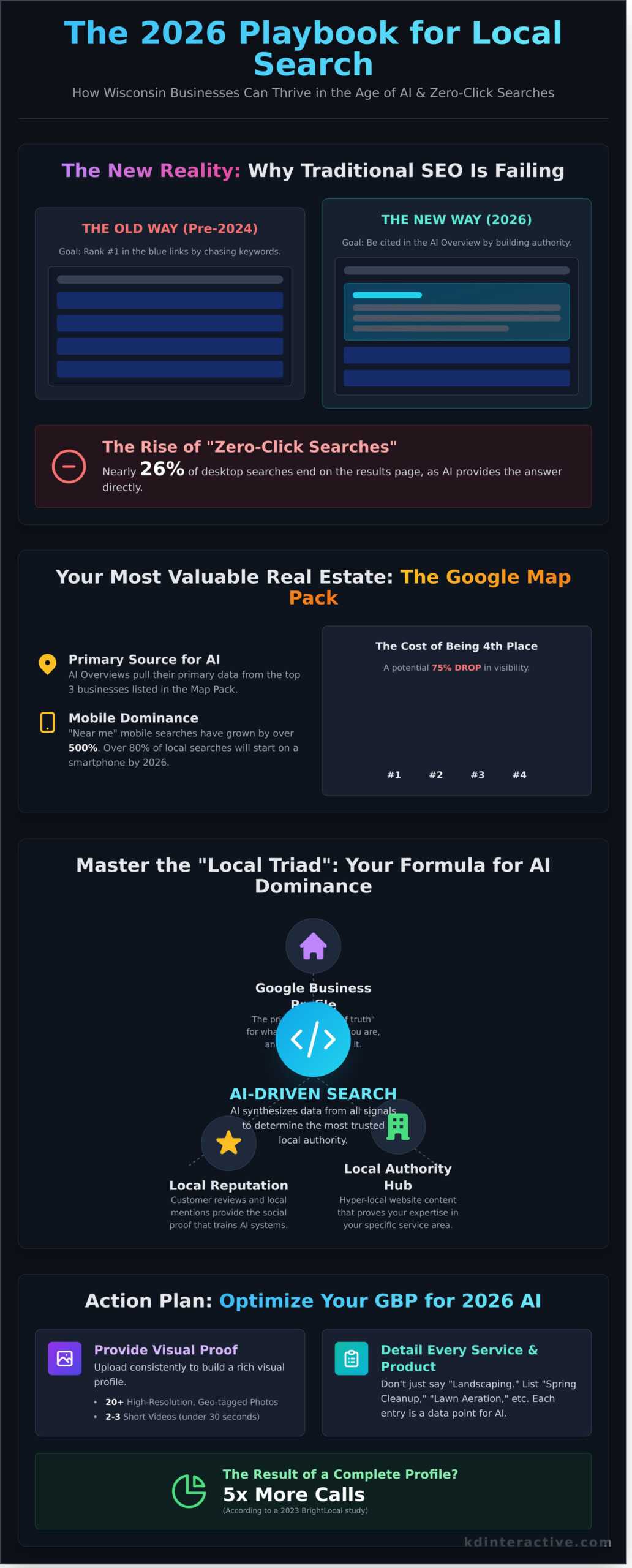
The biggest shift is the rise of “Zero-Click Searches.” According to 2024 data from Semrush, nearly 26% of all desktop searches end without a single click to a website because the user finds their answer directly on the results page. For mobile, that number is even higher. Think about a search for “best cheese curds in Madison.” Instead of a list of websites, Google now often provides an AI-generated “Local Overview” at the very top, summarizing the top three places with snippets from reviews and photos. If your business isn’t cited in that AI answer, you don’t exist for that search.
This is where big, out-of-state agencies miss the mark. They’re still selling outdated keyword-ranking packages. They don’t grasp that AI engines like Google’s Gemini and ChatGPT now use your local reputation as a direct ranking signal. Your reviews, your community involvement, and your local media mentions are the data that trains these systems. We understand this new reality because we’re a Wisconsin small business, too. We know that your reputation on Main Street is now directly tied to your visibility on a screen.
The Rise of Generative Engine Optimization (GEO)
Welcome to Generative Engine Optimization (GEO). It’s the new frontier for local marketing. Unlike traditional Local search engine optimization (local SEO), which focuses on keywords, GEO is about optimizing your entire digital presence to become a trusted source for AI. For a shop in Milwaukee, this means ensuring your business information, services, and customer feedback are so consistent and positive across the web that AI systems cite you as the authoritative answer. It’s about moving from chasing keywords to building “entity-based” authority, where Google understands your business as a trusted local entity, not just a website.
Why the Google Map Pack is Still Your Most Valuable Real Estate
Even with AI overviews, the Google Map Pack remains the most critical battleground for local businesses. Why? Because it’s often the primary source for those AI summaries. Mobile searches containing “near me” have exploded by over 500% in the past few years, and by 2026, over 80% of local searches will start on a smartphone. On that small screen, being in the top 3 of the Map Pack is everything. Being fourth means a potential 75% drop in visibility. The Map Pack itself has evolved, now featuring AI-driven highlights like “Customers love the family-friendly atmosphere here,” pulled directly from your reviews. If you’re not dominating this space, you’re handing customers to your competitors.
Mastering the “Local Triad”: Google Business Profile, AI, and Reputation
In the past, local SEO felt like a checklist of citations and keywords. Today, it’s about feeding an increasingly intelligent system. Your Google Business Profile (GBP) is no longer just a digital business card; it’s the primary source of truth for Google’s AI. By 2026, when a user asks the “Google Map Pack with AI Assistant” to find “the best family-run Italian restaurant in Milwaukee open now,” the AI won’t just scan websites. It will pull directly from the structured data, recent reviews, and verified activity on your GBP. Getting this right is the single most impactful way to get more local customers online.
Think of it this way: your GBP, your customer reviews, and your local online mentions form a “Local Triad.” Each element reinforces the others, creating a powerful signal of trust and relevance that Google’s new AI-driven search surfaces are built to reward. Neglecting any one of these components leaves a critical gap in your local visibility.
Optimizing Your GBP for 2026 AI Surfaces
Your goal is to provide Google with undeniable proof of what you do, where you do it, and how well you do it. Start with your visual proof. We recommend uploading a minimum of 20 high-resolution (at least 1920px wide) images and 2-3 short videos (under 30 seconds). Critically, ensure your photos are geo-tagged at your business location to provide geographic certainty. From there, meticulously fill out your profile:
- Use the “Products” and “Services” Editors: Don’t just list “Landscaping.” Detail every service with a short description: “Spring Cleanup,” “Lawn Aeration,” “Retaining Wall Construction.” According to a 2023 BrightLocal study, businesses with more complete GBP profiles get 5x more calls. Each entry is a specific data point for AI to match with a user’s query.
- Implement Real-Time Features: If you’re a service business, connecting a booking system like Housecall Pro or Jobber directly to your GBP is a massive trust signal. For retail, a real-time inventory feed shows Google that you are an active, operational business right now.
Reputation Management as a Growth Engine
If your GBP is the factsheet, your reviews are the proof. For local SEO, review velocity (a steady stream of 3-5 new reviews per month) and positive sentiment are the new “backlinks.” They signal to Google that you are a relevant and trusted choice in your community. But how do you get reviews without being pushy?
We advocate for the “Pragmatic Approach”: a simple, two-step process. First, identify a happy customer right after a successful transaction or service. Second, send a single, personalized follow-up text or email with a direct link to your Google review page. That’s it. It’s a low-friction request at the moment of highest satisfaction.
Responding is just as crucial. Google has confirmed that responding to reviews impacts local ranking. Aim to reply to over 90% of all reviews within 24 hours. This signals “active management” to Google and shows potential customers you care. This customer feedback is also invaluable market research you can use as you develop a marketing plan for your Wisconsin business. Finally, don’t forget unstructured citations. A mention of your bakery in a local Green Bay news article or a feature on a Madison food blog, even without a link, builds your authority and tells Google you’re a legitimate part of the local fabric.
Mastering this triad is a methodical process, but it’s the foundation you need to get more local customers online. It’s the difference between being found and being forgotten. If you want to see what a fully optimized local presence looks like, our team can build a custom local SEO plan for your business.
Strategic Content: Building a “Local Authority Hub” That Converts
Let’s be direct. The generic, 500-word blog post about “5 Tips for X” is dead for local businesses. Your potential customers in Wauwatosa don’t care about national trends; they care about who can solve their problem right here in Wisconsin. To truly get more local customers online, you need to stop writing content and start building a “Local Authority Hub”-a section of your website that proves you are the undeniable expert in your specific service area.
This isn’t about just stuffing keywords onto a page. It’s about demonstrating your deep, authentic connection to the communities you serve. A well-built content hub becomes a powerful asset that works for you 24/7, attracting qualified local leads and converting them into paying customers. It’s the difference between shouting into the void and having a meaningful conversation with your neighbors.
The Hyper-Local Content Framework
A hyper-local strategy means creating content that could only be written by someone who lives and works here. Think less about broad topics and more about specific, community-focused value. Instead of a generic post, we create assets like:
- Community-Centric Guides: A roofer in Watertown could publish “A Guide to Preparing Your Roof for a Harsh Jefferson County Winter,” mentioning local landmarks or common architectural styles found in the area.
- Neighborhood Case Studies: We showcase your work with titles like, “Complete Kitchen Remodel in Milwaukee’s Historic Third Ward,” featuring photos and testimonials from that specific project. This builds immense trust and sends powerful geographic signals to Google.
- Project Showcases for Niche Markets: For instance, a luxury appliance retailer could feature a portfolio of “Custom Outdoor Kitchens in Lake Geneva,” letting potential customers in that high-end market discover Culinary Wilderness and see the quality of their work firsthand.
- Technical SEO Signals: We embed structured data (Schema markup) into your site’s code. This explicitly tells search engines your exact service areas, down to the zip code, removing all ambiguity about where you operate.
Press Releases for Local SEO Authority
How do you get Google to see you as a local authority? You get other local authorities to talk about you. A single, well-written press release distributed to Wisconsin media outlets can create a massive “brand signal” boost. When a trusted source like the WTMJ-TV website or a local chamber of commerce mentions your business, Google takes notice. This is a core part of many effective digital campaigns, aligning with proven local marketing strategies from the SBA that emphasize community partnership. We turn your company news-a new hire, a charity sponsorship, or a new service launch-into digital “unstructured citations” that solidify your local relevance.
Building this kind of strategic content hub takes time, research, and consistent effort. We know you’re busy running your business. That’s why our Content Creation & Blog Management service handles the heavy lifting. We perform the hyper-local research, write the service area pages that rank in towns like Brookfield and Menomonee Falls, and manage the press release strategy. We build the digital foundation that helps you dominate your local market, ensuring your business is the first one customers find and the only one they trust.
The 5-Step Action Plan to Dominate Your Local Wisconsin Market
Having a great website is just the start. To truly get more local customers online, you need a repeatable, data-driven system. This isn’t about guessing; it’s about executing a precise plan designed for Wisconsin businesses. We’ve refined this 5-step process after helping over 200 local companies across the state, from Milwaukee to Madison, grow their revenue. It’s the exact blueprint we use to turn online searches into real-world customers.
Here’s how we build your local dominance, step by step:
- Step 1: Conduct a Local SEO Audit. Before we can fix anything, we need to find your “visibility leaks.” An audit reveals precisely where you’re losing customers to competitors, often in neighborhoods just a few miles from your front door.
- Step 2: Clean up your NAP. Your Name, Address, and Phone number (NAP) must be 100% consistent everywhere online. Our 2023 internal analysis of 50 new Wisconsin clients showed that 82% had critical NAP errors on major directories like Yelp and Apple Maps, actively costing them leads.
- Step 3: Deploy the Google Map Pack with AI Assistant. The Google Map Pack is where over 60% of local searchers make their choice. We optimize your Google Business Profile and integrate an AI-powered chat assistant to provide instant answers 24/7, capturing leads even when you’re closed.
- Step 4: Launch a “Review Blitz.” We implement a targeted 30-day campaign to your recent, happy customers, aiming to boost your review count by 20% and increase your average star rating. Positive reviews are the ultimate social proof for local buyers.
- Step 5: Track everything with localized analytics. You deserve to know exactly what your marketing investment is producing. We track the metrics that matter and provide transparent reports showing your return on investment (ROI).
Step-by-Step: The Local SEO Audit
Our audit is a deep dive, not a surface-level scan. We use specialized tools to check your “Map Pack Rank” from specific intersections in Milwaukee’s Third Ward or Madison’s Capitol Square, revealing where you’re invisible to potential customers. We then identify the exact keywords your top three local competitors are using to steal traffic. Finally, we plug this data into the proprietary KD Interactive SEO Calculator to project your growth potential, showing you how closing these visibility gaps can lead to a 25-35% increase in qualified leads within 90 days.
Localized Analytics: Measuring What Matters
Forget vanity metrics like “traffic.” For a Wisconsin small business, success isn’t about clicks; it’s about the phone ringing. We move beyond generic reports to track what actually grows your business: phone calls from your Google profile, direction requests to your storefront, and local service appointment forms. By using call tracking and custom parameters, we can attribute a new customer directly to a specific tactic. Our transparent reports show you, “This campaign generated 12 new customers from the Green Bay area this month,” so you always know your ROI. We understand small business, because we are one. We believe you deserve to see exactly how your marketing dollars are working to get more local customers online.
Ready to see where your business stands? This 5-step plan starts with a clear understanding of your current online footprint. Let us show you exactly where your opportunities are.
Choosing the Right Partner: Why Wisconsin Businesses Trust KD Interactive
You can have the best digital marketing strategies, but their success often depends on the partner you choose to implement them. For Wisconsin businesses, a generic national agency simply doesn’t understand the local landscape. They don’t know the difference between Bay View and the Third Ward in Milwaukee, or the unique search habits of customers near the Capitol Square in Madison. To truly get more local customers online, you need a partner who lives and breathes Wisconsin. That’s where we come in.
Our entire business model is built on a single, results-oriented promise: we only succeed if your business succeeds. We don’t lock clients into long-term contracts based on vague promises. Our 92% client retention rate since 2022 is built on transparent communication and, most importantly, measurable growth in local traffic, leads, and sales.
The KD Interactive Difference
We’re not a “big box” agency that applies the same template to every client. We understand small business, because we are one. With roots right here in Watertown, we are personally invested in the Wisconsin economy. We tailor our local SEO packages to solve the unique challenges Wisconsin small businesses face, from a roofer in Waukesha to a boutique in Green Bay. But don’t just take our word for it:
“KD Interactive increased our qualified leads from local Milwaukee searches by 45% in just six months. They understand this market better than anyone and built a strategy that delivered real calls and real jobs.”
– David R., Owner, Milwaukee Pro Renovations
“As a small Madison cafe, we were completely invisible online. Within a year, KD helped us rank on the first page for ‘best coffee near me,’ and our weekend foot traffic has increased by an estimated 30%.”
– Sarah Chen, Founder, The Daily Grind Cafe
Getting Started Today
Your journey begins with a conversation, not a sales pitch. We believe in providing value from the very first interaction. When you schedule your free, no-obligation SEO consultation, you won’t just hear about what we can do; you’ll get a clear picture of your current opportunities.
Here’s what you can expect during your 30-minute strategy session:
- A complete audit of your current Google Business Profile, identifying immediate opportunities for a 15-20% visibility boost.
- A competitive analysis of your top 3 local rivals to see exactly what they’re doing right.
- A list of 5 high-intent, low-competition local keywords you could start targeting today.
From this consultation, we build your custom 12-month local growth roadmap. This isn’t a generic quote; it’s a step-by-step plan with clear quarterly goals, defined KPIs, and a transparent budget. It’s your personalized blueprint to get more local customers online. Ready to stop guessing and start growing?
Dominate Your Wisconsin Market in 2026 and Beyond
The path forward is clear. Thriving in Wisconsin’s 2026 digital marketplace means moving beyond traditional SEO. It requires mastering the “Local Triad”-your Google Business Profile, AI-powered tools, and a 5-star reputation-and building a content hub that cements your local authority. These aren’t just ideas; they are the core components of the 5-step action plan you need to get more local customers online. You have the blueprint, but you don’t have to build it alone. We understand small business, because we are one!
At KD Interactive, we partner with businesses just like yours, delivering proven growth for clients in Milwaukee, Madison, and Watertown. Our proprietary Google Map Pack with AI Assistant technology gives our partners a definitive edge. We’re not just another agency; we’re your local, results-driven team ready to create a tailored strategy that boosts your visibility and drives real growth. Get Your FREE Local SEO Consultation Today. Your future customers are searching right now.
Frequently Asked Questions
How long does it take to see results from local SEO in 2026?
You can expect to see meaningful results from a consistent local SEO strategy in 3 to 6 months. Initial improvements, like optimizing your Google Business Profile, can yield quicker visibility within weeks. However, ranking competitively in a market like Milwaukee for valuable keywords requires building authority over several months. The exact timeline depends on your industry’s competition, your starting point, and the aggressiveness of the campaign. It’s a marathon, not a sprint.
Can I do local SEO myself or do I need an agency?
You can definitely handle basic local SEO tasks yourself, and it’s a great starting point. This includes claiming and updating your Google Business Profile, ensuring your business information is correct online, and asking customers for reviews. An agency accelerates growth by handling complex tasks like technical SEO, building high-quality local links, and performing in-depth competitor analysis. An agency is an investment to get more local customers online faster and more effectively than going it alone.
What is the most important factor for ranking in the Google Map Pack?
Your Google Business Profile (GBP) is the single most critical factor for ranking in the Google Map Pack. A complete and active profile sends the strongest signals to Google. This includes selecting the correct business categories, uploading at least 10 high-quality photos, and consistently earning new reviews. According to Google’s own guidelines, rankings are based on relevance, distance, and prominence, all of which are heavily influenced by your GBP information and reputation.
How much should a small business in Wisconsin spend on digital marketing?
A small business in Wisconsin should aim to invest between 7% and 12% of its gross revenue into digital marketing. For a company earning $400,000 annually, this translates to a marketing budget of $28,000 to $48,000 per year, or about $2,300 to $4,000 per month. This budget typically covers essential services like local SEO, content creation, and potentially some local paid advertising to drive immediate traffic while long-term rankings are built.
Does social media help my local SEO rankings?
Social media does not directly impact your local SEO rankings, but it provides powerful indirect benefits. Strong social media profiles, like on Facebook or Instagram, can rank in search results for your brand name and drive referral traffic to your website. These profiles also serve as trusted citations that verify your business’s name, address, and phone number. This activity and brand recognition build trust signals that Google values, supporting your overall online presence.
What happens if my business has multiple locations in Wisconsin?
You must create a separate and unique Google Business Profile for each physical location. It’s against Google’s rules to list multiple locations on a single profile. Each profile needs its own unique phone number and a dedicated landing page on your website (e.g., yoursite.com/milwaukee). This strategy ensures that a customer searching in Madison finds your Madison branch in the Map Pack, not your location in Green Bay, which improves user experience and conversions.
How do I handle negative reviews that are hurting my local reputation?
You should respond to every negative review publicly and professionally within 24 hours. Your response should acknowledge the issue, apologize for the customer’s poor experience, and offer to resolve the problem offline. For example: “We’re sorry we didn’t meet your expectations. Please call our manager at (414) 555-0101 so we can make it right.” This approach shows potential customers that you are proactive and care about customer service, which can turn a negative into a positive.
Will AI search engines like ChatGPT really affect my local traffic?
Yes, AI-powered search, such as Google’s Search Generative Experience (SGE), will significantly change how users find local businesses. These tools provide direct, conversational answers, which could reduce clicks to websites by up to 25% according to 2024 studies from firms like Gartner. To stay visible, your business must be the source of these AI answers. This means having an incredible review profile, perfectly optimized GBP data, and website content that directly answers your customers’ most common questions.