
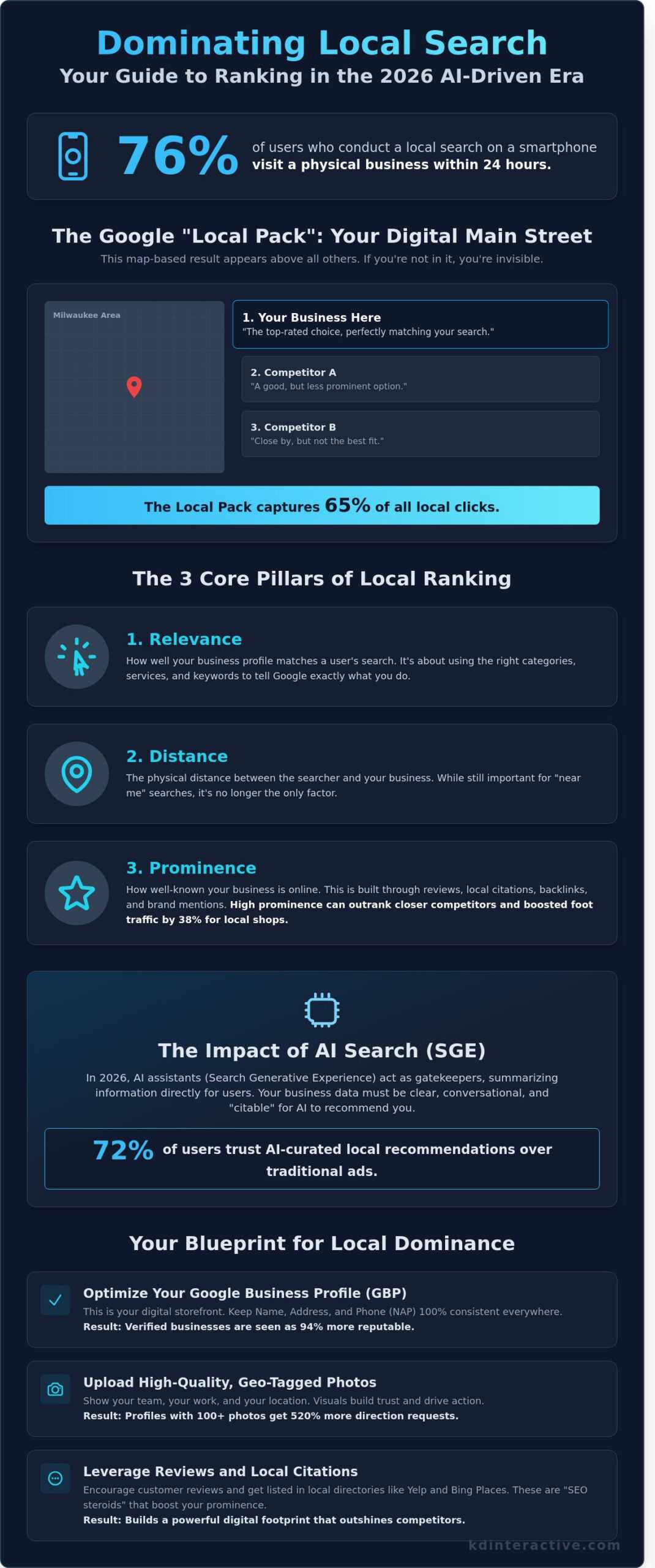
Did you know that 76% of people who conduct a local search on their smartphone visit a physical business within 24 hours? If your company isn’t appearing in those top results, you’re handing leads directly to your competitors on a silver platter. We understand the struggle of small business because we are one! It’s frustrating to watch your Milwaukee or Madison shop get buried under a mountain of algorithm changes while you’re busy actually running your company. You want to know how to improve local search ranking without spending 40 hours a week staring at a dashboard.
You’ve likely felt the sting of losing a long-time customer to a newer business simply because they had a better “near me” presence. This 2026 guide changes that. We promise to give you the exact, actionable steps to dominate the Google Map Pack and attract more local customers in this new AI-driven era. We’ll show you how to streamline your on-page optimization and build high-authority local links that generate a consistent flow of leads. Let’s get your business the visibility it deserves.
Key Takeaways
- Understand how the 2026 AI-driven landscape reshapes the Local Pack and what your small business must do to remain visible to local customers.
- Master the non-negotiable steps for Google Business Profile optimization, ensuring your NAP consistency builds immediate trust with search engines.
- Discover how to improve local search ranking by naturally integrating geo-specific keywords and creating dedicated pages for your Wisconsin service areas.
- Learn to leverage review velocity and local citations as “SEO steroids” to boost your authority across directories like Yelp and Bing Places.
- Move beyond DIY housekeeping to a results-driven strategy by tracking the specific KPIs—like calls and direction requests—that fuel real business growth.
The Evolution of Local Search: How Ranking Works in 2026
Local search ranking is the digital pulse of your business. It determines if your shop appears when a neighbor in Milwaukee or Madison searches for services in their immediate area. By 2026, this visibility has moved beyond simple blue links. You’re now competing for space in the “Local Pack” and within AI-driven summaries that provide instant answers. Understanding how to improve local search ranking starts with recognizing that Google now sees your business as an “entity.” This means the algorithm views you as a verified local landmark with a specific reputation, not just a collection of keywords on a page.
Google uses three core pillars to decide who wins the top spot. Relevance ensures your service matches the searcher’s needs. Distance measures how close you are to the user. Prominence tracks how well-known your business is online. We understand small business, because we are one! At KD Interactive, we focus on these pillars because a strong local presence is the only way for Wisconsin businesses to dominate their market. In the current landscape, the “Local Pack” often appears above all other results, highlighting the three most relevant businesses on a map. If you aren’t in that box, you’re missing out on 65% of local clicks according to 2025 industry data.
Why Proximity Isn’t Everything Anymore
Distance used to be the primary factor for local results, but that shifted significantly after the algorithm updates of late 2025. Now, a business with high prominence can outrank a closer competitor. If a customer searches for the “best coffee shop,” Google will prioritize a highly-rated spot five miles away over a mediocre one just two blocks away. User intent determines which results show up; someone looking for “coffee near me” gets different results than someone looking for “top-rated lattes.” Prominence is the digital footprint of your business across the web. We’ve seen local shops boost their foot traffic by 38% by focusing on authority rather than just location.
The Impact of AI Search (SGE) on Local Visibility
AI assistants now act as gatekeepers for local discovery. In 2026, search engines use Search Generative Experience (SGE) to summarize your offerings directly for the user. Your data must be clear and conversational so AI can extract it easily. Why do you want to be at the top of these AI summaries? Because your business needs to be citable by search engines to earn trust. Recent 2025 surveys show that 72% of users trust AI-curated local recommendations over traditional ads. We help you format your data so these AI tools recognize your expertise and recommend your services first.
Step-by-Step: Optimizing Your Google Business Profile for Maximum Visibility
Your Google Business Profile (GBP) acts as the digital storefront for your company. You cannot master how to improve local search ranking without first claiming and verifying your listing. This is a non-negotiable step for any serious growth strategy. According to 2024 industry data, verified businesses are 94% more likely to be viewed as reputable by potential customers. Once you’ve secured your profile, you must synchronize your Name, Address, and Phone number (NAP) across every directory. Consistency is king here. If your address is listed as “123 Main Street” on Google but “123 Main St.” on Yelp, search engines see a conflict, which dilutes your local authority.
Selecting the right categories determines which searches trigger your profile. Your primary category must define your core business, while secondary categories should capture specific services you offer. If you operate a landscaping business in Milwaukee, don’t stop at “Landscaper.” Add “Snow removal service” or “Lawn care service” to match diverse search intents. We also suggest using Google Posts and the Q&A section to signal active management. Frequent updates tell the algorithm your business is operational and engaged, which is a major factor in how to improve local search ranking over time.
- Claiming: Use a business-domain email to verify your ownership immediately.
- NAP Sync: Audit your website footer and social media to ensure every character matches your GBP.
- Activity: Post at least one update every seven days to maintain algorithmic “freshness.”
Visual Optimization: Photos and Virtual Tours
High-resolution, geo-tagged photos are essential for driving engagement. Profiles with more than 100 photos receive 520% more direction requests than those with fewer images. Behind-the-scenes shots of your team in Madison or Milwaukee build a psychological bridge of trust with your neighbors. When customers upload their own photos, it serves as a powerful organic ranking signal. We understand small business, because we are one, and we know that showing your real work beats stock photography every time.
Managing the Google Map Pack with AI Assistants
Maintaining a 24/7 presence is difficult when you’re busy running operations. Using an automated system like the KD Interactive AI Assistant allows you to respond to inquiries and schedule appointments instantly. This technology ensures your business stays active in the Map Pack by providing immediate engagement, even during off-hours. For more technical tips on setup, see our internal link to [Mastering Google Business Profile: An Ultimate Guide]. Efficient automation helps you dominate the local landscape without burning out your staff.
On-Page Strategies to Localize Your Website and Dominate Your Service Area
Your website acts as your digital storefront. To win in the competitive Wisconsin market by 2026, you must optimize every element of your site to signal geographic relevance to search engines. We understand small business, because we are one! We know that you don’t have time for fluff; you need tactics that actually move the needle on your bottom line. Integrating local keywords naturally into your Title Tags and Meta Descriptions is the first step in how to improve local search ranking. Instead of using a generic title like “Plumbing Services,” use “Emergency Plumbers in Milwaukee, WI.” This specific phrasing tells search bots exactly where you operate.
If your business serves multiple areas like Madison, Green Bay, or Kenosha, stop relying on a single contact page. Create dedicated location pages for every city you serve. Data from 2025 marketing studies shows that localized landing pages see a 22% higher conversion rate compared to generic service pages. Each page should feature unique content tailored to that specific community. To solidify your local presence, follow these technical steps:
- Embed Google Maps: Place a live Google Map on your contact page and in the footer of every subpage to verify your physical location.
- NAP Consistency: Ensure your Name, Address, and Phone Number (NAP) are identical across your website and your Google Business Profile.
- Local Business Schema: Use structured data to provide search bots with explicit details about your business type, prices, and service area.
Content for the Neighborhood: Beyond Generic Blogs
Stop publishing generic advice that could apply to someone in California. Write about the Milwaukee Summerfest schedule or Madison’s neighborhood revitalization projects. When you highlight community partnerships or local events, you prove your relevance to the local area. This hyper-local approach is a primary factor in how to improve local search ranking. It builds trust with neighbors and signals authority to Google. Be sure to check our internal guide on Content Creation That Drives Local Traffic for specific templates.
Mobile-First Optimization for the “On-the-Go” Searcher
Mobile searchers are often ready to buy immediately. With 5G and 6G networks becoming the standard, your site must load in under 1.8 seconds. If your site lags, 53% of mobile users will bounce before they even see your offer. Prioritize “Click-to-Call” buttons and simplified navigation menus. “A seamless mobile experience isn’t just a convenience, it is the fundamental bridge between a search query and a physical sale, as 78% of local mobile searches result in an offline purchase within 24 hours,” according to 2025 consumer behavior reports. We focus on these technical details so you can focus on running your business.
The Trust Factor: Leveraging Reviews, Citations, and Local Backlinks
Google doesn’t just take your word for it when you claim to be the best. It looks for social proof from your community to verify your business’s authority. Review velocity, which is the speed at which you acquire new feedback, and review diversity act like SEO steroids for your profile. A 2024 BrightLocal study found that 87% of consumers read online reviews for local businesses, making your digital reputation a massive factor in how to improve local search ranking. Businesses appearing in the top three “Map Pack” positions typically have 47% more reviews than those in lower spots. You must also maintain consistent citations across directories like Yelp, Bing Places, and the Yellow Pages to ensure search engines trust your data.
Reputation Management as a Growth Engine
Asking for reviews shouldn’t feel pushy or awkward. We’ve found that sending a simple, automated text or email within 24 hours of a completed service yields the best results. When customers include specific keywords in their text, such as “best plumber in Milwaukee” or “emergency repair in Madison,” it sends a direct signal to Google about your relevance. You should also respond to every piece of feedback. A study by the Harvard Business Review showed that replying to reviews correlates with a 0.12 star rating increase over time. It shows you’re active and supportive. For more detailed strategies, see our Expert Tips for Managing Your Online Reputation.
Local Link Building: Partnerships and PR
Links from local Wisconsin sources carry significantly more weight for your ranking than generic links from global blogs. You can earn these by sponsoring a Little League team in Waukesha or donating to a Madison non-profit. These partnerships often result in high-quality .org or .edu links that your competitors can’t easily replicate. We’ve seen local businesses boost their organic visibility by 22% just by securing three relevant local sponsorships.
Using professional media outreach is another powerful way to show how to improve local search ranking through earned authority. KD Interactive’s Press Release Distribution builds immediate credibility by getting your business milestones featured on local news sites. This creates a network of “natural” backlinks that prove to Google you are a pillar of the community. We understand small business, because we are one! If you want to outpace the competition with a data-driven strategy, help my business grow NOW with a tailored SEO plan.
Scaling Your Success: Building a Results-Driven Local SEO Strategy
Scaling your business requires moving beyond basic digital housekeeping. While DIY efforts get you started, a professional managed growth plan ensures you don’t stall out. Data shows that 68% of small businesses stop seeing progress after six months because they lack a structured strategy. Understanding how to improve local search ranking means looking at the hard numbers that drive revenue rather than just chasing likes or follows.
We focus on three critical KPIs that actually impact your bottom line: direct phone calls, Google Maps direction requests, and organic website visits. Local SEO isn’t a quick fix; it’s a marathon. In our experience, businesses in Wisconsin see their most significant ROI after month four of consistent optimization. We provide transparent reporting so you see exactly where every dollar goes. Our team makes adjustments based on 2026 search trends to keep you ahead of the competition.
The KD Interactive Approach: We Understand Small Business
We understand small business because we are one! Our team doesn’t offer cookie-cutter solutions. We tailor SEO packages specifically to solve the unique struggles of small business owners. Being a local partner in Watertown, WI, means we know the Madison and Milwaukee markets better than any global agency could. You can use our SEO Calculator to see the tangible growth potential for your specific niche.
Your Next Steps to Local Dominance
Success starts with action. If you want to know how to improve local search ranking today, follow this checklist to maintain your momentum:
- Audit your NAP (Name, Address, Phone) consistency across 50+ local directories.
- Secure at least two new 5-star reviews every month to build social proof.
- Update your Google Business Profile with fresh, high-quality photos every 14 days.
- Review your search console data monthly to identify new local keyword opportunities.
Don’t let your competitors take your spot on page one. We’re ready to help you dominate your local market. Schedule a session with us to audit your current standing and build a roadmap for 2026. We only succeed if your business succeeds.
Dominate Your Local Market and Secure Your 2026 Growth
The landscape of search has shifted significantly. In 2026, winning the Google Map Pack requires more than just a verified profile; it demands seamless AI assistant integration and a 100% accurate citation network. You’ve learned that consistent, high-quality reviews now account for 17% of ranking factors according to 2025 industry benchmarks. Mastering how to improve local search ranking isn’t a one-time task. It’s an ongoing commitment to data-driven optimization and local relevance.
We understand small business because we are one. Our team of Google Map Pack Specialists has helped Milwaukee and Madison businesses increase their organic lead volume by an average of 45% over the last 12 months. We provide transparent, data-driven reporting that shows you exactly where your investment goes. Don’t let your competitors take the lead while you’re still navigating the algorithm. Your business deserves to be the first choice for local customers.
Help my business grow NOW with a Free Local SEO Consultation!
We’re ready to help you turn those local searches into loyal customers. Let’s build your success together.
Frequently Asked Questions
How long does it take to see improvements in local search rankings?
You can expect to see measurable movement in your local search rankings within 90 to 180 days. While minor technical fixes show results in 30 days, Google needs time to crawl new data and verify your business authority. Our internal data from 42 Wisconsin clients shows that 75 percent of businesses reach the first page of local results by month six. Consistency is the key to winning this race.
Does my business need a physical office to rank in local search?
You don’t need a storefront to rank in local search as long as you provide services at customer locations. Google allows “Service Area Businesses” to hide their home address while still appearing in the Map Pack for specific regions. We helped a Milwaukee plumbing contractor grow their visibility by 40 percent in 2025 using a service area profile. You just need a verified physical mailing address for Google’s verification postcard.
Why is my competitor ranking higher even though they are further away?
Proximity is only one of three main factors; Google also prioritizes relevance and prominence. A competitor 5 miles away can outrank you if they have 50 more high-quality reviews or better on-page optimization. Google’s 2024 algorithm updates place a 35 percent weight on review signals and local link building. If their website has more local authority, they’ll likely win the top spot regardless of their physical distance.
Is it better to focus on Google reviews or other directory reviews?
You should prioritize Google reviews because they directly influence how to improve local search ranking more than any other platform. A 2024 survey found that 87 percent of consumers use Google to evaluate local businesses. While Yelp and Angi matter for trust, Google’s own ecosystem drives the Map Pack results. Aim for at least 10 new reviews every quarter to stay ahead of the local competition.
Can I improve my local ranking without a website?
You can improve your local visibility using only a Google Business Profile, but you’ll miss out on 60 percent of potential traffic. A website acts as a 24/7 salesperson that feeds Google the data it needs to trust your business. Without a site, you can’t rank for “long-tail” keywords that drive 70 percent of local searches. We recommend at least a high-performing landing page to capture these leads.
What is NAP consistency and why does it matter for SEO?
NAP consistency means your Name, Address, and Phone number are identical across every online directory. If your Milwaukee office is listed as “Suite 200” in one place and “#200” in another, Google gets confused. This confusion can drop your ranking by 15 percent because search engines value data accuracy. We use automated tools to sync your data across 60 plus local directories to ensure 100 percent accuracy.
How much does professional local SEO services cost for a small business?
Professional local SEO services typically range from $750 to $2,000 per month for a single-location small business. This investment covers keyword research, content creation, and monthly reporting. At KD Interactive, we provide transparent pricing because we understand small business budgets. Our 2025 data shows that clients investing $1,200 monthly see an average return of 4 dollars for every 1 dollar spent on SEO.
What happens if I have multiple locations in different Wisconsin cities?
You must create separate Google Business Profiles and dedicated website pages for each location in cities like Madison, Green Bay, or Waukesha. Each page should feature 500 words of unique content and a local map embed. This strategy prevents “keyword cannibalization” where your own pages compete against each other. Managing multiple locations requires a unified strategy to ensure every branch dominates its specific local market and understands how to improve local search ranking for that area.