
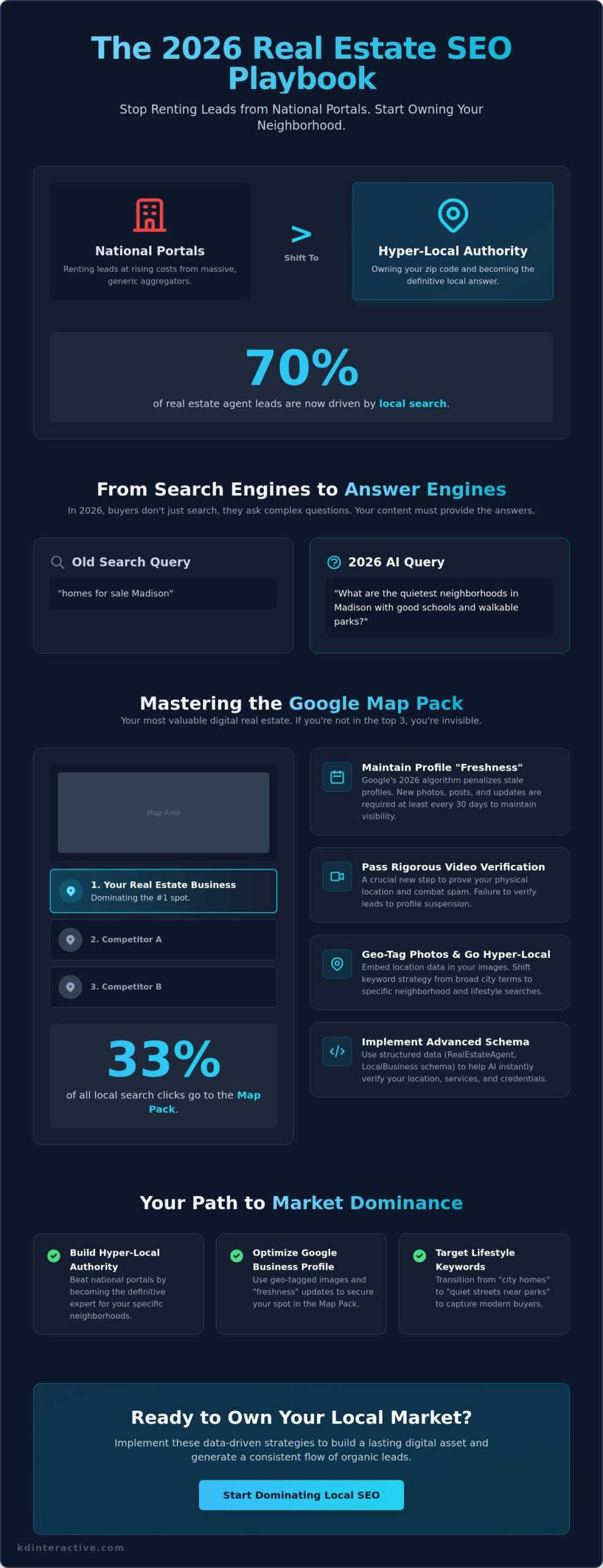
Did you know that over 70% of leads for real estate agents are now driven by local search? While national portals continue to hike their prices, the most successful agents have stopped renting their leads and started owning their neighborhoods. This real estate agent local seo guide is designed to help you reclaim your territory. In 2026, winning isn’t about broad keywords; it’s about becoming the definitive answer engine for your specific zip code. You want to know how to make your business show up first when people search for homes in your specific neighborhood, and we have the data-driven path to get you there.
It’s frustrating to watch a massive corporation outrank you for a street you’ve lived on for decades. You’ve likely felt the sting of rising costs and the confusion of keeping up with Google’s constant changes, like the shift toward video verification and the removal of the Q&A feature. We understand you’re a busy professional who needs results, not a technical manual. This guide teaches you how to dominate the Google Map Pack and build local authority using AI-driven strategies. We’ll cover everything from maintaining profile freshness to navigating new laws like California’s AB 723, ensuring you become the most trusted expert in your market.
Key Takeaways
- Learn why hyper-local authority beats generic national portals in 2026 search environments.
- Optimize your Google Business Profile with geo-tagged images and “freshness” updates to secure your spot in the Map Pack.
- Use this real estate agent local seo guide to transition from broad city-wide searches to neighborhood-level lifestyle keywords.
- Implement advanced technical schema to help search engines verify your location and professional credentials instantly.
- Identify the strategic point to scale your business with professional local SEO services for long-term market dominance.
The 2026 Real Estate Landscape: Why Local SEO Beats Generic Portals
The real estate market shifted when AI Overviews became the standard search experience. In 2026, many agents still throw money at national portals, but they’re essentially renting their business. To build a lasting digital asset, you need a strategy that moves beyond paying for someone else’s traffic. Understanding What is Local SEO? is the first step toward reclaiming your market. This real estate agent local seo guide shows you how to stop being a line item for a portal and start being the authority in your zip code.
National portals like Zillow or Realtor.com are massive data aggregators. They can show a listing, but they can’t explain the vibe of a specific street or the best local coffee shop. When you invest in local SEO, you’re building equity in your own brand. You stop paying a high cost per lead to a middleman and start generating a consistent organic flow. This shift is vital in the Zero-Click era. Google now provides answers directly on the search results page. If you’re the source of that answer, you win the trust of a buyer before they ever visit your site.
From Search Engines to Answer Engines
Buyers now use AI assistants like ChatGPT and Gemini to find their next home. They don’t just type “homes for sale”; they ask, “What are the quietest neighborhoods in Madison with good schools and walkable parks?” If your content isn’t structured for these answer engines, you’re invisible. AI requires authoritative, structured data to recommend you. We help you move past generic descriptions and create content that speaks directly to these conversational queries. Your data must be organized so AI can consume it and present you as the logical choice.
The Local Advantage: Why “Near Me” Still Rules
Data shows that 97% of home searches start online, and over 70% of leads for agents are driven by local search. Google’s algorithm prioritizes proximity over brand size every time. A massive national brand can’t be “near” every searcher, but you can. The Google Local 3-Pack captures about 33% of all local search clicks. By focusing on hyper-local signals, you establish immediate trust with sellers. They want a neighborhood expert, not a distant corporation. Using this real estate agent local seo guide ensures your business is the first thing they see when they search for help in their specific community.
Mastering the Google Map Pack: Your Digital Storefront
The Google Map Pack is the most valuable real estate you’ll ever own. In 2026, it’s the primary way local buyers find experts. If you aren’t in the top three results, you’re essentially invisible to the 33% of searchers who click exclusively on map results. Success here requires more than just a basic profile. This real estate agent local seo guide provides the roadmap to secure your spot at the top. You must treat your Google Business Profile (GBP) as a living, breathing digital storefront that responds to both human needs and AI algorithms.
Google’s 2026 requirements are stricter than ever. You now face a rigorous video verification process to prove your physical location. Additionally, the “freshness” factor is a critical ranking signal. Profiles that don’t upload new photos or posts for more than 30 days often see a significant drop in visibility. You should also note that Google discontinued the Q&A feature in late 2025. You must now integrate answers to common buyer questions directly into your business description and service captions. Managing these technical nuances can be overwhelming, which is why many top producers consider choosing a professional SEO service to maintain their competitive edge.
Optimizing Your GBP for Maximum Visibility
Start by selecting the correct primary category. If you’re an individual, “Realtor” is your best bet; if you lead a team, “Real Estate Agency” may be more appropriate. Your business description should be written for conversational search. Use natural language that an AI assistant can easily parse to recommend you. Don’t overlook “Attributes.” Highlight specific offerings like “Virtual Tours” or “Local Market Reports” to stand out in the crowded 2026 landscape. If you’re looking for a partner to handle these details, you can learn more about our specialized approach.
The Review Engine: Building Trust at Scale
Reviews are a primary ranking factor, but the rules have changed. Google’s updated policies now prohibit selective solicitation or offering incentives for feedback. You need a system that generates high-velocity, authentic reviews naturally. When you receive a review, respond quickly. Use local keywords and neighborhood names in your responses. This signals to Google that you’re active and deeply embedded in your specific territory. High-quality reviews don’t just help you rank; they build the immediate trust necessary to convert a searcher into a client.
Finally, leverage the Google Map Pack with AI Assistant. In 2026, speed is everything. AI assistants are often the first point of contact for home buyers. By integrating an AI assistant into your GBP, you can provide instant responses to inquiries at any hour. This ensures you never miss a lead while you’re out at a showing or closing a deal. Combining high-resolution, geo-tagged photography of local landmarks with these AI tools creates a profile that national portals simply cannot match.
Hyper-Local Keyword Strategy: Winning Neighborhood-Level Searches
Stop wasting your budget on broad city-level keywords where you’re forced to compete with billion-dollar corporations. In 2026, the real battle is won at the neighborhood level. While your competitors chase generic terms like “Madison Realtor,” you can dominate by targeting lifestyle keywords that reflect how people actually want to live. This real estate agent local seo guide moves you beyond the basics. You’ll learn to capture buyers and sellers right where they live, work, and play by focusing on the micro-markets that national portals often ignore.
Buyers aren’t just looking for houses; they’re looking for communities. They ask specific questions about local school ratings, the best dog parks, or upcoming neighborhood festivals. By creating content that answers these long-tail questions, you capture top-of-funnel leads before they ever touch a national portal. This local digital marketing strategy ensures you aren’t just a name on a yard sign, but a trusted community resource. By the time a resident is ready to buy or sell, you’ve already won the battle for their attention because you’ve provided consistent value through local insights.
The Neighborhood Guide Framework
Success starts with high-value neighborhood pages that act as local hubs for your website. Instead of one generic “areas served” page, create dedicated sections for every major subdivision in your territory. You should include specific local details that only an expert would know, such as:
- Local school district performance and boundary maps.
- Detailed guides to community parks, trails, and recreation centers.
- Calendars for annual neighborhood festivals and farmers markets.
- Spotlights on locally-owned businesses and hidden gem restaurants.
When you use local SEO services near me to identify untapped geographic keywords, you’ll find that these hyper-local terms have lower competition and higher conversion rates. Mapping your content to the emotional journey of a buyer allows you to build rapport early. They start with curiosity about a lifestyle and end with a need for your specific expertise.
Keywords That Convert Sellers
Targeting sellers requires a different set of long-tail keywords focused on valuation and market timing. You must address specific concerns about property worth in a changing landscape. Phrases like “What is my home worth in [Neighborhood]” or “average days on market in [Subdivision]” are gold mines for lead generation. Use your unique access to market report data to build trust with local homeowners. If you’re the “best real estate agent for historic homes” or another niche property type, your content needs to reflect that specialization. Following this real estate agent local seo guide will help you capture these high-intent searches that your competitors are completely overlooking.
Technical Foundations: On-Page SEO and Real Estate Schema
Your website’s technical health determines how easily search engines and AI assistants can recommend you. While the previous sections of this real estate agent local seo guide focused on content and map visibility, this section deals with the underlying code. You need a site that loads instantly on a smartphone and speaks the language of modern search engines. Without a solid technical foundation, even the best neighborhood guides will struggle to rank. It’s about making your site as easy to read for a machine as it is for a human.
Schema Markup: Speaking Google’s Language
Structured data is the secret weapon for agents in 2026. By implementing RealEstateAgent and PostalAddress schema, you provide search engines with verified data points that they don’t have to guess. This increases your chances of appearing in “Featured Snippets” and AI Overviews. Real Estate Schema is a structured roadmap that allows AI models to instantly verify your professional credentials and geographic service area. When AI assistants like Gemini or ChatGPT look for a local expert, they prioritize sites that provide this clear, structured data.
Use this checklist for your homepage structured data:
- Official business name and professional logo.
- Physical office address using PostalAddress schema.
- Local phone number with the correct area code.
- Geo-coordinates (latitude and longitude) for your office location.
- Price ranges and specific service types offered.
This technical precision ensures your web and seo services work together to build a dominant digital presence. It’s the difference between being “just another agent” and being a verified local authority in the eyes of Google’s algorithm.
Internal Linking for Local Authority
Your website should be a web of interconnected local knowledge. Link your specific neighborhood pages back to your main service pages to pass authority throughout the entire site. Use descriptive anchor text like “homes for sale in [Neighborhood Name]” instead of generic “click here” buttons. This tells Google exactly what the destination page is about and reinforces your local relevancy. It creates a logical funnel that guides both users and search crawlers through your content.
If you’re just starting, you may want to review our sibling guide on how do i setup a google business page to ensure your foundation is solid. Once your profile is ready, your on-page technical SEO acts as the bridge that connects your map visibility to your website traffic. Mobile-first design is no longer optional for agents on the move. Your clients are searching for listings while sitting in their cars or walking through neighborhoods. High click-through rates depend on optimized title tags and