
Does the thought of asking customers for a review make you hesitate? For many small business owners, building a proactive strategy for reputation management google reviews feels like just one more overwhelming task on an already full plate. It’s a common struggle-you don’t have time to ask every customer, you’re afraid of what they might say, and you’re left feeling vulnerable to that one unexpected negative comment or a malicious 1-star review. This uncertainty can keep your business from unlocking its true potential online.
We understand that struggle, because we’re a small business too. That’s why this guide isn’t about adding more work; it’s about giving you a complete, ethical system that delivers results. You will learn how to consistently generate a stream of authentic, positive reviews, handle all types of feedback with confidence, and transform your Google Business Profile into a powerful magnet that attracts new customers and helps your business grow.
Key Takeaways
- Google reviews are a primary driver of your local SEO performance, directly influencing your visibility and ranking in the Google Map Pack.
- Learn the right time and method to ask for reviews to dramatically increase your positive feedback without pressuring customers.
- A successful strategy for reputation management google reviews involves responding to all feedback, turning even negative comments into a public display of great customer service.
- Discover the critical mistakes to avoid, including tactics that can get your reviews removed or your entire business profile suspended by Google.
Why Google Reviews Are a Non-Negotiable for Local Businesses
In today’s digital marketplace, your Google Business Profile is your new front door, and your reviews are the modern-day word-of-mouth. Before a potential customer ever calls you or visits your website, they are looking at your star rating and reading what others have said. This first impression is absolutely critical. In fact, studies consistently show that the vast majority of consumers trust online reviews as much as a personal recommendation from a friend. This shift makes a proactive strategy for reputation management google reviews a non-negotiable for growth. It’s a core component of modern online reputation management, and neglecting it is like ignoring customers standing in your lobby-it directly impacts your visibility, credibility, and ultimately, your sales.
The Link Between Reviews and Local SEO Rankings
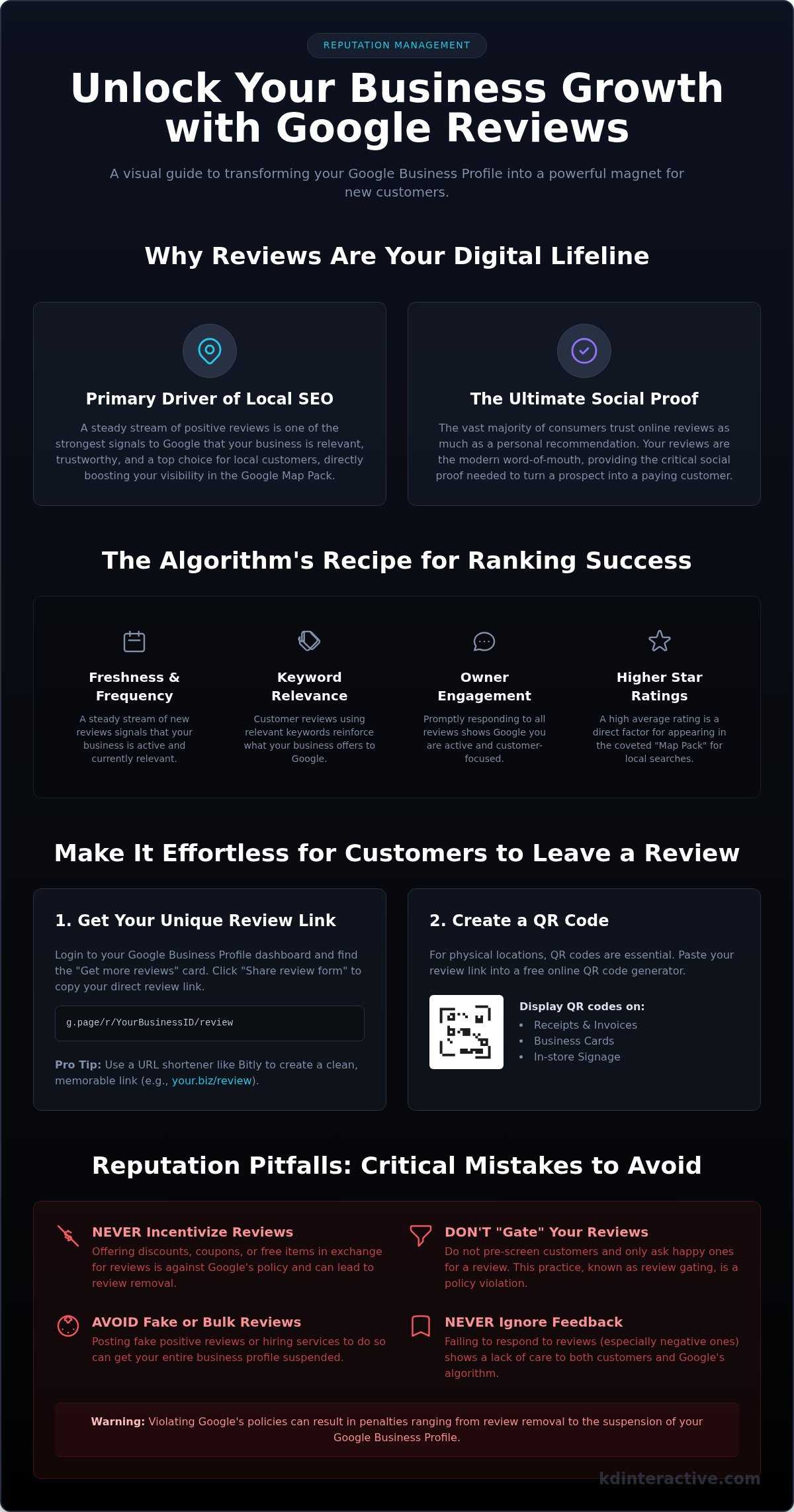
Google’s primary goal is to provide the best, most relevant answer to a user’s search. A strong profile of positive reviews is a powerful signal that your business is a high-quality, trustworthy choice that delivers on its promises. The algorithm specifically rewards businesses that actively manage their reviews. Here’s how:
- Freshness and Frequency: A steady stream of new reviews shows Google your business is active and currently relevant to customers.
- Keyword Relevance: When customers naturally use keywords in their reviews (e.g., “best emergency plumber in Madison”), it reinforces your relevance for those searches.
- Owner Engagement: Promptly responding to all reviews-both positive and negative-signals to Google that you are an active and customer-focused business.
- Higher Ratings: It’s simple-businesses with higher average star ratings are more likely to appear in the coveted Google Map Pack for “near me” searches.
How Reviews Impact Customer Behavior and Your Bottom Line
Beyond the algorithm, reviews directly influence the decisions real people make every day. When a potential customer is choosing between you and a local competitor with similar services, your reviews often become the ultimate tie-breaker. They provide the social proof needed to turn a prospect into a paying customer. A strong review profile also provides invaluable, unfiltered feedback on what you’re doing right and where you can improve. This builds a foundation of trust that can justify premium pricing and foster long-term customer loyalty. By showcasing these positive reviews on your own website, you can significantly boost on-site conversions and reinforce a customer’s decision to choose you.
The Foundation: Setting Up Your Business to Receive Reviews
Before you ask a single customer for feedback, you need to lay the groundwork. Why? Because even the happiest customer won’t leave a review if the process is difficult or confusing. Your goal is to make leaving a review a frictionless, one-minute task. This initial setup is a critical component of any successful strategy for reputation management google reviews, ensuring your efforts lead to real, measurable results.
It all starts with your Google Business Profile (GBP). A fully optimized profile-complete with accurate hours, professional photos, and detailed service descriptions-builds immediate trust. It shows customers you’re a legitimate, active business that values its online presence. Before you start actively soliciting reviews, it’s also wise to have a plan for how you’ll handle them. In fact, many business owners find that reading through expert tips for responding to negative reviews before they start a campaign gives them the confidence to manage any feedback that comes their way.
This online presence extends beyond just your GBP. Having a professional website with helpful content also signals quality. For example, a successful children’s entertainer like Mr. Magico uses their blog to share party ideas, demonstrating expertise and building a positive brand impression long before a review is ever requested.
Finding and Sharing Your Unique Google Review Link
Google provides a direct link that opens the review submission box for your business, removing extra steps for your customers. Here’s how to find it:
- Log in to your Google Business Profile dashboard.
- On the Home tab, look for the card titled “Get more reviews.”
- Click “Share review form” to copy your unique URL.
This long URL isn’t very clean, so we recommend using a free URL shortener like Bitly to create a custom, branded link (e.g., your.biz/review). Place this powerful link in your email signature, on your website’s contact page, and in post-service follow-up messages.
Creating a QR Code for Instant Review Access
For brick-and-mortar businesses, QR codes are the most effective way to bridge the gap between a physical visit and a digital review. Simply paste your shortened review link into a free online QR code generator. Then, place the resulting code where customers will see it:
- On printed receipts or invoices
- At the bottom of business cards
- On table tents or in-store signage near the checkout
Always pair your QR code with a simple, polite call to action, like: “Enjoyed your visit? Scan here to share your feedback on Google!” This small prompt makes a huge difference.
How to Ethically Ask for and Get More Google Reviews
Getting a steady stream of positive reviews isn’t a matter of chance; it’s the result of a deliberate, well-executed process. The most successful strategies for reputation management google reviews are built on a simple foundation: asking the right customers at the right time and making it incredibly easy for them to share their feedback. As highlighted in many leading small business reputation management tips, integrating this ‘ask’ into your daily operations is key. One critical rule to always follow: never offer incentives, discounts, or gifts in exchange for reviews. This violates Google’s policies and can damage the trust you’ve worked so hard to build.
Timing is Everything: The Best Moments to Ask
The “when” is just as important as the “how.” Asking for a review when a customer’s positive experience is fresh in their mind dramatically increases your success rate. Focus on these peak moments of customer satisfaction:
- Immediately after a successful service or purchase: The value you provided is top-of-mind.
- When a customer gives you unsolicited praise: If they say “Thank you, this was great!” in person, that’s your cue to say, “We’d love it if you’d share that online!”
- In a follow-up email or text: A simple, automated message 1-3 days post-transaction works wonders.
- After resolving a support issue successfully: Turning a potential problem into a positive experience is a powerful moment to request feedback.
Automating the Ask: Using Email and SMS
Manually asking every customer can be draining. Automating the request through email or SMS ensures consistency and efficiency. A simple, personalized message that thanks the customer and provides a direct link to your Google Business Profile is all you need. For example: “Hi [Customer Name], thank you for your recent purchase! We’d appreciate it if you could take 30 seconds to share your experience on Google.” This approach streamlines a crucial part of your strategy for reputation management google reviews and captures feedback while you focus on other parts of your business.
In-Person and Print Strategies
Don’t overlook low-tech, high-impact methods. Train your team with a simple, friendly script to use at the point of sale. For businesses with a physical location, QR codes are a powerful tool. Add a QR code that links directly to your Google review page on:
- Business cards or flyers
- Receipts or invoices
- Restaurant menus or table tents
This makes the process frictionless for customers who are already engaging with your brand in person.
The Art of the Response: How to Manage Every Type of Review
Getting a steady stream of Google Reviews is a huge win, but your work isn’t done when the notification arrives. Responding to reviews-both good and bad-is just as important as acquiring them. Each response is a public statement about your brand. It shows potential customers that you are engaged, value feedback, and are committed to customer satisfaction. A well-crafted response can amplify a positive experience or effectively neutralize a negative one, making it a critical component of your overall strategy for reputation management google reviews.
To ensure you reply promptly and consistently, we recommend creating a few templates you can quickly customize. This saves time and keeps your brand voice aligned across all responses.
While you’re creating templates for reviews, it’s a good time to think about other business communications. For help drafting professional letters and documents, you can discover Briefwizard, an AI-powered tool for formal correspondence.
Responding to Positive (4- and 5-Star) Reviews
When a customer leaves a great review, your response turns a happy client into a loyal advocate. Don’t just say “thanks.” Make your reply personal and impactful. Thank the customer by name, and mention a specific detail from their review to show you actually read it. For example, “We’re so glad you enjoyed the custom cabinetry!” Subtly include your business name or a service keyword to boost SEO value, and always end with a warm invitation to return.
Handling Negative (1- and 2-Star) Reviews
A negative review can feel like a personal attack, but a strategic response can protect your reputation. The key is to act quickly, professionally, and without emotion. Never argue or get defensive in a public forum. Instead, follow this simple process:
- Acknowledge and Apologize: Thank them for their feedback and offer a sincere apology for their poor experience. “We are sorry to hear our service did not meet your expectations.”
- Take it Offline: Provide a direct point of contact, like an email address or phone number, so you can resolve the issue privately. This shows you’re taking action without airing dirty laundry.
- Show You Care: Your public response demonstrates to every other potential customer that you take feedback seriously and are committed to making things right. This builds trust, even from a negative situation.
Dealing with Fake or Malicious Reviews
Unfortunately, not all negative reviews are genuine. If you suspect a review is fake or violates Google’s policies (e.g., it contains hate speech or is from a disgruntled ex-employee), do not engage in a public argument. Your first step is to calmly assess if it breaks specific guidelines. If it does, flag the review directly within your Google Business Profile for Google’s team to evaluate. The removal process isn’t guaranteed and can be frustrating. Let our experts handle your reputation management.
Reputation Pitfalls: Critical Mistakes to Avoid with Google Reviews
Earning a steady stream of positive Google Reviews is a powerful way to grow your business. But how you get those reviews matters just as much as how many you have. Taking shortcuts or using “black-hat” tactics can backfire, leading to review removal, profile suspension, and a damaged reputation. True, sustainable growth is built on a foundation of authenticity and transparency. Focus on earning real reviews, not faking them.
Why You Should Never Buy Google Reviews
It can be tempting to look for a quick fix, but buying Google Reviews is a direct violation of Google’s policies and a critical mistake. Google’s sophisticated AI is incredibly effective at detecting and removing inauthentic reviews, meaning your investment will quickly disappear. More importantly, if customers discover your reviews are fake, you will instantly destroy the trust you’ve worked so hard to build. Effective reputation management google reviews is about building genuine social proof, not fabricating it.
- It Violates Trust: Authenticity is non-negotiable for modern consumers.
- Reviews Get Removed: Google will eventually find and delete fake reviews, wasting your money.
- Risk of Suspension: Your Google Business Profile could be suspended, making you invisible to local customers.
The Problem with ‘Review Gating’
Review gating is the practice of selectively soliciting reviews. This typically involves using a survey to first ask customers if they had a positive or negative experience. Happy customers are sent a link to leave a Google review, while unhappy customers are directed to a private feedback form. While it might seem clever, this is also against Google’s policies because it discourages and prohibits negative reviews. The best practice is to give every single customer an equal and straightforward opportunity to share their feedback publicly.
Other Common (and Costly) Mistakes
Beyond buying reviews and gating, a few other common missteps can hurt your online presence. Be sure to avoid these pitfalls:
- Setting up a review kiosk: Having a single tablet or computer for customers to leave reviews at your location is a red flag for Google. Multiple reviews coming from the same IP address look like spam and are often removed.
- Offering incentives: You cannot offer discounts, gift cards, or any form of compensation in exchange for a review. This practice compromises the integrity of the review and violates Google’s terms of service.
- Ignoring negative feedback: A negative review is not the end of the world-it’s an opportunity. Ignoring it makes you look like you don’t care. A professional, helpful response shows potential customers that you take feedback seriously and are committed to customer satisfaction.
Ultimately, a successful strategy for reputation management google reviews relies on providing excellent service and making it easy for your happy customers to share their experiences. Building a five-star reputation takes work, but it’s one of the most valuable assets your business can have. If you need a partner to help you build a transparent and effective review strategy, the team at KD Interactive is here to help.
Turn Your Google Reviews into Your Greatest Asset
Mastering your online reputation isn’t about luck; it’s about a consistent, strategic approach. As we’ve covered, your Google Reviews are a direct line to new customers and a critical factor in local search rankings. The key to success lies in proactively asking for feedback, responding professionally to every review-good or bad-and avoiding the common pitfalls that can undermine customer trust. A strong, ethical strategy for reputation management google reviews transforms customer feedback from a passive metric into an active engine for sustainable business growth.
We know this can feel like another full-time job on top of everything else you do. At KD Interactive, we get it. We understand the unique challenges of a small business because we are one. As Wisconsin-based experts, we provide transparent, results-oriented SEO and reputation services focused entirely on delivering measurable local results. We’re here to be your dedicated partner in that growth, helping you succeed in your community.
Ready to take control of your online story and turn your hard-earned reviews into more customers? Get a FREE consultation to boost your online reputation!
Frequently Asked Questions About Google Reviews
How many Google reviews do I need for my business?
While there’s no magic number, a great starting goal is to acquire at least 10 high-quality reviews to build initial trust. After that, the focus should shift to consistency. Aim to steadily earn more reviews than your direct local competitors. A continuous stream of recent, positive feedback sends a powerful signal to both Google and potential customers that your business is active, credible, and valued in the community.
Can I remove a negative Google review that I think is unfair?
You cannot directly delete a review yourself. However, you can flag a review for removal if it clearly violates Google’s content policies, such as being fake, spam, or containing hate speech. The most effective strategy for reputation management Google reviews is to post a calm, professional public reply and then focus on generating a wave of new, positive reviews. This approach demonstrates excellent customer service and pushes the negative feedback down.
How long does it take for a new review to show up on my profile?
Most Google reviews appear almost instantly after a customer posts them. However, in some cases, there can be a delay of up to 48 hours. This typically happens when Google’s automated systems flag a review for a manual check to ensure it meets their guidelines and isn’t spam. If a legitimate review doesn’t show up after a few days, it was likely removed for a policy violation.
Is it okay to ask friends and family to leave reviews for my business?
No, this is strongly discouraged and is a direct violation of Google’s conflict of interest policy. Reviews should reflect a genuine customer experience. Google’s algorithm is designed to detect and remove reviews from friends, family, or employees. This practice can harm your credibility and lead to penalties. Instead, focus your energy on requesting feedback from your actual, satisfied customers for authentic and impactful results.
What’s the difference between a review and a rating?
A rating is the star value (from 1 to 5) a customer selects, offering a quick, at-a-glance measure of their experience. A review includes that star rating plus written text that describes their experience in detail. While both are important for your overall score, the written review is much more powerful. It provides valuable context for future customers and contains keywords that can help boost your local search ranking.
How do I get my star rating to appear in Google search results?
For local search, your star rating will appear automatically in the Google Map Pack and on your Business Profile as soon as you start getting reviews. To have stars appear next to your website in the main organic search results (the blue links), you need to implement “review schema markup” on your website. This is a specific code that helps Google understand and display your aggregated rating data directly in the search results.