
Does your business actually exist if an AI assistant can’t verify your address across twenty different platforms? With 92% of searchers choosing a business on the first page of local results, being invisible isn’t just a minor setback; it’s a lost opportunity for growth. You likely feel the frustration of seeing competitors dominate the Map Pack while your own shop stays hidden. It’s even worse when inconsistent info leads a customer to a closed door or a disconnected line. We understand these challenges because we’ve helped countless local enterprises navigate the same digital hurdles.
This guide provides a clear strategy for local citation building for small business that works in the current AI-driven market. You’ll learn how to build a rock-solid citation profile that boosts your local rankings and establishes digital trust with both customers and search engines. We’ll preview how to create hyper-local entity authority and navigate Google’s latest 2026 verification processes to ensure your brand presence remains consistent everywhere. It’s time to turn those search queries into increased phone calls and foot traffic for your business.
Key Takeaways
- Learn why citations have shifted from basic directory listings to essential identity validation signals that AI search engines use to verify your business.
- Identify the core search engines and data aggregators required for local citation building for small business to create a powerful trickle-down effect across the web.
- Compare manual and automated management strategies to determine which approach best fits your budget and time constraints while ensuring data accuracy.
- Follow a step-by-step audit process to standardize your business information and secure your position in the local Map Pack.
- Understand how consistent citations provide the location authority needed to boost your blog rankings and overall SEO performance.
What Is Local Citation Building and Why Does It Matter in 2026?
Local citation building for small business is the strategic management of every online mention of your Name, Address, and Phone number, commonly referred to as NAP. While this sounds simple, these digital footprints are the foundation of your online presence. In 2026, the industry has shifted from basic link building to a rigorous model of identity validation. Search engines no longer just look for links; they look for a consensus across the web that your business is exactly who you say it is. This verification process is a core part of how local search ranking factors determine which businesses deserve a spot at the top of the results page.
Trust is the currency of the modern algorithm. Google uses citations as a primary signal to confirm your physical location and operational status. If your data is scattered or incorrect, the consequences are immediate and costly. Bad data, such as an old phone number or a previous address, acts like a broken link in your reputation. It confuses potential customers and tells search engines that your business might be inactive or unreliable. One wrong digit can cause your rankings to tank, effectively handing your local market share to a more organized competitor.
The Anatomy of a Perfect Local Citation
Consistency is your non-negotiable golden rule. Your NAP data must be identical across every directory, from the spelling of “Suite” to the formatting of your area code. To truly dominate, you must go beyond these basics by including enhanced data. This includes your current business hours, high-resolution photos, and a clear list of services. If you operate multiple locations, treat each one as a distinct entity. Create unique landing pages for each branch and ensure every specific citation points to the correct local URL to avoid confusing AI search bots.
Citations in the Era of AI Search
AI crawlers don’t just scan for keywords; they cross-reference directory data to answer complex “near me” voice queries with absolute certainty. When a user asks their AI assistant for a recommendation, the system pulls from the most consistent data sources it can find. Citations are the “ID card” for your business in the digital world. They are the primary source of truth that allows your business to appear in AI-generated local summaries. By maintaining a rock-solid citation profile, you provide the structured data these AI systems need to trust and recommend your services to local customers.
The Local Citation Ecosystem: Where Your Business Needs to Be
Understanding the citation ecosystem is like mapping a digital watershed. Information flows from a few primary sources down into thousands of smaller directories. For effective local citation building for small business, you can’t just throw data at every site you find. You need to target the tiers that matter most. We categorize these into three distinct groups: Core Search Engines, Data Aggregators, and Niche Directories. When your information is accurate on the top tier, it creates a “trickle-down” effect that automatically updates smaller sites across the web. This is a foundational part of broader local marketing strategies for small businesses that prioritize efficiency and authority.
Beyond structured directories, “Unstructured Citations” carry immense weight in 2026. These are mentions of your business on news sites, local blogs, or event pages. While they don’t always follow a standard NAP format, search engines use them to verify your “Geographic Relevance.” For instance, a mention on a Wisconsin-specific business journal provides more local authority than a listing on a generic global directory. It proves you’re an active part of your community. If you want to see how your current presence measures up, our web and seo services can help you audit these critical trust signals.
Core Platforms and Major Aggregators
Your Google Business Profile is the sun at the center of your citation solar system. Since over 70% of local searches result in interactions with these profiles, it’s where your journey begins. However, you must also feed the “Big Three” data aggregators: Data Axle, Foursquare, and Neustar Localeze. These platforms act as the primary data suppliers for the rest of the internet. Don’t ignore Apple Maps or Bing. In 2026, Apple Maps has become even more influential through its integration with the Yelp Assistant AI, making it a vital source for voice-activated search results.
Industry-Specific and Local Directories
Niche directories provide the industry context search engines crave. If you’re a contractor, a listing on Houzz is non-negotiable. For a Wisconsin business, a link from a local Chamber of Commerce acts as a supercharged citation. These high-authority local sites confirm your physical presence in a way a national directory can’t. Neighborhood blogs and hyper-local community pages are also essential for local citation building for small business. They signal to AI crawlers that you aren’t just a business in a city; you’re a trusted fixture in a specific neighborhood. This level of detail is exactly what drives the 78% of mobile commerce transactions triggered by local search.
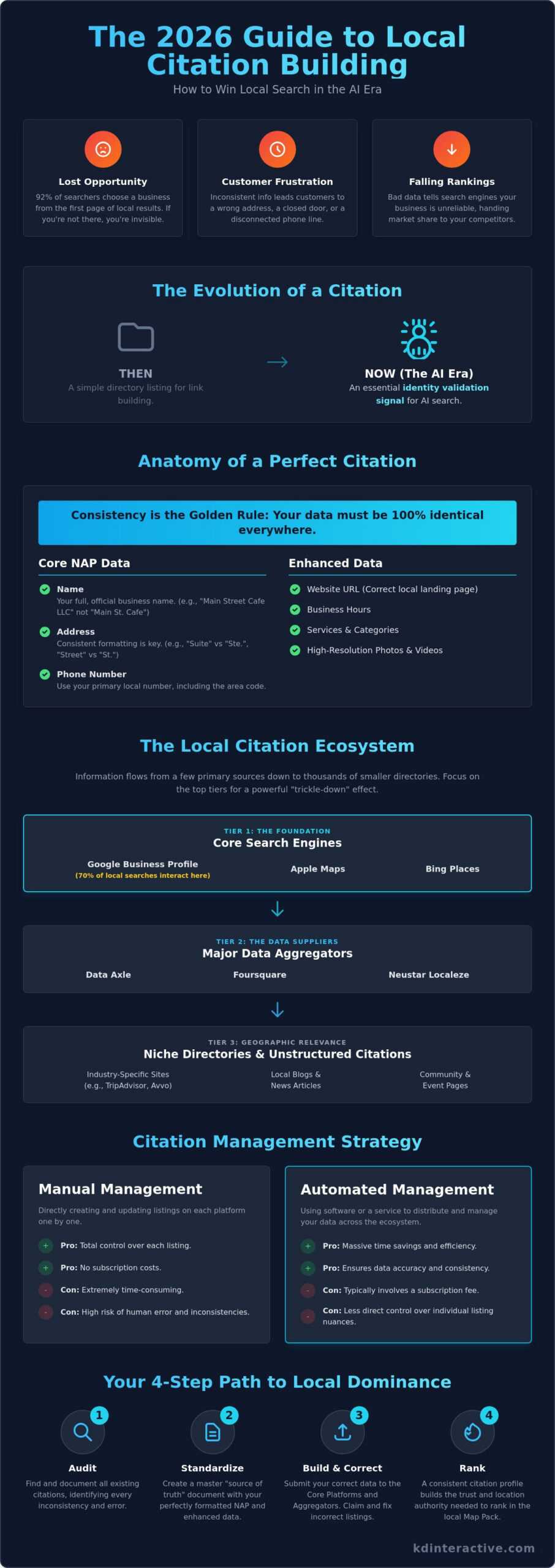
Manual vs. Automated Citation Building: Pros, Cons, and Costs
Every entrepreneur eventually reaches a crossroads: do you invest your limited time or your hard-earned capital? When it comes to local citation building for small business, the choice between manual entry and automated syncing defines your long-term maintenance strategy. The manual path involves a one-time effort to claim and verify listings, while automated solutions provide an “Active Sync” that pushes updates to dozens of directories simultaneously. Choosing the right path is a critical step to improve your local listings and ensure your business remains visible to customers.
A major risk often overlooked by business owners is “data drift.” This occurs when old, incorrect information from obscure data sources resurfaces and overwrites your current listings. Automated platforms can combat this through constant monitoring, but they require ongoing monthly fees. In 2026, many small businesses find that a hybrid approach offers the most protection. This involves manually securing the top-tier directories to ensure permanent ownership while using software for broader reach and protection against algorithmic errors.
When to Choose Manual Citation Building
Manual building is ideal for businesses with a single, permanent location and a tight marketing budget. You effectively “own” these listings forever without worrying about a subscription lapse causing your data to revert to an unverified state. This method also allows for more “flavor” in your niche descriptions. Instead of a generic blurb, you can tailor your message for specific trade directories or local Wisconsin business associations. Pay-as-you-go services currently start at $3.20 per site, making this a cost-effective way to build a permanent foundation for your digital identity.
The Case for Automated Listings Management
If you manage multiple storefronts or frequently update your seasonal hours, automation is a necessity. Software platforms, typically ranging from $20 to $39 per month, provide a “suppression” feature that identifies and kills duplicate listings instantly. This prevents the confusion that arises when multiple versions of your business info appear in search results. Automation is a shield against incorrect third-party data edits that could otherwise damage your authority. It’s a “set it and forget it” solution that frees you to focus on running your business rather than chasing down directory errors.
Step-by-Step: Building a Citation Profile that Dominates Wisconsin
Dominating your local market requires a transition from theory to precise execution. Local citation building for small business isn’t just about adding new listings; it starts with a thorough cleaning of your existing digital footprint. Before you submit your data to new platforms, you must ensure your foundation is spotless. This methodical approach ensures that search engines don’t receive conflicting signals about your location or services. If you’re ready to secure your spot in the Map Pack, our Local SEO services near me provide the expert guidance needed to navigate this complex process.
A successful strategy relies on a clear source of truth. You must standardize your NAP exactly as it appears on your Google Business Page. If your Google profile uses “Ste.” instead of “Suite,” every other directory must follow suit. Once your data is standardized, focus on the “Big 10” high-authority directories like Yelp, Bing, and Apple Maps. Only after these pillars are secured should you move on to smaller niche sites. This hierarchy of importance ensures that your most influential citations are working for you as quickly as possible.
The Audit: Finding the Skeletons in Your Digital Closet
Your first task is to uncover every existing mention of your business online. Use advanced search operators to find hidden or incorrect listings. For example, search for your business name combined with an old phone number or a previous address. You might find “zombie” listings created by previous building tenants or outdated directory scrapers. These incorrect entries actively damage your trust score with AI search engines. Create a master spreadsheet to document every listing you find. Track your login credentials, the status of each submission, and the date of your last update to maintain a clear record of your progress.
Local Signaling for the Wisconsin Market
Establishing regional authority is vital for ranking in specific Wisconsin territories. A listing with the Wisconsin Better Business Bureau (BBB) is a major trust booster that signals reliability to both customers and algorithms. You can further strengthen these ties by using local landmarks in your business descriptions. Mentioning your proximity to a well-known neighborhood park or a historic downtown building helps AI crawlers understand your physical context. This hyper-local signaling proves your deep roots in the community. To ensure your digital presence is as strong as your local reputation, request a professional citation assessment from our experts today to identify and fix your data gaps.
Integrating Citations into Your Total 2026 Growth Strategy
Local citation building for small business is not a standalone task to check off a list. It acts as the anchor for your entire digital presence. When search engines have absolute certainty about your physical location, they grant your brand “location authority.” This authority doesn’t just help you rank for your name; it elevates every piece of content you produce. If you publish a blog post about services in Milwaukee or Green Bay, Google is more likely to show it to local users because your verified citations have already proven you are a legitimate local entity. This validation is a prerequisite for the success of any comprehensive web and seo services plan.
Consistency also plays a vital role in your reputation management and customer experience. Think about the friction caused by a wrong phone number or an old address. If a customer can’t find you easily, they won’t leave a positive review. Since a one-star increase on platforms like Yelp can lead to a 5-9% increase in revenue, every detail matters. Accurate citations ensure that the 70% of local searches resulting in profile interactions lead to actual sales rather than dead ends. Professional management allows you to reclaim your time and focus on serving those customers while we handle the data precision.
The “Map Pack” Advantage
Our “Google Map Pack with AI Assistant” leverages your citation data to secure those coveted top three spots. We’ve found that citations are often the first thing we must fix when launching a digital marketing for small business strategy. Without a clean data foundation, your other marketing efforts will struggle to gain traction. Citations are the foundation, but content is the fuel for growth. Once the foundation is level, your ads, social media, and blog posts can finally perform at their full potential.
Next Steps for Your Business
You can start protecting your brand today by performing a “quick check” of your NAP. Search for your business name and see if the first five results show identical information. If you find discrepancies, it’s a sign that your “identity validation” is at risk. While DIY efforts work for some, there comes a point where manual management becomes a full-time job. When your business begins to scale, it’s time to bring in a local digital marketing expert who understands the Wisconsin landscape. Don’t let bad data hold your business back from dominating the local market. Get a professional SEO audit from KD Interactive and start building a profile that search engines and customers can trust.
Secure Your Digital Identity and Lead Your Local Market
Establishing a verified digital presence is no longer optional for the modern entrepreneur. Local citation building for small business has evolved into a vital system of identity validation that AI search engines use to recommend your services. By cleaning up your audit skeletons and standardizing your NAP data, you create the location authority necessary to dominate the Wisconsin market. This foundation ensures that every customer interaction, whether through a voice query or a map search, leads directly to your door.
You don’t have to manage this complex ecosystem alone. Our team provides Wisconsin-based regional expertise through pragmatic, results-oriented local SEO packages designed for your specific goals. We integrate your data with our Google Map Pack with AI Assistant to ensure your business stays at the top of the results. It’s time to reclaim your schedule and let us handle the technical precision. Dominate the Local Map Pack with KD Interactive and start seeing the increased foot traffic your hard work deserves. Your journey toward total local visibility starts with one accurate listing.
Frequently Asked Questions
What is a local citation for a small business?
A local citation is any online mention of your business’s name, address, and phone number, commonly referred to as NAP. These mentions typically appear on business directories, social media platforms, and local neighborhood websites. They serve as a digital reference that verifies your physical location and operational existence to both human users and AI search crawlers. Accurate citations are the building blocks of your digital identity.
How many citations do I need to rank on the first page of Google?
There is no magic number of citations required to rank, as the quality and relevance of the listings matter more than the raw quantity. While some businesses see results with 30 to 50 high-quality listings, competitive industries in major Wisconsin cities may require more to establish authority. Focus on securing the “Big 10” directories and industry-specific sites before worrying about the total count of your listings.
Do local citations still matter for SEO in 2026?
Yes, local citations are more critical than ever in 2026 because they act as identity validation for AI search engines. With 92% of searchers choosing a business on the first page of local results, these mentions provide the structured data AI systems need to trust and recommend your business. They are the primary trust signals that separate legitimate local shops from unverified entities in a crowded market.
What happens if my business has inconsistent NAP info?
Inconsistent NAP information causes search engines to lose trust in your business’s location and contact details, which directly lowers your rankings. It also creates customer confusion; a single wrong phone number can lead to missed calls and lost revenue. In the 2026 search environment, data accuracy is a non-negotiable requirement for appearing in the Google Map Pack and AI-generated local summaries.
How long does it take for new citations to affect my rankings?
You can typically expect to see the impact of new citations on your local rankings within two to four months. This timeline depends on how quickly search engines crawl the directories and index the new information. Consistent local citation building for small business requires patience, as the algorithm needs time to cross-reference your updated data across multiple platforms before rewarding your profile with higher visibility.
Are paid directories worth the money for a local business?
Paid directories are worth the investment if they offer high domain authority or cater specifically to your local Wisconsin community. Listings on sites like the Better Business Bureau or your local Chamber of Commerce provide significant trust signals that free, generic directories cannot match. Always evaluate the directory’s traffic and relevance to your specific trade before committing your marketing budget to a paid listing.
Can I build local citations myself or should I hire an agency?
You can certainly build citations yourself if you have a single location and the time to manually manage dozens of listings. However, many entrepreneurs find that the technical complexity and risk of data drift make professional management a better choice. Hiring an agency allows you to reclaim your time while ensuring your local citation building for small business is handled with precision and data-driven strategy.
What is the difference between a citation and a backlink?
A citation is a mention of your business’s NAP information, while a backlink is a clickable link from another website to yours. While many citations include a backlink, their primary purpose is to verify your business identity rather than pass link juice. Both are essential for local SEO, but citations specifically build the location authority required to show up in near me search results.