You’ve built a fantastic local business, but online, it can feel like you’re wearing an invisibility cloak. Potential customers in your own neighborhood are searching for your services, but they’re finding your competitors-or the big box stores-instead. If you’re tired of confusing marketing jargon and wasting money on ads that don’t increase foot traffic, you’re in the right place. The answer isn’t a bigger budget; it’s a smarter strategy. Mastering local digital marketing is the key to connecting with the people who matter most: the customers right here in your community.
This complete guide is designed to cut through the noise and deliver results. We’ll break down exactly what local digital marketing is, which strategies actually work to get your phone ringing, and how you can implement them today. You’ll discover how to get your business featured in the Google Map Pack, drive more real-world customers to your physical location, and build a trusted brand that becomes a pillar of your local market. Let’s turn your local presence into your greatest advantage.
Key Takeaways
- Mastering local digital marketing means showing up at the exact moment nearby customers are searching for your services online.
- A winning local strategy is built on three core pillars that work together to boost your visibility, credibility, and customer engagement.
- Your online reviews are the new word-of-mouth and are one of the most powerful factors in ranking higher than your local competitors.
- Learn how to uncover what your customers are actually searching for so you can build a simple, effective marketing plan that gets results.
What is Local Digital Marketing (And Why It Matters More Than Ever)
Simply put, local digital marketing is the strategy you use to promote your business to potential customers within your specific geographic area. Unlike a national brand that wants to reach everyone, your goal is to be the first and best answer when someone in your neighborhood, town, or city searches for the products or services you offer.
Why has this become so critical? The answer is in your pocket. The explosion of mobile search has fundamentally changed how customers find local businesses. People no longer use the phone book; they use their phones to search for “pizza near me” or “emergency plumber in Madison.” In fact, studies from Google have shown that these types of local, intent-driven searches have grown exponentially, making it essential for your business to be visible in those moments.
A core component of any successful local digital marketing plan is local search engine optimization (Local SEO), the process of improving your visibility in local search results. It’s how you ensure that when a local customer needs you, they find you and not your competition.
The Goal: Winning the ‘Near Me’ Moment
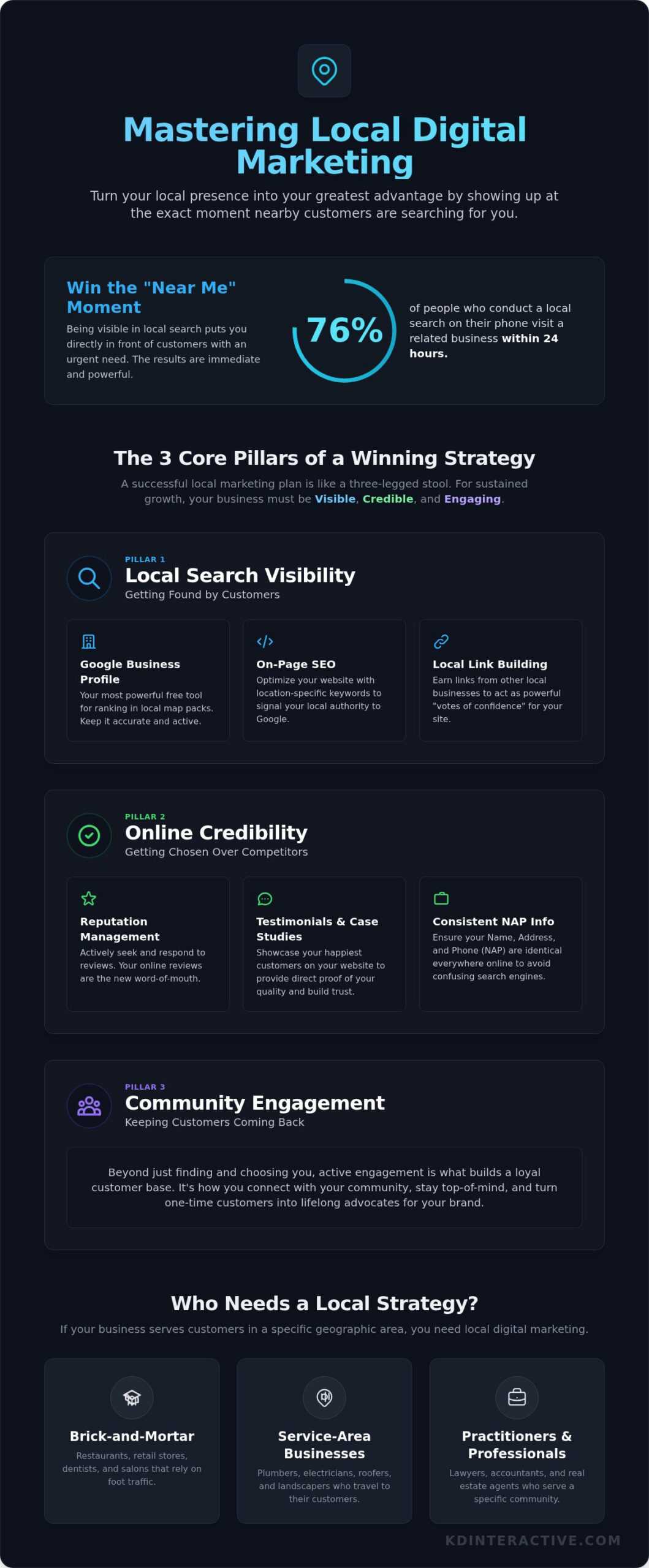
Imagine a potential customer. Their sink is leaking, and they immediately grab their phone and search “plumber near me.” The first thing they see is the Google Map Pack-a box with a map and three local business listings. This is the ‘near me’ moment, and winning it is the primary goal. Being one of those top three results puts you directly in front of a customer with an urgent need. And the results are immediate: powerful industry research shows that 76% of people who conduct a local search visit a related business within 24 hours.
Who Needs Local Digital Marketing?
If your business serves customers in a specific location, you need a local strategy. This isn’t just for storefronts; it’s for any business that relies on a local customer base. This includes:
- Brick-and-mortar businesses: Restaurants, retail stores, coffee shops, dentists, and salons that depend on foot traffic.
- Service-area businesses: Plumbers, electricians, roofers, and landscapers who travel to their customers’ locations.
- Practitioners and professionals: Lawyers, accountants, and real estate agents who serve a specific community or region.
The Core Pillars of a Winning Local Marketing Strategy
To dominate your local market, you need more than just a website. A successful local digital marketing plan is built on three core pillars that work together to attract, convert, and retain customers. Think of it like a three-legged stool: if one leg is weak, the entire structure becomes unstable. For sustained growth, your business needs to be visible, credible, and engaging.
Local SEO is the foundation that gets you seen, online reviews are the cornerstone that builds trust, and active community engagement is what keeps customers coming back. Let’s break down how each pillar contributes to your success.
Pillar 1: Local Search Visibility (Getting Found)
Before a customer can choose you, they have to find you. Visibility is the first and most critical step. If you’re not showing up in local search results or on Google Maps when a potential customer needs your services, you’re effectively invisible. The goal is to be present at the exact moment of need.
- Google Business Profile (GBP): This is your most powerful free tool. A fully optimized GBP listing with accurate information, photos, and posts is the single most important factor for ranking in local map packs.
- On-Page SEO: We optimize your website’s pages with location-specific keywords (e.g., “plumbers in Milwaukee”) to signal to Google that you are the relevant local authority for those searches.
- Local Link Building: Earning links from other respected local businesses, chambers of commerce, or community blogs acts as a powerful vote of confidence, boosting your search engine ranking.
Pillar 2: Online Credibility (Getting Chosen)
Once a customer finds you, why should they choose you over a competitor? This is where credibility comes in. In today’s market, trust is earned through transparency and social proof. Your online reputation is your digital handshake, and it needs to be firm and confident.
- Online Reputation Management: Actively seeking and responding to online reviews on platforms like Google, Yelp, and Facebook shows you care about customer feedback and builds a strong, positive reputation.
- Testimonials and Case Studies: Showcasing your best work and happiest customers directly on your website provides powerful, direct evidence of your quality and reliability.
- Consistent NAP Information: Ensuring your Name, Address, and Phone number (NAP) are identical across all online directories is a critical trust signal for both search engines and potential customers.
Pillar 3: Community Engagement (Getting Remembered)
Getting found and chosen is great, but creating loyal customers who become advocates for your brand is the key to long-term growth. This pillar is about building relationships. It’s a key component of a comprehensive strategy, and many of the most effective local marketing strategies focus on creating this community connection.
- Local Social Media: Go beyond just selling. Share community news, highlight local events, and run promotions that resonate with your neighbors to build a loyal following.
- Local Content Marketing: Write blog posts that answer the specific questions your local customers have. For example, an outdoor shop could blog about local trails, or a service business could create a detailed durability guide—to see a great example of the latter, check out Peninsula Concrete Contractors.
- Email Marketing: Nurture leads and past customers with targeted emails offering exclusive local promotions, seasonal tips, and company news to stay top-of-mind.
Your First Step: Understanding What Local Customers Actually Search For
Before you spend a single dollar on Google Ads or a minute on website updates, there’s a foundational step that determines success or failure: understanding your customer. Many businesses invest in marketing based on a guess about what people are looking for. This is like building a house with no blueprint. A data-driven approach, however, provides the blueprint for a successful local digital marketing strategy.
This is where local keyword research comes in. It’s the methodical process of discovering the exact words and phrases your potential customers in Wisconsin are typing into search engines to find services like yours. It’s the difference between hoping for traffic and engineering it.
Think Like a Local Customer
Get inside the mind of someone with a problem you can solve. They aren’t just searching for “plumber.” They have an urgent, specific need. They’re searching for “emergency plumber in Milwaukee” during a basement flood or “sump pump repair near me” on a rainy day. Brainstorm the real-world problems you solve and combine them with local modifiers like your city, neighborhood, or phrases like “near me” to uncover how real customers search.
Tools and Tactics for Uncovering Local Keywords
You don’t need expensive software to get started. Powerful insights are available for free if you know where to look. Here are a few pragmatic tactics to build your initial keyword list:
- Google’s Own Features: Start typing a service into Google and see what Autocomplete suggests. Scroll down to the “People also ask” section to find the exact questions your customers need answers to.
- Google Keyword Planner: While designed for ads, this free tool is invaluable for SEO. Crucially, it allows you to filter search volume data by specific locations, from the state of Wisconsin down to a single zip code.
- Your Local Competitors: Analyze the websites of the top-ranking businesses in your area. Their page titles, headings, and service descriptions are a roadmap to the keywords that are already working for them.
Match Your Content to Local Search Intent
Understanding what people search for is only half the battle; you also need to understand why. This is called search intent, and matching it is critical for any local digital marketing campaign. Most local searches fall into three categories:
- Informational: The user wants an answer. Example: “how to fix a leaky faucet.”
- Commercial: The user is comparing options before buying. Example: “best plumbers in Watertown.”
- Transactional: The user is ready to hire or buy now. Example: “24/7 plumber near me.”
By creating content that directly addresses the user’s specific intent, you build trust and guide them more effectively from a simple search to a paying customer.
Building a 5-Star Local Reputation
Once your local keyword research gets customers to your digital doorstep, your online reputation determines if they decide to walk inside. In today’s market, online reviews are the new word-of-mouth marketing. They are a powerful trust signal for both potential customers and search engines. In fact, a high quantity of positive reviews is a significant ranking factor for the Google Map Pack, directly impacting your visibility.
Building a strong reputation establishes credibility before a customer ever picks up the phone or visits your store. This isn’t a one-time task; it’s an ongoing process that is a cornerstone of any successful local digital marketing strategy.
How to Get More Google Reviews (The Right Way)
Consistently earning new reviews requires a simple, proactive process. The key is to make it incredibly easy for happy customers to share their feedback. Don’t leave it to chance. Instead, integrate these steps into your customer service workflow:
- Create a direct link: Generate a unique, short link that takes customers directly to the “Leave a Review” pop-up on your Google Business Profile.
- Ask at the right time: The best moment to ask is immediately after a successful job, a positive interaction, or when a customer expresses their satisfaction.
- Use simple follow-ups: Send a brief, personal email or text message a day or two after your service, thanking them for their business and kindly asking them to share their experience.
Responding to All Reviews: Good, Bad, and Neutral
How you handle feedback is just as important as getting it. Responding to every review shows that you are an engaged business owner who values customer service. Thank positive reviewers by name for their kind words. For negative reviews, respond promptly and professionally. Acknowledge their issue, apologize for their experience, and offer to take the conversation offline to find a solution. This approach shows potential customers that you care and are committed to making things right.
Leveraging Your Best Reviews in Your Marketing
Your best reviews are powerful marketing assets that provide compelling social proof. Don’t let them just sit on your Google profile. Put them to work across your entire local digital marketing presence to build trust and drive conversions.
- Add a dedicated testimonials or “What Our Customers Say” page to your website.
- Share screenshots of glowing reviews on your social media profiles.
- Use powerful snippets like “Milwaukee’s 5-Star Rated Plumber” in your local ad copy.
Managing your online reputation can feel like a full-time job, but it delivers a powerful return on investment. Need help managing your online reputation? We can help.
Putting It All Together: A Simple Local Marketing Plan
You’ve learned the ‘why’ and ‘how’ of local keyword research. Now, let’s turn that knowledge into action. Success in online marketing doesn’t come from doing everything at once. It comes from doing a few key things consistently and doing them well. We understand the struggles of small business, because we are one-we know your time is valuable. This simple, six-month plan is designed to be manageable and build a powerful foundation for your local digital marketing efforts.
Month 1-3: Building Your Foundation
The first 90 days are about setting up your digital storefront correctly. This is where you claim your space and make it easy for Google and your customers to understand what you do. Your focus should be on creating a solid, trustworthy base.
- Fully Optimize Your Google Business Profile: This is your most important local asset. Completely fill out every section, upload at least 10 high-quality photos, and add your core services with descriptions.
- Perform Targeted Keyword Research: Use the techniques from this article to identify the top keywords for your 3 most profitable services. These will guide your content strategy.
- Start a System for Reviews: Create a simple process to ask every happy customer for a review. This could be a text, an email, or a QR code on an invoice. Consistency is key.
Month 4-6: Creating Content and Building Trust
With your foundation in place, it’s time to build on it. This phase is about demonstrating your expertise and engaging with your community, turning your online presence from a simple listing into a valuable local resource that attracts new customers.
- Create One Piece of Valuable Content Monthly: Write one blog post or service page per month targeting one of the keyword groups you researched. Answer common customer questions to show you’re an expert.
- Be Social and Local: Choose one social media platform your customers use and post weekly. Share project photos, customer testimonials, or community news.
- Engage with All Feedback: Make it a priority to respond to every single review-positive or negative-within 48 hours. This shows potential customers you’re listening and you care.
Measuring What Matters for a Local Business
Effective local digital marketing is data-driven. You don’t need complex tools to see if your efforts are working. Focus on the metrics that directly impact your bottom line: getting more local customers through the door.
- Google Business Profile Insights: In your profile, track the calls, direction requests, and website clicks. Is the trend going up over time?
- Keyword Rankings: Use a simple rank tracker (or even a private browser window) to check your search ranking for your top 5 local keywords once a month.
- Ask Your Customers: The most reliable metric of all. Make it a habit to ask every new customer, “How did you hear about us?”
This plan provides a powerful start. Consistency over six months will build momentum that drives real, measurable growth. If you’re ready to accelerate your results and partner with Wisconsin’s local SEO experts, contact KD Interactive today for a free consultation.
Turn Local Clicks into Local Customers
Mastering your local market comes down to a few key principles. By understanding what your customers are actually searching for and building a 5-star online reputation, you create a powerful foundation for growth. This is the core of effective local digital marketing: connecting with real people in your community and turning them into loyal customers.
We know that putting it all together can feel overwhelming. As a Wisconsin-based small business, just like you, we understand the daily challenges. That’s why we offer a transparent, results-oriented approach that has delivered proven results for businesses across Milwaukee, Madison, and beyond. We provide clear reporting so you always know exactly how your investment is performing.
You don’t have to do it alone. If you’re ready to increase your visibility and attract more local customers, let’s build a plan for your success. Get a FREE, no-obligation consultation to grow your local business!
Frequently Asked Questions About Local Digital Marketing
How much should a small business budget for local digital marketing?
There isn’t a single magic number, as your budget depends on your industry, location, and growth goals. For a comprehensive local digital marketing strategy that includes Local SEO, content, and Google Business Profile management, most small businesses in Wisconsin should plan to invest between $750 and $2,500 per month. Think of this as a direct investment in attracting more local customers and growing your revenue, not just an expense. A tailored plan ensures every dollar works toward a measurable return.
How long does it take to see results from local SEO?
Local SEO is a marathon, not a sprint. While some foundational improvements can boost visibility within the first 90 days, you should expect to see significant, consistent results in traffic and leads within 4 to 6 months. Building authority with Google takes time and consistent effort. Patience is key, as the long-term growth and dominant local presence you achieve are well worth the wait. The goal is sustainable success, not just a temporary spike in rankings.
Can I do local digital marketing myself, or should I hire an agency?
You can certainly manage some basics yourself, like updating your Google Business Profile. However, effective local digital marketing requires specialized expertise, dedicated time, and advanced tools to track performance and outrank competitors. Hiring a local agency allows you to focus on running your business while experts handle the complex work of keyword research, link building, and on-page optimization. It’s an investment in getting faster, more reliable results.
What’s more important for a local business: social media or Google?
For most local businesses seeking immediate customers, Google is more important. When someone searches “plumber near me” or “best coffee in Milwaukee,” they have an urgent need. Being visible on Google Search and Maps captures that high-intent customer right when they are ready to buy. Social media is excellent for building community and brand loyalty over time, but Google is the undisputed king for driving ready-to-spend local traffic directly to your door or phone.
How is local marketing different for a store versus a service provider?
A retail store with a physical location focuses on driving foot traffic. Their strategy will target keywords like “boutique in downtown Madison” and highlight in-store promotions on their Google Business Profile. A service-area business, like an electrician, targets a specific geographic radius. Their focus is on keywords like “emergency electrician in Waukesha County,” showcasing customer reviews and service guarantees to build trust with homeowners across multiple towns.
Does my business need a website if I have a Google Business Profile?
Yes, absolutely. Think of your Google Business Profile as a powerful billboard that directs traffic, but your website is your digital storefront. It’s the one online property you completely own and control. A professional website allows you to build deeper trust, showcase your full range of services, tell your brand story, and capture leads directly. Your GBP and website work together as a powerful team to convert searchers into paying customers.