
Are you actually growing your local presence, or are you just renting it from a software giant? Many small business owners in Milwaukee and across the country are realizing that their digital footprint feels more like a monthly lease than a permanent asset. It’s a common frustration to pay high recurring costs only to fear that your listings will revert or disappear the moment you cancel. You deserve a strategy that builds lasting authority in the Google Map Pack without the “Yext tax” eating into your margins.
This 2026 guide highlights the most cost-effective yext alternatives for small business that prioritize permanent ownership and personalized support over cold automation. We’ll explore how shifting from simple data syncing to a hybrid of AI-assisted efficiency and regional expertise can lower your overhead while improving your rankings. You will discover how to move beyond complex DIY tools and find a partner that treats your growth as their own success. From specialized listing services to our own AI-driven local SEO approach, we are breaking down the paths to a more sustainable and visible online future.
Key Takeaways
- Understand the critical difference between the “rental” model of automated syncing and the “ownership” model of permanent business listings.
- Compare the most reliable yext alternatives for small business in 2026 to find a solution that balances cost with full data control.
- Learn why simple data syncing is only a small fraction of the local SEO battle and how to build actual market authority.
- Explore how a managed service using a Google Map Pack with AI Assistant provides a more effective, hands-off approach than a standard software subscription.
- Follow a structured transition plan to audit your current presence and secure your primary accounts without losing your search visibility.
Why Small Businesses are Leaving Yext in 2026
Small business owners in Milwaukee and Madison are increasingly skeptical of high-cost automation. For years, the standard approach was to use enterprise-grade software to sync business data across hundreds of directories. In 2026, the “Yext Tax” has become a significant burden. This term refers to the high recurring cost required just to keep your automated listings active. It’s a pragmatic concern; why pay hundreds of dollars a month for a service that doesn’t actually improve your local authority?
The core issue lies in the difference between a rental model and an ownership model. When you use Yext, you’re essentially renting your digital footprint. If you stop paying, the API connection that pushes your data is severed. This is why many are searching for yext alternatives for small business that offer permanent citation building. You want your business information to be a permanent asset, not a monthly liability. Enterprise software often fails the specific needs of Wisconsin businesses because it prioritizes data volume over local relevance. There is a clear breaking point for every entrepreneur: it’s the moment when the cost of the software exceeds the actual ROI of the leads it generates.
The Hidden Cost of Automated Listing Sync
The promise of “set it and forget it” marketing is often a mirage. While automation can sync data quickly, it often leads to data decay because software cannot verify the nuance of a local neighborhood. High monthly fees eat into marketing budgets that could be spent on high-impact strategies like content creation. For a local entrepreneur, every dollar must generate a clear return. Yext’s focus on enterprise-level clients means small businesses often lack the personalized support they need to solve specific local ranking issues. You aren’t just paying for data; you’re paying for a lack of attention.
What Happens When You Cancel Yext?
Cancellation often brings a stressful surprise. Because the software “locks” the listings it manages, cancelling the service can lead to data reversion. This means your listings might revert to old, incorrect phone numbers or addresses stored in a directory’s legacy database. To regain control, you must manually secure your primary accounts, particularly your Google Business Profile. Listing ownership means your business data remains accurate and live even after you stop paying a service provider, whereas listing rental creates a dependency where data often reverts or vanishes once the subscription ends. Regaining your credentials is the first step toward building a presence that you actually own.
Top Yext Alternatives for Small Business: Comparison Table
Choosing the right tool depends on whether you want to manage the work yourself or have a specialist handle it. While Yext relies on a continuous API sync, many yext alternatives for small business offer a more permanent approach to data. Manual citation building is often the preferred choice for those who want to own their listings forever. It takes longer to implement, but you don’t lose your progress if you stop paying a monthly fee. In contrast, API syncing is instant but acts like a light switch; turn off the payment, and your data control often dims.
| Provider | Pricing Model | Data Ownership | Review Management |
|---|---|---|---|
| BrightLocal | Subscription or Pay-per-citation | Permanent (Manual) | Comprehensive |
| Semrush | Monthly Subscription | Hybrid (API-based) | Integrated |
| Moz Local | Annual Subscription | API-based | Basic |
| Managed Service | Flat Monthly Fee | Full Ownership | Expert-led |
BrightLocal: The Leading DIY Software Alternative
BrightLocal is a powerhouse for entrepreneurs who want transparency. It’s a favorite because it offers a “pay-per-citation” option. This means you can pay a one-time fee to have a listing built manually. Once it’s done, you own it. You aren’t trapped in a cycle of high recurring costs just to keep your address correct on a random directory. The platform also provides excellent audit tools that show you exactly where your local SEO stands compared to your Milwaukee or Madison competitors. It’s a pragmatic choice for the business owner with a few hours a week to spare for marketing tasks.
Semrush and Moz Local: Tools for the Data-Driven
Semrush is best if you’re already using their broader suite for keyword research or site audits. Their local tool is efficient, but it’s another automated sync service. Moz Local is similarly streamlined and works well for businesses with very few locations. However, these tools often lack the hyper-local nuance needed for Wisconsin markets. They can’t tell you how a specific neighborhood in Wauwatosa searches differently than one in downtown Madison. They provide the data, but they don’t provide the strategy. If you find yourself overwhelmed by these dashboards, you might prefer a managed local SEO strategy that removes the technical burden entirely. Software helps you organize data, but a dedicated partner helps you dominate the Map Pack.
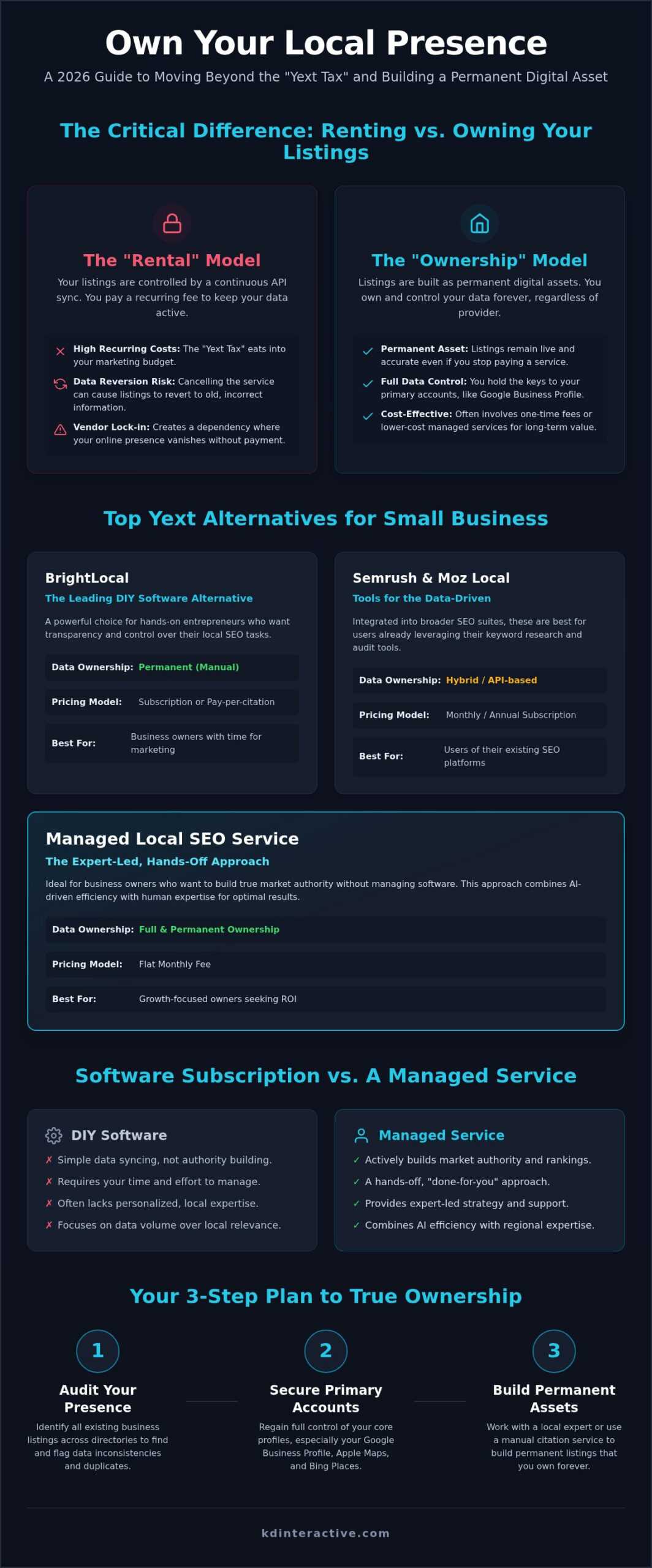
The “Data Rental” Problem: Why Software Isn’t a Full SEO Strategy
Automated software often sells the dream of efficiency, but it rarely delivers the depth required for true local authority. Syncing your name, address, and phone number (NAP) is only about 10% of the local SEO battle. While yext alternatives for small business can help you push data to various directories, they often create “thin” profiles that provide the bare minimum. Google rewards “rich” profiles, which are those filled with high-quality photos, detailed service descriptions, and consistent customer engagement. A thin profile might get you listed, but it won’t get you chosen by a customer.
Effective local digital marketing focuses on building a presence that Google views as a permanent fixture in the community. When you rely solely on API-pushed data, you’re essentially renting a slot on a list. If the API connection breaks, your authority can crumble. In contrast, hand-cleaned and manually built citations signal to search engines that your business is established and verified by humans, not just a script. Google’s algorithms have become sophisticated enough to distinguish between a temporary data feed and a business that has deep, verified roots across the web.
Beyond the Sync: Why Content and Reviews Matter More
Ranking in the Map Pack requires more than just an accurate address. Your strategy must include reputation management google reviews to build social proof and outrank competitors who might have more automated citations but fewer happy customers. Software can’t ask a satisfied Milwaukee client for a specific testimonial, nor can it respond with the empathy and local knowledge of a human expert. Reviews are a primary ranking factor that no automated sync tool can manage effectively on its own.
Automated tools also fail when it comes to localized content. They can’t write blog posts about a local event in Madison or explain how your services solve specific problems for Wisconsin homeowners. There’s a vital synergy between on-page SEO and listing accuracy; your website and your listings must tell the same story. Without unique, local content that converts, your business remains a generic entry in a database rather than a local leader. You need a strategy that connects your digital listings to the real-world value you provide.
Building Permanent Local Authority
The “clean once, own forever” philosophy is the most pragmatic approach for a growing business. It involves identifying and fixing duplicate listings that automated software often overlooks. Duplicates confuse search engines and dilute your ranking power. By manually verifying each major listing, you ensure that your digital assets are permanent. Google places higher trust in manually verified, consistent data than in temporary API feeds that can be switched off at any time. This manual verification process eliminates the “listing lock-in” effect and ensures your visibility doesn’t vanish if you change providers. This is why the best yext alternatives for small business focus on asset ownership rather than temporary data rental.
Why a Managed Local SEO Service Beats a Monthly Software Subscription
Many busy entrepreneurs search for yext alternatives for small business because they realize that owning a tool isn’t the same as achieving a result. Software requires your time, your expertise, and your constant attention to complex dashboards. For business owners in Milwaukee or Madison, the “Do-It-For-Me” (DIFM) model offers a significant advantage. Instead of wrestling with API errors or data sync issues, you can focus on running your operations while experts handle your digital visibility. It’s a matter of efficiency; your time is better spent serving customers than auditing directory listings.
KD Interactive bridges the gap between manual labor and cold automation by using a Google Map Pack with AI Assistant. This approach provides the speed of modern technology with the nuance of human oversight. When you look at the cost-benefit ratio, the choice becomes clear. Standard software fees plus the value of your own time often exceed the cost of a managed professional service that delivers measurable growth. You aren’t just buying a subscription; you’re investing in a collaborator whose success is linked to your own progress.
The Role of AI in 2026 Local SEO
AI technology has moved beyond simple automation. In 2026, our AI assistants identify ranking gaps in the Map Pack much faster than human-only teams ever could. These tools analyze thousands of data points to see why a competitor might be outranking you for specific neighborhood searches. We also use AI to help craft personalized response strategies for local reviews. This ensures your customers feel heard without you spending hours typing replies. It’s a methodical, data-driven way to maintain a high-energy presence online.
The difference lies in the “black box” problem. Many software platforms use hidden algorithms that you can’t control or even understand. Our agency-led approach uses AI as a precision tool guided by SEO specialists. It’s a safer, more transparent way to leverage technology because there’s always a professional ensuring the AI aligns with your brand voice and goals. We use these tools to track performance and deliver measurable outcomes that software alone can’t guarantee.
Regional Expertise: The Wisconsin Advantage
A business in Watertown or Waukesha requires a different strategy than a brand in New York City. National software platforms treat every zip code the same. They don’t understand that leveraging local landmarks or community signals can drastically improve your rankings in a specific suburb. A local seo agency understands the regional market and the way Wisconsin customers search for services. We know the territory because we live here too.
Trust is built through shared community roots. When you work with a partner who knows your neighborhood, you get bespoke strategies that national software simply can’t replicate. We focus on the geographic identifiers that matter to your specific audience. Stop managing software and start growing your revenue by choosing a partner that understands the local landscape. Schedule a strategy session today to see how a managed Map Pack approach can transform your business visibility.
Switching from Yext to a Local Expert: Your 2026 Growth Plan
Transitioning away from an automated platform requires a structured approach to protect your search rankings. Many yext alternatives for small business offer cleaner, more sustainable paths to growth, but you must move carefully. A successful switch involves reclaiming your digital assets and ensuring that your business data remains accurate across the web without a software “lock.” This five-step plan provides a roadmap for Milwaukee and Madison entrepreneurs who are ready to own their online presence.
- Step 1: Audit your current automated presence and export every piece of location data before your subscription ends.
- Step 2: Secure your primary accounts on Google, Bing, and Apple Maps to ensure you have full administrative control.
- Step 3: Choose your path by deciding between DIY tools or a digital marketing agency for small business that offers managed services.
- Step 4: Execute a manual citation cleanup to fix inconsistencies and remove the duplicate listings that software often misses.
- Step 5: Monitor your performance using AI-driven insights to stay ahead of competitors in the Google Map Pack.
Audit and Export: Securing Your Assets
Before you cut ties with any automated service, you must download your full location data. This includes your optimized descriptions, categories, and photo metadata. It’s also the time to verify that you have total ownership of your google business page. If a third-party tool has primary ownership, you could be locked out of your own profile after cancellation. Identify your “power listings,” which are high-traffic directories like Yelp or industry-specific sites that require immediate manual verification. These are the pillars of your local authority.
The 90-Day Transition Strategy
Expect some minor ranking fluctuations during the first 30 to 60 days of your switch. This is normal as search engines re-crawl your manually verified data. You can fill the “automation gap” by focusing on high-quality local content and press releases that signal fresh activity to Google. A managed transition allows you to set up a transparent reporting dashboard. This ensures you can track your ROI based on actual leads and revenue rather than just data sync success rates. By day 90, your permanent citations will provide a more stable foundation for growth than any monthly software lease ever could.
Take Control of Your Local Presence Today
Transitioning to a sustainable local strategy is about moving from a rental model to one of total asset ownership. You’ve seen how yext alternatives for small business can lower your monthly overhead while building permanent authority in the Google Map Pack. By choosing manual citation cleanup and expert-led optimization, you ensure your business data remains your own forever. This pragmatic approach eliminates the fear of data reversion and puts you back in the driver’s seat of your digital footprint. It’s time to stop paying for temporary visibility and start investing in long-term market leadership.
As Wisconsin-based local SEO specialists, we focus on driving actual revenue rather than just syncing rows of data. Our AI-assisted Map Pack optimization is designed to help Milwaukee and Madison entrepreneurs dominate their neighborhoods with methodical, data-driven strategies. We understand the challenges of managing a small enterprise and position ourselves as a reliable collaborator in your growth. Ready to stop paying the “Yext tax” and start owning your results? Get a Free Local SEO Audit & Yext Replacement Plan from KD Interactive. We’re ready to help you build a visible, professional, and profitable future that belongs entirely to you.
Frequently Asked Questions
Is Yext worth it for a small business with only one location?
Generally, the high recurring cost isn’t justifiable for a single-location business. Yext is built for enterprise scale, meaning a small entrepreneur pays a premium for automation they don’t truly need. You can achieve better, more permanent results by focusing on manual management of your primary profiles or using more affordable yext alternatives for small business. It’s better to invest that budget into high-quality local content that actually drives revenue.
Will I lose my Google rankings if I cancel my Yext subscription?
You won’t lose your rankings immediately, but you risk data reversion. Because Yext “rents” your data to directories via an API, cancelling the service can cause your listings to revert to old, incorrect information. This inconsistency confuses search engines and can eventually hurt your Map Pack position. Reclaiming your listings manually before you cancel is the most pragmatic way to protect your hard-earned search visibility.
What is the best free alternative to Yext for local listings?
The most effective free strategy is manual management of the “Big Three”: Google Business Profile, Bing Places, and Apple Maps. These platforms drive the vast majority of local search traffic. While this approach requires more time than using automated software, it ensures you have 100% ownership of your data. You won’t have to worry about monthly fees or your information disappearing if a subscription ends.
How does BrightLocal differ from Yext in terms of pricing?
BrightLocal offers a much more transparent and flexible pricing model. Unlike Yext, which requires expensive annual contracts, BrightLocal provides “pay-per-citation” options for manual listing building. This allows you to pay a one-time fee for permanent listings rather than a recurring “rental” fee. It’s a results-oriented choice for Milwaukee business owners who want to build digital assets they actually own without high monthly overhead.
Can I manage my local SEO manually without any software?
Yes, you can manage your local SEO manually. This involves claiming your business on major directories and consistently updating your profiles with fresh photos, posts, and review responses. While this is a time-consuming task for a busy entrepreneur, it’s a methodical way to ensure your data is accurate and permanent. Many local experts recommend this approach to avoid the “listing lock-in” effect common with automated tools.
What happens to my data if I switch to a managed SEO service?
Your data becomes a permanent business asset. A managed service provider manually cleans your existing citations and builds new ones that you own forever. Unlike a software subscription that acts as a temporary data feed, a professional agency ensures your information is “hard-coded” into directories. This provides a reassuring level of security, as your listings will remain accurate even if you stop the service later.
Is Semrush Local a good alternative for Wisconsin-based businesses?
Semrush is a powerful tool for data-driven marketing, but it lacks hyper-local regional expertise. It uses automated syncing similar to other yext alternatives for small business. For a business in Madison or Waukesha, Semrush won’t understand the specific community signals or local landmarks that help you stand out. A local partner provides a bespoke strategy that generic software dashboards simply cannot replicate.
How long does it take to see results after switching from Yext?
Most businesses experience ranking stabilization within 30 to 60 days of making the switch. This period allows search engines to re-crawl and verify your new, manually cleaned data. By day 90, the combination of accurate citations and optimized local content typically leads to a stronger presence in the Google Map Pack. We focus on building a foundation that delivers measurable outcomes and long-term growth.