
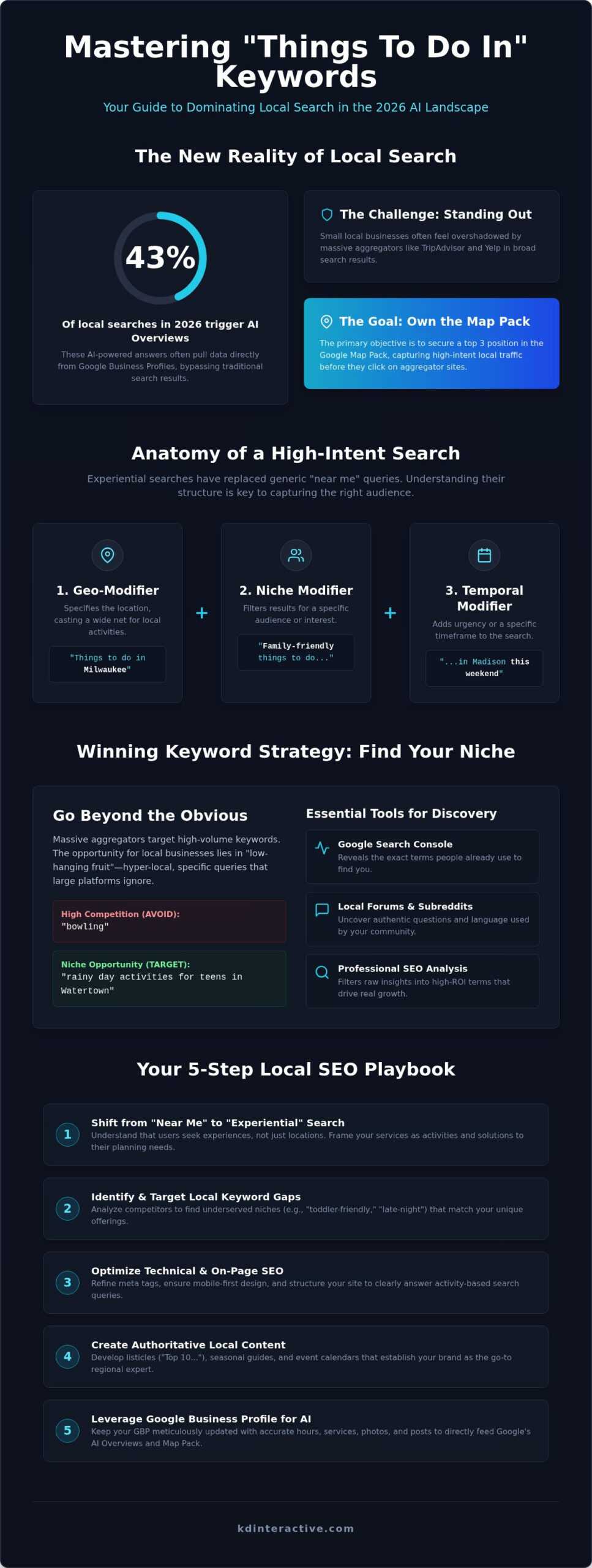
Did you know that 43% of local searches in 2026 now trigger AI Overviews, often pulling data directly from Google Business Profiles to answer user queries before they even click a link? For small business owners in Milwaukee, Madison, or Watertown, it feels like a constant uphill battle against massive aggregators like TripAdvisor and Yelp. You’re likely tired of seeing these giants dominate the search results while you’re left wondering which search terms actually lead to bookings. Mastering the art of optimizing for “things to do in” keywords is no longer just about getting clicks; it’s about securing your spot in the top 3 of the Google Map Pack.
We understand the frustration of losing high-intent traffic to national platforms that don’t know the Wisconsin market like you do. This playbook promises to hand you the strategy needed to capture that local intent and turn digital searches into physical foot traffic. You’ll learn how to navigate the 2026 AI search landscape, refine your Google Business Profile for activity-based searches, and create content that converts. We’re going to move past the window shoppers and focus on the data-driven tactics that result in measurable growth for your enterprise.
Key Takeaways
- Understand why experiential search is replacing “near me” queries and how to capture high-intent traffic for your local business.
- Learn the process of optimizing for “things to do in” keywords by identifying local gaps and low-competition search terms in Milwaukee and Madison.
- Discover the technical and on-page adjustments, from meta-tag refinement to mobile-first indexing, that improve your click-through rates.
- Master the creation of listicles and seasonal guides that establish your brand as a regional authority and drive year-round engagement.
- Future-proof your digital presence by leveraging the Google Map Pack with AI Assistant to dominate the evolving 2026 AI search landscape.
What Are “Things to Do In” Keywords and Why Do They Matter?
“Things to do in” keywords, or TTDI queries, are the digital signals local travelers and residents use when they’re looking for experiences rather than just products. In 2026, the search landscape has shifted away from generic “near me” searches toward more specific, experiential discovery. Intent drives the click. For a business in Milwaukee or Madison, optimizing for “things to do in” keywords is the most direct path to reaching these high-intent users. Mastering Local search engine optimization (local SEO) is the only way to ensure your storefront appears when these questions are asked.
We know that smaller Wisconsin enterprises often feel invisible next to national travel blogs. These queries are a gold mine for local hospitality and service providers because they level the playing field. While a “restaurant” search is broad, a “things to do in Watertown this weekend” search implies a specific timeframe and a desire for an activity. By optimizing for “things to do in” keywords, you position your business as a solution to the user’s planning needs. It’s the practical way to turn a digital search into a physical visit.
The Anatomy of a “Things to Do” Search Query
Understanding these queries requires looking at three distinct layers. First, there’s the primary geo-modifier, such as “Things to do in Milwaukee,” which casts a wide net. Next, niche modifiers like “Family-friendly things to do in Madison” filter for specific audiences. Finally, temporal modifiers like “Things to do in Wisconsin today” add urgency. Context is everything. Your strategy must account for all three to capture different segments of the local market.
How Google Categorizes Local Activities in 2026
Strategic Keyword Research: Finding Your Local Niche
High-volume terms like “best things to do in Milwaukee” are often dominated by massive aggregators like Yelp or TripAdvisor. While these giants focus on broad appeal, they frequently miss the hyper-local nuances that drive actual bookings. Optimizing for “things to do in” keywords at a more granular level allows you to win where the competition isn’t looking. We focus on finding the “low-hanging fruit” keywords that big platforms ignore. For a business in Madison or Watertown, this means targeting specific niches like “dog-friendly indoor activities” or “quiet Friday night spots” that speak directly to a user’s immediate needs.
Competitive gap analysis is your most effective tool for standing out. Look at what your rivals in the Milwaukee area are neglecting. Are they failing to update their content for the 2026 seasonal shifts? Are they ignoring specific demographics like “toddler-friendly” or “late-night”? Mapping your business offerings to these specific gaps ensures you aren’t just attracting window shoppers. If you run a bowling alley, don’t just target “bowling.” Target “rainy day activities for teens in Watertown.” This methodical approach connects your services to the problems your local customers are trying to solve right now.
Tools for Local Keyword Discovery
Start your research with Google Search Console. It reveals the exact terms people use to find your site, even if you aren’t intentionally targeting them yet. You might find you’re getting impressions for “unique date ideas,” which is a signal to create dedicated content. Local subreddits and community forums are also essential. People in Wisconsin communities often ask specific questions that standard tools miss. For a more structured approach, professional SEO keyword analysis helps filter these raw insights into high-ROI terms that actually impact your bottom line.
Analyzing Search Intent for Activity Keywords
Not every search represents the same stage of the customer journey. A query for “best things to do in Madison” usually indicates someone in the planning phase who wants to see a list of options. Conversely, “things to do in Madison tonight” signals an immediate, transactional intent. Local activity search intent is the psychological bridge between a user’s boredom and their immediate physical arrival at your business. You must tailor your strategy to meet both the researcher and the impulsive visitor. If you’re struggling to convert searchers into foot traffic, our web and SEO services can help align your content with these high-conversion intent signals.
On-Page and Technical Optimization for Activity Keywords
Finding the right search terms is only half the battle. Your website must be technically capable of supporting those terms to secure a high ranking. Optimizing for “things to do in” keywords requires a structural approach that prioritizes user experience and search engine clarity. We start by ensuring your site is built for mobile-first local indexing. Since most activity-based searches happen on the go, our web and seo services focus on speed and responsive design to prevent users from bouncing to a competitor.
Your meta titles and descriptions are your first opportunity to win a click. Instead of a generic title, use a results-oriented structure like “Top 10 Things to Do in Milwaukee This Weekend.” This increases your click-through rate by promising immediate value. Within the body copy, integrate geo-specific keywords naturally into your headers. If you’re a local service provider in Watertown, your H2s should mirror the questions people ask, such as “Best Indoor Activities for Families in Watertown.” Don’t forget to build internal links between your activity guides and your core service pages to guide visitors toward a booking.
Structured Data and Schema for Local Attractions
Technical SEO acts as the foundation for how AI search engines interpret your site in 2026. Implementing “Event” and “Attraction” schema allows you to win rich snippets, showing dates and prices directly in the search results. Use “LocalBusiness” markup to verify your physical location and operating hours. This structured data is exactly what Google’s AI uses to generate summaries for local recommendations. If your code is messy, you’ll be left out of the conversation.
Optimizing for the Google Map Pack
Your website and your Google Business Profile must work in tandem. Align your website content with the categories you’ve selected on your profile. If you’re listed as a “Tourist Attraction,” your site should have a dedicated page explaining why you fit that description. Local citations and mentions of your business in “things to do” lists across the web reinforce your authority. For those just starting, follow our guide on how to setup a Google Business page to ensure your baseline optimization is solid before moving to advanced tactics.
Creating Content That Dominates the “Things to Do” SERP
Generic aggregators like Yelp rely on scraped data and automated lists. You can beat these national giants by using original photography and specific “insider” tips that only a local expert would know. Mentioning a specific parking trick for a Madison event or the best time of day to avoid crowds at a Milwaukee attraction builds immediate trust. Every piece of content must lead to a tangible result. Use clear, pragmatic calls to action that tell the reader exactly what to do next. **Optimizing for “things to do in” keywords** isn’t just about the visit; it’s about converting that interest into a booking or a visit to your storefront.
Leveraging Social Proof and Reviews
Integrating customer testimonials directly into your activity pages reinforces your credibility and provides social proof. When your customers leave reviews mentioning specific activities, Google associates your business with those keywords, which boosts your overall visibility. This creates a powerful synergy between your content strategy and your reputation management efforts. If you’re ready to dominate the Wisconsin search results, our local SEO services provide the data-driven strategy you need to win.
Future-Proofing with KD Interactive: Local SEO and AI
The local search landscape in 2026 is defined by speed and artificial intelligence. Optimizing for “things to do in” keywords now requires more than just static content. Google’s AI Overviews now trigger for 43% of local searches, and the rise of conversational assistants means your data must be structured perfectly to be retrieved. Our “Google Map Pack with AI Assistant” service is designed to handle this complexity for you. It ensures your business isn’t just listed; it’s recommended as the top choice for local activities when users ask their devices for recommendations.
While national competitors use automated tools, we believe a digital marketing agency for small business must provide a bespoke approach. Consistent, data-driven optimization is the only way to stay ahead of algorithm shifts like the March 2026 Core Update. We transform your digital visibility into measurable revenue by focusing on the specific queries that drive foot traffic in Milwaukee and Madison. We don’t just track rankings. We track how many people actually walk through your doors.
The KD Interactive Difference: Wisconsin Experts
Our team has deep roots in Watertown and the surrounding regions. This hyper-local signaling is a core part of how we build authority for our clients. We know the Wisconsin landscape better than any national firm because we live here. We use this regional knowledge to build trust with both search engines and your potential customers. Our commitment to pragmatic, results-oriented partnerships ensures that you aren’t just getting a service provider; you’re getting a collaborator dedicated to your professional achievement. Optimizing for “things to do in” keywords in a competitive market like ours requires this level of localized expertise to beat out generic travel blogs.
Next Steps: Your Local SEO Assessment
The 2026 season moves fast. You need to know exactly where you stand before your competitors capture the “low-hanging fruit” keywords we discussed earlier. Getting a professional audit of your current “Things to Do” rankings provides the clarity needed to make informed decisions for your business expansion. We’ll help you set realistic goals and identify the exact technical fixes required to dominate the Google Map Pack. Our assessment looks at your reviews, your technical schema, and your content gaps to create a roadmap for growth. Contact KD Interactive for a tailored local SEO strategy today. It’s time to stop losing traffic to aggregators and start winning with a strategy built for the future of search.
Take Control of Your Local Search Presence in 2026
Dominating the Wisconsin market requires more than just showing up; it requires a methodical approach to optimizing for “things to do in” keywords. You’ve learned that winning in 2026 means aligning your technical schema with high-intent content like listicles and seasonal guides. By focusing on the gaps left by national aggregators, you can reclaim your spot in the top 3 of the Google Map Pack and capture customers who are ready to visit your storefront right now.
We understand the pressure of keeping up with AI search updates while managing daily operations. KD Interactive has focused on Wisconsin markets like Milwaukee, Madison, and Watertown since our inception, delivering pragmatic results for small enterprises. Our specialized Google Map Pack with AI Assistant ensures your business stays visible as search technology evolves. Ready to dominate your local market? Get your KD Interactive SEO assessment today. We’re here to help you turn digital visibility into tangible revenue. Your business is a vital part of our community, and we’re ready to help you grow.
Frequently Asked Questions
How long does it take to rank for “things to do” keywords in a city like Milwaukee?
Ranking for these terms in a competitive market like Milwaukee typically takes three to six months to see significant movement. Your timeline depends on your current domain authority and the specific niche you’re targeting. While broad terms take longer, focusing on long-tail keywords can show results in as little as eight weeks. We focus on consistent content updates and technical fixes to accelerate this process for our Wisconsin partners.
Do I need a separate page for every activity I want to rank for?
You don’t need a unique page for every minor activity, but high-value services deserve their own space. A pillar page or a comprehensive listicle is often the best way to start optimizing for “things to do in” keywords. This allows you to capture broad interest while using internal links to guide users to specific booking pages. We recommend grouping related activities to build topical authority without cluttering your site.
Will AI search engines like ChatGPT or Google Gemini replace local SEO?
AI search engines won’t replace local SEO; they’ve actually made it more critical for your digital visibility. Tools like ChatGPT and Google Gemini rely on structured data and Google Business Profile information to provide recommendations. If your site isn’t optimized for these AI-ready signals, you’ll simply be left out of the conversation. Our Google Map Pack with AI Assistant service specifically addresses this shift by ensuring your data is easily retrievable by modern bots.
How much does it cost to hire a local SEO expert for a small business?
Costs vary based on the scope of your project and the competitiveness of your specific Wisconsin market. Rather than looking for the lowest price, focus on the potential return on investment for your business. A professional partner should provide a transparent breakdown of services like keyword analysis and content creation. We prioritize strategies that drive measurable revenue growth for small businesses in Milwaukee and Madison rather than just vanity rankings.
Can a small business really outrank TripAdvisor or Yelp for local searches?
Small businesses can absolutely outrank national aggregators by leveraging hyper-local expertise. While Yelp and TripAdvisor cover broad categories, they can’t match the granular, insider knowledge you provide about your specific community. By optimizing for “things to do in” keywords with original photography and local tips, you signal to Google that you’re the most relevant choice. We’ve seen local Watertown businesses beat national giants by focusing on these niche gaps.
What is the most important factor for ranking in the Google Map Pack in 2026?
Your Google Business Profile remains the most influential factor, accounting for roughly 32% of ranking influence in the local pack. In 2026, Google prioritizes profiles with high engagement, fresh reviews, and accurate service descriptions. Completing your profile with localized keywords and responding to every customer review is essential. We help our clients manage these signals to ensure they stay in the top three results for activity-based searches.
How often should I update my “Things to Do” content?
You should update your activity-based content at least once per quarter to reflect seasonal changes. In the Wisconsin market, what’s relevant in July is completely different from what searchers want in January. Monthly updates are even better if you’re tracking local events or temporary promotions. Keeping your content fresh tells search engines that your site is an active, reliable resource, which helps maintain your rankings year-round.
Do I need a Google Business Profile to rank for these keywords?
A Google Business Profile is mandatory if you want to appear in the Local Map Pack. While you can technically rank in standard organic results without one, you’ll miss out on 42% of clicks that go to the top map results. It’s the most effective way to verify your location and services for both human users and AI assistants. We consider a fully optimized profile the baseline for any successful local strategy.