
Google visibility for Wisconsin senior living communities starts with a complete, accurate Business Profile, a clear reason families should choose your community, and useful local pages on your website. Effective assisted living marketing in Wisconsin brings these elements together so families can find relevant information and take the next step. The goal is qualified inquiries and tours, not simply more website visits.
Families often compare several communities while weighing care needs, location, pricing information, and trust. Your online presence should make that decision easier by answering practical questions clearly and showing what distinguishes your community.
This article explains how to strengthen local visibility through Google Business Profile optimization, Wisconsin-specific positioning, and content that reflects your care offerings. It also covers how to assess whether local SEO is reaching families most likely to inquire or schedule a tour.
Key Takeaways
- Make community information useful to both older adults and the family members helping them compare care options.
- Differentiate your community with a clear, evidence-based value proposition instead of relying on a generic list of amenities.
- Keep your Google Business Profile accurate and inviting with current details, relevant photos, and thoughtful review responses.
- Build local pages around the care options and questions families are actively searching for, then measure qualified inquiries and tours.
- Marketing costs depend on the scope of work, including keyword analysis, content needs, and the level of ongoing local SEO support.
Who Are the Primary Decision-Makers in Wisconsin’s Senior Living Market?
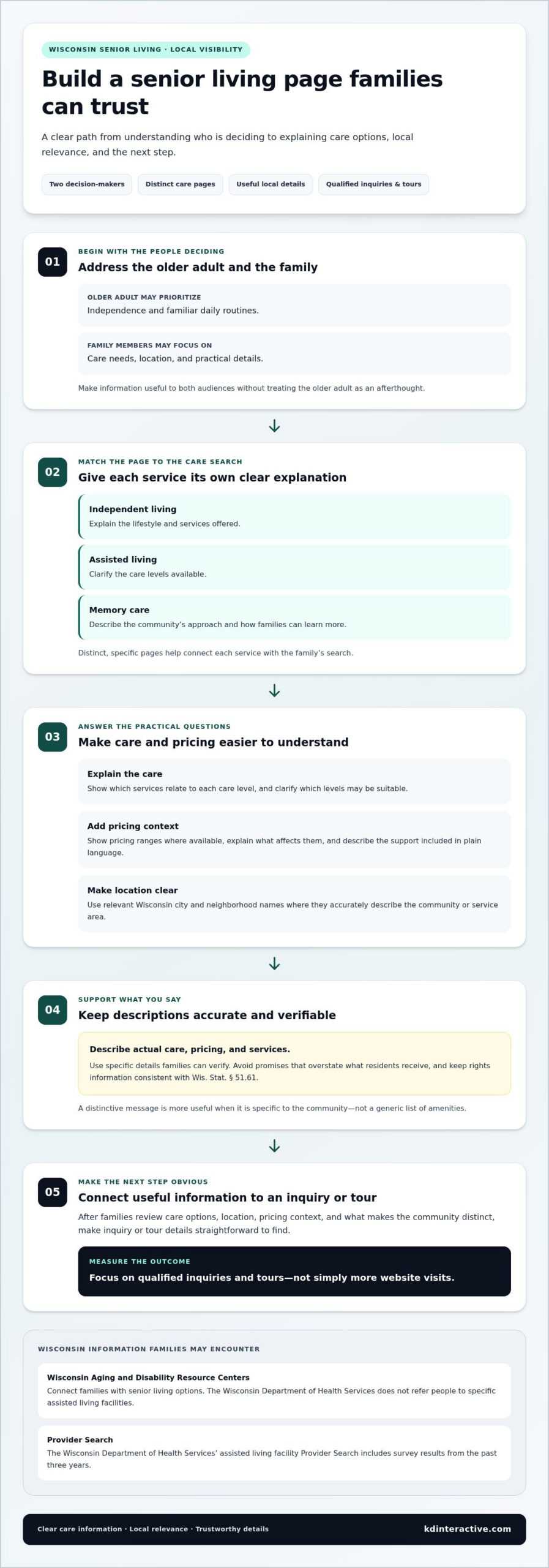
Senior living decisions often involve both the person considering a move and the family members helping compare options. A resident may prioritize independence and daily routines, while an adult child may focus on care needs, location, and practical details. Your marketing should address both audiences without treating the older adult as an afterthought.
Wisconsin communities also serve different search needs. An independent living page can explain the lifestyle and services offered, while an assisted living page should clarify available care levels. A memory care page can describe the community’s approach and show families how to learn more. Distinct, specific pages help match each service to the family’s search.
Care needs shape the questions families ask. Someone comparing memory care may want information about daily support, while a family considering assisted living may need to understand which care levels are suitable. Wisconsin’s Aging and Disability Resource Centers connect families with senior living options, and the Wisconsin Department of Health Services does not refer people to specific assisted living facilities. Your website should therefore explain your community’s options clearly.
Transparent pricing and care-level information can help families decide whether to inquire. Show pricing ranges where available, explain what affects them, and identify which services relate to each care level. For example, pair a stated range with a plain-language description of the support included. This gives residents and families useful context before they call or request a tour.
Wisconsin long-term care providers also operate within a public information environment. The Wisconsin Department of Health Services’ assisted living facility Provider Search includes survey results from the past three years. Wisconsin law cited for client rights includes Wis. Stat. § 51.61, according to the Wisconsin Legislature. Marketing should describe services and resident rights carefully, using claims the community can support.
What Wisconsin rules apply to assisted living advertising and claims? Use accurate descriptions of care, pricing, and services, and avoid promises that overstate what residents receive. Keep rights information consistent with Wis. Stat. § 51.61.
How should assisted living facilities compare marketing agencies in Wisconsin? Compare each agency’s local SEO process, content examples, reporting, and approach to measuring qualified inquiries and tours. Ask how the strategy will distinguish searches for assisted living, independent living, and memory care.
What should an assisted living website include to convert Wisconsin families? Provide clear care-level pages, pricing context, location details, and straightforward inquiry or tour options. Answer practical questions early and make the next step easy to find.
Wisconsin’s senior audience will continue to shape demand: the U.S. Census Bureau estimates nearly 87 million Americans will be age 65 or older by 2050. Communities can prepare by mapping each page to a specific decision-maker, care need, and next action.
Brand positioning and differentiation in saturated senior living markets
In a crowded senior living market, a memorable position starts with a specific, supportable reason to choose your community. “Comfortable apartments and caring staff” could describe almost any provider. A stronger message explains who benefits and how. For example, a community might highlight its memory care approach, daily activities, or connection to a Wisconsin neighborhood. Use details families can verify, not claims that sound interchangeable.
Build that position around the different people involved in a decision. A senior may want to maintain routines and independence, while an adult child may need clear care information and an easy way to arrange a visit. Create a concise message for each audience, then use it consistently across service pages, local search listings, and community materials. For instance, a memory care page can explain daily life and direct families to an inquiry option.
Local SEO helps Wisconsin communities appear in relevant searches across the areas they serve. Start with pages that reflect actual locations and care offerings. Use city and neighborhood names naturally in page titles, headings, and descriptions. A community serving Madison, for example, should make its location and care options clear rather than relying on broad phrases such as “senior living in Wisconsin.” Useful local content answers real questions families have.
- Describe a distinctive care approach with specific examples from community life.
- Connect each service page to a clear next step, such as requesting a tour.
- Use Wisconsin city and neighborhood names where they accurately describe service areas.
- Share community news or event details that demonstrate local involvement.
How can Wisconsin communities market to local hospitals, senior centers, and referral partners? Build relationships through useful collaboration, such as sharing educational materials, participating in community events, or speaking at a senior center program. Local partnerships, event sponsorships, and local news mentions can strengthen relevance and authority.
Digital marketing should support the family’s decision journey. A family might first search for memory care, compare community pages, then look for reviews or tour details. Make every step clear: publish practical answers, explain what sets the community apart, and keep inquiry options visible. Social content can feature community-life photos, short videos, or resident stories shared with permission. Each item should provide context, not just promotion.
How can Wisconsin assisted living providers measure marketing ROI and lead conversion? Track qualified inquiries, scheduled tours, completed visits, and the source of each inquiry. Compare these outcomes with occupancy trends to see which channels contribute to meaningful interest, rather than judging performance by website traffic alone.
A focused local SEO plan can connect positioning, location pages, and measurable inquiries. Consider local SEO strategy when your community needs a clearer path from Wisconsin searches to family inquiries. Keep the message consistent, then review which pages and sources lead to tours.
Google Business Profile optimization
For Wisconsin families, a Google Business Profile can be an important first impression. The article reports that 87% of consumers turn to Google when assessing local businesses. An accurate profile helps families understand a community’s location, services, and next steps before visiting its website. Treat the listing as a practical introduction, not a substitute for clear website information.
Claim and maintain a profile for each community. Check that its name, address, phone number, website, and hours match the information on the community website. Review the care offerings and service details as well. If families see outdated hours or a location mismatch, they may hesitate or contact the wrong place.
Current photos can make a profile more useful. Choose images that accurately reflect the community’s spaces and daily environment, and replace pictures that no longer represent residents’ experience. A shared dining area or activity space, for example, can give families a clearer sense of the setting. Keep images respectful and consistent with the community’s mission.
- Confirm the community name, address, phone number, and hours.
- Describe care offerings accurately and use consistent wording across pages.
- Add current photos that show relevant community spaces.
- Review the listing when hours, services, or contact details change.
Reviews are another visible part of a community’s local presence. The article reports that 76% of consumers consistently read online reviews. Invite residents and families to share feedback through an appropriate, respectful process. Respond to reviews calmly, thank reviewers, and address concerns without sharing private resident information. A thoughtful response also shows prospective families how the community communicates.
Keep the community’s mission visible in the profile description. Explain whom the community serves and what care options it provides. Avoid broad promises about outcomes or care. Instead, use specific, supportable language, such as describing available memory care or explaining how families can arrange a conversation.
Review the profile regularly, perhaps as part of a monthly marketing check. Compare its information with the community website, then note changes to hours, photos, or care details. Review each location’s profile separately. This helps prevent a general corporate description from obscuring the local services families need to find.
Connect profile activity to meaningful actions. Track calls, website visits, and direction requests alongside qualified inquiries and scheduled tours. A rise in profile views alone does not show whether the right families are finding the community. Comparing listing activity with inquiry sources gives Wisconsin senior living teams a clearer picture of which details support local discovery.
Assisted living
Assisted living marketing should explain the support a community provides and who it serves. Wisconsin assisted living facilities serve people who need some care but lack 24-hour access to a caregiver. Make that distinction clear on the website, then describe the care options and daily experience in plain language. Families need practical details before deciding whether to inquire.
National resident demographics can inform useful content, not assumptions about individuals. More than 800,000 people in the United States live in assisted living communities. Women make up 70% of residents, and more than half are aged 85 and above. These figures point to varied audiences, including older adults and family decision-makers. Write for both, while respecting each resident’s preferences and independence.
Care-related content should answer questions without turning health statistics into promises. More than 50% of assisted living residents manage high blood pressure, and 40% live with Alzheimer’s disease or other dementias. A community can explain its actual care offerings and describe how families can discuss fit. Avoid implying that every resident has the same needs or that a particular outcome is assured.
Use separate pages for assisted living, memory care, and respite care when those options are offered. Each page should connect a search need with useful details and a clear next step. For example, a memory care page can describe daily routines, explain how families can arrange a conversation, and link to a tour request.
- Explain care levels with specific, accurate descriptions.
- Answer common questions about daily life and contacting the community.
- Use location terms naturally in page titles and service descriptions.
- Review inquiries and tours to see which pages prompt action.
Local resources can help families explore their choices. Wisconsin’s Aging and Disability Resource Centers connect families with senior living options, and their services are free for Wisconsin residents. Your community website can explain its services and help visitors understand how to continue their search. The Wisconsin Department of Health Services does not refer people to specific assisted living facilities, so clear community information matters.
Stories can help families picture daily life in a community. Share resident stories only with permission, using details that reflect real activities, routines, or community connections. Short videos, community-life photos, and live question-and-answer sessions can add context. Every story should respect residents and support the organization’s stated care approach.
Measure whether content prompts useful action. Track qualified inquiries and tours, then note which page or search led each family to contact the community. Compare those results with general traffic. This gives Wisconsin providers a practical way to refine pages, improve the visitor experience, and focus resources on content that helps families make informed decisions.
How much does assisted living marketing cost in Wisconsin?
Assisted living marketing costs in Wisconsin vary according to the work involved. Cost factors include scope, the number of communities, content needs, and ongoing optimization. A single-location provider improving its local presence has different needs from a multi-community organization creating new pages across Wisconsin.
Start by defining the business goal. A community seeking more qualified tour requests may prioritize local search visibility and inquiry tracking. A provider introducing memory care may need dedicated service-page content and clear supporting information. Write down the goals before comparing proposals, since they shape the work involved.
Break the work into practical components. This helps decision-makers understand what a proposed engagement covers instead of comparing totals without context:
- Initial review: Assess the website, local listings, current content, and search visibility.
- Keyword planning: Identify relevant searches for the community’s location and care offerings.
- Content development: Create or improve pages that answer families’ questions and explain services.
- Ongoing work: Maintain accurate listings, update content, and review performance.
- Measurement: Track qualified inquiries and tours alongside search activity.
Ask what each proposal includes. Does the work cover page recommendations, new writing, profile updates, or reporting? Clarify who supplies community details and reviews drafts. A clear scope makes it easier to see how the strategy supports Wisconsin families and the community’s goals.
Paid advertising is a separate budget consideration from organic local SEO. Advertising can reach people in a city or ZIP code, while local SEO builds visibility through useful website pages and accurate business information. If you consider both, keep their costs and results distinct in your planning. This makes it easier to see which activity generates inquiries and tours.
Measure value through outcomes that matter to admissions teams. Track where inquiries originate, whether they meet the community’s criteria, and whether they lead to tours. Website traffic can help assess reach, but it does not show by itself whether families are moving forward. Review results alongside the marketing scope to identify useful adjustments.
Set a review process before approving a budget. Choose which inquiries and tour outcomes to track, agree on reporting frequency, and assign staff to record lead sources. Your Wisconsin community can then compare progress with its goals and adjust priorities as care offerings or local needs change.
Request a quote for assisted living marketing to discuss the scope, priorities, and cost factors for your Wisconsin community.
KD Interactive: Local SEO Services
KD Interactive helps Wisconsin senior living communities strengthen local search visibility through focused SEO work. Turn to the agency when families struggle to find accurate community information, service pages do not address local searches, or inquiry sources are unclear.
SEO Keyword Analysis can identify relevant searches for a community’s location and care offerings. Content Creation can turn those insights into useful pages that explain services and answer families’ questions. Local SEO Services support a coordinated approach to improving visibility in local search results. Together, these services can connect online discovery with meaningful inquiries, rather than focusing on traffic numbers alone.
For a practical next step, contact KD Interactive to discuss your Wisconsin community’s local SEO priorities.
Make Your Next Local Search Move
Choose one improvement your team can act on now, then build a repeatable process around it. A focused assisted living marketing strategy in Wisconsin connects local search visibility with the information families need as they consider their next steps. Keep the plan aligned with your community’s priorities and review it as those needs change.
KD Interactive supports assisted living marketing in Wisconsin through Local SEO Services, Content Creation, and Press Release Distribution. These services can help communities strengthen local visibility, publish useful information, and share meaningful updates with their markets. The best starting point depends on your priorities, such as improving local search presence or creating clearer service content.
Bring your goals and current challenges into a conversation with KD Interactive. Contact KD Interactive to discuss a practical next step for your Wisconsin community. Steady, informed improvements can help your team build a more useful online presence and connect with families searching locally.
Frequently Asked Questions
How Do I Dominate Local SEO for Senior Living?
Build local visibility by matching each search need to a useful, locally relevant page. Direct searches to the right destination, such as a community page for location queries or a memory care page for care-specific searches. Strengthen those pages with clear navigation and links between related services. Then review search impressions, qualified inquiries, and tour requests together to find gaps between discovery and action.
What marketing strategies work best for assisted living communities in Wisconsin?
The strongest approach combines clear positioning with content that addresses families’ real decision points. Plan content around questions such as what a move involves, how a tour works, and what information families should bring. Use community updates to show local participation, such as a partnership with a nearby senior center. Check every piece for accuracy and give readers a relevant next step.
What are the best local SEO strategies for Wisconsin assisted living facilities?
Organize the website so each community and care option has a clear destination. Connect related pages through descriptive navigation, and avoid repeating the same copy across city pages. A page for a Wisconsin community, for example, should include details that genuinely apply to that location. Review page titles, internal links, and contact details together so visitors can move smoothly from discovery to inquiry.
How can Wisconsin assisted living communities generate qualified leads and tours?
Make the inquiry process simple and useful. A tour request form can ask whether visitors are seeking information for themselves or a family member, which care option they are exploring, and how they prefer to be contacted. Route each inquiry to the appropriate team member, record its source, and follow a consistent process. This helps staff distinguish families ready to arrange a tour from those still researching.
Which marketing channels are most effective for reaching families seeking assisted living in Wisconsin?
Use each channel to meet families at the right decision stage. Local search can reach people actively comparing communities, while educational website content can support families learning about care options. Community events and referral relationships can build awareness through local organizations. Geo-targeted social advertising can introduce a community to nearby audiences. Review qualified inquiries by source to decide which channels warrant continued attention.