
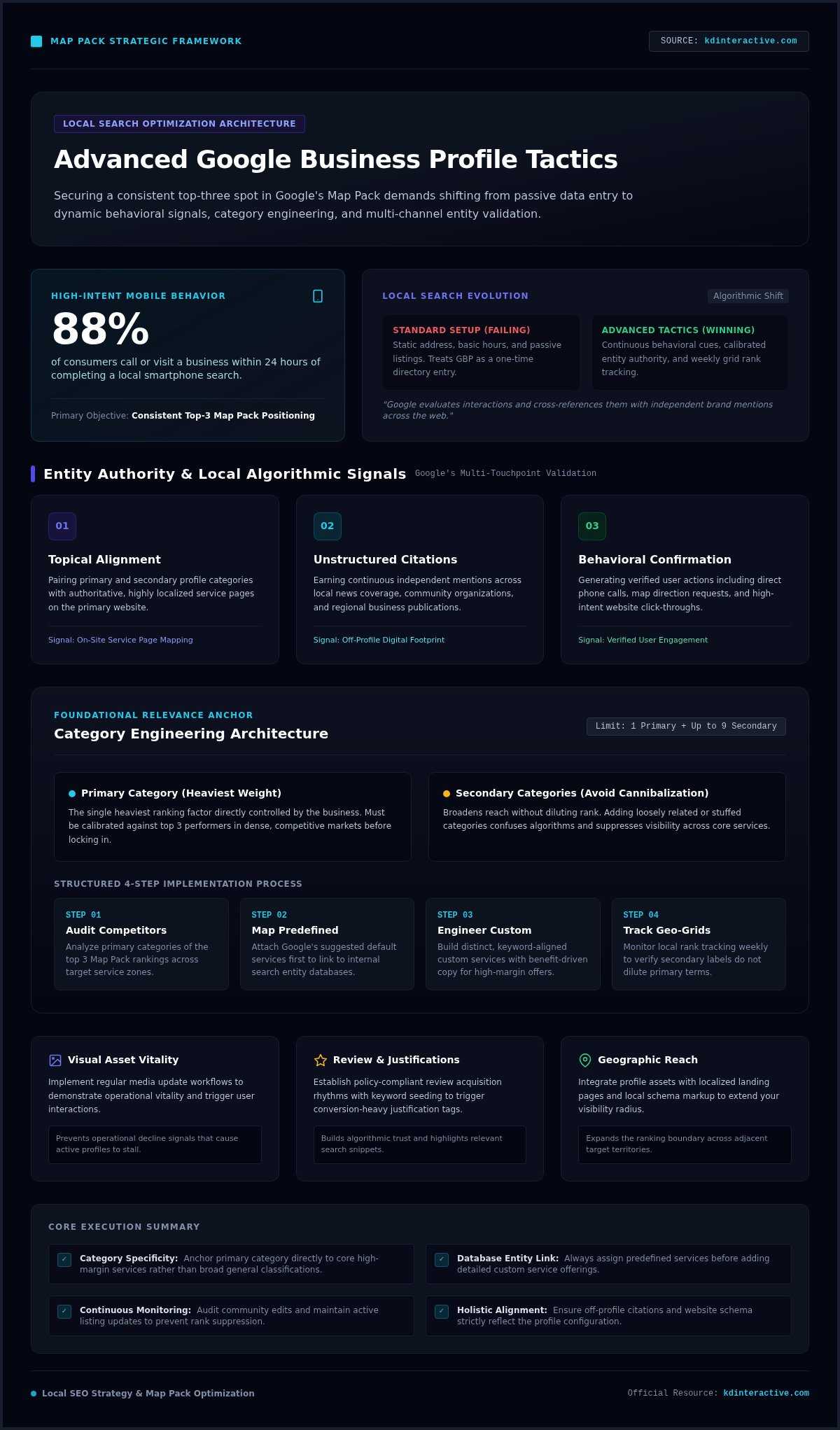
What if the standard optimizations you completed months ago are actually handing your best leads straight to nearby competitors? With 88% of consumers calling or visiting a business within 24 hours of a local smartphone search, relying on a basic listing is an expensive mistake. Securing a consistent top-three spot now demands advanced google business profile tactics that build genuine behavioral signals and entity authority.
It is frustrating to fill out every standard field, maintain your hours, and still watch your profile stall while competitors take high-value inquiries. You shouldn’t have to guess which strategies drive real phone calls or worry about accidental guideline violations.
This guide breaks down the exact strategies you need to push your business into the top three Map Pack positions and capture ready-to-buy local traffic. You’ll discover how category calibration, fresh visual assets, and compliant review workflows work together to turn your profile into a predictable growth engine.
Key Takeaways
- Understand why basic setup falls flat and how advanced google business profile tactics leverage behavioral signals to secure top Map Pack rankings.
- Calibrate primary and secondary category structures to broaden your reach without diluting critical relevance.
- Implement visual asset workflows that demonstrate ongoing business vitality and drive measurable user actions.
- Establish a sustainable, policy-compliant review acquisition rhythm that triggers high-converting justification tags.
- Connect landing page signals and local schema markup to expand your profile’s geographic visibility radius across target territories.
Why Standard Setup Fails: The Evolution of Advanced Google Business Profile Tactics
Completing your business address, phone number, and operating hours used to guarantee a visible spot in local search. That standard setup is now bare-minimum entry criteria. When every competitor in your zip code completes the same basic fields, Google relies on deeper behavioral cues, entity congruence, and engagement patterns to determine who earns the Map Pack.
The core mechanics of local search engine optimization have shifted from static data entry to continuous signal generation. Search algorithms evaluate how users interact with your listing, cross-referencing that behavior with independent brand mentions across the web. Deploying advanced google business profile tactics transforms static listings into dynamic customer acquisition assets that capture high-intent inquiries while passive competitors slip down the rankings.
The Limits of Basic Profile Optimization
A complete profile no longer guarantees visibility. If your profile sits idle, algorithmic updates will favor competitors who actively feed search systems fresh behavioral data. Winning businesses regularly update attributes, monitor community edits, and maintain active listings. Neglecting these areas signals operational decline to search algorithms, costing you valuable visibility across your primary service radius.
Entity Authority and Local Algorithmic Signals
Google doesn’t assess your profile in a vacuum. Instead, search systems build an entity profile by validating your details across local directories, press mentions, and your primary website. Strong entity authority requires cohesive coordination across multiple touchpoints:
- Topical alignment: Pairing your profile categories with authoritative, localized service pages on your website.
- Unstructured citations: Earning mentions in local news, community organizations, and regional business coverage.
- Behavioral confirmation: Driving genuine user interactions, including direction requests, calls, and clicks to your primary site.
When your off-profile digital footprint consistently mirrors your listing information, search engines gain the confidence needed to award top-three rankings.
Category Engineering and Nested Service Architecture
Your primary category is the single heaviest ranking factor directly within your control. While generic guides suggest simply picking a category that loosely fits your business, category engineering treats this selection as your foundational relevance anchor. Mastering this balance is one of the most effective advanced google business profile tactics for expanding your visibility without losing rank for core services.
Follow a structured four-step process to build your architecture:
- Audit top performers: Analyze the primary categories of the top three Map Pack ranking profiles across your service zones.
- Map predefined services: Attach Google’s suggested default services to your primary classification first.
- Engineer custom services: Build distinct, keyword-aligned custom services with detailed descriptions for high-margin offerings.
- Track ranking grids: Monitor local geo-grid rank tracking weekly to verify that secondary additions do not dilute core terms.
Selecting and Testing Primary Versus Secondary Categories
Analyze top competitors in dense, competitive markets like Milwaukee before locking in your primary label. A business categorizing itself as a “General Contractor” often struggles to rank for specialized plumbing or roofing searches. Test variations methodically. You can select one primary category and up to nine secondary categories, but adding unrelated labels confuses search systems and suppresses visibility across all services.
Configuring Predefined and Custom Services
Always select Google-suggested predefined services before creating custom entries. Predefined options link directly to known search entities in Google’s internal database. For services unique to your business, craft custom entries with descriptive, benefit-driven text within the character limit. Connecting these offerings to focused pages on your website builds clear conversion pathways. Partnering with a specialist for dedicated local SEO services ensures your service architecture maps directly to real-world customer search patterns.
Eliminating Common Category Cannibalization Mistakes
Category stuffing damages local visibility. Packing your listing with ten loosely related categories dilutes the topical relevance needed to rank for your main revenue drivers. Check your local ranking grid metrics before and after making any adjustments. If your primary keyword rankings contract after adding secondary categories, strip away the low-performing selections immediately to restore strong thematic relevance.
Advanced Visual Asset Management and Engagement Mechanics
Visual content does far more than make your listing look attractive. Regular image uploads signal ongoing operational vitality to Google’s ranking algorithms. In fact, businesses with photos on their profiles receive 42% more requests for directions and 35% more website clicks compared to those without. Treating your media gallery as an active signal channel is one of the most underutilized advanced google business profile tactics available.
Forget old local SEO myths about geotagging coordinates into image EXIF data. Google strips EXIF metadata upon upload. What matters to search systems today is visual clarity, subject matter relevance via Google Vision AI, and user engagement metrics like image clicks and dwell time.
| Amateur Visual Management | Commercial Asset Framework |
|---|---|
| Dumping 50 stock photos at setup | Uploading 2-3 genuine weekly field photos |
| Relying on low-res exterior shots | Curating crisp team, service, and project media |
| Ignoring customer photo uploads | Monitoring user media and reporting policy violations |
Structuring High-Converting Photo and Video Assets
Upload genuine photos consistently rather than publishing bulk batches once a year. Focus on team members at work, branded fleet vehicles, and clear before-and-after project shots. Incorporate short videos up to 30 seconds with a minimum 720p resolution. Walkthrough clips that answer basic customer questions keep searchers engaged on your profile longer, sending strong behavioral signals directly back to search algorithms.
Analyzing Visual Engagement and Behavioral Signals
Searchers interact heavily with authentic media before making contact. Monitor these behavioral patterns inside your performance reporting. Promptly flag blurry, off-topic, or competitor-uploaded images that degrade your visual appeal. In markets like Madison and Watertown, publishing seasonal images highlighting community involvement builds authentic local relevance that generic listings simply cannot match.
Review Velocity, Keyword Seeding, and Reputation Architecture
Sudden surges in reviews often trigger automated spam filters, causing legitimate customer feedback to vanish overnight. Search algorithms favor a steady, predictable review velocity over sporadic review spikes. Implementing a sustainable feedback pipeline represents one of the foundational advanced google business profile tactics for protecting your listing and securing elite Map Pack placement.
Building an Ethical Review Generation Pipeline
Google strictly prohibits review gating and directed review content, such as telling customers which specific keywords or employee names to write. Instead, use post-service SMS follow-up workflows with open-ended prompts asking what problem your team solved. Clients will naturally describe the job using authentic terms. Consistent acquisition across weeks and months creates algorithmic trust that outlasts competitor review spikes.
Strategic Response Frameworks for Maximum SEO Value
Every owner response provides indexable real estate to reinforce your core services and service territories:
- Contextual confirmation: Mention the specific service rendered and the community served when thanking clients, such as completing a project in Madison or Watertown.
- Professional de-escalation: Respond to critical reviews calmly within 24 hours, outlining steps taken to resolve the issue.
- Operational transparency: Demonstrate reliability to prospective searchers who read responses before making an inquiry.
Justification Snippets and Search Term Matching
Google scans review text to generate Map Pack justification tags, displaying bold snippets like “Their review mentions…” directly below your listing. These justifications validate queries for specific commercial services, immediately elevating your click-through rate over competing listings. Monitoring these snippets reveals which terms search algorithms associate with your brand.
Building a compliant review system while running daily business operations takes dedicated focus. Consider partnering with experts to handle your reputation management and review acceleration so your team can focus on serving new leads. If you want to systematically build review velocity and expand your regional reach, connect with the team at KD Interactive to review your local strategy today.
Integrating Profile Assets with Hyper-Local Website Signals
Treating your profile as a separate asset from your website limits your growth. In reality, your linked landing page directly dictates the geographic reach and authority of your listing. Aligning technical on-page signals with your profile configuration is one of the most effective advanced google business profile tactics for expanding your ranking perimeter into surrounding zip codes.
Search engines evaluate the relationship between your website and your map listing to confirm that your business actually operates where you claim. When your site validates your listing data through clear architecture and localized context, search systems confidently display your business to nearby searchers.
Optimizing the Primary Landing Page URL
Single-location businesses should usually link directly to their homepage to harness maximum domain authority. Multi-location brands should link each profile to a dedicated local landing page. Ensure your page title tag, primary heading, and introductory text align precisely with your primary category. Prominently display your name, address, and phone number in the page footer, matching your profile details character for character.
Technical Schema Markup and Geo-Signals
Structured data provides search crawlers with undeniable verification of your operations. Add comprehensive LocalBusiness schema markup to your landing page to establish clear machine-readable facts:
- Coordinate precision: Specify exact latitude and longitude coordinates matching your physical location.
- Entity validation: Use the
sameAsproperty to link verified social profiles, state registrations, and chamber memberships. - Map integration: Embed an official, responsive Google Map showing your confirmed physical location.
Scaling Visibility with the Google Map Pack with AI Assistant
Securing a top-three placement creates consistent search traffic, but capturing the lead requires immediate action. Local searchers want fast answers, and unanswered inquiries quickly bounce to the next listing. Pairing hands-on optimization with intelligent automation solves this friction point. Explore how the KD Interactive Google Map Pack with AI Assistant captures and engages high-intent prospects instantly, turning expanded search reach across Madison and Milwaukee markets into predictable, long-term business growth.
Dominate Your Local Market with Proven Map Pack Execution
Securing a dominant top-three position in the Map Pack requires moving far beyond basic listing setup. When you systematically calibrate your categories, maintain a steady rhythm of genuine visual assets, and bridge listing signals directly with structured on-page data, search engines reward you with broader geographic reach. Implementing these advanced google business profile tactics ensures your business turns local search visibility into an enduring, competitive moat.
KD Interactive delivers dedicated local SEO services engineered specifically for small enterprises across Wisconsin. By combining proven reputation workflows and targeted content creation with our proprietary Google Map Pack with AI Assistant, we lift the technical burden so you don’t miss high-intent local inquiries. Ready to build predictable market leadership across Watertown, Milwaukee, or Madison? Accelerate your local rankings with KD Interactive’s local SEO services today.
Frequently Asked Questions
What are the most impactful advanced Google Business Profile tactics to implement first?
Start by auditing your primary category against top-ranking local competitors and connecting your listing to a tightly themed landing page. These two elements establish core entity relevance. Next, introduce a consistent workflow for uploading real work photos and gathering authentic client feedback. Implementing these advanced google business profile tactics creates an immediate foundation of relevance and operational activity that search engines prioritize over neglected listings.
Can changing my primary business category cause a sudden drop in rankings?
Yes, changing your primary category can trigger an immediate drop in local rankings. Because the primary category acts as your listing’s heaviest relevance signal, switching it tells Google to re-evaluate your profile for entirely different queries. If you must adjust it, verify competitor choices using ranking grid trackers first. Limit changes during peak operational seasons to avoid disruptions to incoming calls and leads.
How do customer reviews influence my visibility in the Google Map Pack?
Reviews drive visibility by providing steady proof of customer satisfaction and recency. When customers describe their specific experiences, Google extracts relevant terms to produce bold justification snippets beneath your listing. A continuous flow of authentic reviews also protects your profile from algorithmic filters that often penalize sudden, artificial review bursts. Consistent feedback signals an active, reputable business to nearby searchers.
Does geotagging photos before uploading them to Google Business Profile still help rankings?
No, manual EXIF geotagging does not improve local rankings. Google automatically strips image metadata during the upload process. Instead of spending time injecting coordinates into image files, focus on genuine visual content. Upload crisp, real-world images of your team, projects, and storefront. Google Vision AI evaluates the actual objects and text inside the photo, rewarding authentic visual proof over manipulated file data.
Why is my profile ranking well at my office location but invisible five miles away?
Proximity heavily governs local search results, causing rankings to decay as physical distance from your location increases. If your profile drops off just a few miles out, your entity authority is too weak to overcome proximity bias. Expanding your geographic radius requires building hyper-local website signals, earning regional press coverage, and collecting reviews from clients across surrounding towns and service zones.
How does my website landing page affect my Google Business Profile rank?
Your website landing page acts as the factual backbone for your listing. Search crawlers evaluate page titles, localized copy, and LocalBusiness schema markup to confirm your physical location and operational scope. High-authority landing pages extend your listing’s ranking perimeter across adjacent zip codes. Aligning your website content with your primary profile category is one of the proven advanced google business profile tactics that solidifies search dominance.
Can AI tools safely assist with Google Business Profile management and review responses?
Yes, AI tools can streamline review responses and draft service updates safely under Google guidelines. However, you cannot publish AI-generated customer reviews or post automated replies that misrepresent your real-world services. Solutions like the Google Map Pack with AI Assistant help businesses respond to incoming inquiries instantly while preserving natural, human-directed local SEO accuracy across target Wisconsin markets.