
Over 60% of local searches never result in a website click, turning your Google Business Profile into your primary digital storefront. If you are still relying on an outdated checklist of static directory citations, you have likely watched your inbound calls taper off. Building an effective google maps marketing strategy 2026 requires a modern operational playbook, because Google Maps has evolved from a passive directory into an active, conversational reputation engine.
You already know how frustrating it feels to watch local visibility slip while trying to understand Gemini-powered features like “Ask Maps” and stricter profile verification rules. It often seems like the goalposts keep shifting while your marketing budget works harder for fewer high-intent leads.
Fortunately, securing local market leadership does not require guesswork. In this guide, you will discover how emerging AI search trends and Google Map Pack algorithms impact local business visibility in 2026, giving you a clear blueprint to turn map views into booked customer appointments. We will break down the exact profile freshness signals, engagement standards, and conversational search adjustments needed to lock down a consistent top-three ranking.
Key Takeaways
- Transitioning to a winning google maps marketing strategy 2026 requires optimizing your profile for conversational AI prompts rather than relying on outdated, keyword-stuffed directory listings.
- Expand your ranking footprint beyond your immediate physical address by building brand prominence through high-authority press releases and verified local entity signals.
- Replace generic citation blasts with dynamic profile management, complete service menus, and real-time attribute updates to satisfy Google’s strict freshness rules.
- Convert more profile impressions into paying customers by structuring your primary and secondary categories to feed real-time answers into Gemini-powered search queries.
- Streamline your local visibility and protect top-three Map Pack rankings using automated management tools like the Google Map Pack with AI Assistant.
How Google Maps Search Has Evolved: Key 2026 Shifts
Google Maps marketing in 2026 is entity-focused, generative, and intent-driven. The days of simply claiming a listing and waiting for the phone to ring are long gone. The underlying architecture of local search engine optimization has shifted from basic keyword matching to deep contextual comprehension. Google’s algorithm now parses user behavior, semantic brand entities, and unstructured web signals to decide which three businesses earn the coveted Map Pack placement.
Old tactics like stuffing service keywords or city names into your business title now carry severe risks. Google strictly enforces legal naming conventions through rigorous video verifications, penalizing profiles that attempt to manipulate rankings with artificial titles. Instead, Gemini-powered AI summaries extract insights directly from customer reviews, service menus, and website content to populate dynamic preview cards on map interfaces. Your entire online presence now fuels what customers see before they ever tap your phone number.
The Rise of Conversational and Intent-Based Map Queries
Consumers rarely type choppy two-word searches like “plumber Watertown” into mobile devices anymore. Instead, hands-free voice search and navigational prompts look like: “Find a licensed heating specialist near me that handles emergency boiler repairs on Sunday.” Natural language processing evaluates your business description, customer feedback, and service attributes against these nuanced questions.
Semantic local search is the algorithmic process of matching a user’s situational intent with verified entity data rather than exact keyword phrases. Profiles that provide comprehensive, structured context around specific customer problems consistently outrank competitors stuck in basic keyword configurations.
Visual and Multimodal Signals Driving Map Pack Selections
Visual search plays an equally decisive role in ranking algorithms. Through Google Lens integration, the platform analyzes imagery to verify that a business location matches its declared services. Clean storefront photos, geotagged team images, and real-time product pictures validate operational authenticity.
Customer photo uploads send powerful engagement signals to the local algorithm. When clients upload clear photos alongside their feedback, it reinforces profile trust and can lift direction requests by double digits. Aligning visual assets with your broader local digital marketing blueprint ensures your profile stands out visually and contextually across mobile devices. Implementing these visual upgrades is a foundational pillar of any competitive google maps marketing strategy 2026.
Core Google Map Pack Ranking Signals to Prioritize in 2026
Winning top placement requires understanding how Google measures local authority today. Proximity still matters, but exceptional brand prominence can outrank a physically closer competitor. User interactions such as click-to-call actions, navigation requests, and profile dwell time tell Google whether searchers find your business genuinely useful. A refined google maps marketing strategy 2026 balances raw geographic distance with active behavioral proof.
Relevance, Distance, and Prominence: Modern Calibrations
Physical distance used to dictate who showed up in local maps. Today, Google calibrates proximity against real-world prominence. A business on the outskirts of town can reliably rank across regional commercial hubs like Madison or Milwaukee if it demonstrates commanding digital authority. Strategic press release distribution and off-page media mentions cement your entity within Google’s Knowledge Graph. Pairing off-page signals with strong foundational digital marketing for small business establishes the external credibility algorithms reward.
Review Velocity, Sentiment Analysis, and Customer Responses
Sheer volume of five-star reviews is no longer enough. Natural language processing models evaluate sentiment velocity and conversational depth. Google scans customer feedback for specific service terms, reliability cues, and problem-solving language to generate automated profile badges.
- Consistent review pacing signals healthy, ongoing operational activity.
- Detailed feedback mentioning specific project work carries more weight than generic five-star ratings.
- Owner responses that reference completed services reinforce contextual relevance for AI-driven queries.
Website Integration and Local Entity Architecture
Your Google Business Profile does not live in isolation; it depends directly on your website’s underlying entity architecture. Local schema markup, dedicated service territory pages, and structured business records validate your profile details against primary search indexes. If you need to review foundational setup steps, following our guide on how do i setup a google business page ensures your base listing aligns with strict verification rules. For business owners ready to dominate their territory, exploring professional local SEO support with KD Interactive helps eliminate the technical entity errors that quietly suppress local rankings.
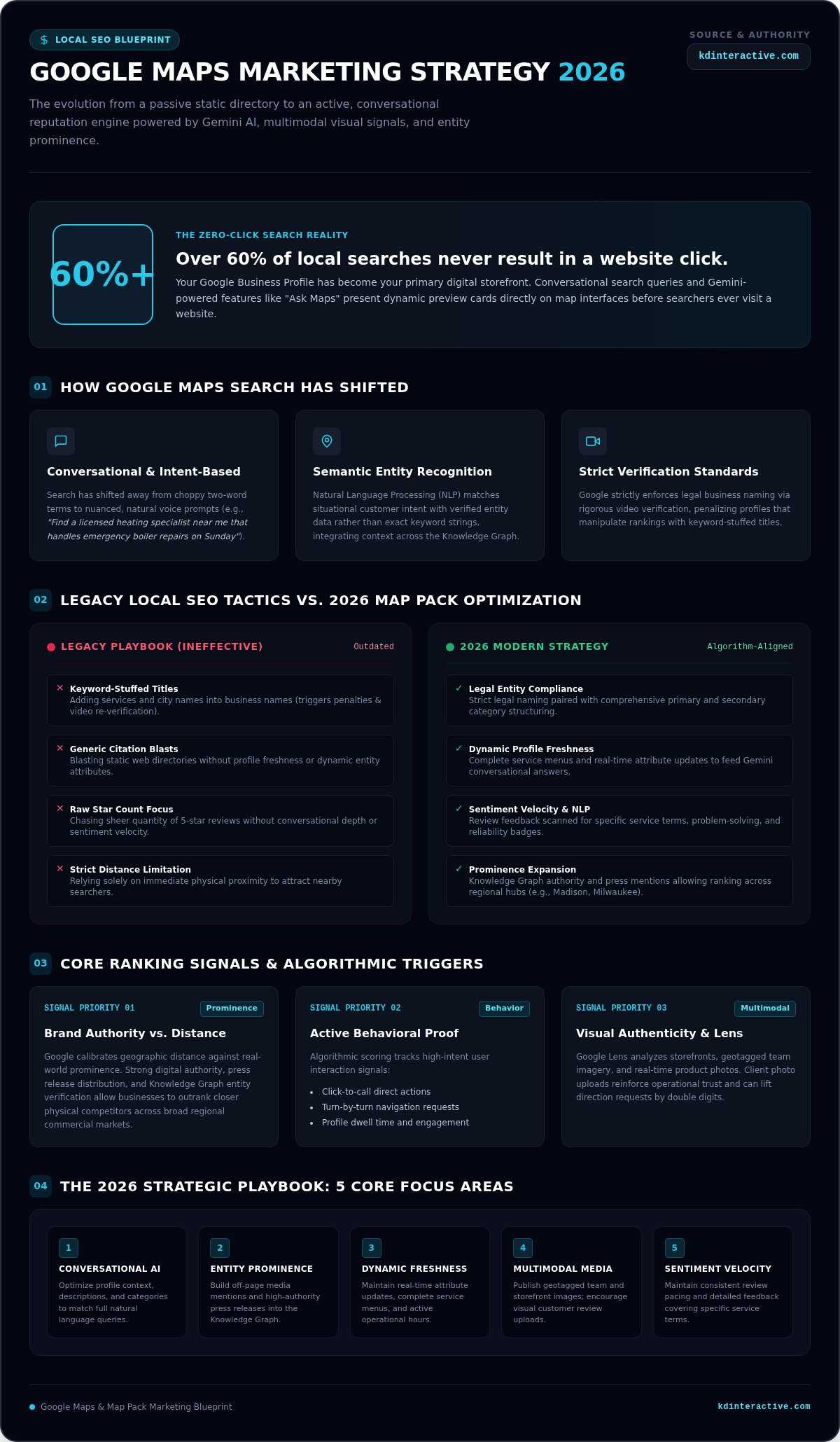
Legacy Local SEO Tactics vs. 2026 Map Pack Optimization
Local search optimization has moved far beyond the static directory submissions that once formed the backbone of regional marketing. Treating your profile like an online phone book guarantees falling behind competitors who manage dynamic digital storefronts. Today, real-time inventory syncs, integrated appointment scheduling, and rich entity validation determine placement. Modernizing your approach requires abandoning obsolete routines in favor of an active, responsive system.
| Legacy Approach | 2026 Map Pack Optimization |
|---|---|
| Mass directory submissions across obscure platforms | High-authority regional press coverage and entity mentions |
| Static business hours and basic text descriptions | Real-time booking integrations and updated service attributes |
| Soliciting generic 5-star ratings without feedback depth | Natural review flow containing specific service keywords |
| Isolated Google Business Profile updates | Integrated local ecosystem across website, content, and profile |
Directory Citations vs. Digital PR and Authority Mentions
Submitting business listings to hundreds of generic, unmoderated web directories yields practically zero ranking benefits today. Google easily identifies low-quality directories and discounts their inbound links. The algorithm seeks authentic regional prominence across verified publications. Regional press release distribution, community event coverage, and hyper-local content creation provide clear entity validation. When credible local publishers discuss your services, search engines connect the dots between your brand and your operating territory.
Static Profile Maintenance vs. Interactive AI-Assisted Engagement
Leaving a listing untouched for months hurts visibility. Profiles inactive for 30 days experience noticeable drops in search impressions because Google equates inactivity with unreliability. Modern searchers expect immediate responses when they reach out via direct messaging or post questions.
Failing to answer incoming questions directly harms conversion rates. The discontinuation of standard Q&A fields in late 2025 gave way to conversational AI systems like “Ask Maps,” which pull live answers from your profile, website, and reviews. Unmonitored or empty profiles leave the AI without accurate data, leading to vague answers or lost inquiries. Implementing continuous automated monitoring through specialized tools like the Google Map Pack with AI Assistant prevents operational gaps and keeps profile attributes continuously aligned with customer search behavior. Shifting from passive listings to proactive management defines a resilient google maps marketing strategy 2026.
The 2026 Google Maps Marketing Playbook: Step-by-Step
Executing an effective google maps marketing strategy 2026 demands a methodical, repeatable process. Skipping profile fields or relying on sporadic updates directly limits your local reach. Follow this structured five-step framework to build profile authority and secure your spot in competitive Map Packs.
- Audit Primary and Secondary Categories: Select the most specific primary category available, then add relevant secondary categories that reflect your true commercial scope without diluting your core offering.
- Configure Complete Menus and Conversational Attributes: Populate descriptive service items, upfront price ranges, accessibility features, and operational amenities.
- Implement an Automated Review Engine: Systematically request detailed reviews after every completed job and post prompt, context-rich responses.
- Publish Weekly Visual Updates: Upload original team photos and short Google updates highlighting seasonal promotions or regional projects.
- Align Website Schema with Profile Records: Ensure your website’s LocalBusiness structured data perfectly mirrors your registered name, address, phone number, and service areas.
Fine-Tuning Categories, Services, and Business Attributes
Your primary category carries the heaviest algorithmic weight. Choose the classification that directly represents your core revenue driver. Secondary categories should only cover distinct, ongoing capabilities. If you run a heating and cooling firm, make HVAC Contractor your primary category, then add Furnace Repair Service and Air Conditioning Repair Service as secondary tags.
Flesh out your service menu completely. Avoid blank item descriptions. Detail the exact problem solved, typical project turnaround, and starting costs. Finally, check every applicable attribute tag, including wheelchair accessibility, veteran ownership, and on-site consultation options, as these filters refine AI-driven voice queries.
Managing Profile Media and Visual Customer Evidence
High-resolution, authentic imagery directly improves conversions. Listings with comprehensive visual assets earn up to 42% more requests for directions and phone calls than text-only profiles. Skip generic stock photos entirely. Upload three to five weekly photos showcasing completed field work, branded fleet vehicles, and your real staff.
Encourage satisfied clients to include snapshots in their reviews. A customer picture showing a completed installation or repaired storefront confirms authenticity and feeds visual confirmation signals to Google Lens.
Connecting On-Page Content with Map Pack Performance
Map rankings rely heavily on the landing page connected to your profile. Build localized landing pages featuring embedded map pins, regional project case studies, and structured service territory coordinates. Integrating these components into a broader plan for local seo services near me bridges website authority with map performance.
Track your calls, website clicks, and direction requests inside profile analytics every month to measure geographic lead expansion. If you want to accelerate your territorial footprint without operational headaches, partner with KD Interactive to build a data-driven local visibility engine that delivers measurable phone calls.
Scaling Your Local Reach with KD Interactive Map Solutions
Managing an aggressive map presence while running day-to-day operations stretches most small business owners thin. KD Interactive serves as a pragmatic, results-oriented regional digital marketing partner, helping local businesses cut through algorithm volatility to capture predictable inbound revenue. Instead of fragmented tactics, we bundle specialized Local SEO Services, targeted SEO Keyword Analysis, Content Creation, and Press Release Distribution into a cohesive growth engine. This connected ecosystem accelerates prominence across competitive regional territories.
Automating Profile Intelligence: Google Map Pack with AI Assistant
Maintaining daily profile activity without endless manual labor requires intelligent systems. Our dedicated Google Map Pack with AI Assistant delivers automated monitoring, conversational search optimization, and geo-targeted visibility tracking. The assistant monitors incoming customer inquiries, tracks sentiment patterns across feedback, and flags unauthorized public edits before they harm your rankings.
- Continuous profile monitoring protects core business details against competitor tampering.
- Automated tracking logs conversational search shifts across your target service areas.
- Hands-off maintenance frees up valuable hours so owners can focus on running operations.
A Tailored Approach for Wisconsin and Regional Small Businesses
Cookie-cutter packages designed by distant national agencies routinely miss local competitive dynamics. Operating directly across Wisconsin commercial centers like Milwaukee, Madison, and Watertown, KD Interactive delivers regional expertise tailored to how Midwestern consumers search, interact, and buy. We treat your local expansion as a collaborative partnership, measuring our own success by the measurable progress of your business.
If you are reviewing potential marketing partners, exploring our framework on choosing the right seo agency will help you identify a team dedicated to measurable revenue growth rather than vanity metrics. Building a resilient google maps marketing strategy 2026 gives your company a durable advantage over slower competitors. Connect with KD Interactive today to assess your profile and secure top Map Pack placement across your commercial territory.
Turn Map Pack Visibility into Predictable Local Revenue
Winning local customers requires shifting from passive listings to an active, responsive digital presence. Static citations no longer protect your rankings against agile competitors. By aligning your business with conversational voice queries, maintaining steady review sentiment, and verifying your entity across authoritative channels, you build a resilient regional presence.
Executing an effective google maps marketing strategy 2026 shouldn’t pull your attention away from day-to-day operations. KD Interactive delivers specialized regional expertise for small enterprises across Milwaukee, Madison, and Watertown. Through our proprietary Google Map Pack with AI Assistant and an integrated suite covering Local SEO Services, Content Creation, and Press Release Distribution, we manage your profile intelligence while you handle new business. Ready to capture local market share? Dominate Your Local Map Pack with KD Interactive and secure high-intent inbound customer calls today.
Frequently Asked Questions
How long does it take to rank in the Google Map Pack in 2026?
Ranking improvements typically appear within 60 to 90 days after completing technical profile verification and structured category alignment. Highly competitive service sectors in metropolitan markets often require four to six months of steady review acquisition, entity validation, and localized content publishing before securing a consistent top-three placement.
What is the difference between Google Maps marketing and standard local SEO?
Google Maps marketing focuses specifically on optimizing your Google Business Profile to capture top placements in the local 3-Pack and map navigation apps. Standard local SEO emphasizes your website’s organic search rankings through localized on-page content, technical website optimization, and external backlink profiles. A comprehensive google maps marketing strategy 2026 integrates both areas to maximize territorial visibility.
Can my business rank on Google Maps without a physical storefront?
Yes, service-area businesses can rank without exposing a public address to customers. You simply set your profile as a service-area business during setup and hide your residential or depot address. You must still complete Google’s strict verification procedures, which often involve video verification showing work vehicles, equipment, and registered business documents.
How do AI Overviews in Google Search affect local map rankings?
AI Overviews pull data directly from complete, verified Google Business Profiles, customer review text, and structured website data to deliver conversational recommendations. Profiles that lack detailed service attributes or remain inactive for over 30 days are frequently bypassed by the AI. An active profile with rich conversational descriptions dramatically improves your chances of being cited in these synthesized answers.
Why do competitor profiles rank higher despite having fewer reviews?
Review volume is only one ranking signal among dozens evaluated by the algorithm. Competitors with fewer total reviews often outperform others because they maintain superior entity prominence, stronger domain authority, or greater geographic proximity to the searcher. Their customer feedback may also contain deeper semantic keyword relevance and higher recent review velocity than older, inactive profiles.
What should I do if my Google Business Profile gets suspended?
Audit your listing against Google’s legal naming and location policies before submitting an appeal. Ensure your displayed business name precisely matches your official registration documents, tax filings, or state licensing. Gather proof of operations, such as utility bills, lease agreements, and vehicle branding, then submit a formal reinstatement request through the official Google Business Profile appeal tool.
How does the Google Map Pack with AI Assistant improve my rankings?
The Google Map Pack with AI Assistant continuously monitors incoming inquiries, tracks customer review sentiment patterns, and detects unauthorized listing edits in real time. By automating profile maintenance and optimizing conversational data points, the assistant prevents the visibility drops that typically hit neglected profiles, helping small businesses maintain competitive rankings across their target territories.