
What if your next local marketing win came from doing less, but choosing more deliberately? When time and budget are tight, it’s easy to spread effort across channels without knowing what’s working. Learning how to build a local marketing plan starts with a clearer question: which local customers and locations matter most to your business goals?
A practical plan doesn’t need to cover every channel or serve every nearby community. It should connect customer needs with the areas you can realistically reach and the work your team can sustain. That focus helps you choose priorities, set meaningful targets, and decide when an activity deserves more attention or a change in direction.
This guide walks through a manageable process for identifying your audience and service area, selecting channels that fit your resources, and tracking results with simple metrics. You’ll also see how local SEO can support a broader strategy without replacing customer research or clear business goals. Whether your small business serves one Wisconsin community or several, you’ll leave with a plan you can put into action and refine over time.
Key Takeaways
- Learn how to build a local marketing plan by connecting one clear business goal to the customers and service areas you want to reach.
- Use customer conversations, reviews, and local search demand to understand what people nearby need before choosing channels.
- Compare channels by audience fit, time, budget, and how easily you can measure their results.
- Turn your priorities into a practical quarterly calendar with clear owners, deadlines, and a regular review routine.
- Make sure each tactic supports a real offer and that your team can handle the demand your marketing may create.
Start Your Local Marketing Plan with Business Goals and Wisconsin Service-Area Priorities
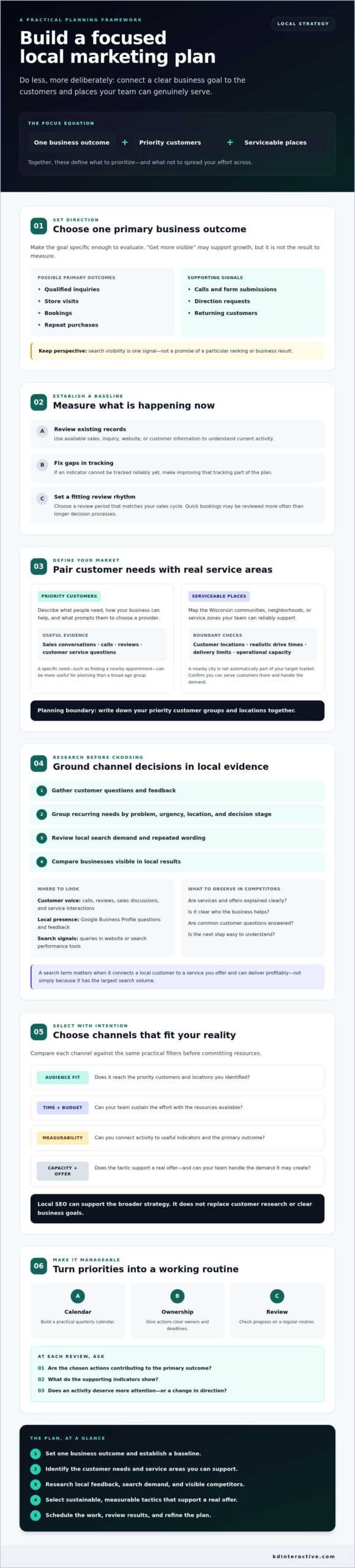
A local marketing plan is a prioritized set of actions for reaching and converting customers in a defined market. The idea behind local store marketing is to focus on customers and needs within a particular community. For a small business, that focus begins with two decisions: which business outcome matters most, and where can you reliably serve customers?
To understand how to build a local marketing plan, choose a specific outcome rather than a broad ambition like “get more visible.” Visibility can support growth, but it isn’t the result you ultimately need to evaluate. Choose one primary outcome, such as qualified inquiries, store visits, bookings, or repeat purchases. Then select supporting indicators that help explain progress, such as calls, form submissions, direction requests, or returning customers.
Set local marketing goals you can evaluate
Before setting a target, record a baseline using the information you already have. Review available sales, inquiry, website, or customer records to understand current activity. If you can’t reliably track an indicator yet, make improving that tracking part of the plan. A baseline gives you a more useful starting point than a target based on guesswork.
Set a review period that fits your sales cycle. A business with quick bookings may review activity more often than one with a longer decision process. At each review, ask whether the chosen actions are contributing to the primary outcome and what the supporting indicators show. Treat search visibility as one signal, not a promise of a particular ranking or business result.
Define the customers and places your plan serves
Describe priority customers by what they need, how your business can help, and what prompts them to choose a provider. For planning, a specific need, such as finding a nearby appointment, is often more useful than a broad age group. Use questions from sales conversations, calls, reviews, and customer service interactions to clarify those needs.
Next, map your genuine Wisconsin service area. Use customer locations, realistic drive times, delivery limits, or other operational boundaries to identify the communities, neighborhoods, and service zones you can support. Don’t assume a nearby city belongs in your target market just because it appears on a map. Confirm your team can serve customers there and handle the demand your marketing could create.
Write down your priority customer groups and locations together. This gives you a practical boundary for the next decisions: which local needs to address and where to focus your effort. For wider context on how channels can support a local strategy, see this local digital marketing guide.
Research Local Customers, Competitors, and Search Demand Before Choosing Channels
Once your business goal and service area are clear, research what local customers need before deciding where to market. A useful sequence is to review customer feedback, identify recurring needs, examine local search demand, and then compare businesses competing for those customers. This keeps channel choices grounded in evidence rather than habit or guesswork.
Find the questions local customers actually ask
Start with conversations and records you already have. Gather questions from calls, reviews, sales discussions, and customer service interactions. Group them by the problem a person needs solved, urgency, location, and decision stage. For example, a question about whether a service is available in a particular community signals a different need from a question about comparing options or getting started.
Where available, review questions and feedback on your Google Business Profile, along with search queries shown in your website or search performance tools. Look for repeated wording and needs, not just phrases with the largest search volume. A search term matters most when it connects a local customer to a service you offer and can deliver profitably.
Turn competitor observations into useful research
Search for the services you provide alongside the communities you genuinely serve. Note which businesses appear in local results, then compare what a potential customer can learn from their visible offers, content, and reviews. Consider whether each business clearly explains its services, says who it helps, answers common questions, and makes the next step easy to understand.
Keep observations separate from conclusions. A competitor’s thin content may point to a question worth investigating, but it doesn’t prove local demand. Validate potential gaps against customer feedback, search queries, business priorities, and your ability to fulfill the work.
A simple research log can keep the process focused:
- Customer signal: What question or need keeps coming up?
- Local search signal: What relevant searches or queries can you observe?
- Competitor signal: What offers, information, or review themes stand out?
- Business fit: Does the opportunity match a profitable service and available capacity?
Use the log to rank opportunities by relevance to your goals, strength of customer evidence, and ability to serve the demand. Search volume alone shouldn’t determine your priorities. A broad, popular term may attract people outside your service area or people looking for something you don’t provide. A more specific local need may align closely with your offer.
When search patterns are difficult to interpret, SEO keyword analysis can help connect local search demand with the services your business is prepared to deliver.
Choose Local Marketing Channels That Fit Your Budget, Capacity, and Customers
The best channel mix is one your customers use and your team can manage consistently. As you decide how to build a local marketing plan, compare each option by audience fit, staff time, cash cost, capacity to respond, and how well you can track its contribution to your goal. Start with a small, focused mix. Add channels when you have a clear reason and enough capacity to maintain them.
Match local SEO and content to search intent
Local SEO can help people actively searching for nearby services or providers find relevant information about your business. Make sure service pages describe real offerings and supported locations. Create useful content around questions customers actually ask. Local SEO is one part of a coordinated plan, not a substitute for understanding your audience and business goals. For more detail, see this local SEO services guide.
Other channels play different roles. Social media can keep a business visible to people who follow or discover it. Paid promotion can extend reach when you can handle inquiries and track outcomes. Email may support ongoing communication with customers, while events and partnerships can create in-person community connections. Referrals can encourage word-of-mouth. Choose channels based on fit, not pressure to appear everywhere.
Balance digital channels with community marketing
Community partnerships, local events, referrals, and local media can complement digital activity when they reach the right audience and fit your available time. Customer reviews and reputation also need steady attention. Treat them as ongoing trust-building work, not a one-time campaign. Before paying to promote an offer, confirm who will respond to inquiries and how you’ll record resulting leads or sales.
Use this comparison to narrow your starting options. The effort involved depends on the scope and consistency you can support.
| Channel | Primary purpose | Typical effort to plan for | Possible indicator |
|---|---|---|---|
| Local SEO and content | Reach people searching for nearby services | Ongoing updates and content work | Relevant local visits or inquiries |
| Social media | Share updates and build familiarity | Regular content and responses | Engagement or referral visits |
| Paid promotion | Put a specific offer in front of a chosen audience | Campaign setup, monitoring, and follow-up | Tracked inquiries or conversions |
| Communicate with an existing audience | List care and planned messages | Responses or resulting actions | |
| Events and partnerships | Build local connections and awareness | Coordination and participation | Contacts or inquiries generated |
| Referrals and reviews | Strengthen trust and word-of-mouth | Consistent customer follow-up | Referral inquiries or review activity |
Choose the channels that best support your goal and your team’s capacity, then track one useful indicator for each. If local search is a priority, you can also explore local SEO services as one part of a focused mix.
Build a Local Marketing Calendar, Budget, and Measurement Routine
A channel only contributes to growth if someone has time to manage it and you can tell whether it supports your goal. Turn your priorities into a quarterly action plan with named owners, due dates, and realistic time commitments. This is how to build a local marketing plan your team can follow, rather than a list of tasks that gets forgotten when day-to-day work takes over.
Create a calendar your team can maintain
Schedule recurring work that supports the channels you selected. Depending on your plan, that might include updating your business profile, publishing useful content, responding to reviews, or checking campaign performance. Assign each task to a specific person and set a completion date. If one person owns every task, make sure the workload fits their available hours.
Plan around your business, too. Leave room for seasonal demand, staffing changes, and shifts in service availability. A simple calendar can include the task, owner, due date, estimated time, and status. List cash expenses separately from staff time and tool costs so you can see the full commitment behind each activity, not just what you pay outside providers.
Measure outcomes instead of activity alone
Choose a small set of indicators tied to your business objective. Calls, bookings, qualified leads, and completed sales are closer to business outcomes than impressions or social engagement. Reach and engagement can still help explain whether people are seeing or interacting with your marketing, but don’t treat them as proof that the activity is generating customers.
Where appropriate and accessible, review Google Business Profile data alongside Google Analytics 4 and Search Console. These sources can help you understand different parts of local visibility and website activity. Before drawing conclusions, check that tracking is set up correctly and that inquiries or sales are recorded consistently. Otherwise, a change in reported performance may reflect a tracking issue rather than a change in customer response.
Set a regular review, such as monthly for ongoing checks and quarterly for broader decisions. Compare results with your baseline and note what changed: the offer, location focus, content, schedule, or promotion. Look for patterns over time instead of reacting to one short-term fluctuation. If an activity isn’t supporting the goal, investigate why before stopping it. The issue may be the message, audience, follow-up, or measurement.
Keep the routine manageable: check the indicators, record what you learned, and choose the next adjustment. If you need support with the local search part of your plan, explore KD Interactive’s local SEO services.
Improve Your Wisconsin Local Marketing Plan with Consistent Execution
A local marketing plan works only if it can be carried out and reviewed. Pull the decisions from your research and channel selection into one working document: business goals, priority audiences, verified Wisconsin service areas, selected channels, task owners, and review dates. This helps everyone involved understand what the plan is meant to achieve and what happens next.
Use a simple plan-review checklist
Before launching or refreshing activities, check that every goal has an owner, a time frame, and a measurable indicator. Then review each tactic against its purpose and practical limits:
- Goal: Does this activity support a defined business outcome?
- Audience: Is it aimed at a customer group the business can serve?
- Location: Do the location claims reflect actual coverage, not assumed reach?
- Offer: Is there a real service or product behind the message?
- Execution: Is someone responsible, with enough time to complete the work?
- Review: Is there a date to check results and decide what to adjust?
Remove or revise activities that lack a clear audience, purpose, or realistic owner. Confirm that your team can handle the demand a campaign may create. If a service area, offer, or staffing situation changes, update the plan and related marketing information so prospective customers aren’t given an outdated impression.
Know when specialist support can help
Some work may be manageable in-house, while other needs can exceed the time or expertise available. Consider outside support if keyword research is difficult to interpret, useful content is falling behind, review and reputation tasks aren’t being handled consistently, or reporting doesn’t show whether marketing contributes to business goals. Identify the specific gap first. That helps you evaluate support based on the work your business needs, rather than buying services that don’t fit.
KD Interactive works with small businesses on local SEO, keyword analysis, and content creation. These services can support a broader plan when local search visibility or content production is a priority, while your customer knowledge, business goals, and service capacity remain the foundation.
To explore whether outside help fits your priorities, explore local marketing support.
How to Build a Local Marketing Plan: Put Your Priorities Into Action
A strong local plan gives your marketing a clear direction: focus on customers and Wisconsin communities you can serve, choose channels that fit your capacity, and measure progress against a business goal. The key to how to build a local marketing plan is making it manageable enough to execute and flexible enough to improve as you learn.
Start with the priorities you’ve identified, assign ownership, and set a date to review what’s working. Focus on outcomes that matter to your business, not activity for its own sake. Consistent, thoughtful adjustments can help turn local marketing into a more coordinated effort over time.
If keyword research, local search visibility, content creation, or online reputation management is stretching your team’s capacity, KD Interactive offers services in these areas for small businesses. Explore local marketing support and consider what fits your plan.
Your next step doesn’t need to be complicated. Choose one priority, put it on the calendar, and build from there.
Frequently Asked Questions
How do I create a local marketing plan for a small business?
Start by choosing a business outcome, such as more qualified inquiries, bookings, store visits, or repeat purchases. Identify the customers and locations you can serve, then research their needs and local search behavior. Select a manageable mix of channels, assign owners and deadlines, and track a few indicators linked to your goal. To learn how to build a local marketing plan, use existing customer and sales information as your starting point, then refine the plan as results come in.
What should a local marketing plan include?
A useful plan includes a primary business goal, priority customer groups, the communities or service zones you genuinely cover, and the channels you’ll use to reach those customers. It should also outline key actions, responsible team members, deadlines, and a budget that accounts for money, staff time, and tools. Add a small set of measurable indicators and regular review dates. This gives your team a clear way to carry out the work and decide what to adjust.
Which marketing channels work best for local businesses?
The right channels depend on what customers use, the offer you want to promote, and the work your team can sustain. Local SEO can help people searching for nearby providers; social media, paid promotion, events, partnerships, referrals, and email each serve different purposes. Start with a focused mix rather than trying every option at once. Track a relevant indicator for each channel, such as inquiries, bookings, referral visits, or customer responses, and expand only when capacity allows.
How much should a small business budget for local marketing?
There’s no single budget that fits every small business. Set an amount your business can sustain, based on its goals, available resources, and the channels you plan to use. Separate direct expenses from staff time and tool costs so the full investment is visible. Start with essential activities, then review whether they contribute to qualified inquiries, bookings, sales, or another chosen outcome. Adjust spending based on evidence and capacity, not on a competitor’s budget or an assumed industry standard.
How do I identify my local target audience and service area?
Use customer conversations, reviews, sales records, and service questions to identify who benefits most from your offer and what prompts them to act. Define your service area using actual customer locations, realistic travel times, delivery limits, or operational coverage. List only the communities your team can genuinely serve. In Wisconsin, that may mean prioritizing certain towns or neighborhoods rather than treating the whole state as one market. Revisit the boundaries if capacity or coverage changes.
How can I measure whether my local marketing plan is working?
Measure progress against the business outcome you chose, not visibility alone. Track relevant actions such as qualified leads, calls, bookings, conversions, or completed sales, and use reach or engagement metrics as supporting context. Where appropriate and available, compare data from your business profile, website analytics, and search performance tools. First confirm that tracking works and inquiries are recorded consistently. Review results over a suitable period, document what changed, and look for patterns before changing course.
How often should I update my local marketing plan?
Review routine indicators regularly and revisit the full plan on a schedule that suits your sales cycle. Monthly check-ins can help catch execution or tracking issues, while a quarterly review can support broader decisions about goals, channels, budget, and service areas. Update the plan sooner if your offer, staffing, capacity, or customer demand changes. Avoid reacting to a brief fluctuation; document adjustments and give them enough time to produce useful evidence before judging their impact.