
What if your local page is getting visits but still makes nearby customers work too hard to understand your service, confirm your location, or take the next step? Local landing page optimization isn’t just about adding a city name or polishing the design. It’s about making the page relevant, easy to use, and clear about how to contact you.
If you manage pages for multiple service areas, it’s easy for them to start feeling repetitive or generic. When results stall, it can be hard to tell whether the problem is usability, local relevance, or the conversion path. A higher ranking alone won’t tell you whether the page is generating meaningful inquiries.
This practical 2026 checklist will help you review each page with clear priorities. You’ll learn how to clarify the service and location, make useful information easy to find, improve the mobile experience, and give visitors an obvious next step. You’ll also see how to track calls, inquiries, and other page actions so you can decide what to improve next. The goal is a repeatable review process that connects keyword research, helpful page content, and performance measurement, not a cosmetic redesign or ranking shortcut.
Key Takeaways
- Use local landing page optimization to connect each page’s service, genuine coverage area, and next step to the needs of nearby visitors.
- Review content clarity, mobile usability, trust signals, and contact options with a repeatable checklist, not just a cosmetic redesign.
- Match page type and content to customer intent. A service-area page, city page, and single-service page each serve different needs.
- Assess visibility, engagement, and business conversions separately so you can identify friction and choose a meaningful next improvement.
- Build a Wisconsin-focused plan around accurate local details, relevant content, and the resources available to your business.
What Local Landing Page Optimization Should Achieve for Nearby Customers
Local landing page optimization improves a location- or service-focused page so nearby visitors can quickly see whether the business fits their needs, while helping the page become more relevant to local searches. It brings local context, a usable experience, and a clear conversion action together. General landing page optimization focuses on making a page more effective for its intended purpose. The local version also makes the service and genuine coverage area clear.
A useful page answers three questions without making visitors hunt: who does this business help, what does it offer, and where does it serve? Adding a city name to otherwise unchanged copy doesn’t answer those questions. Include details that help someone decide whether to keep reading and what to do next.
What makes a landing page genuinely local?
A genuinely local page reflects the business’s actual operations and the needs of customers in the area it serves. State the relevant location or service area accurately, describe the specific service, and explain what a prospective customer can learn or do on the page. Avoid naming neighborhoods or claiming local experience unless those details are accurate and supported.
Each page should also have a meaningful reason to exist. If two location pages use the same general text with only the city name changed, neither may help visitors choose the right service. Make differences clear through relevant service details, coverage information, or answers to questions customers in that area are likely to have.
How user experience supports local search intent
Local searchers often arrive with a practical question: “Can this business help me here?” Put the service and location near the top, organize details under clear headings, and make the next step easy to spot. On a phone, short sections and scannable content help visitors find the essentials without working through a wall of text.
Make the action specific to the visitor’s decision. Depending on the business, that could mean calling, requesting information, or reviewing service details. Keep the route from the initial answer to that action clear.
- Service: Name what the page is about.
- Location: State the genuine coverage area.
- Next step: Make the appropriate action clear.
Good usability helps visitors complete their task and supports a coherent page experience. It doesn’t guarantee search rankings. Treat local relevance, helpful content, and usability as parts of a thoughtful SEO strategy, then assess visibility and customer actions separately.
Local Landing Page Optimization Checklist: Improve Relevance and Usability
Use this checklist to spot practical improvements before considering a full redesign. Effective local landing page optimization starts with the visitor’s questions, then checks whether the page makes answers and contact options easy to find. LocaliQ’s high-converting landing page checklist also covers useful fundamentals such as clear messaging and strong headlines.
Does the page answer local customers’ questions quickly?
Check the first screen on both desktop and mobile. Visitors should be able to identify the service and accurate coverage area without scrolling. Then confirm the page explains what the service includes, who it’s for, and what to do next. Add local context only when it answers a real customer question, not simply to repeat place names.
- Content clarity: Make the headline specific to the service and intended audience. Ensure the description matches what the business actually provides and the location wording reflects its genuine service area.
- Useful local detail: Include relevant service information, process details, or answers to common customer concerns. Check that each location page offers a distinct reason to exist instead of swapping a city name into duplicate copy.
- Trust: Use accurate proof, such as genuine customer reviews or clear service details. Don’t imply local credentials, experience, or community ties that haven’t been verified.
- Conversion path: Make the next action easy to understand. Check that phone links work, forms request only necessary information, and confirmation or error messages help visitors know what to do.
Can visitors use the page easily on mobile?
Review the page on a phone, not just in a desktop preview. Confirm that text is readable, contrast is clear, navigation is easy to understand, and buttons have enough space to tap comfortably. Test every contact option and form. Watch for content that shifts unexpectedly or elements that overlap as the page loads.
Use Core Web Vitals as diagnostic signals, not as a promise of ranking improvement. Google’s benchmarks assess real-user data at the 75th percentile: Largest Contentful Paint (LCP) of 2.5 seconds or less, Interaction to Next Paint (INP) of 200 milliseconds or less, and Cumulative Layout Shift (CLS) of 0.1 or less. If a metric falls short, investigate the experience and address the underlying issue.
Work through the checks in order. Fix anything that blocks understanding or contact first, then reassess. If you want support aligning page content with local search needs, explore Wisconsin local SEO services from KD Interactive.
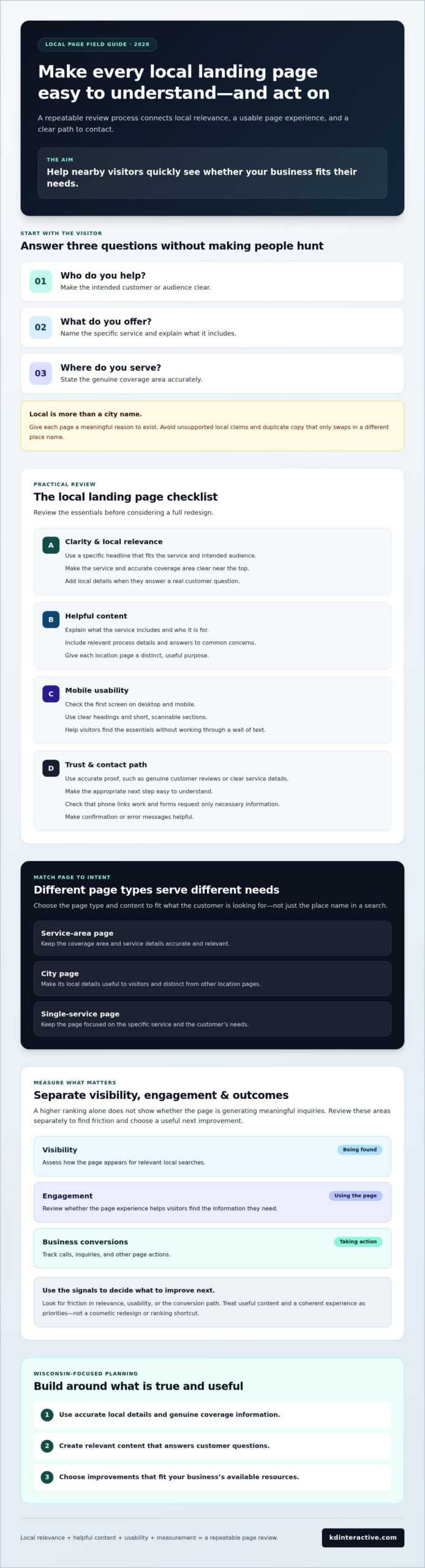
Compare Local Landing Page Elements by Customer Need and Search Intent
The right page format depends on what a nearby searcher needs to decide. A broad overview may help someone confirm coverage, while a focused service page can answer detailed questions about one offer. Use this comparison to choose a useful page, not to create one for every place name or keyword variation.
| Page format | Visitor need and useful content | Relevant proof | Suitable next action |
|---|---|---|---|
| Service-area page | Understand which areas the business serves and what services are available. Summarize genuine coverage and link visitors to relevant service details. | Accurate service-area information and clear descriptions of available services. | Call with a coverage question or request information. |
| City-specific page | Find details tied to a real business location or a distinct local offering. Explain what’s available there and how the location serves customers. | Verified location details and specific, relevant information about the offering. | Call, request an appointment, or plan a store visit if appropriate. |
| Single-service page | Learn what one particular service involves, who it suits, and what to expect. | Accurate service details, process information, or genuine customer feedback. | Request a quote or appointment when the visitor has enough information to consider proceeding. |
Which local page format fits the business?
A service-area page is useful when coverage and a range of services are the main questions. A location page makes sense when a real business location or distinct local offering warrants its own useful details. Choose a single-service page when searchers need a deeper explanation of one service. A business may need one format or a combination. Each page should serve a distinct customer need.
Creating near-identical pages with different city names can leave visitors without meaningful local information. Before adding a page, ask what it can say truthfully that existing pages don’t. If the answer is only the place name, improve the existing page instead.
Which calls to action fit different customer journeys?
Match the action to the visitor’s readiness and the business’s actual process. Someone comparing options may prefer to call with a question. A visitor who understands the service may be ready to request an appointment or quote. A store visit is suitable only when an in-person location is relevant. Keep one primary action prominent. Competing requests can make the next step less clear.
Strong local landing page optimization aligns page format, supporting details, and the next action with search intent. Review the page from the customer’s perspective: does its information help them make a decision, and does the action follow naturally?
Measure Local Landing Page Performance and Prioritize Fixes
A page’s ranking is only one part of its performance. For useful local landing page optimization, track whether the page appears in relevant searches, whether visitors engage with it, and whether it helps generate the business actions it was built to support. A simple review process can turn those signals into a practical next step.
Which metrics help evaluate a local landing page?
Use Google Search Console to review the page’s search impressions, clicks, and queries. These metrics help show whether it’s appearing for relevant searches and which searches bring people to it. In Google Analytics 4, review engaged visits and conversion events, such as a form submission, once those events are configured and tested. Compare those measures with the page’s actual goal: calls, quote requests, appointments, or another meaningful inquiry.
Keep the categories distinct. Search visibility shows whether people encounter the page in search. Engagement helps you understand what visitors do after arriving. Business conversions indicate whether the page contributes to an outcome that matters. An increase in clicks alone doesn’t confirm that the page is producing inquiries.
How should a small business prioritize improvements?
Work through this review in sequence. Record the changes you make and use comparable reporting periods when reassessing, while allowing enough time to gather useful observations. Avoid treating short-term movement as proof that one edit caused a result.
- 1. Establish a baseline. Note current Search Console visibility, GA4 engagement, configured conversions, and the page’s relevant calls or inquiries.
- 2. Inspect behavior. Check the search queries bringing visitors in, how they use the page, and whether key contact actions are being recorded correctly.
- 3. Identify friction. Look for barriers such as broken contact links, a confusing form, missing service details, or inaccurate coverage information.
- 4. Change one priority. Address access, contact, or information problems before cosmetic preferences. Weigh the likely customer impact, effort required, and confidence in the diagnosis.
- 5. Reassess. Review the same measures again, document what changed, and decide whether to keep the adjustment or investigate another issue.
Consistent tracking makes it easier to choose improvements based on evidence rather than assumption. It also helps distinguish a page that attracts search visits from one that supports real customer inquiries. For help connecting local SEO priorities with performance tracking, discuss local SEO services with KD Interactive.
Build a Wisconsin-Focused Optimization Plan With the Right Support
Turn your review into a manageable plan. Start with one page, one customer action, and the most important obstacle between a visitor and that action. For a Wisconsin business, check that the page uses accurate service-area details and familiar local terminology. Don’t claim coverage in a city or community unless the business genuinely serves it.
What should a local page improvement plan include?
Give each task an owner and a realistic timeline. Content updates, usability fixes, tracking checks, and technical changes may involve different people, so clarify responsibilities before work begins. A simple plan can include:
- Page and goal: Choose the page to improve and define its primary customer action.
- Priority: Identify the main issue, such as unclear service information or a difficult contact path.
- Owner and timing: Assign responsibility for the content, usability, tracking, or technical work and set a review date.
- Measurement: Record the current signals you’ll compare after the change, such as relevant search activity or inquiries.
For broader context on how individual pages fit into a larger local search strategy, consult a guide such as “Local SEO Services Near Me.” Keep the page’s claims grounded in the business’s actual services and coverage. Local relevance comes from useful, accurate detail, not from adding more place names.
When can an SEO partner help with optimization?
In-house updates can be practical when someone on your team understands the service, knows the genuine coverage area, and can make and review changes. Outside support may be useful when keyword selection, content development, or measurement has no clear owner. Ask a provider how recommendations will reflect your business and customer needs, which outcomes they’ll report, and how they’ll distinguish visibility from inquiries.
KD Interactive works with Wisconsin businesses on local SEO services, SEO keyword analysis, and content creation. That support can help connect page priorities with a broader local SEO strategy, without treating one page change as a guaranteed ranking shortcut. After you’ve identified the page, customer action, and gaps to address, discuss a practical assessment with KD Interactive to determine whether outside support fits your needs.
Turn Your Local Page Review Into a Clear Plan
Strong local landing page optimization starts with a page that reflects the business’s real services and coverage, then makes it easy for nearby visitors to take a relevant next step. Use the checklist to identify the most important usability or content issue, and match each page’s format and call to action to what customers need. Track visibility, engagement, and inquiries separately so your next change is guided by evidence, not rankings alone.
You don’t need to overhaul every page at once. Choose one priority, assign the work, and review what happens. For Wisconsin businesses that want help connecting keyword research, on-page optimization, content creation, and analytics tracking, KD Interactive offers local SEO services tailored to business needs.
Discuss a tailored local landing page plan with KD Interactive and take a practical next step toward pages that serve both your business and your local customers.
Frequently Asked Questions
What is local landing page optimization?
Local landing page optimization is the process of improving a page that targets a particular service, location, or nearby audience. It helps visitors understand whether a business meets their needs and helps search engines interpret the page’s relevance to local searches. The work can include refining page content, clarifying service coverage, improving mobile usability, and making the next step clear. The aim is a useful page, not simply more location keywords.
How do I optimize a landing page for local SEO?
Start by identifying the page’s audience, service, and genuine coverage area. Research the terms local customers use, then make sure the page answers their likely questions with accurate, specific information. Review mobile usability, contact options, and trust details, such as verified reviews. Check search visibility and visitor actions using tools such as Google Search Console and Google Analytics 4. Make changes based on observed needs, then reassess rather than assuming an edit guarantees better rankings.
What should a local business landing page include?
A local business landing page should clearly explain its main service, who it helps, and the locations it actually serves. Include practical details that help a visitor decide, such as what the service involves, relevant customer proof, and a clear way to inquire or take another appropriate action. Keep information accurate and easy to scan, especially on a phone. The page should answer real customer questions rather than rely on generic claims or repeated location phrases.
Do local landing pages need a separate page for every city?
No. Create a separate city page only when it can provide genuinely useful details for people in that location, such as a real business location, distinct service information, or relevant coverage details. If the only change would be the city name, one broader page may serve visitors better. Review existing pages before adding more, and make sure each has a clear purpose. A larger page count alone doesn’t establish stronger local relevance.
How can I improve the user experience of a local landing page?
How do I measure whether a local landing page is working?
Measure search visibility, on-page engagement, and business outcomes as separate signals. Search Console can show relevant queries, impressions, and clicks. In Google Analytics 4, review engaged visits and conversion events after confirming they’re configured correctly. Then compare those reports with meaningful actions, such as calls or completed inquiries. Establish a baseline, record page changes, and review comparable periods. A ranking or traffic increase by itself doesn’t prove the page is generating valuable leads.
Can multiple local landing pages have the same content?
Pages that repeat nearly identical content and differ only by city name offer little distinct guidance to visitors. They may also make it harder to maintain accurate coverage details across the site. If several pages are needed, give each a clear audience and purpose, and include information that is genuinely relevant to that location or service. Don’t invent local credentials or details to make pages seem unique. If there’s no meaningful difference to explain, consider consolidating the content.