
A strong SEO proposal connects your business baseline, a clear objective, planned work, measurable outcomes, and a review timeframe. The clearest way to justify SEO spend to a business partner is to show how search activity can support business goals, then agree on what evidence will guide the decision. Meaningful movement on competitive SEO terms can take three to six months, so set expectations around progress rather than promising an instant return.
It’s reasonable to ask how much SEO will cost, when results might appear, and how you’ll know whether the investment is working. Starting with those questions, rather than a budget figure alone, makes the conversation more practical and focused on what the business needs.
This guide shows you how to frame SEO’s financial value, connect targets such as enquiries and sales to the work, and address cost, timing, and proof. You’ll also learn to set review points, state your assumptions, and compare SEO with other budget priorities. The goal is a shared decision based on business fit, measurable signals, and a sensible plan for evaluating progress.
Key Takeaways
- Start with the business goal, then connect SEO activity to outcomes such as qualified enquiries, sales, or booked calls.
- Explain cost, timing, and proof together, using measures that show how search contributes to business results.
- Turn service-area job targets into financial goals by considering lead quality, conversion rates, and the value of completed work.
- State your assumptions and agree on review points, responsibilities, and the evidence that will guide future decisions.
- Compare SEO with other budget priorities using consistent criteria, including business fit, available resources, measurement, and uncertainty.
1. How do I explain marketing ROI to my business partner?
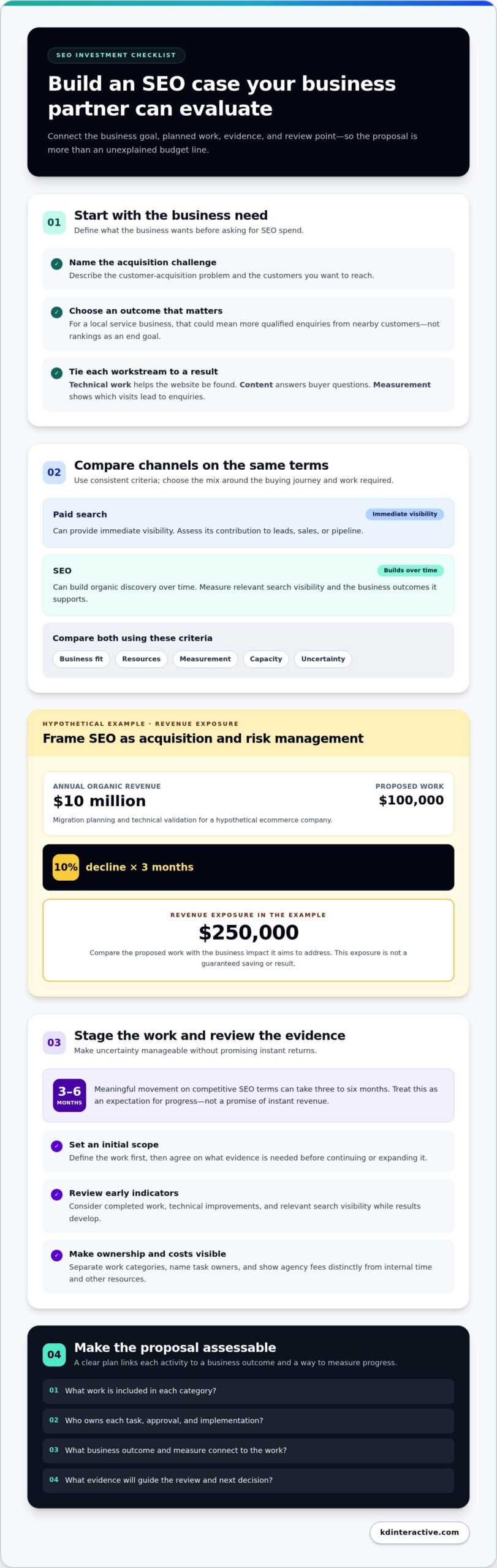
Start with the business goal, not a request for an SEO budget. Name the current customer-acquisition challenge, the customers you want to reach, and the outcome that matters. For example, a local service business might want more qualified enquiries from nearby customers. Its strategy can then connect search visibility to demand, rather than treating rankings as the end goal.
Compare SEO with paid search and other marketing channels using the same criteria: business fit, resources, measurement, capacity, and uncertainty. Paid search can provide immediate visibility, while SEO can build organic discovery over time. Choose the channel mix based on the buying journey and the work required, then assess each channel’s contribution to leads, sales, or pipeline.
Connect each investment category to an outcome your partner recognizes. Technical work can help ensure a website can be found; content can answer buyer questions; measurement can show which visits lead to enquiries. A content plan, for example, should identify its audience, search intent, and the action each page supports. This turns the marketing budget into a set of linked decisions, not one unexplained line item.
A hypothetical ecommerce company generates $10 million in annual organic revenue and requests $100,000 for migration planning and technical validation. In that example, a 10% organic revenue decline lasting three months represents $250,000 in revenue exposure. The figures show how to frame SEO as acquisition and risk management: compare the proposed work with the business impact it aims to address, without treating projected savings as guaranteed results.
Manage uncertainty through staged investment. Define an initial scope, agree on the evidence needed to continue, and set a review point before expanding the work. Competitive SEO terms can take three to six months to show meaningful movement, so early reviews should also consider completed work, technical improvements, and relevant search visibility. This gives partners a reasoned way to adjust the plan as evidence develops.
Make the investment plan specific enough to assess. Separate the proposed work into categories, identify who owns each task, and state its expected business outcome and measurement. Show agency fees as a distinct budget line alongside internal time and other resources. Explain what each workstream includes and how progress will be reported. Clear scope helps partners compare the proposal with other acquisition priorities and build a stronger working relationship.
2. Addressing questions about cost, timing, and proof
Address cost, timing, and proof directly before your partner has to ask. SEO pricing varies with the work involved, including website condition, competition, scope, and required resources. Compare the proposed work and its deliverables, not a fee in isolation. An agency should explain its fees clearly and connect each activity to the business outcome it supports.
How much does SEO typically cost for a small business in the United States? There’s no single typical figure for every small business because the scope and complexity of SEO work vary. A focused local campaign and a large website with technical needs require different work, so compare proposals by scope, deliverables, and measurement.
Timing needs the same clarity. SEO visibility can take time to develop, and the timeline varies with the work involved. That timeframe describes when visibility may emerge, not when revenue is certain. Ask the agency to map its early work to practical indicators, such as completed technical fixes, relevant search visibility, and qualified enquiries. This gives your partner useful evidence before final sales attribution is available.
Trust expertise without giving up oversight. A successful working relationship allows the agency to apply its judgment while keeping goals, scope, and reporting transparent. Ask what it plans to do during the first 90 days. A clear answer should cover an audit, quick wins, and a roadmap. Also agree who approves changes, how results will be shared, and which business outcomes matter most.
Improve attribution at the point of enquiry. Add a short form question asking how customers found your business and which AI platforms they used. Keep it easy to answer, then compare responses with analytics data. Forms can also capture the service requested and location, helping the team connect enquiries with relevant campaigns. Review both direct conversions and assisted journeys, since SEO may contribute before a buyer contacts the business.
Before hiring, use a consistent set of questions: What work will you complete? Which measures connect that work to revenue? What assumptions shape the timeline? How will you report progress? Who owns approvals and implementation? Clear answers reveal whether the proposal fits your needs and whether the agency can explain its expertise in practical terms. A discussion of SEO proposal planning can help frame those questions around scope and outcomes.
The cost depends on the work required, so a small business should compare quotes based on the scope, deliverables, and how results will be measured.
3. Connecting job targets to financial goals
Translate search activity into the work your business needs to win. Start by listing the jobs you want in each service area and location. Then identify which services can meet that demand, how much delivery capacity is available, and what counts as a qualified enquiry. A target for emergency plumbing jobs in one town, for example, should not be mixed with interest in unrelated services across the state.
Use current business records to establish a realistic starting point. Review your CRM, sales records, website analytics, and call logs for the same service and location. Separate organic enquiries from other sources where tracking allows, then compare enquiry quality and completed work. This baseline shows whether the main gap is traffic, visibility for relevant searches, or converting existing visits into enquiries.
To justify investment with data and case studies, bring together organic traffic, search position, qualified enquiries, booked jobs, and revenue records. Use case studies with a similar service, location, starting point, and timeframe, and show the work completed alongside the outcomes. These details help your partner judge relevance without treating another business’s results as a forecast for yours.
Make each SEO goal measurable and tied to a business decision. A useful goal states the service, location, intended result, and evidence you’ll use to assess progress. For example, track whether pages for a priority service attract relevant local visits and generate qualified enquiries. Rankings and visibility offer context, but completed jobs and revenue show whether the activity supports the business goal.
Build the financial connection using your own figures. Multiply the target number of completed jobs by the average gross profit per job, then compare that potential contribution with the investment and delivery capacity required. Use a realistic close rate from your sales records to connect enquiries with likely jobs. Keep revenue and profit distinct, and state assumptions about lead quality, cancellations, and available staff.
Give both partners measurable responsibilities, not just a shared target. One person may approve content and service priorities; another may review incoming leads and record outcomes in the CRM. Agree on how progress will be discussed and what evidence will prompt a change in direction. Rewards can recognize agreed business outcomes, such as qualified jobs completed, rather than search position alone.
Structure reporting around the decisions your partner needs to make. A concise report can show target versus actual enquiries, completed jobs, revenue contribution, and relevant visibility changes for each service area. Note what changed and what the next action will be. This keeps SEO metrics connected to business outcomes, rather than leaving your partner to interpret traffic charts without context.
4. Stating assumptions and setting review points
A useful SEO plan makes its assumptions visible before work begins. Record the current website condition, priority services, target locations, available staff, and known tracking gaps. Then explain how each factor shapes the proposed work. For example, a service business with outdated location pages may need different priorities from one with strong pages but weak enquiry tracking. These details help partners assess the strategy fairly.
Include the first marketing review in the plan, along with its purpose and attendees. Agree on which measures you’ll review, who will present them, and what decisions the meeting can make. Early measures might include completed technical tasks, published pages, or changes in relevant search visibility. Later, connect those signals to qualified enquiries and business outcomes. A review should produce answers and next steps, not just a channel report.
Set realistic expectations for the first 30 days. Expecting significant SEO results within that period is not realistic, so use the opening review to assess implementation, access, and the agreed roadmap. If a technical change is blocked or a page needs approval, record the owner and next action. This gives both partners a clear way to distinguish slow execution from the time needed for search performance to develop.
Choose a partner based on how well its proposed work matches your needs. Ask the agency to explain its process, deliverables, measurement approach, and assumptions in plain language. Compare its proposed topics with the searches and questions that influence your customers’ buying decisions. A credible plan connects activity to business priorities and identifies what your team must contribute, such as subject expertise, approvals, or access to website data.
Clarify responsibilities before work starts. Write down who delivers each task, who approves changes, and who provides source material. For content, for example, assign someone to review technical accuracy and another person to approve publishing. Put project responsibilities and rights in the contract so deadlines, permissions, and decision-making are clear. This reduces the chance that a missed approval is mistaken for poor SEO performance.
Keep expectations focused on controllable work and measurable progress. An SEO agency cannot guarantee a specific position on Google, so don’t make a ranking promise the test of success. Instead, agree on what work will be completed, how relevant visibility will be monitored, and how enquiries will be assessed. At each review, compare changes with the original assumptions, explain any new obstacle, and decide whether the plan needs adjustment.
Document the review process in one shared plan. Include the initial baseline, assumptions, owners, review agenda, and criteria for changing direction. If business priorities shift, such as when a service becomes unavailable, update the target and explain how that affects planned work. A written record keeps the conversation grounded in shared facts and helps both partners make consistent decisions.
5. Accounting for opportunity cost in budget proposals
Every budget decision gives one priority resources that another project could use. To compare SEO fairly, set it beside the actual alternatives: paid search, sales capacity, website improvements, or another marketing channel. Use the same criteria for each option: business fit, resources, measurement, capacity, and uncertainty. This helps partners decide what the business would gain, delay, or leave unfunded by approving the proposal.
Separate financial investment from the staff time each option requires. A campaign may need subject experts to review pages, sales staff to record lead outcomes, and managers to approve changes. If those people are already at capacity, the opportunity cost includes delayed work elsewhere. Write down who will contribute and which existing tasks may need to move, so the budget discussion reflects the actual operational impact.
Use an illustrative annual portfolio to make trade-offs clear. The useful finding is how each allocation supports a distinct business need.
For a smaller company, apply the same logic without copying that portfolio’s scale. List each proposed activity, the outcome it supports, the resources it needs, and the alternative it displaces. For example, compare improving service pages with increasing paid-search activity. The former may build organic visibility over time; the latter can support paid placements. Decide by matching the channel to customer demand, team capacity, measurement, and timing.
Account for the cost of inaction, too. If a priority service has weak search visibility, estimate the business impact using internal enquiry and sales records. Then compare that exposure with competing needs, such as improving conversion paths or expanding sales coverage. Keep assumptions visible and distinguish observed results from projections. This makes the proposal a decision about relative value, not a claim that SEO automatically outranks every other investment.
Before approval, agree on a staged budget and a finding that would justify continuing, changing, or pausing the work. Tie that decision to the review process, rather than judging an entire strategy by a single metric. To shape a proposal around business priorities, discuss your SEO budget priorities.
KD Interactive: Local SEO Services
KD Interactive helps businesses connect local search activity with goals such as stronger visibility and qualified enquiries. Its Local SEO Services support businesses looking to reach nearby customers, while SEO Keyword Analysis helps identify search terms aligned with priority services and buyer intent.
When your plan needs useful pages to answer customer questions, KD Interactive’s Content Creation can support the work. Press Release Distribution can help your business share news as part of broader marketing activity. These offerings give you practical options to consider once your SEO priorities, internal resources, and business goals are clear.
Ready to discuss how local SEO could support your business goals? Contact KD Interactive.
Turn a shared decision into a practical next step
The strongest case for justifying SEO spend to a business partner isn’t a polished forecast. It’s a decision you can revisit together as business priorities and customer demand evolve. Use your agreed goals to guide next steps, and keep the conversation open as performance data comes in. That makes the investment a shared business responsibility, not simply a marketing line item.
If local visibility is part of your growth plan, KD Interactive can help put the strategy into action through Local SEO Services, Content Creation, and Press Release Distribution. These offerings support a focused plan to reach local searchers, answer their questions, and share relevant business news.
Contact KD Interactive to discuss your SEO plans and take the next step with a clear direction.
Frequently Asked Questions
How do I explain marketing ROI to my business partner?
Explain ROI by connecting marketing activity to a business result your partner values, such as qualified sales opportunities or completed purchases. When justifying SEO spend to a business partner, use a simple example: trace a customer from an organic search visit to an enquiry, then to a closed sale. Separate revenue influenced by SEO from revenue directly attributed to it, and state how your tracking identifies each path.
How can I justify marketing spend when results take time?
Explain why the work takes time, then identify useful early signs of progress. For example, a new site may need technical corrections and relevant pages before search visibility can improve. Meaningful movement on competitive SEO terms can take three to six months. Agree on what the team will assess along the way, such as completed work and qualified enquiries, so the investment has checkpoints before longer-term outcomes mature.
What should a marketing budget proposal include?
A strong proposal includes the business problem, target audience, recommended work, required resources, measures, assumptions, and review plan. Explain briefly how each activity supports an outcome. For example, a proposal to reach customers searching for a particular service should identify the pages or content needed, who provides subject expertise, and how the business will track resulting enquiries. This makes scope and responsibilities easier to assess.
How do you calculate SEO ROI for a business?
Compare the financial return attributed to SEO with the investment required, using a consistent period and clear attribution rules. One common formula is (SEO-attributed gross profit minus SEO investment) divided by SEO investment. Use gross profit rather than revenue alone, and include the cost of internal time if it is material. For example, connect CRM-recorded sales to organic enquiries while noting assisted conversions separately.
What metrics show SEO’s impact on revenue and leads?
Track completed purchases or jobs, qualified enquiries, booked calls, and pipeline created from organic visits. Pair those business measures with supporting indicators such as organic traffic, branded search demand, and conversion rates. For example, if visits rise but qualified enquiries do not, the landing page or search intent may need attention. Assisted conversions and multi-touch journeys can also show SEO’s role before a buyer converts through another channel.
How long does SEO take to produce measurable results?
Meaningful movement on competitive SEO terms can take three to six months, while a new site may take three to six months to reach Google’s first page. The pace depends on factors such as competition, site condition, and the work required. Early measurement can focus on implementation and relevant visibility; business outcomes, such as qualified leads, provide a later view of commercial impact.
How do you build an SEO budget and forecast expected returns?
Build the budget from the work required to address business goals, not from a hoped-for return alone. List deliverables, internal time, measurement needs, and dependencies, then estimate outcomes using your own conversion and sales records. Create conservative, expected, and stronger scenarios by varying assumptions such as lead quality or close rate. Label these as planning estimates, and revise them when actual campaign data replaces assumptions.
How do you set SEO goals, KPIs, and reporting milestones?
Start with a business target, then choose KPIs that show progress toward it. A local business might track enquiries for a priority service and location, alongside relevant organic visits and conversions. Assign each metric an owner and data source, such as analytics for visits and a CRM for lead outcomes. Set reporting milestones around planned work and business decisions, so each review identifies what changed and what action follows.