
More marketing activity doesn’t automatically mean more customers. Knowing how to market a service business with a team means coordinating the work around clear goals, credible proof, and the right channels. Paid search can produce inquiries within weeks, while SEO, content, and referral programs take months to build momentum.
A team’s marketing can easily become scattered across social posts, website updates, search, and ads. A shared plan helps each activity support the same business priorities and shows what brings in qualified leads. This guide explains how to use customer testimonials, focused service pages, local search, paid advertising, and AI visibility as parts of one strategy. You’ll also learn how to review performance, learn from peers, and adapt to trends without losing sight of the work that leads to sales.
Key Takeaways
- Use genuine customer feedback and work-in-progress content to help prospective customers judge your expertise and reliability.
- Build service pages around the specific customer, service, and location, with clear proof and a next step.
- Coordinate local search, SEO, paid ads, and AI visibility so each channel supports shared business priorities.
- Review inquiries and won work, then use performance data, peer observations, and relevant trends to guide your next marketing decisions.
1. Adding customer testimonials to websites and social media
Use customer testimonials to show potential customers what working with your team is like. After a successful job, ask for a review or repeat-booking request within 24 hours. Feature specific feedback on relevant service pages and social media posts, rather than sharing praise without context. For example, pair a comment about reliable scheduling with a short explanation of the service delivered. This gives each testimonial a clear role in your marketing strategy: reducing uncertainty and supporting a customer’s decision.
How should a service business divide marketing roles among team members? Assign one person to own the overall strategy, goals, messaging, and measurement. Then give practical tasks to people closest to the work: a technician can capture a job photo, while an office team member requests feedback and records lead sources. One accountable owner keeps contributions consistent and makes sure someone follows up on inquiries.
Build trust with expert content that answers real customer questions. A team member can record a short first-person video explaining a common process, then reuse its key points in a social media post or service page. A simple photo and useful caption can also encourage engagement without requiring an elaborate production. If customers need different scopes of work, present tailored service packages clearly; a discounted package or session bundle can give them a concrete option without making every offer the same.
Referrals, reviews, and partnerships help a service business reach people through trusted relationships. Ask satisfied customers for reviews, and collaborate with a complementary local business on a useful post or discussion. Train staff in customer service and basic sales processes, including how to explain next steps and respond to common concerns. A monthly or seasonal message can keep the business top of mind between jobs and encourage repeat work.
How can a service business create a marketing plan and content calendar? Set a shared goal, choose the audience and channels, then schedule useful topics in advance. For example, plan a customer story, a process video, and a seasonal service reminder, assigning an owner and publication date to each. Review the calendar regularly and adjust it based on customer questions and team capacity.
2. Creating clear service and audience-specific website pages
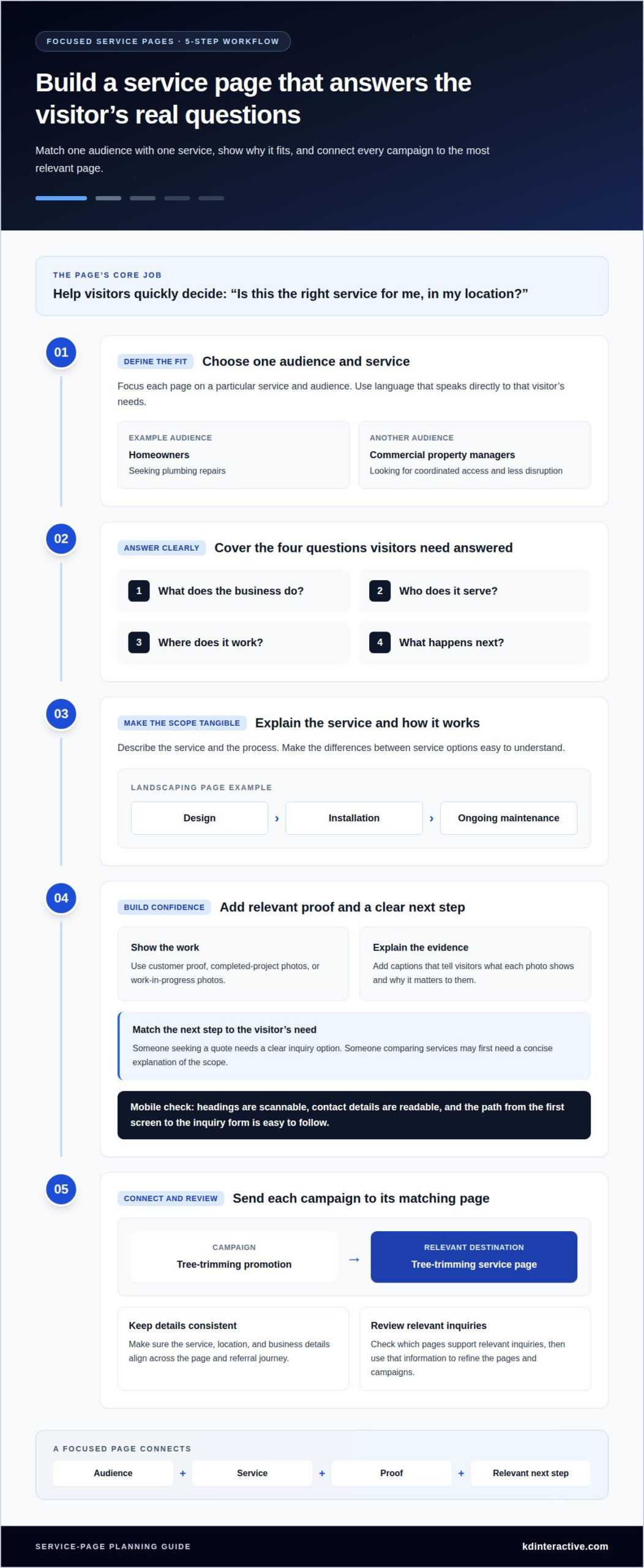
A useful service page answers what the business does, who it serves, where it works, and what happens next. A practical answer to how to market a service business with a team is to create a focused page for each audience. For example, a page for homeowners seeking plumbing repairs should address their needs directly. A page for commercial property managers can explain how the team coordinates access and limits disruption. Focus each page on a particular service and audience so visitors can quickly assess the fit.
Build a clear path from the visitor’s need to their next action. Describe the service, explain the process, add relevant customer proof, and make the next step easy to find. A landscaping page, for instance, can distinguish design, installation, and ongoing maintenance. Photos of completed projects or work in progress make the service tangible. Use captions to explain what each photo shows and why it matters to that audience.
Conversion-focused pages make the next action specific. A visitor seeking a quote should find a clear inquiry option, while someone comparing services may first need a concise explanation of the scope. Check mobile pages for scannable headings, easy-to-tap buttons, and readable contact details. Test the experience on a phone by following the visitor’s path from the first screen to the inquiry form.
For teams asking how to market a service business with a team, connect each campaign to its most relevant page. A tree-trimming campaign should lead to a page about that service, not a generic homepage. Referrals also benefit from a page that confirms visitors have found the right service and location. Keep business details consistent, and use audience-specific language that fits the brand’s voice. Then review which pages support relevant inquiries.
3. Local search, SEO, paid ads, and AI visibility
Start with accurate business information across your website and Google Business Profile. Add fresh job photos and short business updates to the profile at least twice a month. Make sure your services, service areas, and contact details are consistent. Clear pages, expert content, and customer proof help search systems understand what the business does and where it works. They also give potential customers useful reasons to choose you.
SEO and paid ads work on different timelines. SEO, content, and referral programs can take months because they rely on consistency and trust. Paid search can produce inquiries within weeks, making it useful when the team needs demand sooner. Connect each campaign to a relevant service page, then track whether inquiries become qualified opportunities. For AI visibility, publish direct answers to customer questions and keep business details clear across channels. These steps help search systems interpret your expertise and local relevance.
Local marketing materials should reinforce the same message. A press release about a new service or community project can support local awareness, while printed materials should name the service area and provide a clear next step. Keep claims specific and accurate. A connected strategy aligns these materials with website content, search, and paid campaigns so each activity supports the desired outcome rather than competing for attention.
How can a service business compare in-house marketing with hiring an agency? In-house staff bring customer knowledge and can capture updates during daily work; an agency can add dedicated search or content expertise. Compare the skills, time, and coordination each approach requires. For marketing rules in the United States, use truthful claims, get permission before sharing identifiable customer stories, and handle contact information carefully. The SBDC recommends spending between three and five percent of actual or expected annual turnover on marketing.
Avoid spreading effort across channels without shared goals or tracking. Set a sustainable daily budget for paid search, follow inquiries through to sales, and review campaign performance before making changes. Keep profile details consistent, use customer proof responsibly, and don’t treat early clicks as the final outcome. Marketing works best when someone owns coordination and the team can see which channels generate worthwhile conversations.
4. Using analytics, peer research, and trends to refine marketing
Use monthly data to connect marketing activity with business outcomes. Review inquiries, their sources, and won work together, rather than treating impressions as proof of success. An impression shows that content appeared; it doesn’t show whether a profitable project followed. For example, compare leads from a service page with the work those leads eventually booked. This gives the team a clearer basis for continuing, adjusting, or pausing an activity.
Check website and social media analytics each week to spot useful patterns. If a post about a common repair gets engagement but no inquiries, its next step may be unclear. If a service page earns visits but few calls, review its message and contact path. Weekly checks can reveal possible issues; monthly reviews of inquiries and sales help determine whether a change made a difference.
Peer research can reveal approaches worth considering without turning imitation into strategy. Look at how businesses in the same niche explain their process, show customer proof, or organize service pages. Then compare those choices with the questions your own customers ask. A respected local partner may also offer a fresh perspective through a collaborative post or discussion. Keep your business’s voice and audience central instead of copying another company’s campaign.
Trends can inspire timely promotional ideas, but viral attention may be short-lived. Use a trend only when it fits the service and gives potential customers something useful. Where practical, test one change at a time, such as a different page headline or post format, so the team can identify what influenced the result. During monthly marketing reviews, agree on one or two changes, assign an owner, and revisit their impact at the next review. Initially, review the broader marketing plan every three months.
Keep the discussion focused on decisions, not dashboards. Ask which channel brought suitable inquiries, which service attracted profitable work, and what the team should test next. A simple record of source, conversation, proposal, and outcome helps connect activity to sales. Improve your local search visibility with a strategy informed by those patterns.
KD Interactive: Local SEO Services
KD Interactive helps service businesses strengthen local visibility when referrals alone don’t provide a steady source of inquiries. Its Local SEO Services support businesses that need clearer search visibility, relevant service content, or a stronger local presence. The team also offers a Google Map Pack with AI Assistant, Content Creation, and Press Release Distribution.
These services connect naturally to the marketing work covered here: useful content supports search visibility, while local SEO helps businesses reach customers in their target areas. Press release distribution can also help share business news with a wider audience. The right starting point depends on your goals, target customers, and the marketing gaps your team wants to address.
For support with local visibility and content, contact KD Interactive.
Turn your marketing plan into a shared next step
Knowing how to market a service business with a team starts with a decision everyone can act on. Choose the business priority that matters most now, then make ownership clear: who contributes, who coordinates, and what progress should look like. This gives the team practical direction without adding activity for its own sake.
If local visibility or content capacity is holding back your marketing, KD Interactive offers Local SEO Services, Content Creation, and Press Release Distribution. These services can support businesses working to strengthen local search presence, publish useful material, or share company news. The right starting point depends on the challenge you want to address and the audience you need to reach.
Take the next step with a focused conversation about your goals and marketing priorities. Discuss your marketing with KD Interactive, and give your team a clear path forward.
Frequently Asked Questions
How long does marketing take to work?
Paid search can produce service-business inquiries within weeks, while SEO, content, and referral programs can take months. For KD Interactive’s local SEO services, stated timing is improvements in 3-6 months and full results in 6-12 months; competition and industry affect the timeline. Judge progress by qualified inquiries and won work, not only by early visibility or clicks.
What marketing strategies work best for a service business with a team?
The best strategy connects marketing activity to the work the team can deliver profitably. Choose a priority service, identify the customers it suits, and make sure staff can handle the inquiries it may generate. For example, a team with open capacity for recurring maintenance can emphasize that work in its campaign and sales conversations, rather than promoting services it cannot schedule.
How do you define target customers and positioning for a service business?
Define target customers by the work the business wants to win, not by broad labels alone. Consider profitable project types, recurring agreements, target locations, and higher-margin services. Then describe the problem you solve, the customers you serve, and what makes your approach relevant to them. A clear position helps staff qualify inquiries consistently and keeps marketing focused on suitable opportunities.
Which marketing channels generate the most leads for local service businesses?
No single channel generates the most suitable leads for every local business. Search can reach people actively looking for a service, while referrals can bring prospects through existing relationships. Compare channels by qualified inquiries and completed work, not lead volume alone. A busy team may value fewer inquiries that fit its service area and schedule over a larger number of poor-fit requests.
How should a team track marketing leads, conversion rates, and return on investment?
Record each inquiry’s source, requested service, location, and progress through the sales process. Track how inquiries become qualified leads, proposals, and won work; conversion rates reveal where prospects move forward or drop away. Then compare revenue from won work with the marketing activity and spend associated with it. A shared record helps the team spot which sources bring valuable customers and make informed adjustments.