
A crowded event can still leave people feeling unseen. Effective community engagement marketing ideas create genuine opportunities for people to connect, contribute, and feel heard, rather than treating attendance or social likes as the goal.
It makes sense to look beyond promotion: lasting community relationships grow when businesses show up in person, listen to local needs, and follow through. The challenge is choosing activities that feel genuine and give people a real reason to participate.
This article explores practical ways to build those connections. You’ll learn how face-to-face conversations and thoughtful events can bring people together, how to invite attendees to share their own social content, and how surveys and social listening can reveal what your audience values. Shape engagement around your community, not just your brand, and give each interaction a clear purpose.
Key Takeaways
- Use face-to-face conversations to learn what matters to local customers and build relationships beyond a single interaction.
- Design events around a genuine community purpose, with activities that make it easy for people to participate and connect.
- Invite attendees to share their own event moments, then recognize contributions in ways that encourage authentic participation.
- Use surveys and social listening to identify community priorities and show how feedback shapes what you do next.
1. Building customer relationships through face-to-face interactions
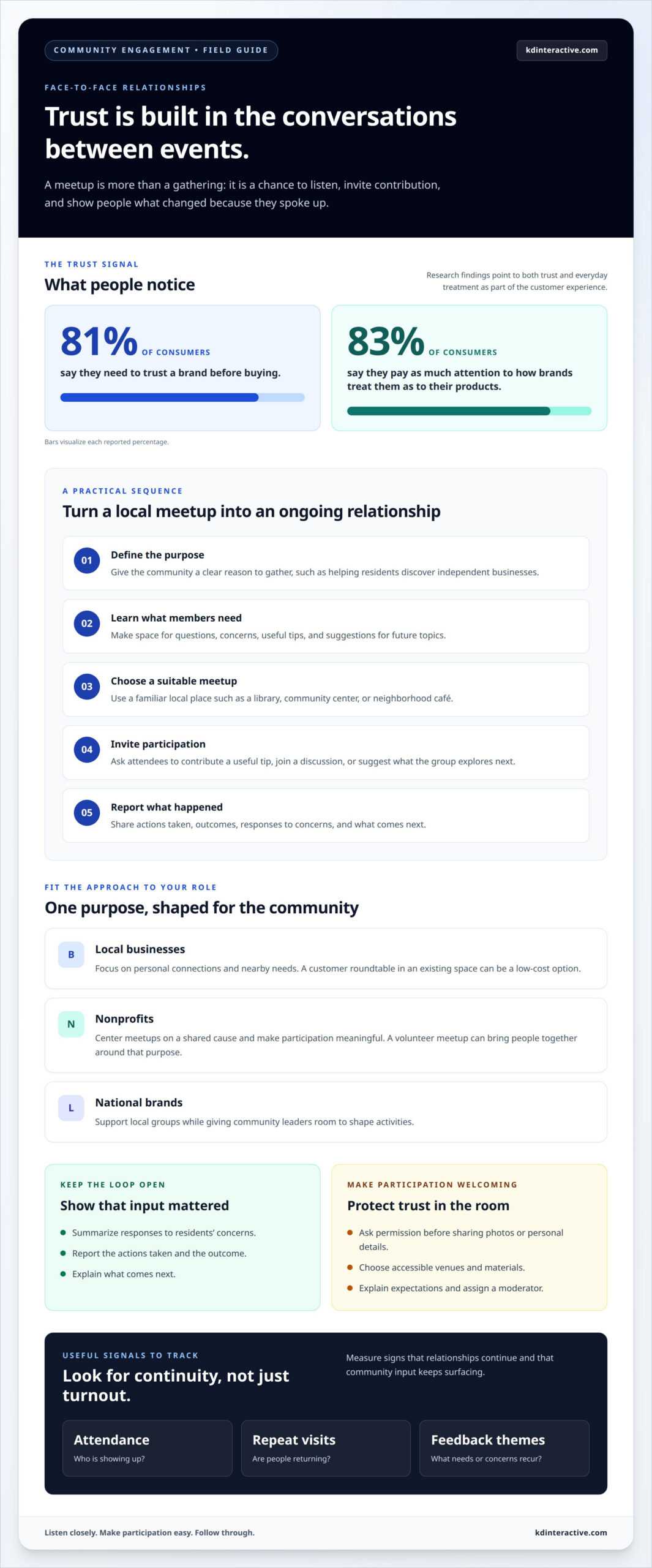
Face-to-face interactions turn a local business from a name into familiar people. A customer can ask questions, share concerns, and see how a brand responds. In research findings, 81% of consumers say they need to trust a brand before buying. Another 83% say they pay as much attention to how brands treat them as to their products. That makes each conversation part of the customer experience, not simply advertising.
Start a branded community with a clear purpose, such as helping residents discover independent businesses. Invite customers to a regular local meetup at a library, community center, or neighborhood café. Make participation easy: ask attendees to share a useful tip or suggest a future topic. Consistent interaction can build relationships that continue between events.
Local businesses can focus on personal connections and nearby needs. Nonprofits can center meetups on a shared cause and make participation meaningful. National brands can support local groups while giving community leaders room to shape activities. The approach should fit the organization’s role, audience, and purpose.
Trust grows when organizations show what happened after people contributed. After a cleanup or fundraising project, report the actions taken, the outcome, and what comes next. If residents raised concerns at a meetup, summarize the response and any changes made. Closing the feedback loop gives people a reason to return and strengthens the organization’s reputation.
VIP tiers can build belonging when they recognize participation, not just spending. Offer regular contributors early invitations, a chance to suggest meetup topics, or a member spotlight. Keep the benefits clear and attainable: a neighborhood group might invite active members to host a discussion. Recognition should strengthen the community, not divide it.
Low-cost options include a customer roundtable in an existing space, a volunteer meetup, or a member-led discussion. Costs vary with the venue, refreshments, printed materials, and staff time. Donated space and digital updates can help limit expenses.
Build a strategy step by step: define the community’s purpose, learn what members need, choose a suitable meetup, invite participation, and report outcomes. Track useful signals such as attendance, repeat visits, and recurring feedback themes.
Reduce privacy and moderation risks by asking permission before sharing attendee photos or personal details. Choose accessible venues and materials, explain participation expectations, and assign a moderator to address disruptive comments respectfully.
2. Designing sincere, engaging event experiences
A meaningful event gives people a reason to participate beyond seeing a logo. Start with one clear purpose, such as supporting a school fundraiser or organizing an environmental cleanup. Match the activity to the cause, then make the action useful and easy to understand. A cleanup, for example, can bring residents together and show them what happens to collected materials. Keep promotion modest, focusing on the organization and community the event supports.
Local businesses can take part in events at parks, libraries, coffee shops, community centers, and schools. Sponsoring a youth sports team or neighborhood festival can connect a business with shared local interests. Set up a pop-up stand with a simple activity, or collaborate with another local business on a useful demonstration. A small business expo or local shopping day also creates opportunities for direct conversation. Choose events that fit the community instead of treating every gathering as an advertising slot.
Virtual events can bring those discussions to people who can’t attend in person. Host an ask-me-anything session with a community leader, then use chat, polls, and a question-and-answer segment to encourage active participation. Keep the conversation going afterward in a digital community space where attendees can exchange information asynchronously. Clear prompts, such as “What should we explore next?”, help turn passive viewing into shared participation.
Technology works best when it supports the people in the room. Display a live social feed on a large screen, or invite attendees to post a photo and one key takeaway after a presentation. A digital platform can carry keynote discussions beyond the venue and help participants continue new connections. Before the event, explain how to join and what content may appear publicly. Afterward, share an event recap that recognizes partners and participants. A well-organized local event page can also make essential details easier for nearby audiences to find.
3. Generating user-created social media content
Customer-created photos, comments, and stories give a community’s social media presence a more personal voice. Start with one clear invitation, such as asking members to share a photo of how they use a product or participate in a local activity. A specific prompt makes it easier to join in than a broad request to “post about us.” Provide a hashtag or tag so people can find and share related contributions on the platform.
Incentives can encourage contributions, but keep the exchange fair and transparent. Offer a small reward, merchandise, a discount, or public recognition for submitting feedback or content. If a reward is tied to a review, make it available for feedback of any sentiment, not just positive comments. A points program can also recognize different kinds of participation, such as answering another member’s question or sharing a useful tip.
Customer stories add context that a product description can’t provide. Invite community members to describe a challenge, the steps they took, and what they learned. With permission, feature a short story on a blog, newsletter, or podcast, then share it on social media. For example, a neighborhood bakery could spotlight a customer’s tradition of ordering bread for a weekly family meal. Keep the member’s perspective central instead of turning every story into an advertisement.
Reviews are another form of user-created content. Ask customers to describe specific parts of their experience, such as service, selection, or how they used an item. Respond to praise with a sincere thank-you; acknowledge concerns and explain the next step without arguing publicly. This shows future readers that feedback receives attention, whatever its tone.
Promote contributions in a way that recognizes the people who created them. Credit the original member, ask permission before reposting, and avoid editing a quote in a way that changes its meaning. Feature different voices over time instead of repeatedly highlighting the same contributors. A successful member-content program encourages participation with clear prompts, respectful recognition, and visible follow-through.
4. Audience research through surveys and social listening
Good research starts before a campaign launches. Review local news, community groups, and public conversations to understand neighborhood history, concerns, and causes. Then use a short survey to ask what residents value and which activities would help. Compare responses with social listening, looking for recurring questions and themes in user-generated content, to identify genuine priorities.
Keep surveys easy to answer. Ask one focused question, such as which community project residents would support, and offer a brief space for comments. Use social media polls to invite quick responses, and share a longer questionnaire when detailed feedback matters. Regular listening can turn audience comments into useful themes, rather than leaving them as a collection of individual opinions.
Employees can add local context that online monitoring may miss. Invite staff to name organizations, events, and causes they know firsthand, then ask which community activities feel relevant. A small employee group can review community feedback and recommend a practical next step, such as supporting a school supply drive. This helps align company action with local needs and values.
Social media can promote an engagement page or initiative, while targeted advertising can help reach residents by location or interest. For example, a community garden project could use a post that explains the need, includes a clear participation prompt, and asks about volunteer tasks in a poll. Direct people to a place where they can learn more and contribute, rather than relying on a promotional post alone.
Measure success against the campaign’s purpose. Track attendance, repeat participation, survey responses, meaningful comments, shares, and whether feedback led to visible action. For a food drive, useful signals might include volunteer sign-ups and community questions answered. A successful campaign could ask residents to identify local needs, share progress, and explain how contributions supported the chosen cause.
Turn audience insights into clear, useful messaging with audience-informed content creation.
KD Interactive
KD Interactive can connect community engagement with stronger local visibility and useful online content. Turn audience insights and event updates into clear messaging that helps nearby customers understand your work and how to participate.
When your community efforts need stronger local search visibility, Local SEO Services can support that goal. Content Creation can help share relevant stories, while SEO Keyword Analysis can guide the language you use to reach local audiences. Press Release Distribution can also help communicate significant community initiatives.
Bring your goals and audience insights together into a practical digital marketing approach. Contact KD Interactive to discuss your community engagement goals.
Turn Community Insight Into Your Next Step
Choose one community priority to guide your next decision. Treat community engagement marketing ideas as starting points, then shape them around what local people say they need and value. A focused initiative is easier to explain, coordinate, and learn from than several disconnected activities.
Decide what meaningful progress would look like before you begin. It might mean stronger participation, clearer community feedback, or better awareness of a local cause. Afterward, use what you learn to refine your next step and keep your communication aligned with the people you want to reach.
KD Interactive can help connect your community goals with a practical marketing approach. Contact KD Interactive to discuss your marketing and identify a suitable next step. Thoughtful planning can help your community efforts grow with purpose.
Frequently Asked Questions
What are effective community engagement marketing ideas for small businesses?
Effective community engagement marketing ideas for small businesses start with a focused audience and an activity they can sustain. A neighborhood bookstore, for example, could invite customers to recommend local authors, then publish a seasonal reading list that credits contributors. A small customer advisory circle can also help test new offerings. Explain how suggestions shaped a decision so members can see the practical effect of their input.
How can businesses use events, workshops, and local partnerships to engage their community?
Build an event around a useful skill or shared local need, then involve a partner with relevant expertise. A bicycle shop and a neighborhood association might host a basic bike-maintenance workshop, for example. Ask registrants what they hope to learn, plan around those needs, and provide a short resource afterward. A partner can share the follow-up with its own audience, extending the event’s value beyond attendees.
What are effective social media and online community engagement tactics?
Give online participation a clear rhythm and a specific place to continue. A local gardening group could use a weekly social post to collect seasonal questions, then organize ongoing discussion rooms by topic, such as soil care or native plants. Assign a moderator to keep conversations welcoming and useful. Summarize recurring questions in a resource members can revisit, rather than letting helpful answers disappear in a feed.
How can a brand encourage user-generated content and customer advocacy?
Invite customers to contribute something useful to others, not just praise for your brand. A software company might ask experienced customers to share a practical workflow or answer a newcomer’s common question. With permission, collect these contributions in a peer-created guide and recognize each contributor. Make participation optional and explain where their words or images may appear.
What are examples of successful community engagement marketing campaigns?
Examples include organizing an environmental cleanup and explaining what happens to the collected materials, supporting a school fundraiser, or hosting a local food drive. Businesses can also sponsor a neighborhood festival or youth sports team and invite attendees to share event photos using a hashtag.