
What if your worst 1-star review was actually the secret to outranking your competitors in the Google Map Pack? It’s a gut-punch when a notification pops up and you see a scathing comment, especially when it feels unfair. You’ve worked hard to build your reputation here in Watertown or across the Milwaukee market. Implementing effective crisis management for bad online reviews is essential because 97% of consumers are looking at those stars before they call you. We know how it feels to face a troll because we’re small business owners too.
This playbook will show you why a negative review is a high-visibility stage where you can prove your integrity to both future customers and Google’s AI. You’ll learn how to transform a reputation-threatening post into a powerful demonstration of customer service and local SEO authority. We’ll walk through a clear response plan, strategies to ethically increase your review velocity, and ways to stay on the right side of the FTC’s 2026 consumer review rules. It’s time to stop fearing the notification bell and start using every piece of feedback to fuel your growth.
Key Takeaways
- Discover how negative sentiment directly impacts your Google Map Pack ranking and why a single review can shift your local search visibility.
- Master a 24-hour response protocol for effective crisis management for bad online reviews that prioritizes professional composure over emotional reaction.
- Learn to use the “Empathy-First” and “Solution-Oriented” models to move public complaints into private resolutions that build trust with prospective customers.
- Implement a “Dilution Strategy” to ethically generate a steady stream of 5-star reviews that bury negativity without violating 2026 FTC guidelines.
- Explore how proactive monitoring and the latest AI tools can help your team intercept customer frustration before it ever reaches a public forum.
Why Bad Reviews Feel Like a Crisis (and How They Impact Local SEO)
It’s completely natural to feel protective of the business you’ve built. Whether you’re running a shop in Watertown or a service in the heart of Milwaukee, your reputation is your most valuable asset. A “Review Crisis” occurs when negative sentiment reaches a point where it actively threatens your customer acquisition. It isn’t just about a single unhappy person; it’s about how that feedback alters the digital perception of your brand. When you’re forced into crisis management for bad online reviews, you’re essentially fighting to keep your doors open in a digital-first economy.
Google treats your reputation as a primary ranking signal for the Map Pack. The algorithm doesn’t just count your stars. It uses advanced sentiment analysis to determine if you’re a reliable local option. If your recent feedback is peppered with complaints, your visibility will drop. Google wants to recommend the best businesses to its users, and a cluster of negative reviews tells the system that you might not be the safest bet. This makes maintaining a clean profile a core part of your local search strategy.
The Hidden Cost of a 1-Star Rating
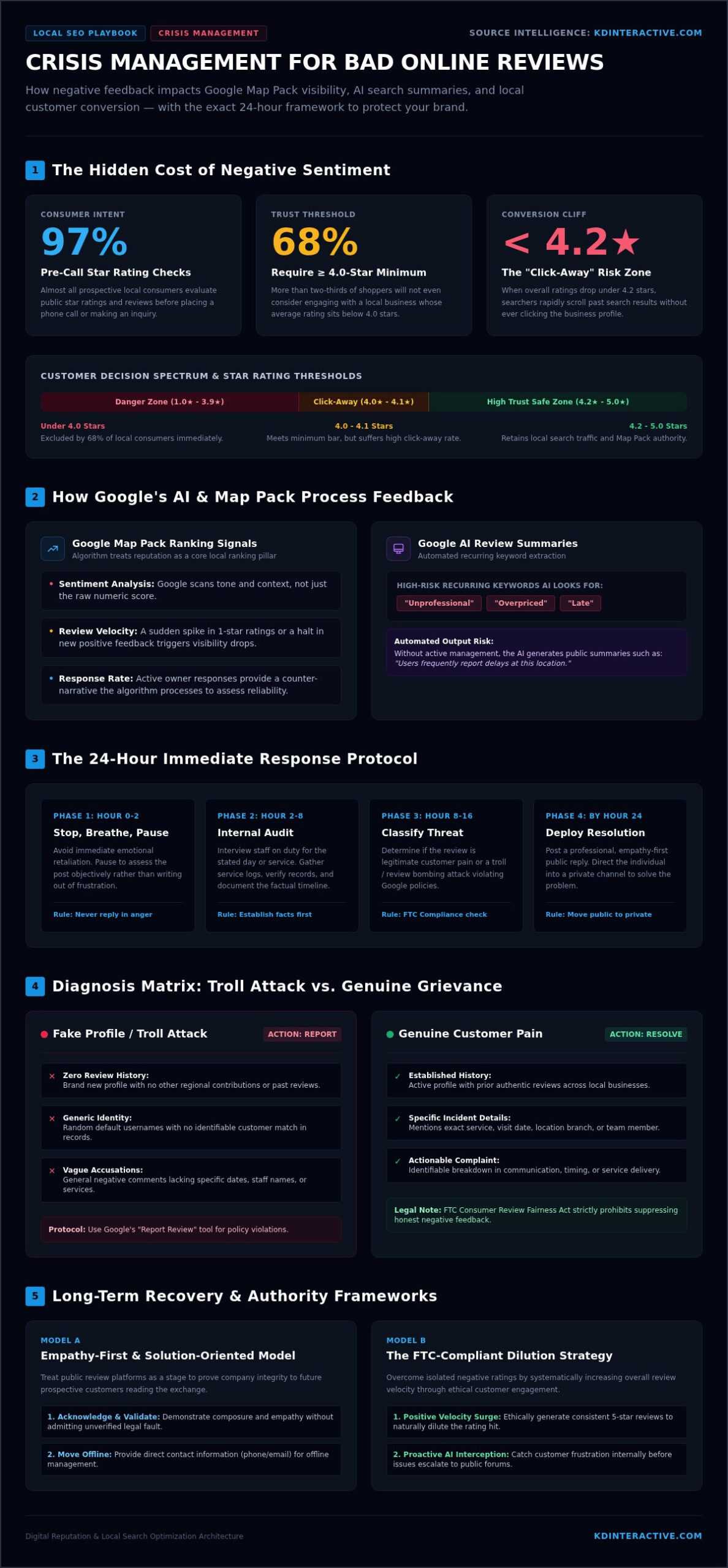
Most consumers operate with a strict “trust threshold.” According to 2026 consumer data, 68% of shoppers require at least a 4.0-star rating to even consider a local business. If your average drops below 4.2 stars, you’ll likely experience the “click-away” factor. This is when a prospect sees your rating in search results and keeps scrolling without ever clicking your link. You also need to watch your Review Velocity. This term refers to how frequently you receive new reviews. A sudden halt in positive feedback combined with a spike in 1-star ratings is a major red flag for search engines and customers alike.
How Google’s AI Assistant Interprets Negative Feedback
By 2026, search has moved beyond simple lists. Google’s AI Assistant now summarizes your reviews for users before they even read the individual comments. These AI tools scan for recurring keywords like “unprofessional,” “overpriced,” or “late” to build a summary of your business character. If you don’t engage in active online reputation management, the AI might tell a potential customer, “Users frequently report delays at this location.”
Responding to every review is the only way to provide a counter-narrative that the AI can process. To manage this effectively, you must have a solid foundation. Learning how do i setup a google business page correctly is the first step toward gaining the control you need. It gives you the dashboard required to monitor these AI-driven summaries and implement crisis management for bad online reviews before the damage becomes permanent.
The Immediate Response Protocol: How to Handle Viral Negativity
When a negative review surfaces, your first instinct might be to defend your business immediately. However, effective crisis management for bad online reviews requires a disciplined approach. We recommend the 24-hour rule. You should respond quickly enough to show you care, but wait long enough to ensure you aren’t writing out of frustration. Use the “Stop, Breathe, Analyze” framework. This pause allows you to look at the feedback objectively and determine if you’re dealing with a legitimate customer concern or a coordinated attack.
Identifying “Troll” Reviews vs. Genuine Customer Pain
Not every 1-star rating comes from a real customer. In local Milwaukee or Madison business circles, review bombing can occasionally occur. You can often spot these fake profiles by looking for a lack of review history, generic usernames, or vague complaints that don’t mention specific services. If you identify a clear policy violation, use Google’s “Report Review” tool. It’s vital to remember the FTC Consumer Review Fairness Act guidance; you cannot legally suppress honest, albeit negative, feedback. Focus your energy on removing the fraudulent ones while addressing the real ones with grace.
Internal Investigation: Getting the Facts Straight
Before you type a single word in response, talk to your staff. If the reviewer mentions a specific day or service at your Watertown location, verify the details with the team members who were on duty. Document everything. Did the customer mention the issue at the time? Was a solution offered? This internal investigation ensures your public response is rooted in facts rather than assumptions. Once the situation is resolved, conduct an internal post-mortem to see if your customer service protocols need an update. If you want to ensure your digital reputation stays secure, our local SEO services include professional reputation monitoring to keep you ahead of the curve.
Crafting the Perfect Response: A Comparison of Effective Strategies
Your response to a negative review is more than just a reply; it’s a public demonstration of your brand’s character. A Harvard Business Review study on review response shows that businesses that engage with feedback actually see their average ratings rise over time. This interaction serves as a cornerstone of crisis management for bad online reviews. Mastering the art of the reply is the fastest way to stabilize your reputation during a PR dip. When you write, remember that you’re speaking to the hundreds of prospective customers in Milwaukee or Madison who will scan your profile this month.
The most effective strategies focus on de-escalation and moving the conversation into a private channel. By moving the discussion offline, you prevent a public back-and-forth that can spiral out of control. You can also naturally weave in your location and service names to help your local search authority. Mentioning your specific expertise helps Google’s AI understand that you’re still a relevant local provider despite the negative feedback. This keeps your crisis management for bad online reviews grounded in both customer service and technical SEO performance.
The Empathy-First Approach for Legitimate Complaints
When a complaint is valid, lead with empathy. Use a template like: “We hear you, and we want to make it right.” It’s often safer to apologize for the experience the customer had rather than admitting to a specific operational mistake. For example, saying “We’re sorry you felt frustrated by the wait time” validates their feelings without creating legal liability. This approach signals to other readers that you’re a supportive, client-focused partner who values transparency. It builds immediate rapport with the 95% of people who read responses before making a purchase.
The Fact-Based Rebuttal for False Claims
If a review contains flat-out lies, you must professionally correct the narrative. Avoid name-calling or defensive venting. Instead, provide objective evidence. If a reviewer claims your team was late to a job in Watertown, but your internal records show they arrived ten minutes early, state the facts clearly. “Our records indicate our team arrived at 8:50 AM for the scheduled 9:00 AM appointment.” A calm, data-driven rebuttal is far more persuasive than an angry response. For most Wisconsin small businesses, this level of professionalism is a more effective deterrent against trolls than a costly legal battle.
Turning the Tide: How to Bury Bad Reviews with a Positive Surge
Once you’ve responded to the negativity, your next move is to flood your profile with fresh, positive sentiment. This is known as the “Dilution Strategy.” It isn’t about hiding from the past; it’s about providing a more accurate picture of your current service. Since 74% of consumers only trust reviews published within the last 3 months, according to the 2026 BrightLocal survey, a steady stream of new 5-star ratings quickly pushes that one bad headline out of the spotlight. This is a vital part of crisis management for bad online reviews because it restores your average rating and signals to Google’s AI that your business is healthy and active.
Ethical Strategies for Review Acquisition in 2026
You don’t need to bribe people for feedback. In fact, offering discounts or gift cards for positive reviews can lead to FTC penalties of up to $53,088 per violation. Instead, use your local advantage. If you’re a Watertown business owner, a personal, face-to-face ask often yields the best results. Your neighbors in the Milwaukee and Madison areas want to see local businesses succeed. They’re usually happy to help if you make it easy for them.
- QR Codes: Place these at your checkout counter or on service vehicles to make the process instant for the customer.
- Automated Follow-ups: Send follow-up emails that link directly to your Google Business Profile after a successful transaction.
- Avoid Review Gating: Google’s 2026 algorithms are designed to detect and penalize the practice of pre-screening customers to filter out negative feedback.
Leveraging Your Google Business Profile for Reputation Recovery
A stagnant profile looks suspicious during a crisis. Use your Google Business Profile to show you’re still a leader in your field. Upload high-quality photos of your team working in the community and share weekly updates via Google Posts. You can also use the Q&A section to answer common concerns proactively. Managing these moving parts while running a company is a challenge. Many entrepreneurs choose to partner with a professional seo agency to handle reputation monitoring and keyword optimization at scale.
Success in crisis management for bad online reviews requires a blend of customer service and technical expertise. If you’re ready to take control of your digital presence and dominate the local Map Pack, explore our Local SEO services today.
Proactive Reputation Management: Preventing the Next Crisis
Reacting to a fire is necessary, but fireproofing your business is a much smarter strategy. Effective crisis management for bad online reviews starts long before a disgruntled customer opens their phone to complain. You need a system that alerts you the moment your brand is mentioned online. Setting up Google Alerts for your business name and specific local keywords is a basic but essential first step. However, technology is only half the battle. You must also train your team on customer service protocols that stop frustration at the source. When your staff in Watertown or Madison knows how to handle a complaint in person, that grievance rarely turns into a digital scar.
Partnering with a proactive digital marketing agency for small business is your best defense against reputational damage. By 2026, AI had fully transformed how we track sentiment. We now use automated tools that scan for shifts in customer tone across multiple platforms simultaneously. This allows you to identify a brewing issue before it reaches a boiling point. It’s about moving from a reactive stance to a position of total control over your local narrative.
Why Wisconsin Businesses Trust KD Interactive
We aren’t a faceless national firm; we have deep local roots right here in Wisconsin. We understand the specific competitive landscape of the Milwaukee, Madison, and Watertown markets. Our data-driven approach ensures we don’t just “manage” your reviews. We optimize your entire digital presence to reflect the quality of your work. Our customized local SEO packages include reputation monitoring as a standard feature. This means we’re constantly analyzing your data to ensure your business remains the top choice for local searchers.
Integrating AI Assistants into Your Customer Service Loop
The future of local search is being the “recommended” choice by AI search agents. Our unique Google Map Pack with AI Assistant service keeps you ahead of the curve by using advanced sentiment analysis to identify recurring patterns in your feedback. If multiple customers mention a specific service delay, the AI flags it for you immediately. This allows you to adjust your operations before the next 1-star review even hits your profile. By integrating these tools into your daily loop, you ensure your crisis management for bad online reviews is built on a foundation of prevention rather than just damage control.
Take Control of Your Local Reputation Today
A single negative comment doesn’t have to define your business’s future. By mastering crisis management for bad online reviews, you turn potential brand damage into a powerful demonstration of your commitment to excellence. We’ve explored how a disciplined response protocol and a proactive dilution strategy can protect your Google Map Pack ranking while building authority. It’s important to remember that 2026 searchers and AI assistants value transparency and consistency far more than a perfect five-star record. Your integrity is your greatest asset in the local market.
As Wisconsin-based local SEO experts, we specialize in helping Watertown, Milwaukee, and Madison businesses dominate search results through seamless Google Map Pack and AI Assistant integration. We provide pragmatic, results-oriented reputation strategies that build lasting trust with your regional community. Don’t wait for the next notification to catch you off guard. Get a Professional Reputation Assessment from KD Interactive and secure your digital presence today. Your business has a story to tell; let’s work together to make sure it’s the right one.
Frequently Asked Questions
Can I delete a bad Google review if it is unfair?
No, you can’t manually delete a review simply because it feels unfair. Google only removes content that violates specific policies, such as spam, harassment, or fake engagement. If the review is legitimate but negative, your best path is a professional response. We recommend focusing on crisis management for bad online reviews by addressing the customer’s concerns publicly. This shows prospective clients in Watertown that you’re a responsible and attentive business owner.
How long does a bad review stay on my Google Business Profile?
Reviews remain on your profile indefinitely unless the author removes them or Google finds a policy violation. While they don’t expire, their influence on your star rating and local search visibility decreases as they age. Most shoppers prioritize feedback from the last 90 days. We help Wisconsin businesses maintain a steady stream of new, positive reviews to ensure older, negative comments don’t define their online reputation or search performance.
Should I offer a refund in exchange for a customer removing a bad review?
You should never offer money, refunds, or discounts in exchange for review removal. This practice violates Google’s terms of service and can lead to severe penalties from the FTC. It’s much better to resolve the customer’s complaint through excellent service. Once the issue is fixed, the customer may decide to update their rating on their own. Focus on building genuine trust rather than attempting to buy your way out of a bad experience.
How many bad reviews does it take to lower my Google Map Pack ranking?
Google doesn’t use a specific “magic number” of negative reviews to trigger a ranking drop. Instead, the algorithm looks at your overall star rating, review recency, and the sentiment of the text. Dropping below a 4.0 average is often where businesses see a noticeable decline in Map Pack visibility. Maintaining a high volume of positive feedback is essential for staying competitive in the Milwaukee and Madison markets. Steady, authentic review growth is the best protection.
What is the best way to respond to a review that is clearly a lie?
The most effective response to a false claim is a calm, fact-based rebuttal. Avoid being defensive or aggressive. State clearly that you have no record of the transaction or that your internal documentation contradicts their claims. Once you’ve posted your professional response, flag the review for Google to examine. This approach protects your reputation with the 97% of consumers who read reviews while signaling to Google that the content is likely fraudulent.
Does responding to reviews help with my local SEO in Wisconsin?
Responding to reviews is a confirmed local ranking factor that directly impacts your visibility. It shows Google that you are an active, engaged business owner who cares about customer experience. For companies in Madison or Watertown, this activity signals relevance and reliability. Engaging with feedback is a core part of crisis management for bad online reviews. It helps build the “prominence” Google requires to rank you higher in the local Map Pack results.
How can KD Interactive help with my online reputation management?
KD Interactive provides a specialized Google Map Pack with AI Assistant service designed to monitor and manage your digital sentiment. We don’t just react to problems; we use a data-driven approach to optimize your entire local presence. Our team handles everything from keyword analysis to reputation monitoring. We act as your local partner in Wisconsin, ensuring your brand stays protected and visible so you can focus on running your business.
What should I do if my business is being “review bombed” by a competitor?
If you’re hit by a sudden wave of fake reviews, document the activity and report it to Google Business Support immediately. Don’t engage with every troll, as this can amplify the negativity. Google’s neural anomaly detection is designed to freeze profiles during viral attacks and remove coordinated spam. We help our clients navigate these situations by providing the technical proof needed to get fraudulent reviews suppressed quickly, preserving your hard-earned local reputation.