
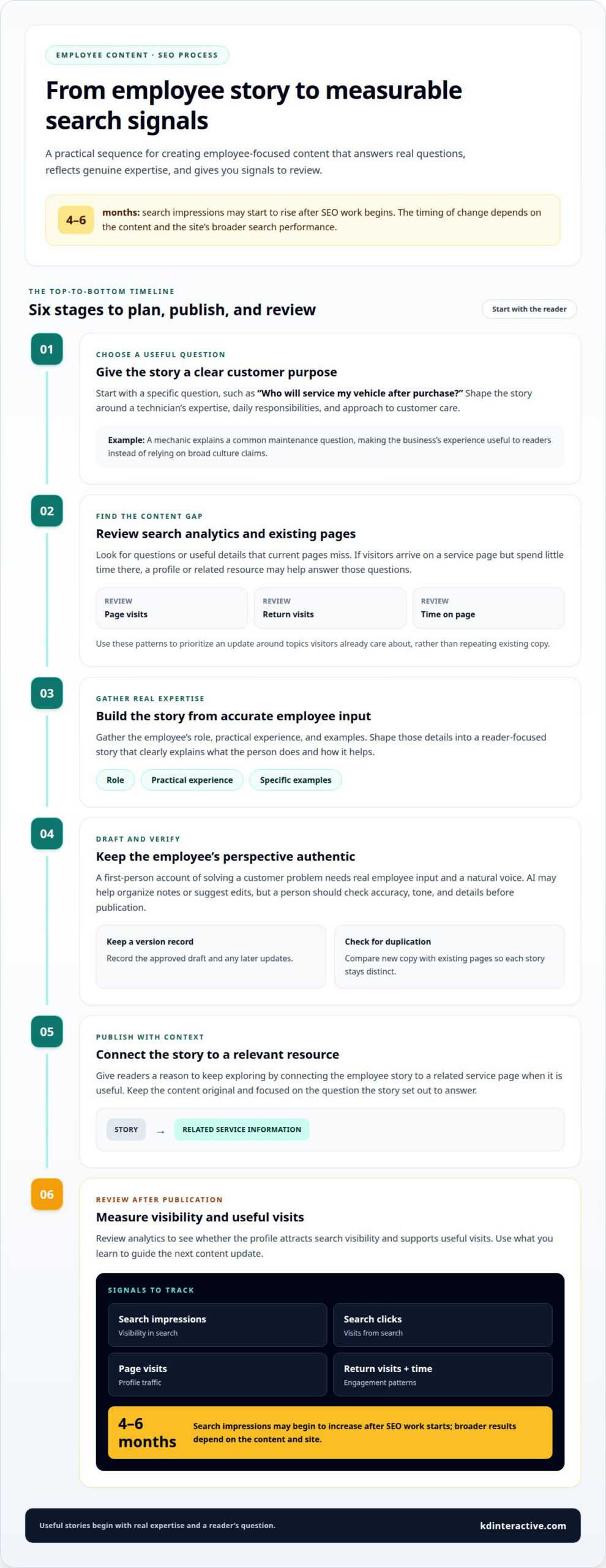
Featuring employees on your website for SEO can support visibility, but it’s not an overnight fix. After SEO work begins, start looking for an increase in search impressions after 4-6 months; the timing of any change depends on the content and the site’s broader search performance.
It’s understandable to want a clear timeline before investing in employee stories and staff profiles. This article explains how employee-focused content can help searchers and potential customers, and what to look for as results develop. We’ll cover useful search terms, effective bios, employee advocacy, and the signals that help you measure progress.
Key Takeaways
- Share genuine employee experiences to give visitors a clearer sense of your company and the people behind its work.
- Use the language people naturally search for to shape helpful employee-focused content, rather than forcing in keyword variations.
- Make staff profiles useful and relatable with names, roles, relevant credentials, and details that help customers connect.
- Encourage employees to share workplace stories to extend your content’s reach and reinforce a consistent picture of your brand.
1. Creating content about company culture and employee experiences
Start with a specific customer question, such as who will service a vehicle after purchase. Shape an employee story around the technician’s expertise, daily responsibilities, and approach to customer care. That gives the page a practical purpose instead of relying on broad claims about company culture. A mechanic’s explanation of a common maintenance question, for example, can make the business’s experience useful to readers. Featuring employees on your website for SEO works best when each story offers a clear benefit to readers.
Next, a professional reviews search analytics and existing pages to spot content gaps. If visitors arrive on a service page but spend little time there, a profile or related resource may answer questions the page misses. Analytics can show page visits, return visits, and time spent on individual pages. These patterns help prioritize an update and focus content efforts on topics visitors already care about. A professional can then plan a story that fills a specific gap rather than repeating existing copy.
How does a professional measure SEO results from employee profile pages? They track search impressions and clicks alongside page visits, return visits, and time spent on the profile. After SEO work begins, search impressions may start to rise after 4-6 months, while broader results depend on the content and site.
For LinkedIn, choose human-written or AI-assisted content based on the story and its purpose. A first-person account of solving a customer problem needs real employee input and a natural voice. AI may help organize notes or suggest edits, but a person should check accuracy, tone, and details before publication. This keeps the employee’s experience central rather than making the post sound generic. The same principle applies to featuring employees on your website for SEO: preserve their authentic perspective.
Relevant expertise starts with clear input from the employee. Gather their role, practical experience, and examples, then shape them into an accurate, reader-focused story. A version-control process records the approved draft and subsequent updates. Before publishing, compare new copy with existing pages to prevent duplicate passages and keep employee stories distinct.
Connect each story to a clear next step, such as visiting a related service page. Helpful, original content gives readers a reason to keep exploring. Review analytics after publication to see whether the profile attracts search visibility and supports useful visits, then use those insights to guide the next content update.
2. Using popular employee search terms as keywords
Keyword research starts with the language people use, not a list of phrases to force into a page. Separate customer questions from job-seeker searches. For example, “meet the service team” serves customers, while “service advisor jobs in Madison” signals hiring interest. Both searches involve employees, but they call for different pages and goals.
For candidate-focused research, group phrases by role, location, and intent. “Technician careers,” “automotive technician jobs,” and “mechanic apprenticeship” may reflect different candidate needs. Search engine optimization uses these terms to help search engines connect useful pages with relevant searches. Choose language that fits the page instead of inserting every variation.
How do you optimize employee pages for Google Search? Place relevant terms naturally in the page title, headings, and readable copy, while clearly describing the employee’s work. Google recommends writing naturally for users’ search terms rather than trying to anticipate every variation.
A strategic keyword plan also considers the platform and the reader’s next step. A company careers page can address open roles, while a staff profile can explain a team member’s expertise. Check whether each proposed phrase matches the page’s actual purpose. If “sales consultant” describes the role better than “sales expert,” clear wording takes priority over a broader keyword.
Keyword research also informs content structure. Map one main topic to each page, add related terms only where they clarify the subject, and avoid repeating the same phrase unnaturally. For example, a profile about a parts specialist might mention the department, the person’s responsibilities, and common customer questions. Each detail supports the topic without turning the bio into a keyword list.
SEO keyword analysis can help organize this research into a focused content plan. If your employee pages need clearer search intent, SEO keyword analysis can guide which topics and terms deserve attention.
3. Employee names, titles, credentials, and bios
A useful employee profile starts with the person’s name and current role beside their image. Add credentials relevant to the work, then explain the employee’s responsibilities in plain language. For example, a service advisor’s bio could describe how they help customers understand repair recommendations. Specific details make the profile more engaging than a generic career summary.
Should employee profiles have individual URLs or appear on one team page? A team page works when profiles are brief and visitors mainly need to identify the staff. Individual URLs make sense for employees with distinct expertise, responsibilities, or useful experience to explain. Consider search intent, the value of the content, and the effort required to keep each page updated.
Do employee photos and bios improve E-E-A-T? They can show who does the work and what experience they bring, helping visitors understand a business’s expertise. A photo or bio alone doesn’t guarantee stronger rankings, so each profile should be accurate, useful, and connected to the employee’s real role.
Clear page titles and headings tell visitors what a profile covers. Write a descriptive title, such as “Jordan Lee, Service Advisor,” rather than “Meet Our Team.” A heading can then explain Jordan’s focus, such as helping drivers understand maintenance needs. Make sure the page title, its content, and the visitor’s reason for opening it align.
Metadata should describe the profile accurately and distinguish it from other staff pages. Include the employee’s name, role, and business in the page title, then write a concise description that reflects the page. Google recommends clear, concise, accurate page titles, so vague labels or repeated titles across profiles make them less useful.
How do you add employee structured data or schema markup? Use relevant structured data, such as a Person description, to represent details already visible on the page, including the employee’s name and job title. Keep the markup consistent with the profile and update it when the role or page details change.
4. Employee advocacy and brand entity signals
Employee advocacy means employees voluntarily sharing useful company content through their professional networks. For example, a technician can share a maintenance article and add a brief, personal note about the customer question it answers. That human context can help readers discover the resource and extend its reach beyond the company’s own platforms. The goal is relevant sharing, not identical posts copied across every employee account.
How does featuring employees on a website help SEO? A clear profile explains who works at the business, what they do, and how their experience relates to its services. That useful context can strengthen the connection between the people, the organization, and its expertise, while employee sharing may bring more readers to the page. It doesn’t guarantee rankings or make advocacy a direct ranking shortcut.
Consistency matters. Align the company name, employee names, job titles, and service descriptions across the website and public profiles. If a parts specialist is introduced online as a member of the parts team, shared content should describe that role accurately. Consistent details help people and search platforms understand which organization and expertise a story represents.
Advocacy works best when employees share content they know and can stand behind. A professional can publish an original staff story, then provide a short summary employees may adapt in their own voice. A hiring post, for example, could explain the role and link to its full description. Avoid scripting identical endorsements or asking staff to make claims they can’t support. Authenticity protects trust and gives each share a useful purpose.
Measure the effort by reviewing referral visits and engagement on the employee-focused pages being shared. If a post sends interested readers to a profile or service resource, that audience response can guide future content. A professional can connect employee experiences with clear, helpful website stories through employee-focused content creation. This gives employees relevant material to share and helps readers understand the people behind the business.
KD Interactive
KD Interactive helps businesses connect employee-focused website content with a wider local SEO strategy. When staff stories, profile pages, and search terms need to work together, its content creation and SEO keyword analysis can help shape a clear, useful approach. Local SEO Services and Press Release Distribution can also support broader visibility efforts when they fit your goals.
Turn to KD Interactive for professional guidance on choosing employee topics, aligning content with relevant searches, and building a consistent presence for your business. The right approach depends on your audience, existing pages, and the expertise your employees can share. Contact KD Interactive to discuss how employee-focused content can support your SEO efforts.
Make Your Next SEO Move Deliberate
Featuring employees on your website for SEO works best as an ongoing part of your visibility strategy, not a one-time page update. Start by identifying which employee expertise can answer a real customer need, then decide how that content fits your wider website priorities.
Set a clear review point for the content and its performance. Search visibility can take time to develop, so assess trends alongside the quality and relevance of visits rather than judging a profile by a single early result. As your team and services change, keep employee content accurate and aligned with what customers need to know.
KD Interactive can help you connect employee-focused content with broader SEO efforts, including Local SEO Services, Content Creation, and Press Release Distribution. Contact KD Interactive for SEO help and take the next step toward a stronger, more useful presence in search.
Frequently Asked Questions
What are the SEO benefits of employee bio pages?
Employee bio pages can give search engines and prospective customers clearer context about your team’s roles and expertise. A profile for a named service manager, for example, can help visitors understand who handles service questions and what that person contributes. These pages may also create relevant entry points from search. Their value comes from being useful and distinct, not simply adding more pages.
What should an employee profile page include for SEO?
Include the employee’s name, current job title, relevant credentials, and a concise description of their responsibilities. Add a concrete detail that helps customers, such as the types of questions a service advisor handles. Give the page a descriptive title and make sure its details match the employee’s current role. Use a photo only with permission, and keep personal information relevant to the work.
Can employee pages create duplicate or thin content SEO problems?
Yes. Identical bios that only swap an employee’s name can offer little distinct value and make content repetitive. Make each profile more useful by focusing on the person’s actual responsibilities, expertise, and customer interactions. If a team member has little unique information to share, including them on a well-organized team page may be more appropriate than publishing a near-empty standalone page.
What privacy and consent rules apply to publishing employee information and photos?
Get an employee’s permission before publishing their photo or personal story, and explain where the content will appear. Share only work-relevant details, such as a role or professional credential, rather than private contact information or sensitive personal history. Agree on a process for correcting or removing content if details change or the employee leaves, and follow applicable workplace policies and privacy requirements.