
Your next valuable local keyword may be hiding in a topic your website mentions but doesn’t fully cover. To find untapped local keywords, compare the pages ranking for your services, study the top 3 search competitors, and look for relevant phrases that appear in searches or content without a dedicated page on your site. Give extra attention to recent competitor content published in the last two to three months, while filtering out topics that don’t match your services or local customers.
It’s easy to focus on familiar keywords with obvious search volume and miss the specific questions people ask before choosing a local business. A relevant topic gap can be a better opportunity than a broad phrase when your site can answer the searcher’s need more directly.
This guide explains how to assess local keyword potential, weigh search volume against difficulty, and filter out phrases that don’t fit your business. You’ll learn to spot recurring topics that deserve their own pages and organize the strongest opportunities into a practical content priority list.
Key Takeaways
- Look beyond direct business rivals: pages that rank for your core services can reveal useful topics and gaps.
- Compare local search volume with keyword difficulty and your current rankings to prioritize opportunities your site can realistically target.
- Remove phrases that don’t match your services, location, or customers so your keyword list stays relevant and actionable.
- Find recurring search phrases that your site mentions but doesn’t answer on a dedicated page, then consider whether a focused page would serve that need.
- Use keyword tools to compare local demand and competition, but apply your knowledge of customer intent before choosing what to create.
1. Evaluating keyword competition and topic potential
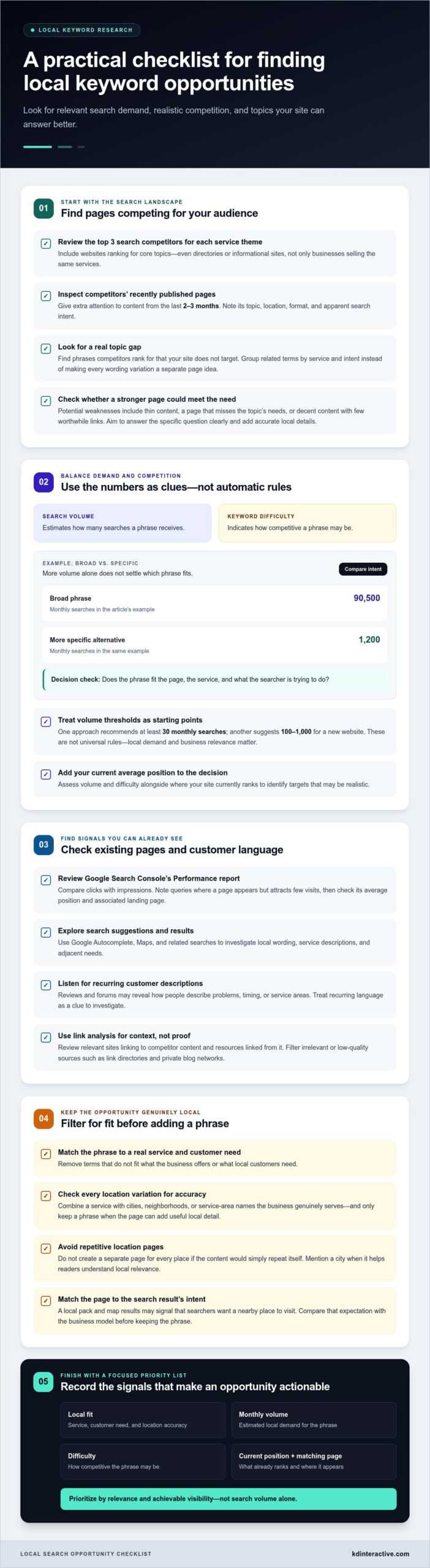
Start by identifying search competitors, not just businesses selling the same services. A website that outranks your business for a core topic can reveal what local searchers expect, even if it’s a directory or an informational site. Review the top 3 competitors for each service theme, then note the pages that attract relevant searches. This gives your research a practical focus: pages competing for your audience’s attention, rather than only familiar local rivals.
Next, reverse-engineer competitors’ new pages. Review content published in the last two to three months and record its topic, location, page format, and apparent search intent. For example, a Watertown heating company might publish a page answering a specific question about furnace repair. Check whether the page addresses a customer need your site hasn’t covered. Underused competitor keywords may help a site start generating traffic in half the time, but relevance and page quality still matter.
Use organic keyword data to find phrases competitors rank for that your site doesn’t target. Group related terms by service and intent instead of treating every wording variation as a separate page idea. Search results also reveal what people expect: a local pack and maps may indicate that users are looking for a nearby place to visit. Compare the results with your business model before adding a phrase to your opportunity list.
Backlink and outbound-link analysis can add context to competitor pages. Review which relevant websites link to their content, filtering out irrelevant or low-quality sources such as link directories and private blog networks. Outbound links may point to resources that help explain a page’s purpose. Treat these links as clues for further research, not proof that a topic will work for your business.
Look for content weaknesses you can address with a more useful page. These include thin content, pages that don’t meet the topic’s needs, or decent content with few worthwhile links. A stronger page should answer the searcher’s specific question, organize information clearly, and add details that matter locally. For example, a snow removal page can explain the service area and property types served when those details accurately reflect the business.
How much does local keyword research software cost? Prices vary by tool and plan, so compare local search data, competitor tracking, exports, and usage limits before choosing. To target local keywords without keyword stuffing or doorway pages, create useful pages for distinct services or search needs. Mention a city when it helps readers understand local relevance, not as a repeated phrase.
2. Prioritizing opportunities by search volume and difficulty
Search volume estimates demand, while keyword difficulty indicates how competitive a phrase may be. Use both alongside your current average position to choose realistic targets. One research approach recommends aiming for at least 30 monthly searches. For a new website, another suggests focusing on phrases with 100-1,000 monthly searches. Treat these ranges as starting points, not universal rules: local demand and business relevance still shape the decision.
Compare broad phrases with specific ones before assigning priority. A broad keyword in one example has 90,500 monthly searches, while its more specific alternative has 1,200 monthly searches. The broad phrase may attract more searches, but the specific phrase can better reflect a service and the searcher’s intent. For a Madison plumber, “plumber” and “emergency drain repair Madison” represent different levels of detail. Check which phrase fits the page and the customer need.
Google Search Console can reveal opportunities in queries already earning impressions. Review the Performance report, compare clicks with impressions, and note queries where a page appears but attracts few visits. Check the average position and the landing page associated with each query. A relevant phrase ranking below the top results may point to a content or page-alignment opportunity, rather than a need to create another page.
To find neighborhood, city, and service-area variations, combine each service with places the business genuinely serves. For example, a Madison landscaper can compare “lawn care Madison” with terms using nearby neighborhoods or a broader service-area name. Keep a variation only when the location is accurate and the page can provide useful local detail. Don’t create a separate page for every place if the content would simply repeat itself.
Google Autocomplete, Maps, and related searches can surface wording and intent worth investigating. Enter a service and location in Google Autocomplete, then note suggested completions; inspect Maps results for how local businesses describe their services. Related searches can reveal adjacent needs, such as “same-day appliance repair” beside a repair query. Reviews and forums add customer language: look for recurring descriptions of problems, timing, or service areas. Forums can appear in the top 10 search results when their topics closely match user needs.
Turn those findings into a simple priority list. Record each phrase’s local fit, monthly volume, difficulty, current position, and matching page, then rank opportunities by relevance and achievable visibility. A focused local keyword review can help organize those signals into clear next steps.
3. Filtering keyword data by relevance and quality
A large keyword export is useful only after you remove irrelevant phrases. Match each query to an actual service, customer need, and location. For a Madison roofing company, “roof inspection Madison” may fit, while “roofing jobs Madison” likely targets job seekers. Keep the intended audience clear: a phrase with search activity has little value if it attracts people the business cannot serve.
Group the remaining terms by search intent before deciding what deserves a page. Separate service inquiries, informational questions, and navigational searches. For example, “emergency plumber near me” signals a need for service, while “how does a sump pump work” asks for an explanation. The same business might address both, but they call for different content and conversion paths. Don’t combine them simply because both mention plumbing.
Check geographic fit carefully. A phrase using a city name is relevant only if the business serves that location and can give visitors useful information. A Milwaukee contractor shouldn’t target a distant town just because its name appears in a keyword list. Neighborhood wording should reflect real service coverage, not a list of place names copied across pages. Local pack and map results can indicate that searchers want to visit a physical location.
Clean the data before assessing its quality. Standardize capitalization, remove duplicates, and group close wording variations that express the same need. Review ambiguous terms manually. “Apple repair” could refer to a device service, a fruit crop, or a company name; the search results and business offering help clarify its meaning. Context matters more than a keyword’s appearance in a spreadsheet.
Check every phrase for relevance. Ask whether the business provides the service, whether the intended customer is local, and whether the site can answer the query better than its existing pages. A Madison dentist could keep “teeth whitening Madison” if the service is offered, but should exclude a phrase about a treatment unavailable at the practice. These checks prevent attractive-looking data from driving unsuitable content.
Finally, compare each phrase with the page already assigned to its topic. If “roof leak repair” and “emergency roof leak repair” reflect the same customer need, one focused service page may serve both. If “roof maintenance checklist” calls for guidance, it may need a separate informational page. Record the phrase, intent, local fit, and best destination in a working sheet. This makes keyword decisions easier to explain and keeps content plans connected to real customer needs.
4. Finding topics mentioned frequently without a dedicated page
A topic can appear across search queries, customer questions, and existing website copy without receiving a page of its own. That gap matters when people repeatedly seek a subject your business can genuinely address. In one example, “Social Media Marketing” appeared 22 times in search queries but was absent from the target page. The recurring phrase signaled a possible topic opportunity, not an automatic instruction to publish.
Start with a simple content inventory. List your important pages, their main purpose, and the questions each answers. Compare that map with recurring phrases from search-query reports, customer conversations, and existing page text. For a Wisconsin landscaping company, repeated searches about native plants might reveal a topic worth exploring. First confirm that it connects to the company’s services and local customers’ needs.
Smaller websites can find these gaps manually. Read each relevant page, mark recurring topics, and check whether any page answers them directly. Search your own site for the phrase, then inspect the results instead of relying on a word count. A phrase mentioned briefly in a paragraph may still lack a page that fully addresses the user’s intent.
Larger websites can use an automated content audit to search page text and query data at scale. Export relevant records, standardize spelling and close variations, then group phrases by topic. Automation helps surface patterns across many pages, but a human review still needs to confirm relevance, context, and whether the site already covers the need. For example, “native plants,” “plants for pollinators,” and “Wisconsin pollinator garden” may share a theme, but each can signal a different question.
Before creating a page, decide whether the topic belongs on an existing page or needs a dedicated destination. Add a focused section to an existing service page when the query supports its purpose. Create a separate page when searchers have a distinct need that deserves a complete answer. A lawn care page can include a useful section on native planting, while a detailed guide may better serve customers researching pollinator gardens.
Build a topic map to prevent thin or repetitive pages. Assign each approved topic a primary page, note related subtopics, and link those pages back to the core page where useful. As a practical guideline, keep the hierarchy to no more than three levels of subpages. Review the map against new queries regularly. A recurring phrase is a strong content candidate when it fits your services, answers a clear local need, and lacks a suitable page.
5. What tools can identify local keyword search volume and competition?
Use a small set of tools, since each answers a different keyword question. Google Search Console shows queries already bringing impressions to your site, along with clicks and average position. Google Keyword Planner can provide search-volume estimates for selected locations. SEO platforms add keyword-difficulty estimates and competitor ranking data. Together, these views help you compare demand, competition, and existing visibility instead of relying on one metric.
Start with location settings. In Google Keyword Planner, set the target area to the city or region where customers can realistically reach you. Then compare service phrases such as “Madison tree removal” and “tree removal near me.” Search volume can vary by location and wording, so treat estimates as directional, not as precise forecasts of visits. A broad national estimate may not represent local demand.
To assess competition, use an SEO platform to review keyword difficulty and the pages ranking for each phrase. Difficulty scores are tool estimates, not a promise of how hard it will be to rank. Inspect the results and note the page types, local businesses, directories, and map listings competing for attention. If local service pages appear, create a page that matches that intent. If guides dominate, consider whether an informative answer fits your site.
Google Search Console is useful for improving an existing page, while keyword planners and SEO platforms help explore new opportunities. Export relevant query and keyword data to CSV files, then combine files from different tools. Compare search volume, difficulty, and average position in one sheet. This can reveal phrases that appear across several datasets and gaps a single tool might not surface. Keep location and date ranges consistent when comparing data.
Build a working shortlist rather than treating every suggestion as a task. One research process recommends shortlisting 100 or more keywords, then reviewing them for local relevance and page fit. Group close variations by customer need, assign each group to an existing or proposed page, and mark which figures came from which tool. Revisit the list every quarter to reflect changes in rankings, services, and search demand.
Before acting, compare the tools’ findings with the actual search results and your knowledge of local customers. A phrase with volume but poor service fit should not outrank a lower-volume query that matches your offering. If you want help turning keyword metrics into a practical local search plan, get support prioritizing local keyword opportunities.
Seed keywords are short-tail terms, typically one or two words long. When reviewing competitors, look for thin content, pages that don’t fully meet a topic’s needs, and decent content with few worthwhile links. These weaknesses can point to opportunities.
KD Interactive: Local SEO Services
When keyword research reveals local opportunities but you need support turning them into a clear plan, KD Interactive can help. Its SEO Keyword Analysis can identify relevant search terms, while Local SEO Services and Content Creation support stronger local visibility and useful pages for Wisconsin customers.
Consider this next step if your keyword list feels scattered, important topics lack dedicated pages, or your content isn’t aligned with local search intent. A focused strategy connects keyword priorities with the pages and content your business needs, rather than chasing every phrase in a tool.
Contact KD Interactive to discuss your local search goals, or visit kdinteractive.com.
Turn Local Search Insights Into Your Next Move
The best next step is to turn promising search terms into a focused plan your team can maintain. Choose a topic that aligns with your services, decide which page should answer it, and make that page genuinely useful to local customers. Track how people find and use the content, then refine your priorities as search behavior changes. Finding untapped local keywords is most valuable when each discovery leads to a clear, relevant improvement to your website.
If you’re ready to put those opportunities into action, KD Interactive can support you with Local SEO Services and Content Creation. Its approach connects local search priorities with content designed for the customers you want to reach.
Contact KD Interactive to discuss your local search goals. A clear plan can help you build visibility with purpose and keep moving forward.
Frequently Asked Questions
How do I find untapped local keywords for my business?
Finding untapped local keywords starts with your customers’ real problems and the services you provide. Write down how customers describe their needs, including informal terms that may not appear in your website copy. Compare those phrases with your pages and identify questions that lack a clear answer. For example, a garage might find that customers repeatedly ask about preparing a car for winter, a topic its service pages don’t cover.
How do I analyze local competitors to find keywords they rank for?
Choose businesses appearing in search results for your main services, then examine the specific pages ranking for those searches. Record each page’s title, subject, and the customer question it addresses. A competitor’s service page may reveal a useful phrase, while a directory listing may suggest a different search intent. Compare these observations with your site to find relevant subjects you haven’t addressed clearly.
How do I assess local keyword difficulty, search intent, and ranking potential?
Assess a phrase by reviewing the actual search results and judging whether your site can provide the kind of answer they feature. A results page dominated by detailed local service pages calls for a different approach than one filled with explanatory guides. Consider your existing expertise, the page quality you can produce, and how closely the phrase matches your services. Tool difficulty scores offer context, but the competing pages show what users encounter.
How do I prioritize local keywords by traffic, conversion value, and competition?
Prioritize phrases by balancing potential traffic with the likelihood that searchers need your service. A broad research query may attract visitors who are still learning, while a specific service phrase may signal that someone is ready to contact a business. Compare those needs with your ability to compete and serve the searcher. Prioritize relevant phrases tied to services you want to grow, then use engagement and inquiries to refine your choices.