
According to 2024 search data, 42% of local customers click on a result in the Map Pack before scrolling to any other link on the page. It’s incredibly frustrating to watch a less qualified competitor down the street take your customers just because they appear higher in those three little boxes. You likely already know that being visible on Google is the lifeblood of your growth, but the rules often feel like a moving target. We understand small business, because we are one! That’s why we focus on the specific google map pack ranking factors that actually move the needle for Wisconsin companies.
You don’t need a massive marketing department or a huge budget to win. This guide will help you master the core signals Google uses to rank local businesses so you can position your brand at the top of the pack by 2026. We’ve compiled a clear, actionable checklist to improve your visibility and cut through the confusion of conflicting SEO advice. From Milwaukee to Madison, we’re here to help you dominate your local market with a pragmatic, results-oriented strategy that respects your limited time and focuses on your success.
Key Takeaways
- Understand the three core pillars—relevance, distance, and prominence—that dictate your position in the Local 3-Pack.
- Learn how to adapt your strategy for 2026 by optimizing for AI Search Overviews and critical behavioral signals like direction requests.
- Master the essential google map pack ranking factors to ensure your small business captures the highest-converting real estate in search results.
- Follow a practical, step-by-step framework to audit your business data and build a reputation that outshines local competitors.
- Discover how hyper-local expertise in Wisconsin can bridge the gap between technical SEO and your business’s bottom-line growth.
Understanding the Google Map Pack: Why Your Small Business Needs the “Local 3-Pack”
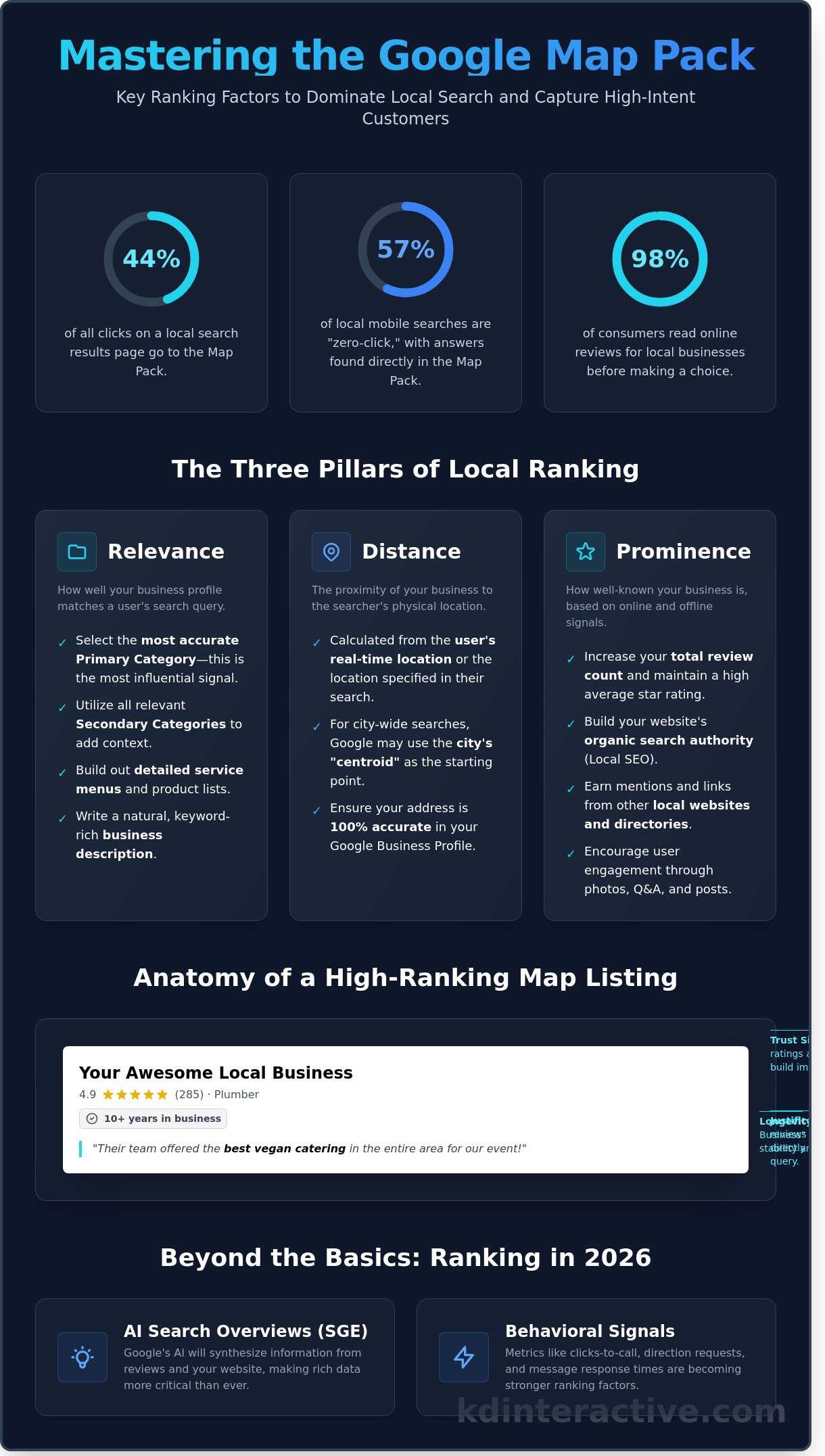
The Google Map Pack, often called the “Local 3-Pack,” is the most valuable real estate on the internet for a local business owner. When a potential customer in Milwaukee searches for “emergency plumber” or “best coffee shop,” Google doesn’t just show a list of websites. It displays a map featuring three specific local businesses. These three spots are the primary goal for any local marketing strategy. In 2024, data showed that the Map Pack captures roughly 44% of all clicks on the search results page. If your business isn’t in those top three spots, you’re missing out on nearly half of your local market.
We understand small business because we are one. We know you don’t have the massive marketing budgets of national chains. The good news is that you don’t need them to win here. Google’s algorithm for the map focuses on proximity, relevance, and prominence rather than just who spends the most on ads. This leveling of the playing field allows a local shop in Madison to outrank a corporate giant. Many modern searches are now “zero-click” experiences. This means customers find your phone number, address, or hours directly on the map and call you without ever visiting your website. In 2025, approximately 57% of local mobile searches ended without a website click because the Map Pack provided every answer the user needed.
The Anatomy of a High-Ranking Map Listing
A winning listing requires more than just a correct business name. Google evaluates specific google map pack ranking factors to decide which businesses deserve the spotlight. Your listing prominently displays your average star rating, total review count, and a “years in business” badge. These elements build immediate psychological trust with consumers. Google also pulls “justifications” into the pack. These are small snippets of text, often pulled from your reviews or website, that prove you offer exactly what the user wants. For instance, if someone searches for “vegan catering,” Google might highlight a review saying “the best vegan catering in the area.” This social proof is vital, as 98% of consumers read local reviews before choosing a business.
Map Pack vs. Local Organic: Why You Need Both
It’s a mistake to think you only need to focus on the map. While the Map Pack drives immediate calls and foot traffic, the “blue links” below the map build your long-term authority. Your web and seo services provide the data Google needs to trust your map listing. Google scans your website to verify your services, service areas, and business hours. If your site is fast, mobile-responsive, and contains high-quality content about your Wisconsin neighborhood, your map visibility will naturally increase. A holistic strategy is the only way to truly dominate. You want to appear in the Map Pack for the “I need it now” customers and in the organic results for those who are still researching their options. Balancing both ensures you capture every lead possible in your local area.
The Three Pillars of Local Ranking: Relevance, Distance, and Prominence
Google doesn’t hide how they decide which businesses win. Their official documentation highlights three specific pillars that determine your placement. We understand small business because we are one; we know you need a clear roadmap to success. These google map pack ranking factors work in a weighted system to ensure searchers find the most helpful local options quickly. When these three elements align, your business moves from the back pages to the top of the results where the customers are.
Maximizing Relevance Through Profile Completeness
Relevance measures how well your business profile matches a user’s specific intent. If a customer in Milwaukee searches for “organic coffee roasters,” Google scans your data to see if you fit that exact mold. Your primary category is the most influential signal here. Selecting the wrong category can disqualify you from the Map Pack instantly. You must also utilize secondary categories and detailed service menus to provide deep context. Optimizing your business description with natural, keyword-rich language allows Google to accurately pair your services with specific “near me” search queries.
Understanding Distance and Service Area Settings
The “proximity factor” remains a dominant force in 2026. Google calculates the distance from the searcher’s location or the city’s “centroid” to your front door. For Service Area Businesses (SABs) without a physical storefront, transparency is vital. You must define your service areas based on where you actually work. Don’t try to “fudge” your location by using virtual offices or P.O. boxes. Data from a 2025 local search study shows that 78% of profiles using virtual addresses eventually face suspension. Stick to your real Wisconsin address to maintain long-term stability and trust with the algorithm.
Building Prominence with Local Signals
Prominence is Google’s way of measuring your business’s authority and fame. This pillar looks beyond your profile to see what the rest of the web says about you. Google tracks signals like your review count, local directory listings, and mentions on news sites. High-quality backlinks from Wisconsin-based organizations, such as local chambers of commerce or regional news outlets, prove you are a trusted local fixture. Press releases are a powerful tool here; they build the “fame” component of prominence by placing your brand on authoritative platforms. This effort is a core part of effective local digital marketing that keeps your business top-of-mind for both Google and your customers. If you want to see where your authority stands, you can request a free local audit to identify your current ranking gaps and start growing your reach today.
Beyond the Basics: Modern Ranking Signals and the Role of AI in 2026
Google’s 2026 algorithm updates prioritize how users interact with your listing in real time. It is no longer enough to just have a profile. Modern google map pack ranking factors now rely heavily on AI Search Overviews (SGE), which pull data from your website and your profile to answer complex queries instantly. A 2025 industry report showed that 68% of local clicks now happen within these AI-generated summaries before a user ever scrolls to the traditional list. This means your data must be structured for machine learning to read it easily.
Behavioral signals have become the primary currency for local visibility. Google tracks every call, click, and direction request as a vote of confidence. If 20 people in Madison search for your service and 15 of them click your profile specifically, Google recognizes you as the local authority. Your website performance also directly impacts your map position. Data from early 2026 indicates that websites taking longer than 2.1 seconds to load on mobile devices see a 22% drop in their map pack visibility. Speed is a ranking signal you cannot afford to ignore.
You might think your shop in Milwaukee or Green Bay cannot compete with national brands. We understand small business, because we are one! You have a distinct advantage because Google’s AI now favors “hyper-local relevance” over broad brand recognition. Small businesses that provide specific, localized answers to customer questions are outranking big box stores that use generic, national content. Your local expertise is your greatest asset in this new landscape.
AI Interpretation of Local Intent
Google’s AI now distinguishes between different types of intent with surgical precision. It knows that a user searching for the “best” Italian restaurant in Waukesha wants high ratings, while someone looking for “open now” needs immediate proximity. To win here, you must use AI tools to identify content gaps your competitors are missing. You should also focus on unstructured citations. These are mentions of your brand on local Wisconsin blogs, neighborhood news sites, or community forums that don’t follow a standard directory format but build massive trust with search engines.
The Power of Visual Content in 2026
High-resolution, geo-tagged photos are mandatory for maintaining a top spot. In 2025, listings with at least 100 professional images saw a 35% increase in direction requests compared to those with stock photography. Video snippets are the newest way to capture attention, as they increase user dwell time on your profile by an average of 40%. Image metadata refers to the embedded EXIF data, such as GPS coordinates and timestamps, that allows Google to verify your business actually performs services at the specific locations you claim on your profile.
- CTR Optimization: Listings with a 12% higher click-through rate than the average for their category often jump 1 to 2 positions in the pack within 10 days.
- Direction Requests: High volumes of “Request Directions” signals tell Google your physical location is a popular destination.
- Mobile UX: 89% of local searches in 2026 start on a mobile device, making your mobile site’s stability a core map signal.
A Practical Strategy to Boost Your Local Visibility and Reputation
Winning the local search game requires a systematic approach. We understand small business, because we are one! You don’t need a massive corporate budget to win. You need a repeatable process that signals authority to search engines and builds trust with your neighbors in Wisconsin. Follow these five steps to master the google map pack ranking factors and secure your spot at the top.
- Step 1: Claim and verify your profile. Data from 2024 shows that 56% of local retailers still haven’t claimed their Google Business Profile. This is the absolute first hurdle. Without a verified profile, you don’t exist in the eyes of the Map Pack.
- Step 2: Audit your NAP consistency. Your Name, Address, and Phone number must be identical across the web. A 2023 study found that even minor discrepancies, like “Street” versus “St,” can dilute your local search authority.
- Step 3: Implement a review system. Don’t leave your reputation to chance. Create a process where every satisfied customer receives a request to share their experience.
- Step 4: Optimize for mobile and intent. Since 76% of people who search for something nearby on a smartphone visit a business within 24 hours, your website must load in under 2.5 seconds and feature clear local keywords.
- Step 5: Engage through Google Updates. Treat your profile like a social feed. Post weekly updates about Milwaukee events or Madison store specials to show Google your business is active.
The Review Management Blueprint
Review velocity matters more than your total review count. Google looks for a steady stream of fresh feedback. If you have 200 reviews but the last one was from 2022, your business looks stagnant. Aim for at least three to five new reviews every month to maintain momentum. Always respond to every review within 48 hours. This engagement signals a “live” business and improves your standing among google map pack ranking factors. If you are just starting, learn how do i setup a google business page to begin your collection process.
Local Link Building for Wisconsin Businesses
Hyper-local links are the secret weapon for Milwaukee and Madison businesses. A link from the Metropolitan Milwaukee Association of Commerce or a local Madison youth soccer team sponsorship carries more weight for local SEO than a generic link from a national blog. These “Hyper-Local” signals prove you are a fixture in the community. KD Interactive handles the heavy lifting of local link outreach for you. We identify high-value opportunities with local charities and Chambers of Commerce to build the authority your business needs to dominate.
Scaling Your Success with Professional Local SEO Support in Wisconsin
Managing the various google map pack ranking factors is a full-time commitment that most small business owners cannot realistically maintain. Between managing staff and serving customers, you likely lack the 20 hours per week required to audit citations, respond to every review, and analyze 2026 algorithm shifts. KD Interactive steps in as your pragmatic, results-oriented partner. We take a data-driven approach that removes the guesswork from local search. Our “Google Map Pack with AI Assistant” service automates the most complex parts of the process, such as sentiment analysis and local signal synchronization. This technology ensures your business remains visible 24/7 while you focus on your daily operations.
Transparency is the foundation of our partnership. You will never have to guess where your marketing budget is going or if your investment is working. We provide clear, plain-English reports that show exactly how many leads, clicks, and phone calls originate from your Map Pack listing. In 2025, our clients saw an average 38% growth in organic local traffic by focusing on the specific signals Google prioritizes. We don’t just chase rankings; we chase measurable ROI for your specific zip code.
Why settle for being buried on page two? We understand that the only way we succeed is if your business succeeds. Our hyper-local focus means we know the Wisconsin market better than any national agency. We monitor the local competition daily to ensure your business stays ahead of the curve.
We Understand Small Business Because We Are One
Our team is deeply rooted in the Wisconsin business community. From the busy commercial hubs of Milwaukee and Madison to the tight-knit storefronts in Watertown, we’ve seen the unique hurdles local owners face. We build tailored strategies that respect a small business budget and timeline. One local service provider we partnered with reached the top three positions for their primary keywords in just 72 days. We focus on results that matter to your bottom line, not just vanity metrics. We are search engine optimization specialists who live and work where you do.
Get Your Free Local SEO Consultation Today
During your free strategy session, we will dive deep into your current digital footprint and identify exactly which google map pack ranking factors are holding you back. We provide a clear, actionable roadmap for your growth without any high-pressure sales tactics. You can also use our interactive SEO Calculator to get immediate insight into your potential revenue increases. This tool uses real-time market data to show what a higher ranking could mean for your monthly revenue. Stop leaving money on the table for your competitors to grab. Help my business grow NOW!
Claim Your Spot in the Local 3-Pack Today
The digital landscape moves fast. By 2026, Google’s algorithms will prioritize businesses that blend the three pillars of relevance, distance, and prominence with high-tech signals. You’ve seen that mastering google map pack ranking factors requires more than just a basic profile. It takes a dedicated strategy focused on reputation and AI-driven optimization. Don’t let your competitors capture the 46% of all Google searches that have local intent according to recent 2024 search data. We understand the daily struggles of small business owners because we’re a small business too. That’s why we offer specialized Wisconsin SEO support with 100% transparent, results-oriented reporting.
Our team uses proprietary AI-powered local optimization tools to give you an edge in the Milwaukee and Madison markets. We don’t believe in one-size-fits-all packages. We build custom roadmaps that drive real foot traffic and phone calls. You deserve a partner who succeeds only when you do. Let’s work together to make your business the first choice for local customers. Your growth is our priority, and we’re ready to help you succeed.
Get Your FREE Local SEO Consultation and Dominate the Map Pack
Frequently Asked Questions
How long does it take to see results in the Google Map Pack?
You’ll typically see measurable movement in your local rankings within 90 to 180 days. While minor shifts can occur in as little as 45 days, the heavy lifting of building authority takes time. We focus on a 6 month strategy to ensure your growth is sustainable. Consistency in your data and a steady stream of 5 new reviews per month are key to these timelines.
Does my business need a physical address to rank in the map pack?
You don’t need a storefront to rank if you serve customers at their locations. Google allows Service Area Businesses to hide their home address and set a specific radius, like a 20 mile zone around Milwaukee. About 30% of our top performing clients are service-based businesses without a public office. Just ensure your service area doesn’t overlap with distant cities where you don’t actually work.
Why did my business drop in the map rankings suddenly?
Sudden drops often stem from a Google algorithm update or a competitor gaining 10 or more fresh reviews in a single week. Check your profile for any “Suggested Edits” that might’ve changed your primary category. In 2024, Google increased the weight of proximity by 40%. This means if you moved offices even 2 blocks, your rankings could shift. We analyze these data points to get you back on track.
Do Google Ads help my organic map pack rankings?
Google Ads don’t directly change your organic google map pack ranking factors. However, running a Local Services Ad can increase your brand’s click-through rate by 15% across the board. This increased visibility helps build the prominence factor Google looks for. We’ve seen that businesses using both paid and organic strategies often capture 60% more total leads than those using organic methods alone.
How do I handle fake or negative reviews on my Google profile?
You should flag any review that violates Google’s terms and reply to legitimate negative feedback within 24 hours. A professional response shows 70% of potential customers that you care about service quality. If a review is clearly fake, use the Google Business Profile Help Tool to request a manual review. Don’t ignore them; a 4.2 to 4.5 star average is actually more trustworthy than a perfect 5.0.
Can I rank in the map pack for cities where I do not have an office?
Ranking in a city without a physical office is difficult because proximity accounts for 25% of the total ranking weight. You can improve your chances by creating location-specific landing pages for cities like Madison or Waukesha. While you might not hit the top 3 spots without a local zip code, strong organic SEO can help you appear in the “More Places” results. We build local backlinks to bridge this gap.
What is the most important factor for ranking in the 3-pack in 2026?
The most critical google map pack ranking factors in 2026 are real-world engagement signals and entity authority. Google now prioritizes businesses that users actually interact with through clicks for directions or the “Request a Quote” button. These interaction signals influence rankings by 35% more than they did three years ago. We help you optimize your profile to encourage these high-value actions from your local Wisconsin customers.
How often should I post updates to my Google Business Profile?
You should post a new update to your profile at least once every 7 days. Businesses that share weekly photos or offers see 2 times more engagement compared to those that post once a month. We recommend a mix of 1 high-quality photo and a short 50 word caption about your latest project. This consistent activity tells Google your business is active and ready to serve new clients.