
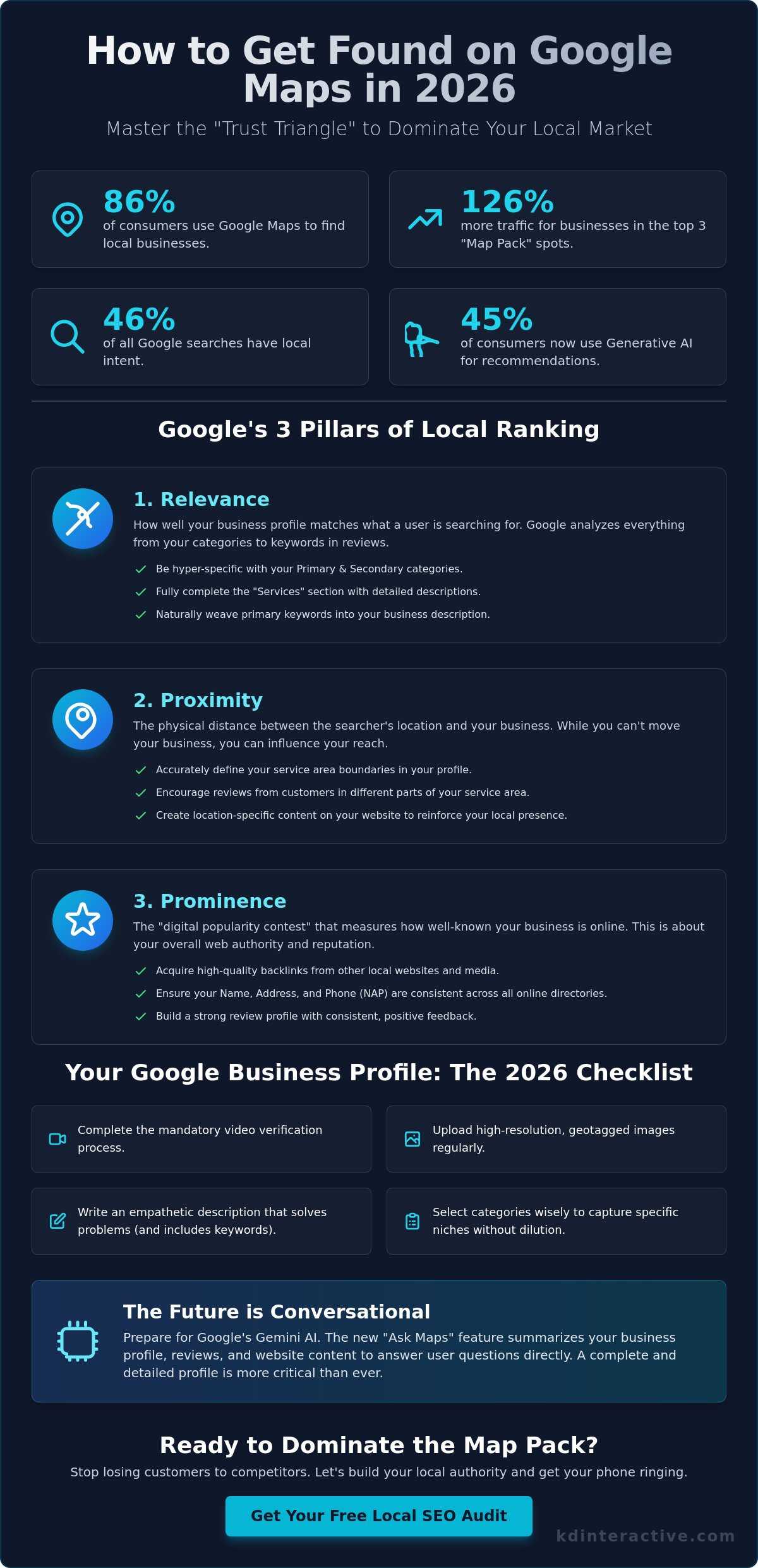
What if the reason you’re losing local customers to less-qualified competitors isn’t your service quality, but a “Freshness” score you didn’t even know existed? We hear it every day from hardworking owners asking: “Why does my business not show up when I search for my services on Google Maps?” It’s frustrating to watch 86% of consumers use Google Maps to find local help while your phone stays silent. Learning how to get found on google maps search is no longer about “set it and forget it” tactics; it’s about staying active in a landscape where 45% of consumers now use generative AI for recommendations.
We understand the struggle of small business because we are one. You’ve likely felt overwhelmed by technical jargon or wasted time on “hacks” that simply don’t move the needle. As local SEO experts in Wisconsin, we believe the only way we succeed is if your business succeeds. This guide will show you exactly how to move your business into the coveted Google Map Pack by mastering the 2026 “trust triangle” of profile optimization, website authority, and real-world validation. We’ll break down the new Gemini-powered “Ask Maps” features, strict 2026 review policies, and the exact steps to land in the top 3 spots where businesses see 126% more traffic than organic results alone.
Key Takeaways
- Master the three core pillars of local search to understand which ranking factors you can control and which you can simply influence for better visibility.
- Learn the exact optimization steps for your Google Business Profile to discover how to get found on google maps search and dominate your local market.
- Go beyond star ratings by building review velocity and maintaining strict NAP consistency to establish undeniable local authority.
- Use Local Business Schema and organic website authority to give your Maps ranking a significant lift in a competitive landscape.
- Prepare for the shift toward conversational search and learn how Google’s Gemini AI now summarizes your business details for potential customers.
Understanding the Google Maps Algorithm: Proximity, Relevance, and Prominence
Google uses a specific recipe to decide which businesses deserve the top spots in the Local Pack. If you want to know how to get found on google maps search, you must master the three pillars of local SEO: proximity, relevance, and prominence. These factors determine whether your shop appears when a hungry customer searches for a local café or a homeowner needs an emergency plumber. Understanding Local SEO requires moving past the idea that Google just picks the closest business. It’s a complex calculation designed to provide the most helpful answer in seconds. Since 46% of all Google searches have local intent, the algorithm is constantly working to match users with the most authoritative local options.
The Proximity Paradox
Proximity is the distance between the searcher and your business. It’s the one factor you cannot control, but you can influence it. Google determines “searcher intent” based on GPS data or the location mentioned in a query. You might not rank for a user 10 miles away even if you are the best in the state; Google prioritizes convenience. However, you can expand your reach by accurately setting your service area boundaries. This helps the algorithm understand your true operating radius.
Prominence: The Digital Popularity Contest
Optimizing Your Google Business Profile for Maximum Visibility
Your Google Business Profile (GBP) is the digital storefront of 2026. It is the most powerful tool you have when determining how to get found on google maps search. However, a “set it and forget it” approach no longer works. As of early 2026, Google has standardized video verification for most regions to combat spam and ensure your business is legitimate. This means you need to be ready to show your physical location, equipment, and proof of management through a live or recorded video. We understand small business, because we are one! We know that these technical hurdles can feel overwhelming, but completing them is the first step toward dominating your local market in Milwaukee or Madison.
Once verified, your focus must shift to profile completeness. Profiles with high-resolution, geotagged images see significantly higher engagement because they provide visual proof of your location to both Google and your customers. When writing your business description, balance SEO keyword analysis with human empathy. Describe how you solve your customers’ problems while naturally including your primary services. For a deeper look at the technical requirements, this comprehensive guide to Google Business Profile offers a roadmap for 2026 domination.
Selecting Your Categories Wisely
Your primary category carries the most weight in the algorithm. If you choose a term that is too broad, you’ll get lost in the noise. If it’s too narrow, you’ll miss out on relevant traffic. Use secondary categories to capture specific niches, but avoid “over-categorizing,” which can dilute your relevance. For a detailed walkthrough on choosing the right labels, see our guide on how to set up a Google Business page. Getting this right is a foundational step in our Local SEO services.
The Power of Google Posts and Freshness
In 2026, “freshness” is a critical ranking factor. Profiles that have not been updated with new photos or posts within 30 days often see a measurable drop in visibility. Frequent posting acts as a “freshness” signal for the algorithm, telling Google that your business is active and reliable. While the official Q&A feature was discontinued in late 2025, you should now use your posts and service descriptions to pre-emptively answer customer questions. This proactive approach ensures Google’s AI assistants have the right data to recommend you during conversational “Ask Maps” queries.
Building Local Authority Through Reviews and Consistent Citations
Building authority is about proving to Google that your business is real, reliable, and active in your community. 88% of consumers trust online reviews as much as personal recommendations in 2026. This level of trust is exactly how to get found on google maps search when local competition is high. It isn’t just about having a high star rating anymore. Google now prioritizes review velocity (how often you receive new feedback) and diversity (getting reviews from a wide range of customers). If your profile hasn’t received a fresh review in 30 days, your visibility will likely drop due to the “freshness” factor being a heavier ranking signal this year.
Consistency across the web is equally vital for your ranking. The NAP rule ensures your Name, Address, and Phone number are identical on every platform where your business is mentioned. Building local authority with citations creates a web of trust that confirms your physical location to the algorithm. Inconsistent data on platforms like Yelp, the Yellow Pages, or local Wisconsin directories sends mixed signals that hurt your rank. Google needs to be 100% certain of your data before it will recommend you to a user via “Ask Maps” or standard search.
The NAP Consistency Audit
Start by checking your information on major directories and local Wisconsin hubs, such as the Wisconsin Business Directory or your local Chamber of Commerce. Even a small difference like “St.” versus “Street” can cause confusion for AI crawlers. We find that local SEO services near me often begin with a deep citation audit to fix these errors. Use tools like BrightLocal to scan for duplicates or outdated addresses from when you first opened your doors in Milwaukee or Madison. Correcting these errors provides a quick “lift” to your Maps authority.
Review Strategy for Small Businesses
Ask your customers for feedback at the moment of peak satisfaction. Don’t be pushy. Instead, explain that their feedback helps other local neighbors find quality service. In 2026, the content of the review matters more than ever. When a customer mentions the “best plumber in Watertown” or uses specific service keywords, it acts as a powerful relevance signal. Responding to every review is now non-negotiable. Whether it’s a five-star praise or a one-star complaint, your response shows future customers that you’re an active, caring partner. Remember that 2026 policies strictly prohibit offering incentives for reviews or using on-site review kiosks. Focus on genuine interactions to build a professional online reputation that survives any algorithm update.
Connecting Your Website to Google Maps for Better Rankings
Your website and your Google Business Profile are not separate tools; they are two halves of the same local search engine. Many business owners overlook this synergy, yet it is a primary driver in how to get found on google maps search. When your website ranks well organically, it provides a “lift” to your Map listing. This happens because Google uses your site’s authority to verify your prominence. If your website is buried on page five, your Map profile will likely struggle to break into the top three. This connection is why we emphasize a holistic approach rather than just focusing on the profile itself.
Local Business Schema: The Secret Language
Structured data is a specific code that speaks directly to Google’s AI. By implementing JSON-LD Local Business Schema, you provide a clear, machine-readable confirmation of your address, hours, and services. This eliminates any guesswork for the algorithm. It acts as a digital handshake between your site and the Map Pack. If you need help with technical implementation, our web and SEO services ensure your site is speaking Google’s language fluently and accurately.
Location-Specific Content
Generic content won’t cut it in 2026. You need service-area pages tailored to cities like Milwaukee, Waukesha, or Madison. Mentioning local landmarks like the Milwaukee Art Museum or specific neighborhood names helps Google’s AI assistants connect your business to the physical world. This isn’t just about keywords; it’s about context. Ensure your website content matches the services listed on your Map profile. If you claim to be a “24-hour plumber” on your profile but your website says you close at 5:00 PM, you will lose the algorithm’s trust.
Finally, prioritize a mobile-first design. Since 76% of people who conduct a local search on their smartphone visit a business within 24 hours, your site must load instantly. A slow mobile experience can kill your conversion rate even if you rank well. Your footer and contact page should mirror your NAP (Name, Address, Phone) data exactly. In 2026, Google’s “Ask Maps” feature pulls data from these pages to answer complex user questions. If your site is mobile-optimized and technically sound, you’ll see a consistent stream of local phone calls. We specialize in building sites that turn direction requests into actual foot traffic. To see how your current site measures up and learn more about how to get found on google maps search, get your free consultation with our Wisconsin-based team today.
Navigating the 2026 Local SEO Landscape with KD Interactive
The 2026 local search landscape has moved beyond static lists. Google’s Gemini AI now powers “Ask Maps,” a feature that lets users ask complex questions to get personalized recommendations. This shift means the algorithm is looking for depth. It pulls from your reviews, photos, and service details to summarize your business for potential customers. If your profile lacks detail, the AI simply won’t recommend you. We understand small business, because we are one! We know you don’t have hours to spend monitoring every minor algorithm tweak. A “set it and forget it” approach will leave you behind while competitors who stay active dominate the results. Our “Map Pack with AI Assistant” service helps bridge this gap by ensuring your profile remains optimized for these conversational summaries.
Voice Search and Conversational Queries
Searchers are moving away from short phrases like “plumber near me” toward complex questions. They now ask things like “Where is the nearest plumber who handles emergency pipe bursts and has 24-hour service?” Your business description needs to use natural, conversational language to match these queries. AI tools now analyze customer reviews to answer these specific questions for you. When a reviewer mentions your “fast response for a basement flood,” it becomes a data point that Gemini uses to recommend you. In early 2026, 45% of consumers use generative AI tools for local business recommendations. This is a massive jump from just 6% in 2025. Learning how to get found on google maps search now requires managing your reputation as a data source for these AI models.
Partnering for Success in Wisconsin
Dominating the Local Pack requires a partner who knows the Wisconsin terrain. As local SEO experts in Wisconsin, we focus on the specific needs of businesses in Milwaukee, Madison, and the surrounding communities. We don’t just offer generic advice; we provide tailored solutions that drive a consistent stream of phone calls and direction requests. Our methodical approach uses analytics and tracking to ensure measurable results. We believe in transparent, data-driven growth. The only way we succeed is if your business succeeds. You deserve a professional online reputation that works as hard as you do. Let’s start building your dominance in the local market today. Get your free consultation with KD Interactive and help your business grow now!
Take Control of Your Local Visibility and Dominate the Map Pack
The transition to AI-driven search in 2026 means that simply having a profile is no longer enough. You must actively feed Google’s algorithm with high-quality data, fresh reviews, and technical schema that confirms your authority. We have explored how 86% of consumers use Maps to find their next service provider; missing out on those leads is a risk your business shouldn’t take. Mastering how to get found on google maps search is the single most effective way to ensure a consistent stream of direction requests and phone calls from local customers.
We understand small business because we are one! Our team of Wisconsin-based experts has a proven track record of moving clients into the top spots where they see 126% more traffic than organic results alone. We provide transparent, results-oriented reporting so you always know exactly how your investment is driving growth. Stop losing customers to less-qualified competitors who simply have better digital visibility. Get Your FREE Local SEO Consultation today and let us handle the technical jargon while you focus on serving your community. Your success is our success, and we’re ready to help your business grow now.
Frequently Asked Questions
How long does it take to show up on Google Maps search?
Most businesses see their initial listing appear within 2 to 4 weeks after completing the mandatory video verification. However, climbing into the top 3 Map Pack results typically requires 3 to 6 months of consistent optimization. Google’s 2026 “freshness” factor means you must update your photos or posts every 30 days to maintain your ranking momentum and visibility.
Can I rank on Google Maps if I do not have a physical office?
You can definitely rank by listing your business as a Service Area Business (SAB) in your profile settings. You simply hide your home address and define the specific Wisconsin counties or cities you serve. Since 76% of people who conduct a local search on their smartphone visit a business within 24 hours, being an SAB is a highly effective way to capture local leads.
Do I need to pay Google to be in the top 3 Map results?
Organic Map Pack rankings are free and earned through proximity, relevance, and prominence. You don’t have to pay a fee to appear in the top 3, though you can choose to run “Promoted Pins” through Google Ads. A typical monthly budget for small business local ads ranges from $1,000 to $10,000, but the organic spots remain the most trusted by consumers.
How do I change my business address on Google Maps without losing my rank?
Update your address in the “Info” tab of your Google Business Profile and be prepared for a re-verification request. Google’s 2026 standards often require a new video verification to confirm the legitimacy of your move. To protect your rank, you must update your NAP data on your website and all Wisconsin directories simultaneously to prevent any trust-damaging inconsistencies.
What is the most important ranking factor for Google Maps in 2026?
“Freshness” and “AI-Readiness” have become the most critical factors for staying visible this year. While proximity is the baseline, businesses that provide detailed service descriptions and regular updates rank higher. This level of detail is how to get found on google maps search because it allows Google’s Gemini AI to accurately recommend your business during conversational “Ask Maps” queries.
How do I remove a fake or spammy review from my Google listing?
Flag the review in your dashboard for a specific policy violation, such as “Conflict of Interest” or “Spam.” Google’s 2026 review policies are much stricter, so you should provide clear evidence if the reviewer was never a customer. If the review stays, write a professional response to show the 88% of consumers who read reviews that you are a reliable partner.
Does having a high organic ranking help my Google Maps visibility?
Yes, your website’s organic authority provides a direct “lift” to your Maps ranking by proving your prominence to the algorithm. Google uses your site’s content and backlink profile to verify that your business is a leader in its field. Implementing Local Business Schema on your site is a vital step in how to get found on google maps search because it confirms your data.
What happens if my business has multiple locations in Wisconsin?
You must create and verify a unique Google Business Profile for every physical location you operate. Each profile requires its own local phone number, specific photos, and tailored service descriptions for cities like Milwaukee or Madison. Managing multiple locations requires a centralized strategy to ensure that NAP data remains consistent across the web, which prevents ranking-killing data conflicts or profile suspensions.