
The true local seo cost for small business isn’t determined by arbitrary agency rate sheets, but by your actual geographic market density and competitive landscape. If you’ve spent any time requesting proposals, you’ve likely received wildly inconsistent estimates that leave you guessing. One provider pitches an automated bargain package, while another demands an enterprise retainer with vague promises about visibility. It’s frustrating when you simply want to know what work is actually required to turn searchers into paying customers without getting locked into vanity metrics.
You deserve complete clarity before committing your hard-earned marketing budget. In this guide, you’ll learn how realistic local search investment models function, which specific deliverables move the needle in Google Map Pack results, and how to evaluate your territory’s true competition level. We’ll also cover the essential questions you must ask any agency before signing on the dotted line, so you can partner with a provider that drives measurable calls, foot traffic, and revenue.
Key Takeaways
- Understand how geographic market density, local competition, and business maturity dictate the realistic local seo cost for small business instead of arbitrary agency fees.
- Compare the distinct advantages of monthly retainers, project-based sprints, and hourly consulting to select the right contracting model for your growth stage.
- Identify the core deliverables required to secure Google Map Pack positions, including profile optimization, review acquisition strategies, and localized content assets.
- Apply a practical budgeting framework grounded in your average customer value to set realistic acquisition targets and track measurable revenue gains.
- Spot common warning signs in cheap, automated service proposals and master the exact vetting questions to ask prospective partners before signing an agreement.
Deciphering Local SEO Cost: What Small Businesses Actually Pay For
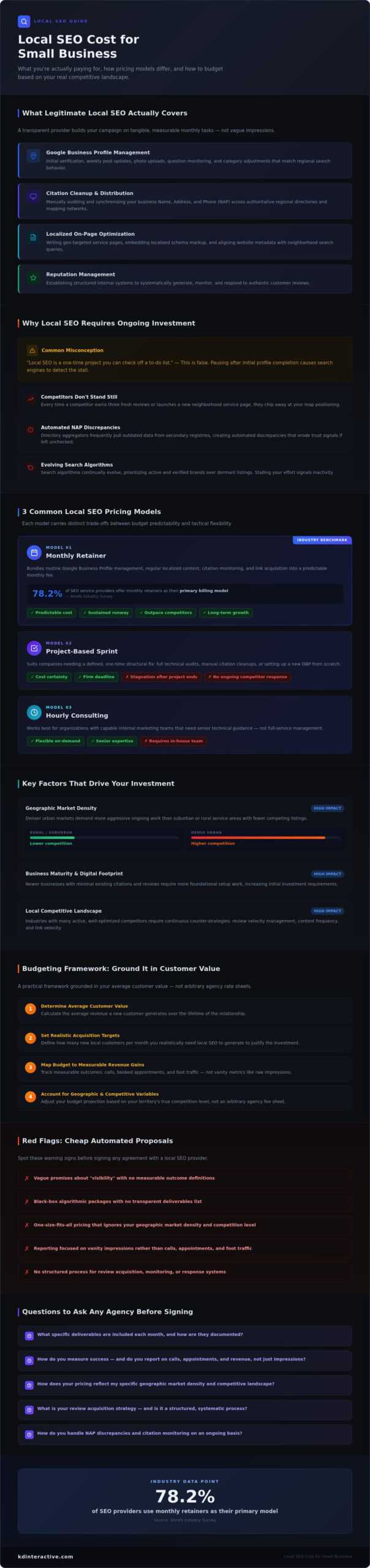
Every marketing line item needs to justify its existence on a balance sheet. When you look closely at the realistic local seo cost for small business, you aren’t paying for black-box algorithms or vague vanity impressions. You are funding the specialized, hands-on labor required to capture nearby search demand right when buying intent peaks. Unlike broad organic campaigns that cast a nationwide net, local search engine optimization zeroes in on driving actual phone calls, booked appointments, and foot traffic from qualified prospects within your specific service territory.
Core Deliverables Included in Legitimate Local SEO Scopes
A transparent provider builds your campaign on tangible, measurable tasks. Here is what legitimate local optimization labor covers month after month:
- Google Business Profile management: Initial verification, weekly post updates, photo uploads, question monitoring, and category adjustments that match regional search behavior.
- Citation cleanup and distribution: Manually auditing and synchronizing your business Name, Address, and Phone number (NAP) across authoritative regional directories and mapping networks.
- Localized on-page optimization: Writing geo-targeted service pages, embedding localized schema markup, and aligning website metadata with neighborhood search queries.
- Reputation management: Establishing structured internal systems to systematically generate, monitor, and respond to authentic customer reviews.
Why Local SEO Requires Ongoing Investment Rather Than One-Time Setup
A common misconception is that local optimization is a one-time project you can check off a to-do list. In practice, search algorithms continually evolve, prioritizing active and verified brands over dormant listings. If you pause your efforts after initial profile completion, search engines detect the stall.
Nearby competitors also don’t sit idle. Every time a competitor down the street earns three fresh customer reviews or launches a new neighborhood service page, they chip away at your map positioning. Directory aggregators frequently pull outdated data from secondary registries, creating automated NAP discrepancies that erode trust signals if left unchecked. Sustained local investment protects your digital territory, shields your rankings from algorithmic volatility, and ensures your small business captures steady leads all year long.
Common Local SEO Pricing Models: Retainers, Projects, and Hourly Rates
Agencies structure service agreements differently depending on their internal operations and your growth objectives. Rather than forcing your company into a rigid box, reputable partners match their billing format to your current operational needs. Determining the right structure is essential for projecting your local seo cost for small business accurately over a full fiscal year. Each option carries distinct trade-offs between budgetary predictability and tactical flexibility.
Monthly Retainer Agreements for Steady Market Growth
The monthly retainer serves as the industry benchmark for long-term growth. This model bundles routine Google Business Profile management, regular localized content, citation monitoring, and link acquisition into a predictable monthly operational fee. According to an industry survey by Ahrefs, 78.2% of SEO service providers offer monthly retainers as their primary billing model. Retainers give the agency the sustained runway needed to test strategies, build geographic relevance, and outpace active competitors without nickel-and-diming you for every localized update.
Project-Based Local SEO for Audits and Initial Foundations
Project-based contracts suit companies needing a defined, one-time structural fix. Common project scopes include full technical website audits, manual citation cleanups, or setting up a new Google Business Profile from scratch. The primary benefit is cost certainty. You pay a set fee for an agreed-upon list of deliverables with a firm completion deadline. The main drawback is stagnation: once the engagement ends, ongoing tasks like review velocity management, algorithmic adjustments, and proactive competitor counter-strategies stop completely.
Hourly Consulting and Niche Advisory Support
Hourly consulting works well for organizations that maintain capable internal marketing teams but need senior technical guidance. Common hourly engagements cover algorithmic penalty recoveries, complex website migrations, or localized keyword mapping before a major redesign. Across the search industry, typical rates for specialized US agency consultants range between $100 and $250 per hour. While this provides extreme flexibility, paying hourly for basic execution tasks quickly strains small business budgets.
Before committing to any contract structure, conduct thorough market research and competitive analysis to evaluate your market’s true difficulty level. If you are comparing proposals and want an objective look at what your service area requires, partnering with a dependable team like KD Interactive can help clarify the exact scope needed to drive local revenue.
Key Factors That Determine Your Business Local SEO Investment
Every commercial market operates under its own rules. When estimating your local seo cost for small business, generic package rates fail because they ignore the physical realities of your operational footprint. Search engines evaluate geographical prominence and relevance within specific regional borders. As a result, your necessary investment is shaped directly by your competitive surroundings, the breadth of your service territory, and the baseline health of your web assets.
Market Competition and Regional Population Density
Population density changes everything. Competing for search placement in a dense metro market like Milwaukee requires significantly more aggressive outreach, link building, and content publishing than ranking in a tight-knit community like Watertown. In major metropolitan areas, hundreds of established competitors vie for the exact same Google Map Pack spots. High-ticket verticals such as personal injury law, roofing, or emergency HVAC face aggressive bidding and entrenched competitors with hundreds of reviews. In contrast, smaller regional markets require fewer localized assets to secure top rankings, lowering the ongoing labor hours required.
Single-Location Versus Multi-Location Service Areas
Your geographic scope dictates how many digital assets an agency must build, monitor, and defend. Operating a single brick-and-mortar storefront concentrates your efforts around a single Google Business Profile and localized homepage signals. Expanding across multiple territories creates complex operational requirements:
- Service-area footprints: Serving multiple counties requires dedicated, high-converting location landing pages that prevent keyword cannibalization across adjacent towns.
- Multi-branch verification: Each physical storefront requires individual Google profile verification, separate review acquisition campaigns, and distinct localized photo updates.
- Directory scaling: Listing consistency must be established and audited across every individual physical address, multiplying citation management hours.
Current Website Authority and Technical Condition
Where your site starts determines how fast it moves. A brand-new domain with zero established trust signals requires extensive foundational work, including technical infrastructure setup, core local keyword analysis, and initial backlink generation before competitive phrases can gain traction. An established business domain that already possesses ten years of local market trust requires far less preliminary heavy lifting.
Technical debt also drives up initial labor. Slow load speeds, broken mobile layouts, and missing local schema markup force developers to repair foundational code before promotional work begins. Factoring in these technical repairs gives you a practical, data-backed expectation for your overall local seo cost for small business.
A Step-by-Step Local SEO Budgeting Framework for Small Businesses
Budgeting for search optimization should never feel like guessing on a roulette wheel. Rather than committing to arbitrary agency packages, build your financial targets around your unit economics and measurable customer acquisition goals. This practical framework grounds your local seo cost for small business in verifiable financial returns, ensuring every marketing dollar supports bottom-line profitability.
Calculating Local Search ROI and Customer Acquisition Targets
Every dependable marketing plan starts with customer value. To establish a justifiable acquisition budget, follow a simple three-step calculation:
- Determine gross lifetime profit: Calculate the average net profit a customer brings across their entire relationship with your business, factoring in recurring work or repeat visits.
- Track inquiry close rates: Review your historical sales data to determine how many incoming phone calls, map direction requests, or form submissions convert into paying jobs.
- Reverse-engineer acquisition cost: If a local customer generates $3,000 in gross margin and your front desk closes one out of every three qualified inquiries, you can comfortably spend a portion of that margin to acquire each verified lead while maintaining strong margins.
Connecting your monthly spend directly to customer lifetime value prevents emotional decision-making. You stop viewing search optimization as an overhead expense and start managing it as an accountable revenue engine.
Balancing In-House Execution Against Full Professional Management
Small business owners often achieve the best cost efficiency by adopting a hybrid management approach. Your on-site team is uniquely positioned to handle frontline assets: snapping authentic job-site photos, recording behind-the-scenes video updates, and asking satisfied local customers for Google reviews right at the point of sale. These real-world trust signals cannot be manufactured authentically by an outside vendor.
Conversely, specialized tasks require technical proficiency and dedicated commercial tools. Implementing localized JSON-LD schema markup, diagnosing crawl anomalies, executing competitive citation audits, and building regional digital PR links demand technical expertise. When vetting partners to handle these technical layers, consult our guide on choosing the right SEO agency for small business growth for evaluation tips. If you want to streamline this operational workload, partner with KD Interactive to manage your local search strategy and secure predictable territorial growth.
How to Evaluate Agency Proposals and Avoid Costly Traps
Evaluating agency quotes often feels like comparing apples to construction equipment. When assessing the true local seo cost for small business, the lowest quote on paper frequently becomes the most expensive mistake in reality. Providers charging rock-bottom fees typically rely on automated software syncs and spam scripts that deliver zero real-world inquiries while locking you into restrictive terms. Separating predatory sales pitches from genuine operational expertise protects both your marketing capital and your digital reputation.
Red Flags in Low-Cost Local SEO Packages
If a proposal looks too good to be true, your instincts are spot on. Watch for these operational traps when reviewing service scopes:
- Guaranteed overnight map rankings: No ethical marketer controls Google’s ranking algorithms. Promises of immediate top-three placement almost always rely on keyword-stuffed profile titles and manipulative tactics that trigger profile suspensions.
- Automated directory blasts and link spam: Cheap monthly packages often farm out link building to automated bots and irrelevant networks. These shortcuts degrade your domain authority and risk severe algorithmic penalties.
- Hostage digital assets: Never work with an agency that insists on owning your Google Business Profile, local citations, or analytics properties. You must maintain primary administrative ownership of your assets.
- Proprietary dashboard obfuscation: Agencies hiding raw data behind custom portals often mask stagnant call volumes. For a deeper breakdown of sustainable mechanics, review our complete guide to local SEO services near me.
Questions to Ask Potential Providers Before Signing an Agreement
Interview candidate agencies with the same rigor you would use when hiring a key employee. Demand specific answers to these direct questions:
- “How do you earn hyper-local citations and backlinks from authentic community sources?”
- “How do you configure call tracking and form attribution to tie campaigns directly to closed customer revenue?”
- “Will our account strategy be handled by dedicated regional specialists or outsourced overseas?”
Legitimate partners welcome these questions because their business model depends on measurable client retention. If you want honest guidance backed by reliable execution, discover how KD Interactive Local SEO Services helps regional businesses establish lasting map visibility and steady customer acquisition.
Turn Your Local Search Budget Into Measurable Growth
Securing top placement in your territory shouldn’t feel like a shot in the dark. The realistic local seo cost for small business always reflects your competitive market density, target customer value, and deliberate monthly labor. By rejecting bargain automated packages and demanding clear deliverable scopes, you trade empty vanity metrics for qualified inquiries and higher revenue.
As Wisconsin-based regional search specialists with proven Midwestern market expertise, KD Interactive builds customized Google Map Pack optimization around verified call tracking and actual lead generation. We operate with complete transparency. You retain 100% ownership of your profiles, citations, and tracking data with no proprietary data silos or hidden traps. Take the next step toward dominating your local territory. Request a transparent local SEO strategy plan with KD Interactive and start expanding your regional reach today.
Frequently Asked Questions
Is local SEO worth the investment for a very small service business?
Yes, local SEO delivers exceptional returns for small service companies because it captures prospects searching with immediate buying intent. When homeowners or commercial clients search for emergency repairs or regional contractors, they rarely look past the top map listings. Allocating a focused budget toward local visibility secures recurring phone calls and qualified inquiries, making the overall local seo cost for small business far more sustainable than continuous pay-per-click bidding.
Why do local SEO quotes vary so dramatically between different agencies?
Price variations stem primarily from the difference between manual labor and automated tools. Low-end quotes typically cover software-driven directory syncs with no dedicated human oversight. Higher-tier proposals fund custom localized content creation, proactive review campaigns, technical schema updates, and hands-on regional link acquisition. Pricing also shifts based on an agency’s market expertise and whether work is completed internally by regional specialists or outsourced overseas.
How long does it typically take to see measurable returns from a local SEO campaign?
Most small businesses begin seeing initial ranking improvements and increased profile views within 60 to 90 days. However, driving consistent map pack placements, inbound phone calls, and converted revenue typically requires four to six months of active optimization. Highly competitive service areas or newly registered domains often take longer, as search engines require time to verify location trust, index citations, and measure consumer interaction signals.
Can I handle my own small business local SEO without hiring an outside agency?
You can manage foundational baseline tasks internally, such as claiming your Google profile, requesting customer reviews, and uploading job site photography. However, scaling your regional visibility requires deeper technical proficiency. Diagnosing indexation errors, building structured schema markup, executing competitor keyword analysis, and managing multi-channel citations consume considerable time. Attempting to handle full technical execution yourself frequently pulls valuable focus away from daily client operations.
Does running Google Local Services Ads eliminate the need for ongoing local SEO?
Paid advertising does not replace local SEO; the two channels complement each other. Google Local Services Ads stop generating leads the second your daily ad spend runs out. Local SEO builds a durable digital footprint that generates organic inquiries without a recurring cost per click. Organic authority also reinforces paid campaigns. Searchers frequently cross-reference sponsored ad listings with verified Google Map Pack reviews before calling.
What happens to my local search rankings if I pause my monthly SEO services?
Your rankings won’t drop overnight, but your visibility will gradually erode over time. Local search algorithms reward fresh activity, steady customer review velocity, and accurate directory citations. Nearby competitors will continue publishing localized pages and earning citations. As directory information drifts and competing listings gain traction, unmanaged profiles slowly slide down the map pack, ultimately increasing the future local seo cost for small business recovery.
How does optimizing for the Google Map Pack differ from standard website SEO?
Standard website optimization focuses on technical site health, domain authority, and organic keyword rankings across national or regional search result pages. Google Map Pack optimization targets the local 3-pack box driven by proximity, profile completeness, and geographic relevance. It prioritizes verified physical addresses, review recency, primary category alignment, and consistent localized directory citations rather than traditional backlink volume alone.