
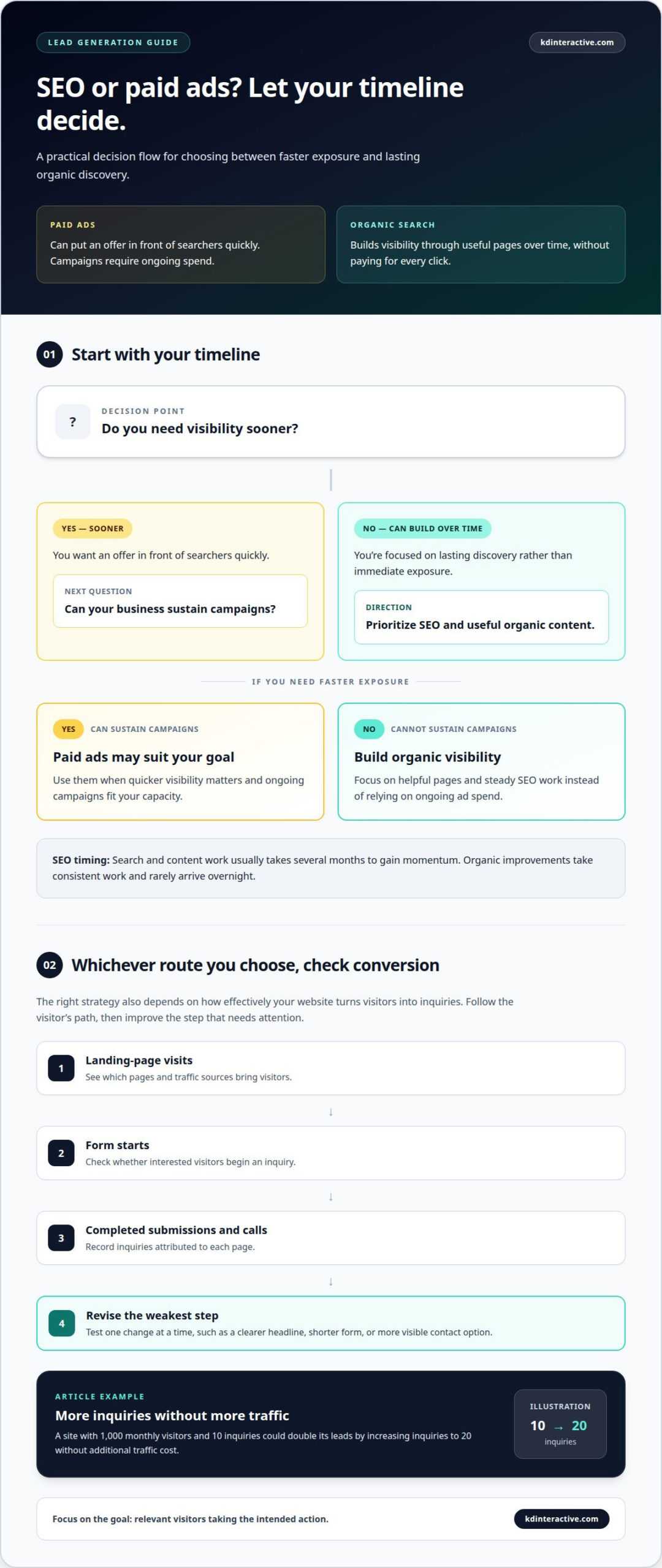
Paid ads can bring attention quickly, but organic marketing can build a steadier path to leads without paying for every click. If you’re weighing how to get more leads without paying for ads, SEO can be a stronger long-term approach. Paid ads may suit businesses that need visibility sooner and can sustain campaigns. The right strategy depends on your timeline and how effectively your website turns visitors into inquiries.
It’s understandable to want a reliable source of new business without ongoing ad spend. Organic results take consistent work and rarely arrive overnight, but improvements to your website, local visibility, and reputation can support discovery over time.
This guide explains how SEO compares with paid ads for lead generation, then covers practical ways to attract prospects organically. Learn how to strengthen website pages, build local trust through reviews, encourage referrals, and form useful business partnerships, so you can focus on efforts that support growth.
Key Takeaways
- Choose between SEO and paid ads based on your timeline, budget, and whether you need lasting visibility or faster exposure.
- Improve website pages and lead capture so organic visitors have a clear next step when they’re ready to inquire.
- Build local visibility by strengthening your reputation and making it easier for nearby customers to discover and trust your business.
- Encourage satisfied customers to refer others, and develop partnerships that connect your business with relevant audiences.
1. Is SEO better than paid ads for lead generation?
SEO and paid ads serve different lead-generation goals. Paid ads can put an offer in front of searchers quickly, while organic search builds visibility through useful pages that attract relevant visitors over time. Search and content work usually takes several months to gain momentum, so it suits businesses focused on lasting discovery rather than immediate exposure. To attract organic traffic, match each page to a specific customer need, such as comparing service options or solving a common problem. Focused content helps search engines connect your page with people looking for answers.
Plan content around customer questions, not a publishing quota. Group related topics into a calendar, then create an article, service page, or guide for each search intent. For example, a home contractor could explain how to prepare for a roof inspection and link to a relevant service page. Repurpose the article as a short social post, checklist, and customer FAQ. Social media automation can schedule those versions, while someone reviews comments and responds personally. This extends each piece without treating automated posts as a substitute for interaction.
For U.S. commercial email, CAN-SPAM applies to business-to-business messages and requires honoring opt-out requests within 10 business days. Privacy obligations depend on the information collected and applicable state rules, so explain why a form requests each detail and how submissions will be used. Email can generate leads by sharing useful updates with people who chose to hear from you. Costs depend on platform features, list management, and the time required to create and send content.
Start with practical tools: a spreadsheet can organize topics and outreach, while website analytics can show which pages attract visits and inquiries. Tool pricing limits vary by provider and plan, including caps on contacts, reports, or scheduled posts. Check those limits against your workflow before building a process around a platform.
Evergreen guides, such as a seasonal maintenance checklist, can attract search traffic beyond a single campaign. Offer a related downloadable checklist as a lead magnet, with a concise form that captures only useful details. Share suitable articles on relevant industry websites or community publications, following their editorial rules and linking to the original resource where allowed. Press release distribution can also support organic reach when there is genuine business news, rather than routine promotions repackaged as announcements.
2. Website lead capture and conversion optimization
A landing page should answer one customer question and make the next step obvious. Match its headline to the search or social post that brought the visitor. Explain the service, show relevant proof, and place a clear inquiry button near the main message. For example, a plumbing page about water-heater installation should focus on that service, not a general company introduction. Keep navigation focused so visitors can act without searching through unrelated pages.
Improve forms by asking only for details you need to respond. A local service inquiry might need a name, a way to reply, and a short description of the job. Remove fields that don’t help qualify or handle the request. Explain what happens after submission, use clear labels, and make error messages easy to understand. On mobile, test that fields, buttons, and confirmation messages work on a small screen. These changes reduce friction and help interested visitors convert.
Track lead generation from the first visit through the inquiry. Record landing-page visits, form starts, completed submissions, and calls attributed to the page. Compare those actions by page and traffic source, then revise the weakest step. For example, a site with 1,000 monthly visitors and 10 inquiries could double its leads by increasing inquiries to 20 without additional traffic cost. The useful measure is not traffic alone, but how often relevant visitors take the intended action.
Test one change at a time, such as a clearer headline, shorter form, or more visible contact option. Review results over a consistent period and keep the version that produces more qualified inquiries. Pair each high-intent page with useful content that addresses a customer concern, then connect readers to the related service page. Thoughtful website content creation can support that journey by giving visitors relevant information before they submit a request.
3. Local lead generation and community reputation
Local SEO helps nearby customers find your business when they search for relevant services. Google says local search rankings depend on relevance, distance, and prominence. A strong local presence combines accurate business information, helpful website pages, and a trusted community reputation. Complete your Google Business Profile, keep business details consistent, and create location-focused pages explaining the services available in each area. Social media can also help local businesses connect with customers and build community recognition.
Reviews and local content make that recognition useful to potential customers. Invite customers to share honest feedback after a completed job, then respond professionally to positive and negative comments. Share examples of local work or answer common regional questions on social channels. These actions give visitors practical reasons to trust your business and can encourage word-of-mouth referrals. Local lead generation works best when online information reflects the service customers experience in person.
Chatbots can capture lead details around the clock, including when staff aren’t available to answer immediately. Keep prompts simple: ask what service the visitor needs and how the business can reply. Route each inquiry to the right person, then respond promptly during business hours. A lead waiting half a day after submitting a form may already have contacted two other companies. Clear ownership and timely follow-up help prevent promising inquiries from getting overlooked.
Paid models clarify what businesses pay for: in pay-per-click advertising, the platform charges when someone clicks an ad; in pay-per-lead advertising, the advertiser pays when it receives a qualified lead. Organic lead generation avoids those per-click or per-lead charges, but still requires time and work for content, website improvements, and follow-up. To manage a marketing budget, track spending and staff effort against qualified inquiries. Cost per lead depends on both the resources invested and how effectively the business turns inquiries into prospects. Faster response processes and profile updates can help generate leads within weeks, while sustained local SEO builds visibility over time.
4. Referrals, reviews, and business partnerships
Referrals work best when asking feels like a natural next step, not pressure. After a successful project, thank the customer and invite them to introduce someone with a similar need. For example, ask five of your best clients each quarter who else they know with the same problem. Make it easy by sharing a short description of your ideal customer and the service you provide. Send a personal thank-you when an introduction leads to a conversation.
Reviews help prospective customers assess your reputation before contacting you. The article’s research reports that 72% of consumers act only after reading positive reviews. After completing a job, invite customers to leave an honest review and make the process straightforward. Never dictate what they should write. Respond professionally to feedback, including criticism, and address specific concerns without sharing private details. A thoughtful reply can show your audience how your business handles customer care.
Partnerships can introduce your business to relevant audiences through trusted local relationships. For example, a home renovation contractor could build a referral relationship with a real estate agent, while a bookkeeper might connect with a business attorney. Agree on the customers each partner serves, the problems you can address together, and how referrals will be handled. Co-hosting a practical workshop or contributing expert advice to a partner’s newsletter gives both businesses useful exposure without paid placements.
Measure these channels by tracking introductions, review-driven inquiries, and partnership referrals separately. The cited 2025 B2B lead-to-MQL benchmarks report a 56% conversion rate for client referrals. Referred customers also have a 30% higher lifetime value than customers acquired through paid ads. These figures make referrals worth nurturing, but your own results depend on fit, follow-up, and customer experience. Build a steady stream of useful material that partners can share with their audiences through referral-focused content.
KD Interactive: Google Map Pack with AI Assistant
KD Interactive helps businesses strengthen local visibility with its Google Map Pack with AI Assistant and Local SEO Services. If your business is hard to find in local search or your website needs useful pages for nearby customers, these services offer a practical next step. Content Creation can support relevant website pages, while Press Release Distribution can share genuine business news with a wider audience.
The right starting point depends on what is limiting discovery. A business with incomplete local search visibility may benefit from local SEO support; one with few useful pages may need focused content. KD Interactive can connect these organic marketing needs to a clearer plan. Contact KD Interactive to discuss your local lead-generation goals.
Make your next marketing move count
Organic growth is easier to manage when you focus on one priority instead of trying every tactic at once. Identify the main barrier between your business and a qualified inquiry. Then decide what progress would look like, such as clearer local visibility, more useful website content, or stronger distribution for company news. This focus can turn the question of how to get more leads without paying for ads into a practical next step for your business.
KD Interactive offers Local SEO Services, Content Creation, and Press Release Distribution to support businesses building organic visibility. The best starting point depends on your goals, audience, and current marketing approach. A conversation can clarify which effort deserves attention first and how to shape it around your business.
Contact KD Interactive to discuss lead generation and explore a thoughtful next step for sustainable growth.
Frequently Asked Questions
Is SEO better than paid ads for lead generation?
SEO can build lasting visibility, while paid ads can support campaigns that need immediate exposure. Choose based on the timing of your goal and how long you can sustain the effort. For example, a seasonal promotion may need short-term reach, while a service page can keep attracting searchers after publication. Compare qualified inquiries, not clicks alone, when deciding what deserves more attention.
How can I get more leads for free?
Start with the customer relationships and materials you already have. Ask satisfied customers for introductions, turn common sales questions into helpful website answers, and share those answers in relevant community discussions. Make each resource point to a clear next step, such as requesting a quote or booking an appointment. For a small business exploring how to get more leads without paying for ads, consistency matters more than trying every channel at once.
What are the best free ways to generate leads for a small business?
Useful options include participating in local business groups, answering customer questions publicly, building referral relationships, and improving existing website pages. Pick methods that fit how your customers make decisions. A consultant, for example, could offer a short educational session through a community organization, then give attendees a relevant guide. Track which activity leads to genuine conversations, and spend more time on channels that attract suitable prospects.
How can businesses generate leads through social media without paid promotion?
Choose the platform where your customers already discuss related problems, then share specific expertise instead of constant sales pitches. A landscaper might explain how to plan a low-maintenance garden and invite questions in the comments. Use a profile link or post to direct interested people to one relevant resource. Review meaningful actions, such as inquiries and conversations, rather than judging success by likes alone.
What types of lead magnets and content convert visitors into leads?
Lead magnets work best when they solve a focused problem the visitor is already trying to address. Useful examples include a project-planning worksheet, a comparison guide, or a checklist tailored to a specific service decision. Explain what the resource helps someone do before asking for their details. A clear title and simple follow-up step make the exchange useful, unlike a broad download with little practical value.
How do referral programs and partnerships help businesses get more leads?
They create trusted introductions to people who may already need your service. Set simple referral expectations: describe the customers you can help, agree how introductions happen, and follow up respectfully. A partnership can also share useful expertise, such as a joint workshop for an overlapping audience. Track which relationships produce relevant inquiries, then invest in partnerships that offer value to both businesses and their customers.