
What if a potential customer sees an unanswered complaint before they see your website? For a small business, a negative review or inconsistent response can raise doubts. If you’re wondering how to protect my brand reputation online, start with a steady process rather than scrambling after a problem appears.
It’s understandable to feel unsure where your business is being discussed or what to say when criticism appears. You don’t need to respond to every comment with the same script, but you shouldn’t ignore feedback that could help you improve. A calm, thoughtful reply shows customers that you take their concerns seriously.
This 2026 guide explains which channels to monitor, how to respond constructively, and how to build a clear, credible online presence over time. Reputation management works best as an ongoing feedback loop: listen for patterns, address concerns consistently, and use what you learn to improve your business information and customer experience.
Key Takeaways
- Learn how to protect my brand reputation online with a repeatable routine for monitoring feedback, responding thoughtfully, and reviewing recurring themes.
- Distinguish constructive criticism from disputed factual claims and issues that may need an internal response.
- Set clear response principles so your team communicates consistently while protecting customer privacy.
- Build a more credible online presence by keeping business information accurate across relevant channels.
- See how KD Interactive connects online review management with local SEO, analytics tracking, and content creation for Wisconsin businesses.
Why protecting your brand reputation online matters for a local business
A prospective customer may look up your business before calling, booking, or walking through the door. They might see a review, a map listing, a search result, or information on your website. Together, these signals shape your online brand reputation: the impression people form from what they find online.
For a small business, that impression can influence whether someone feels confident taking the next step. A Wisconsin business with multiple locations has an added consideration: each location may have its own reviews, listing details, and customer experiences. Accurate information and steady, respectful communication help people understand what to expect. Protecting your reputation doesn’t mean removing every criticism. It means paying attention, learning from feedback, and responding with care.
What shapes a business’s online reputation?
People form an impression from more than star ratings. Reviews offer firsthand accounts, while business listings provide practical details such as location, hours, and contact information. Branded search results can surface news, directory pages, and other public mentions. Content published by the business, including website pages and updates, helps explain what it does in its own words.
What people see can vary depending on their search and location. A customer searching for a particular service in one Wisconsin city may see different results from someone searching for the business name near another location. Check that each location’s details are accurate and public content reflects what the business currently does. A customer describing a visit is offering firsthand feedback; an old address or incomplete service description is information the business can correct.
Why local businesses should pay attention
Nearby customers often compare local options using information they can find quickly. They may read reviews, check whether a business serves their area, and compare details across listings before deciding whom to contact. Different hours on two profiles, for example, can create avoidable uncertainty. For a multi-location business, clear, location-specific information helps people find the right branch and understand which services are available there.
Feedback matters, too. If a customer raises a concern and sees no reply, prospective customers may have only one side of the exchange to consider. A thoughtful response can add context and show that the business is listening, without arguing or sharing private details. Not every comment needs the same response, and a single negative review doesn’t automatically predict a change in rankings or revenue.
So, how to protect my brand reputation online in a practical way? Check what customers can see, correct outdated business information, and make sure feedback has a clear owner inside the business. Treat reputation as an ongoing part of local visibility and customer communication, not a project to tackle only when a complaint appears. A steady approach helps small and multi-location Wisconsin businesses present an accurate, trustworthy picture over time.
How online reputation protection works as a feedback loop
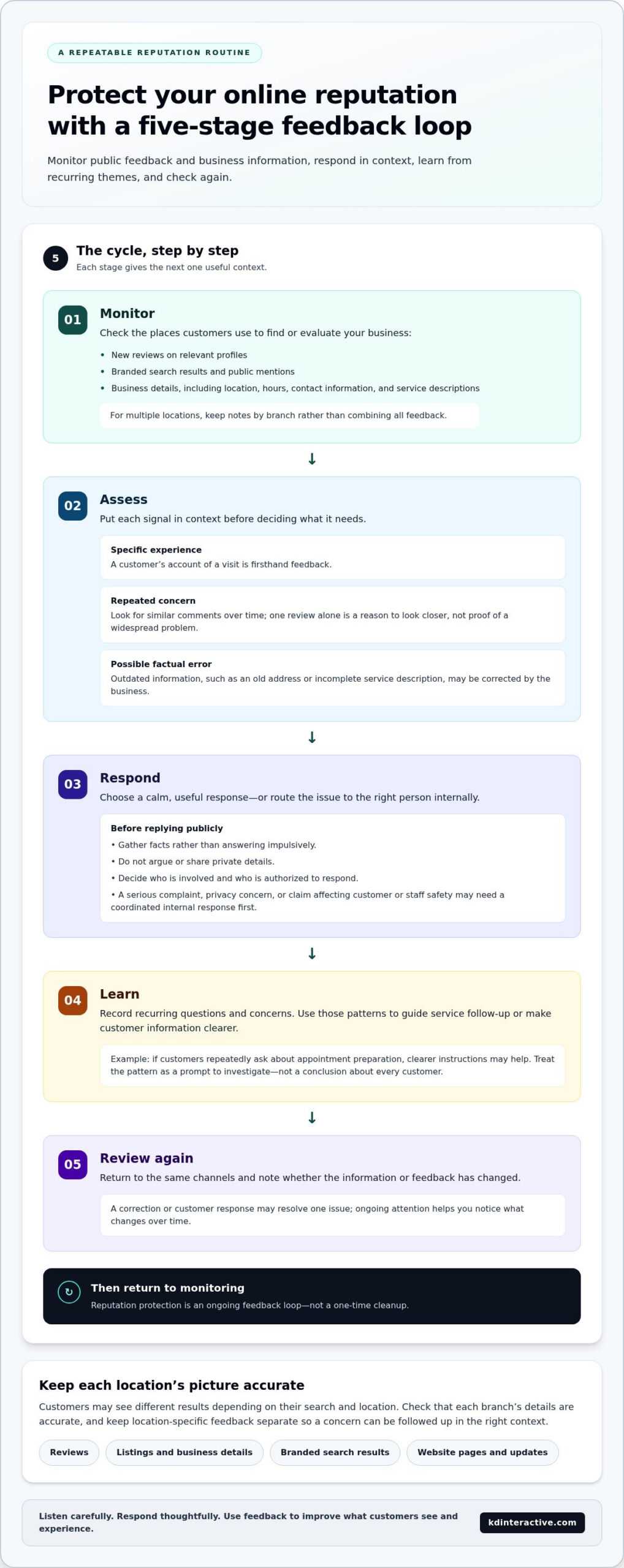
Online reputation protection works best as a cycle, not a one-time cleanup. Monitor what people are saying and what information appears in search. Assess each signal in context, respond where useful, and consider what the feedback can teach you. Then check again. That last step matters: a correction or customer response may resolve one issue, but ongoing attention helps you notice what changes over time.
Reputation monitoring is the recurring process of checking public feedback and business information, responding appropriately, and using what you learn to guide the next review.
- Monitor: Check relevant review profiles, branded search results, and business details.
- Assess: Identify whether a comment reflects a specific experience, a repeated concern, or a possible factual error.
- Respond: Choose a calm, useful response, or route the issue to the right person internally.
- Learn: Record recurring questions and concerns so they can inform service follow-up or clearer customer information.
- Review again: Return to the same channels and note whether the information or feedback has changed.
Not every signal needs the same level of attention. A routine review can go through the usual response process. A serious complaint, privacy concern, or claim that could affect customer or staff safety may call for a coordinated internal response before anyone replies publicly. Decide who should be involved and who is authorized to respond. Taking time to gather the facts is often more constructive than answering impulsively.
What should a small business monitor?
Focus on the channels customers use to find or evaluate your business. Check new reviews on relevant profiles, search for your business name, and compare public descriptions with current details. For multiple locations, keep notes by branch rather than combining all feedback. A concern linked to one location may need different follow-up from a question appearing across several branches.
How feedback becomes a useful business signal
One review is a reason to look closer, not proof of a widespread problem. Group similar comments over time, then compare them with direct customer feedback and the details of the service provided. If customers repeatedly ask about appointment preparation, for example, clearer instructions may help. Treat the pattern as a prompt to investigate, not a conclusion about every customer’s experience.
Keep a simple record of the theme, location, response, and any follow-up. This helps distinguish an isolated incident from a recurring point of friction and gives staff a shared reference for future conversations. It also provides a practical basis for updating customer-facing information or planning useful content, without overstating what the feedback proves.
If you’re working out how to protect my brand reputation online, make this cycle part of your regular local visibility routine. KD Interactive can connect reputation work with a broader local SEO strategy, considering accurate business information and customer feedback together.
Negative reviews, misinformation, and criticism: how to tell them apart
A low rating, an incorrect detail, and a serious allegation call for different responses. Sort out the issue before replying so your business can respond proportionately and credibly. One negative review doesn’t make reputation protection pointless. Customers can see how your business handles criticism, and a consistent record of accurate information and thoughtful replies gives them more context than any single comment.
Constructive criticism
A customer describes a specific experience or opinion, such as a long wait or confusing instructions. Acknowledge the concern, address what you can, and look for similar feedback over time.
Disputed factual claim
A comment includes a detail you believe is inaccurate, such as the wrong location or a claim about a service. Preserve the public information and check what your records can verify before replying with a concise correction.
Issue needing internal escalation
A post raises a serious allegation, a privacy concern, or a matter with potential customer or staff safety implications. Follow your internal decision-making process before making a public response.
A calm, specific reply is more useful than an argument or a copied template. Address the concern in front of you and help other readers see that the business has paid attention. Avoid trying to win a public exchange. Don’t disclose private customer details, speculate about motives, or make claims you can’t support.
When a review describes a genuine customer concern
Recognize the experience without automatically agreeing with every interpretation. If a customer says a booking was confusing, you might acknowledge that the process felt unclear and explain where to find the relevant information. If a next step would help, invite the customer to continue the conversation privately. Repeated comments about the same point can signal a question, instruction, or service gap worth addressing.
When information appears inaccurate or requires escalation
Keep a record of the review or public listing and note what can be checked internally. Reply only with relevant, supportable facts. If personal or case-specific details are involved, move the conversation to a private channel. A negative review is not automatically unlawful or removable. In Wisconsin, a defamation concern generally involves a false statement of fact, rather than opinion, that harms reputation; consider legal guidance for serious allegations instead of making public accusations.
Use the same measured approach whether your business serves one Wisconsin community or has several locations. A single complaint may describe one person’s experience, while repeated, independent comments can point to a pattern worth investigating. If you’re asking how to protect my brand reputation online, first identify what kind of feedback you’re facing, then choose a response that is accurate, respectful, and appropriate to the situation.
A practical reputation protection routine for Wisconsin businesses
A routine only works if your team can maintain it. Give someone clear responsibility for checking public feedback, deciding who should respond, and tracking follow-up. Set a review schedule that fits your operation, whether that means checking at a regular time each week or assigning a different day to each location. The aim is a dependable process, not constant monitoring that no one can sustain.
Use this simple workflow as a starting point:
- Assign ownership: Name the person who checks reviews and identifies who handles sensitive or complex concerns.
- Review relevant channels: Check customer feedback and search-visible business information on a consistent schedule.
- Respond thoughtfully: Apply shared response principles and route sensitive details to the right internal decision-maker.
- Record themes and actions: Note recurring questions, response status, and any follow-up needed.
- Reassess: Review the record regularly and update the process when business details, customer questions, or responsibilities change.
Create a manageable monitoring and response process
Write down who owns each step and what requires escalation. Staff should know not to share private customer information in public replies, speculate about a complaint, or make commitments they can’t authorize. Keep a simple record with the date, channel, location, topic, response status, and follow-up owner. This creates continuity when responsibilities shift and helps the business identify recurring concerns.
For a business with several Wisconsin locations, organize the record by branch. A review about a specific location should reach the person familiar with its operations, while common themes across branches can be reviewed centrally. Keep each location’s profile details and response responsibilities clear. For profile fundamentals, see this Google Business Profile setup guide.
Build trust with accurate, useful information
As part of the routine, compare public business details across relevant profiles. Check names, addresses, phone numbers, hours, and descriptions against the information the business currently uses. For multiple locations, verify each branch separately. Consistent details help customers identify the right location and reduce confusion as they compare local options.
Useful content can answer practical questions customers ask before choosing a business, such as what a service includes or which location serves their area. Keep answers specific and accurate, and revise them when business details change. Reputation is one part of local visibility, alongside the information people find in search. KD Interactive’s local SEO services guide explains how local search work can support a clear, consistent presence.
If maintaining this routine across reviews, listings, and locations is becoming difficult, learn about KD Interactive’s online reviews and reputation management support as part of a tailored local SEO approach.
How KD Interactive helps Wisconsin businesses manage online reputation
Protecting a business’s online reputation takes more than replying to one review. KD Interactive helps small and multi-location businesses in Wisconsin through Online Reviews & Reputation Management, which includes monitoring reviews and responding to feedback. This work can sit alongside local SEO, analytics tracking, and content creation, connecting customer feedback with search visibility as parts of a business’s online presence.
The goal is a thoughtful, ongoing approach that fits the business: understand what customers are saying, communicate consistently, and keep public information useful and accurate. For a Wisconsin business with more than one location, that means considering feedback and visibility in the context of each branch.
What reputation support can look like in a local SEO strategy
Review monitoring and considered responses provide practical input for local visibility work. Analytics tracking can help assess rankings, website traffic, user behavior, and conversions, giving the business information to review alongside customer feedback. Content creation can address real questions customers ask, while press release distribution can support a business goal when sharing timely, relevant news is part of the plan.
These activities work best when they’re selected for the business’s needs rather than treated as a standard package. A recurring question in reviews might point to information customers need on a website or location page. Analytics can help the business assess how people interact with that information. Together, these inputs support informed decisions without assuming that one tactic will produce a particular result.
A clear next step for a Wisconsin business
KD Interactive takes a tailored, collaborative approach grounded in Wisconsin’s local-business environment. Transparent communication helps business owners understand what’s being monitored, what themes are emerging, and how proposed next steps relate to their goals. That clarity is especially useful when several locations or staff members contribute to customer communication.
KD Interactive’s website features testimonials from Carl Anden of Anden Business Systems, David Alecock of Link It Call Center, and Mike Yenser of Y’s Way Flooring. These named client perspectives offer additional context about working with the company, without suggesting every business will have the same experience or outcome.
If you’re deciding how to protect my brand reputation online and want a more organized approach, bring your priorities, current challenges, and questions into a conversation. KD Interactive can discuss tailored recommendations for your reputation and local visibility, with clear communication. Schedule a FREE Consultation with KD Interactive.
Make reputation care part of your next growth step
Your business will change, and the way customers discover and describe it will change too. Treat reputation care as an ongoing business practice that adapts as you add services, reach new communities, or refine how you serve customers. Choose one practical improvement to carry forward, then decide when you’ll review its effect and what you’ll adjust next.
If you’re asking how to protect my brand reputation online as your business grows, you don’t have to build the process alone. KD Interactive works with Wisconsin businesses on online reviews and reputation management as part of a tailored approach to local visibility. A conversation can help clarify what deserves attention now and identify sensible next steps.
Consistent, thoughtful attention can help you meet change with confidence.
Frequently Asked Questions
What does it mean to protect a brand’s reputation online?
It means managing the public information people encounter, not trying to make every review positive. If you’re asking how to protect my brand reputation online, treat reviews, search results, and your own website content as parts of the same customer-facing picture. For example, a clear service description can help address confusion that appears in customer feedback. The goal is an accurate, credible presence and a thoughtful response when concerns arise.
How often should a small business monitor its online reputation?
Monitor it on a schedule your business can reliably maintain, with a named person responsible for the check. The right frequency depends on how much feedback you receive and whether you manage more than one location. Name a backup owner for vacations or staff changes so new feedback doesn’t go unnoticed. Keep brief notes on open replies and recurring topics, then use them to guide follow-up.
Can a business remove a negative online review?
Removal isn’t something a business should expect simply because a review is unfavorable. First, identify the specific concern and check the platform’s current reporting process to see whether the content may violate its rules. Keep a copy of the review and note why you reported it. A customer’s negative opinion alone doesn’t establish a policy violation, so avoid promising removal or treating a report as a substitute for a measured public response.
How should I respond to a negative review without making things worse?
Respond with a brief, professional message that addresses the reviewer’s actual concern. A useful structure is to acknowledge the issue, state what you can verify, and offer a reasonable next step. For example, if a customer reports a scheduling mix-up, avoid guessing about what happened and invite them to discuss the booking privately. Before posting, reread the reply from a prospective customer’s perspective, and remove personal details or unsupported claims.
What should I do if search results show inaccurate information about my business?
Find the original page or profile behind the result and verify the correct details against your current business information. Correct the source where possible, or use that platform’s established process to request an update. Keep a record of the result and any action taken. Search snippets may not update immediately after a source changes, so avoid repeating the incorrect detail publicly while you work through the correction.
Is online reputation management the same as SEO?
No. SEO focuses on making a business easier to find in search, while reputation management addresses how its public feedback and information are perceived. The work can overlap: an incorrect location detail may confuse customers and reduce the usefulness of a local search presence. KD Interactive’s Local SEO Services can include reputation management, while analytics tracking measures rankings, traffic, user behavior, and conversions to inform ongoing decisions.