
Does it feel like you’re shouting into the void? You’ve built a fantastic local business, but when potential customers search online, all they see are the big-budget national brands and long-established competitors. It’s frustrating, and it can make SEO feel like an unwinnable game-too complex, too expensive, and with no clear path forward. We understand that struggle because we’re a small business, too.
The good news is that you don’t need a massive marketing budget to succeed. The secret to how to rank in a competitive niche isn’t about outspending your rivals; it’s about outsmarting them with a focused, local strategy. It’s about finding the opportunities they’ve overlooked and becoming the go-to authority for customers right in your community.
This guide is your step-by-step playbook. We’re cutting through the noise to give you actionable SEO strategies you can implement right away. You will learn how to uncover keywords you can actually own, optimize your online presence to attract ready-to-buy local customers, and build a clear, achievable plan that turns your limited resources into measurable results. It’s time to stop feeling invisible and start dominating your market.
Key Takeaways
Key Takeaways
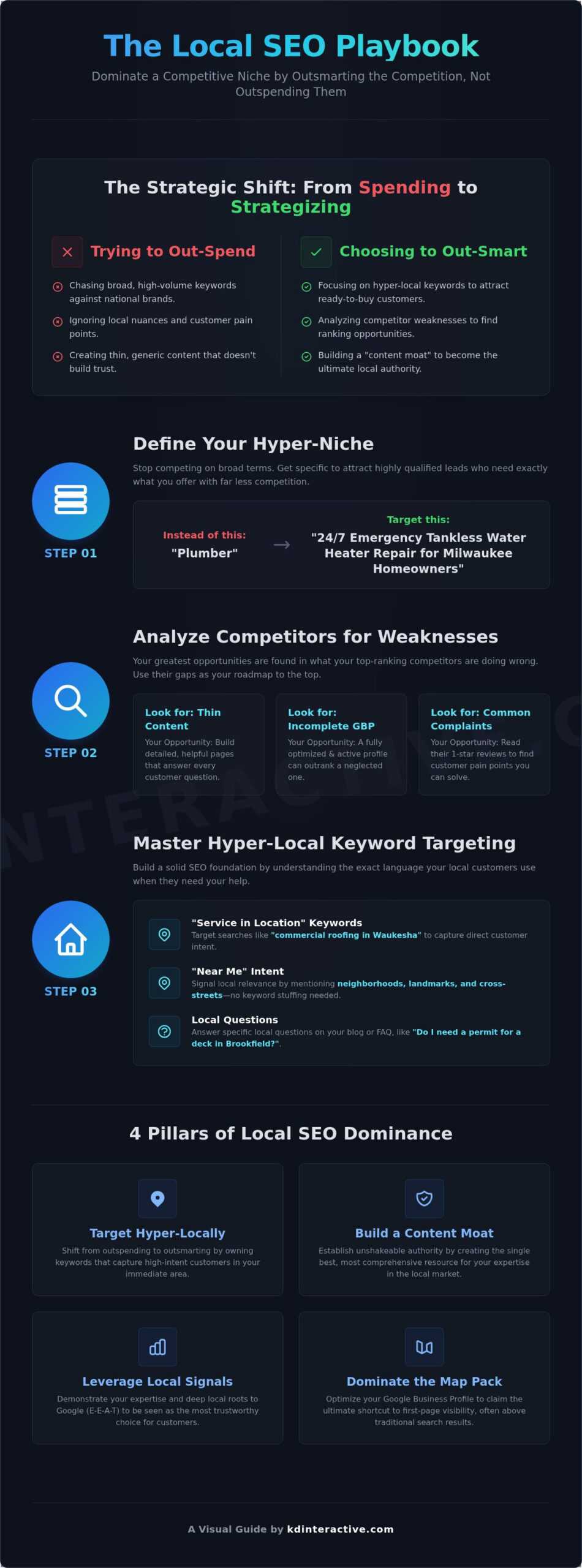
- Shift your strategy from outspending to outsmarting by targeting hyper-local keywords that capture high-intent customers in your immediate area.
- Build unshakeable authority by creating a “content moat”-the single best resource for your expertise in your local market.
- Learn how to leverage local signals and demonstrate your expertise to Google, a crucial step to rank in a competitive niche and be seen as a trustworthy business.
- Discover how to dominate the Google Map Pack, your small business’s ultimate shortcut to first-page visibility, often appearing above traditional search results.
Shift Your Mindset: You Can’t Out-Spend, But You Can Out-Smart
Trying to compete with national chains and authority sites can feel like an uphill battle. They have massive marketing budgets and teams of people dedicated to SEO. We understand the struggle because we’re a small business, too. But here’s the secret: you don’t have to play their game. The strategy to rank in a competitive niche isn’t about out-spending them; it’s about out-smarting them by redefining the battlefield.
Your goal is to become the biggest fish in your local pond. Google is your most powerful ally in this mission. Its algorithm is designed to deliver the most relevant result for a user, and for local services, that means prioritizing a trusted local business over a generic national directory. Understanding the basics of how local search works shows that Google values proximity and local relevance above all else. You have a home-field advantage-it’s time to use it to grow your business.
Define Your Hyper-Niche
Stop thinking of yourself in broad terms like “contractor” or “attorney.” To dominate search results, you must get specific. By focusing your SEO efforts on a hyper-niche-a combination of your specialty, location, and ideal customer-you face far less competition and attract highly qualified leads who need exactly what you offer.
For specialized fields like law, this extends beyond just keywords to the systems you use for client intake. For example, law firms can use specialized platforms like retainerengine.com to streamline their client acquisition process, which is a key part of outsmarting the competition.
- Instead of “Plumber,” target “24/7 emergency tankless water heater repair for Milwaukee homeowners.”
- Instead of “Landscaper,” target “Custom fire pit and patio installation in Madison, WI.”
- This level of specialization can even create dedicated marketing agencies; for example, businesses in the marine industry can work with a firm like Aquatic SEO that focuses exclusively on their unique market.
- This applies globally. Instead of just “Dog Food,” a company could target “fresh, human-grade dog meals in Malaysia.” To see a real-world example of this kind of niche targeting, you can learn more about DF Dog Food.
- Specialized service providers also benefit from this approach; for example, you can discover Diego’s Shop to see how a business focusing exclusively on warrantied diesel vehicle repairs captures a specific local audience.
Analyze Competitors for Weaknesses, Not Strengths
It’s easy to get discouraged looking at what the top-ranking competitors are doing right. Shift your focus. Your greatest opportunities are found in what they are doing wrong or not doing at all. A quick, strategic analysis will reveal gaps you can exploit to climb the rankings and win over their dissatisfied customers.
- Thin Content: Do their service pages have only a few sentences? You can win by building out detailed, helpful pages that answer every potential customer question.
- Incomplete Google Business Profile: Are they missing photos, services, or recent customer reviews? A fully optimized and active profile can quickly outrank a neglected one.
- Common Complaints: Read their 1- and 2-star reviews. These are a roadmap of customer pain points that your business can solve and highlight in your marketing.
Foundation First: Master Hyper-Local Keyword Targeting
When you’re trying to rank in a competitive niche, it’s easy to get fixated on broad, high-volume keywords like “plumbing” or “landscaping.” This is a mistake. Chasing these terms pits your small business against national brands with massive budgets. Instead, the goal is to win where it matters most: in your own backyard. Your focus should be on capturing high-intent customers who are actively looking for your specific services, right here, right now.
The cornerstone of this approach is mastering hyper-local keyword targeting. This isn’t just about SEO; it’s about understanding the exact language your local customers use when they need help. This is how you build a solid foundation for growth and dominate local search results.
Uncover ‘Service-in-Location’ Keywords
Forget generic terms. Your most valuable keywords follow a simple, powerful pattern: [your service] in [your location]. Think about how a real customer searches. They don’t just type “roofing”; they search for “commercial roofing in Waukesha” or “emergency plumber in the Third Ward.” Use Google’s autocomplete and the “People also ask” section to find dozens of variations. These aren’t just keywords; they are direct lines to customers ready to make a decision.
Capture ‘Near Me’ Intent
Google understands that when a user searches for “restaurants near me,” they expect local results. Your job is to make it incredibly easy for Google to connect your business to these searches. You can optimize for “near me” intent without ever awkwardly stuffing that phrase into your content. Instead, weave local identifiers naturally throughout your website. Mention specific neighborhoods you serve, nearby landmarks, or cross-streets to signal your deep local relevance.
Answer Local Questions
What questions do your customers have that only a true local expert can answer? Think beyond your services. Maybe it’s, “Do I need a special permit for a new deck in Brookfield?” or “What’s the best grass seed for Waukesha County clay soil?” Answering these questions on a blog or FAQ page is a powerful part of a local SEO strategy to compete because it builds unmatched trust and authority. Use local Reddit forums or Facebook groups to discover the real-world questions your community is asking.
Build Your Content Moat: Become the Go-To Local Expert
Your website’s content is the single most powerful tool you have for building authority and earning customer trust. Forget generic blog posts that could be written by anyone, anywhere. To truly dominate your local market, your goal is to create the single best, most comprehensive online resource for your expertise in your specific service area. This is how you build a “content moat”-an advantage so strong that larger, non-local competitors simply can’t cross it. This focused approach is essential if you want to rank in a competitive niche.
By moving beyond basic service descriptions and proving your hands-on, local experience, you send powerful signals to both Google and potential customers that you are the top choice. Each piece of content you create should be a strategic asset targeting a specific local keyword phrase.
Create Hyper-Local Service Pages
Don’t settle for one generic “Services” page. Create unique, detailed pages for each primary city or neighborhood you serve (e.g., “Milwaukee Kitchen Remodeling” and “Waukesha Kitchen Remodeling”). On these pages, include project photos from that specific area, testimonials from local clients, and discuss challenges or building regulations unique to that community. This demonstrates deep local knowledge and boosts your relevance for geo-targeted searches.
Develop Project Case Studies and Galleries
Show, don’t just tell. A detailed case study of a recent job is one of the most effective trust-building assets you can create. Walk potential customers through a project from start to finish, detailing the challenges and your solutions. Feature high-quality before-and-after photos with descriptive, geo-tagged captions like, “New roof installation on a historic home in Wauwatosa, WI.” This provides a steady stream of fresh, highly relevant content for search engines.
Write the Ultimate Local FAQ
What are the top 10-15 questions you hear from local customers every week? Compile them and create a comprehensive FAQ page or blog post that answers each one in detail. Address concerns specific to your area, such as weather impacts, local material suppliers, or permit processes. This content is incredibly valuable for searchers and immediately positions you as a helpful, transparent expert, making it a powerful strategy to rank in a competitive niche.
Building a content moat takes a clear strategy and consistent effort, but the payoff is immense. Need help creating content that ranks? Check out our content services.
Amplify Authority with Local Signals and E-E-A-T
To truly stand out and rank in a competitive niche, you need more than just the right keywords. Google needs to see your business as a legitimate, trustworthy entity. This is where E-E-A-T comes in. Think of it as Google’s real-world credibility check, standing for:
- Experience: Do you have firsthand, real-life experience in your field?
- Expertise: Are you a knowledgeable authority on your subject?
- Authoritativeness: Are you recognized as a go-to source by others in your industry?
- Trust: Is your business reliable, transparent, and secure?
Proving your E-E-A-T isn’t a single action; it’s a process of building a strong reputation both on your website and across the web. You achieve this through clear on-page signals and powerful off-page validation from other respected local sources.
Optimize Your On-Page E-E-A-T
Start by telling your story directly on your website. Your site should immediately communicate who you are and why customers should trust you. Create a detailed ‘About Us’ page that shares your history and local roots. For your blog, include author bios that showcase the real-world experience of your team. Most importantly, make your physical address, phone number, and any professional licenses or certifications easy to find. These are foundational trust signals for both users and search engines.
Earn High-Quality Local Backlinks
Off-page signals, primarily backlinks, act as votes of confidence from other websites. When it comes to local SEO, quality and local relevance crush quantity every time. The goal is to earn links from other respected local organizations to prove your authority within the community. This is a critical step if you want to successfully rank in a competitive niche.
Actionable ideas include:
- Sponsoring a local youth sports team or a community charity event.
- Joining and getting a directory listing from your local Chamber of Commerce.
- Hosting a free workshop and inviting local bloggers or news outlets to cover it.
- Partnering with a non-competing local business for a cross-promotional campaign.
Building a strong, locally-focused backlink profile is a core part of the tailored SEO strategies we implement for Wisconsin businesses. If you need help building your local authority, the team at KD Interactive is ready to assist.
Dominate the Map Pack: Your Ultimate Competitive Advantage
For any local business, the Google Map Pack is the ultimate first-page shortcut. You’ve seen it: the map with three local listings that appears at the very top of the search results for queries like “plumber near me” or “best coffee in Madison.” In many high-value searches, this block appears above the traditional organic results, giving you incredible visibility. Getting here isn’t about complex link-building; it’s a different game focused on three core pillars: proximity, relevance, and prominence.
To even have a chance to rank in a competitive niche locally, a fully optimized Google Business Profile (GBP) is non-negotiable. It is the foundation of your local SEO success.
Perfect Your Google Business Profile
Think of your GBP as a digital storefront. Leaving sections blank is like having an empty window display. Fill out every single field with complete and accurate information. Choose the most specific business categories possible (e.g., “Residential Architect” instead of just “Architect”) to tell Google exactly what you do. Most importantly, upload high-quality, real photos of your team, your work, and your location every single week to show Google you are an active, thriving business.
Leverage GBP Features Competitors Ignore
A complete profile is just the starting point. The real advantage comes from using the features most of your competitors overlook. These simple actions signal constant activity to Google and provide immense value to your customers.
- Google Posts: Share company updates, special offers, and photos of recent projects. These posts appear directly on your profile and have a huge impact on engagement.
- Q&A Feature: Don’t wait for customers to ask questions. Proactively populate this section by asking common questions and providing clear, helpful answers yourself.
- Messaging: Turn this feature on to allow customers to contact you directly from your profile. A fast response time is a positive signal to both Google and your future customers.
Implement a Consistent Review Strategy
Customer reviews are one of the most powerful ranking factors for the Map Pack. Google trusts the opinions of your customers, and a steady stream of positive reviews proves your prominence and authority. Create a simple, repeatable process for asking happy customers for a review via email or text. Just as crucial is your response: always reply professionally to all reviews-thanking positive reviewers and addressing concerns in negative ones. This shows you’re engaged and value customer feedback.
Overwhelmed by the constant updates and management required to rank in a competitive niche? Let our Wisconsin-based experts manage your SEO.
Your Blueprint for Local SEO Success
Beating the big players doesn’t require a bigger budget-it requires a smarter strategy. By mastering hyper-local keywords, building your authority as the go-to expert, and dominating the Google Map Pack, you create a powerful advantage they can’t easily replicate. This is exactly how you rank in a competitive niche and turn your local status into your greatest strength.
We understand the challenges because we’re a small Wisconsin business, too. We’ve used these same transparent, data-driven strategies to deliver proven results for local businesses across Milwaukee, Madison, and beyond. We don’t just talk about growth; we build the customized plan to achieve it, focusing on the metrics that matter most to you.
Stop letting your competition own the top spot. It’s time to out-smart them and claim your place. Get Your FREE Consultation and Start Ranking Higher!
Frequently Asked Questions About Ranking in a Competitive Niche
How long does it take to rank in a competitive local niche?
While every market is different, you should plan for SEO to be a long-term strategy. Generally, it can take anywhere from 6 to 12 months to see significant, consistent results. The time it takes to rank in a competitive niche depends on factors like your website’s current authority, the level of competition, and the consistency of your efforts. Patience and a steady, data-driven approach are essential for achieving sustainable growth and dominating your local market.
Can I really compete with big brands without a huge marketing budget?
Absolutely. As a local business, your advantage is your focus. While big brands target broad terms, you can win by concentrating on hyper-local search terms and services specific to your community. By creating expert content that speaks directly to local customers and building a strong community reputation, you can carve out a powerful online presence. We know how to leverage these unique strengths for a big impact because we understand the struggles of small business.
What’s more important for ranking: content, backlinks, or technical SEO?
This is a classic question, but the truth is they are all equally important and work together. Think of it as a three-legged stool-without one leg, the whole thing topples. High-quality content establishes your relevance. Authoritative backlinks build your website’s trust and authority. A solid technical SEO foundation ensures search engines can easily find and understand your site. A successful strategy requires a balanced, customized focus on all three of these core pillars.
How do I know if my SEO efforts are actually working?
The proof is in the data, and we believe in transparent, measurable results. Key performance indicators (KPIs) show clear progress: improvements in keyword rankings for your target terms, a steady increase in organic website traffic, and-most importantly-a boost in qualified leads, phone calls, and contact form submissions. We track these metrics closely to show you exactly how your investment is translating into real business growth, so you’re never left guessing about your ROI.
Is it better to target one city or multiple cities at once?
Our results-oriented approach recommends starting with and dominating one primary city first. This allows you to focus your resources, build a strong foundation of local authority, and establish a proven track record of success. Once you have achieved high rankings and a steady flow of leads in your main service area, you can then strategically and effectively expand your efforts to adjacent cities. This methodical expansion is far more powerful than spreading your budget too thin from the start.
Should I focus more on my website or my Google Business Profile?
You must focus on both, as they work hand-in-hand for local market dominance. Your Google Business Profile (GBP) is crucial for immediate visibility in the local map pack and for customers seeking quick information like your hours or phone number. Your website is your digital storefront where you build deeper trust, showcase your expertise, and convert that traffic into paying customers. A powerful local SEO strategy ensures both are fully optimized and working together to boost your business.