
Did you know that 42% of local searchers click on one of the top three results in the Google Map Pack? It’s incredibly frustrating to watch competitors with fewer reviews outrank you while you’re left spending money on ads that don’t drive organic visibility. If you’ve been wondering how to rank in google map pack without getting lost in technical jargon, you are in the right place. We know how it feels to see your visibility shift after the May 2026 Core Update, but achieving a top-3 spot is still within your reach.
You deserve a strategy that turns search volume into actual phone calls and direction requests. This article reveals the exact blueprint to help your small business dominate local search in your city. We’ll show you how to master the 2026 AI search landscape by focusing on hyper-local relevance and authentic data. From optimizing your profile for the latest Information Gain standards to leveraging local community signals, you will learn how to secure your spot at the top and increase your conversion rates beyond the 2026 average of 33%.
Key Takeaways
- Understand how Google’s AI Assistant now summarizes your business data directly within the Map Pack to influence customer decisions.
- Learn the exact steps for how to rank in google map pack by mastering the core pillars of relevance and distance in the 2026 search landscape.
- Discover why using natural language in your content and reviews is essential for Google’s AI to “read” and recommend your business to local searchers.
- Follow a proven five-step checklist that begins with securing your Google Business Profile and auditing your NAP consistency across the web.
- See how hyper-local geographic signaling can give your business a competitive edge in specific Wisconsin markets like Watertown or Madison.
What is the Google Map Pack and Why Does it Matter in 2026?
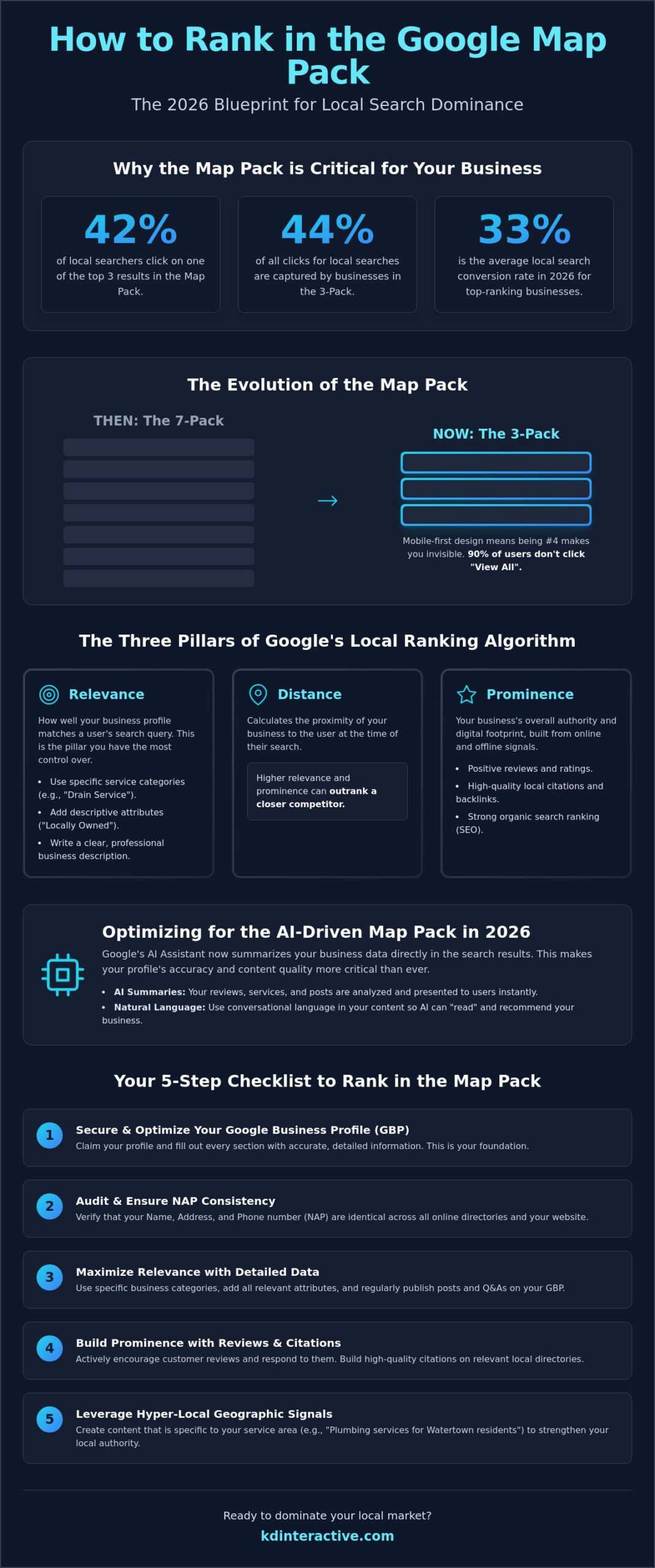
The Google Map Pack is the curated block of three business listings that appears at the top of search results, accompanied by an interactive map. While it has always been a prime piece of digital real estate, the 2026 landscape has transformed it into an interactive hub. Google’s AI Assistant now plays a massive role by summarizing your business data, reviews, and services directly within the pack. This means customers often get the answers they need without even clicking through to your website, making your profile’s accuracy more critical than ever.
Securing a spot here is the most direct way to drive foot traffic to your door. Statistics from 2026 show that businesses in the local 3-pack capture 44% of all clicks for local searches. When a user searches for a service “near me,” they are looking for immediate solutions. Ranking in this section triggers high-intent actions like “Click to Call” or “Get Directions” instantly. If you are struggling with how to rank in google map pack, you are likely missing out on a local search conversion rate that has climbed to 33% this year.
The Evolution of Local Search: From 7-Pack to 3-Pack and Beyond
Local search hasn’t always been this crowded. Older users might remember the “7-Pack,” which gave more businesses a chance at the front page. Google eventually narrowed this down to three results to prioritize quality and improve the mobile experience. For entrepreneurs in Wisconsin, this shift was a game changer. Mobile-first indexing means that whether a customer is in Watertown or Madison, they are seeing a layout optimized for small screens. Being “number 4” on the list essentially makes you invisible; 90% of potential customers won’t bother to click the “View All” button.
Map Pack vs. Organic Search: Understanding the Difference
It is vital to distinguish between standard organic results and the Map Pack. Traditional search results are often triggered by informational queries, while the Map Pack is fueled by local intent. Understanding Local search engine optimization (local SEO) is the first step in bridging this gap. There is a powerful synergy between the two. Businesses that rank well in organic search are often viewed as more prominent by Google’s algorithm, which helps them land in the 3-Pack. To see how these elements work together for your specific industry, explore the KD Interactive guide to local SEO. Learning how to rank in google map pack requires a dual focus on your website’s authority and your Google Business Profile’s real-time activity.
The Three Pillars of Google’s Local Ranking Algorithm
While Google’s interface is constantly evolving, the core algorithm still rests on three foundational pillars: Relevance, Distance, and Prominence. Understanding how these forces interact is the first step in learning how to rank in google map pack effectively. Relevance measures how well your business matches a specific search query. Distance calculates how close you are to the user. Prominence reflects your business’s overall authority and digital footprint. These factors work in tandem to ensure that a searcher in Watertown or Madison finds the most reliable local solution quickly.
The “secret sauce” of local SEO lies in the fact that these pillars aren’t weighted equally in every scenario. You can actually outrank a competitor who is physically closer to the searcher if your prominence and relevance scores are significantly higher. This is why a small shop with a robust digital presence can beat a larger, closer franchise. Since 46% of all Google searches have local intent, mastering these pillars is non-negotiable for growth.
Maximizing Relevance Through Detailed Data
Relevance is the factor you have the most control over. Your primary and secondary service categories are the most influential fields in your Google Business Profile. If you’re a plumber, don’t just list “Plumber”; add specific categories like “Drain Service” or “Hot Water Heater Repair.” Using “Attributes” is another way to capture niche searches. Tags like “locally owned,” “veteran-led,” or “wheelchair accessible” help Google match you with users seeking those specific traits. Your business description should be clear and professional, naturally incorporating the phrase how to rank in google map pack to signal your expertise to both users and algorithms without resorting to spammy tactics.
Building Prominence with Local Citations and Backlinks
Prominence is Google’s way of asking, “Do other people trust this business?” It is built through consistent NAP (Name, Address, Phone) data across every directory on the web. Inconsistencies here create friction and lower your trust score. For Wisconsin businesses, links from local sources like the Watertown Chamber of Commerce or Madison-based news outlets carry immense weight. These geographic signals prove you are an active part of the community. Using local marketing strategies like press release distribution can act as a “cheat code” to boost prominence by generating high-quality backlinks and media mentions. If you need help identifying the right local directories for your industry, our Local SEO Services can streamline the process for you.
Optimizing for the AI-Driven Map Pack in 2026
By 2026, artificial intelligence has moved from an experimental feature to the primary engine behind local search. Google’s AI Assistant now processes data with incredible speed. Your business profile isn’t just a static listing; it is a data source for a conversational search experience. The use of generative AI for local recommendations jumped from 6% to 45% in just one year. This shift changes everything about how to rank in google map pack. You’re no longer just optimizing for keywords. You’re optimizing for an AI that understands the context of your business and the specific needs of searchers in Wisconsin.
Visual search has also become a critical ranking signal. High-quality, AI-scannable photos allow Google to identify products or services within your images. If a customer searches for “industrial grade tools in Madison,” Google’s AI can scan your uploaded photos to verify you actually have those items on your shelves. This contributes to the rise of “Zero-Click” searches, where users find all the information they need directly in the Map Pack. Staying relevant in this environment requires a profile that is as comprehensive and visually rich as possible. Implementing modern Google Maps SEO strategies ensures that the AI views your business as the most authoritative local option.
- Natural Language: Use conversational phrasing in your profile that mirrors how people actually talk to AI assistants.
- Freshness: Update your photos and posts at least once every 30 days to signal real-world activity.
- Engagement: Respond to questions in your Q&A section immediately; AI monitors these interaction speeds.
The Role of Reviews in AI Summaries
Google’s AI Assistant now analyzes your reviews to generate summaries that justify your ranking. It pulls specific quotes to answer user questions, such as “Does this Watertown shop offer same-day repairs?” If your reviews contain those exact phrases, you’re more likely to appear in the top 3. Encourage your customers to use natural language and mention specific services in their feedback. For a deeper look at managing these interactions, check out our reputation management guide to build a review profile that the AI loves.
Technical Schema for Local Businesses
Precision is the key to feeding Google’s AI the data it craves. Using LocalBusiness Structured Data (schema) on your website provides a clear map for AI crawlers to follow. This technical layer ensures that your hours, location, and services are perfectly synced between your site and your Map Pack listing. Optimizing your “About” and “Contact” pages for these crawlers is essential for visibility. We know technical SEO can be overwhelming for busy entrepreneurs, which is why KD Interactive’s web and SEO services automate this technical heavy lifting for you, letting you focus on running your business.
Your 5-Step Checklist to Rank in the Google Map Pack
Ranking in the top three isn’t an accident. It’s the result of a methodical approach that combines technical accuracy with active community engagement. This checklist provides a clear path for small business owners who are tired of being outranked by competitors. If you want to know how to rank in google map pack, follow these five steps to build a profile that Google trusts and customers find.
- Step 1: Claim and verify your Google Business Profile (the foundation).
- Step 2: Audit your NAP consistency across every local directory.
- Step 3: Optimize your website for local keywords (e.g., ‘SEO in Milwaukee’).
- Step 4: Execute a local PR campaign to skyrocket your prominence.
- Step 5: Implement an automated review management system.
Step 1 & 2: Setting the Foundation
Verification is the first hurdle. Without it, you don’t exist in the eyes of local search. One of the biggest mistakes we see is the “Duplicate Listing” trap. Having multiple profiles for the same location confuses the algorithm and effectively kills your rankings. For Wisconsin contractors, you must decide between a physical office location or a “Service Area” listing. If you work from a home office in Watertown but serve all of Jefferson County, setting a clear service area prevents proximity issues. NAP consistency serves as a critical trust signal that helps Google’s algorithm verify your business identity and location across the digital ecosystem.
Step 3: Local Keyword Optimization
Your website needs to speak the language of your city. If you’re targeting specific terms like “SEO in Milwaukee,” your landing pages must reflect that geographic focus. This isn’t just about the footer; it’s about your headers, meta tags, and blog content. This step ensures your site and your Map Pack profile are perfectly aligned, which is a major factor in how to rank in google map pack effectively.
Step 4 & 5: Driving Growth
Prominence is where most businesses fail. While competitors focus only on reviews, you can skyrocket your visibility by leveraging local news outlets. A well-timed press release can earn high-authority Wisconsin backlinks that prove your regional importance. Once the traffic arrives, you need a system to capture and respond to feedback. Responding to every review, both positive and negative, shows Google that you are an active, client-focused business. To stay ahead of the competition, use the Google Map Pack with AI Assistant to monitor your performance 24/7. This tool provides the data-driven insights needed to adjust your strategy in real time. If you’re ready to dominate your local market, start with a professional SEO Keyword Analysis to identify your best opportunities.
Why a Wisconsin-Focused Strategy Wins the Map Pack
National agencies often use a one-size-fits-all approach that fails to account for the nuances of regional markets. In Wisconsin, the competition looks different in Watertown than it does in downtown Madison. When you are researching how to rank in google map pack, you’ll find plenty of generic advice, but success here requires “Geographic Signaling.” This means proving to Google that your business is a vital part of its specific community. A business on the Madison Isthmus needs to target different neighborhood-level keywords than a shop serving Jefferson County. Google’s 2026 algorithm updates prioritize these hyper-local markers because they indicate real-world relevance.
Positioning your business as a community leader is a powerful way to outshine national chains. While a corporate competitor might have a larger overall budget, they lack the local knowledge to choose the right “Neighborhood” keywords. They don’t know the importance of appearing in local directories like the Milwaukee Business Journal or sponsoring a little league team in Waukesha. These local signals are exactly what Google’s AI Assistant looks for when summarizing why a business is the “best” option in a specific zip code. We specialize in showing local entrepreneurs how to rank in google map pack by leveraging these community-specific signals that national firms simply overlook.
KD Interactive: Your Local SEO Partner
Our approach is pragmatic and results-oriented. We understand the challenges smaller enterprises face because we share that same entrepreneurial spirit. We don’t just provide a service; we act as a collaborator in your growth. By using data-driven strategies tailored for the Wisconsin landscape, we help you beat national competitors who rely on standardized, thin content. Our goal is to turn your digital presence into a dependable source of phone calls and foot traffic. If you are ready for a professional assessment of your current map visibility, we are here to help.
Getting Started with a Local SEO Audit
A professional audit is the first step toward dominating your city. It reveals “hidden” ranking blockers that often go unnoticed, such as suppressed duplicate listings or broken schema data. When we help a Milwaukee business rank, we look at three primary factors immediately: your current NAP consistency, the quality of your local Wisconsin backlinks, and your recent profile activity. These elements provide a clear picture of where you stand and what is needed to move into the top 3. Contact KD Interactive today to claim your spot in the Map Pack and start driving more local customers to your door.
Secure Your Local Market Leadership Today
Local visibility in 2026 isn’t just about showing up; it’s about staying ahead of the AI and outperforming the competition. You’ve seen that success comes down to mastering the core pillars of prominence and relevance while ensuring your data is perfectly optimized for Google’s AI Assistant. By following our five-step checklist and leaning into a hyper-local Wisconsin strategy, you can turn search intent into actual foot traffic.
Understanding how to rank in google map pack is the first step toward reclaiming your territory from national chains. We provide specialized Wisconsin SEO expertise and transparent, pragmatic reporting that focuses on data-driven results for small businesses. Don’t let your business remain invisible to 90% of your potential customers. Claim your top-3 spot with our Google Map Pack with AI Assistant service. Your growth is our priority, and we’re ready to help you dominate your local market.
Frequently Asked Questions
How long does it take to rank in the Google Map Pack?
Most small businesses see measurable results within three to six months of consistent optimization. This timeline depends on the competition in your specific Wisconsin city and the current state of your profile. While some improvements happen faster, building the prominence needed to displace established competitors requires a steady stream of reviews and local citations. We focus on pragmatic, long-term growth rather than temporary spikes.
Can I rank in the Map Pack without a physical office?
You can definitely rank by setting up a “Service Area Business” profile. This is ideal for contractors in Watertown or Madison who work from home but travel to clients. You simply tell Google which regions you serve and hide your home address from the public. This ensures you still appear for local searches without needing a traditional storefront or commercial office space.
Do Google Ads help me rank higher in the organic Map Pack?
No, running a paid ad campaign does not directly boost your organic ranking position. While ads can put you at the very top of the map results as a “sponsored” listing, the organic algorithm remains separate. If you want to learn how to rank in google map pack permanently, you must focus on building organic relevance and prominence through our data-driven blueprint rather than relying on ad spend.
Why did my business suddenly drop out of the Map Pack?
Sudden drops often follow major algorithm updates, such as the May 2026 Core Update, or occur if your profile hasn’t been updated in 30 days. Google prioritizes “freshness” and real-world activity. If you stop posting photos or responding to reviews, the algorithm may view your business as less active. It’s also possible that a competitor has recently gained a significant boost in local prominence.
How many reviews do I need to reach the top 3?
You don’t need a specific number, but you should aim for more recent, high-quality reviews than your top three competitors. In 2026, Google’s AI Assistant prioritizes the quality and detail of the feedback over the raw count. One detailed review that mentions a specific service like “Milwaukee roof repair” is often more valuable than five generic five-star ratings without any text.
Is NAP consistency still important for SEO in 2026?
Yes, keeping your Name, Address, and Phone number identical across the web is a fundamental trust signal. Inconsistent data across different Wisconsin directories creates confusion for Google’s crawlers and can suppress your rankings. We audit your digital footprint to ensure every citation reinforces your authority. This consistency proves to Google that your business is a legitimate and reliable local entity.
What is the most important factor for ranking in the Map Pack?
Relevance is the most critical factor because it determines if you actually provide what the user needs. While you can’t change your physical distance from a searcher, you can control your relevance through detailed service categories and natural language. Mastering how to rank in google map pack involves proving to the AI that your business is the most logical answer to a customer’s specific local query.
Can I rank in multiple cities for the same service?
You can rank in multiple cities if you have a physical presence in each or if you serve a wide geographic area. However, your ranking power is usually strongest closest to your verified location. We help businesses expand their reach by using geographic signaling and local community links to prove relevance in neighboring towns. This strategy allows you to capture more regional traffic without opening new offices.