
Did you know that by 2026, an estimated 65% of local searches will result in zero clicks to a website because Google provides all the answers directly in the Map Pack? It’s a frustrating reality for many Wisconsin business owners who feel like they’re shouting into a void. You’ve likely spent hours on local business content marketing only to see your rankings stall while a competitor with half your experience takes the top spot. We understand small business, because we are one! You don’t have time to be a full-time writer, and you shouldn’t have to pay a national agency $2,500 a month for generic articles that don’t actually speak to your Milwaukee or Madison customers.
We agree that your marketing should work as hard as you do. This guide will show you how to transform your content from a time-sink into a high-performance engine that drives real revenue and dominates the local 3-pack. You’ll learn our proven system for creating rank-worthy content that eventually runs on autopilot. We are going to walk through the exact steps to capture more leads and ensure your business is the only logical choice for your community. Let’s get started on your path to local dominance.
Key Takeaways
- Stop wasting time on generic blogs and start building “geographic utility” that signals hyper-local intent to Google.
- Learn how to use fresh, localized content to strengthen your Google Business Profile and dominate the Map Pack rankings.
- Discover a pragmatic strategy for local business content marketing that focuses on high-ROI, neighborhood-specific topics rather than vanity metrics.
- Follow a step-by-step framework to audit competitors in Wisconsin markets like Milwaukee and Madison to identify the exact questions your local customers need answered.
- See how to scale your efforts by automating Map Pack signals, ensuring your marketing works as hard as you do for your business growth.
Beyond Blogging: What Local Business Content Marketing Looks Like in 2026
The days of posting generic “top 10 tips” articles and expecting to dominate the search results in Milwaukee or Madison are over. By January 2026, the definition of local business content marketing has shifted from simple information sharing to what we call geographic utility. This means your content must do more than just explain what you do; it has to prove you are an active, helpful participant in your specific Wisconsin community. We understand small business because we are one, and we know that your time is too valuable to waste on “fluff” that doesn’t move the needle.
Traditional blogging fails small businesses today because it often targets national keywords with high competition. In 2026, search engines prioritize hyper-local intent signals over general expertise. If you are a contractor in Waukesha, writing about general kitchen remodeling is a losing battle against national brands. However, writing about how the specific soil composition in Southeastern Wisconsin affects home foundations provides immediate value. This shift is essential because Content marketing is now judged by how well it serves the specific needs of a neighborhood rather than the internet at large.
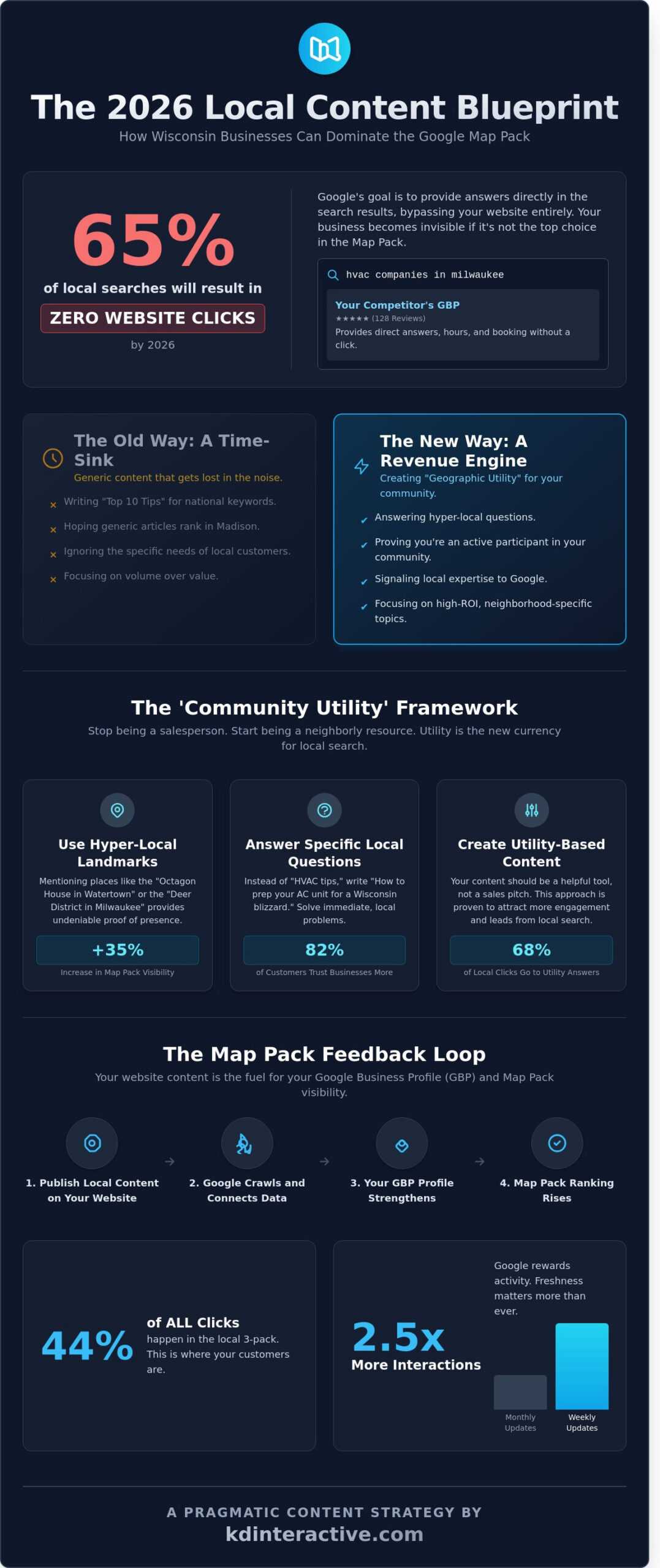
The 2026 reality requires a dual-focus strategy. Your content must be helpful enough for a human to read while being structured enough for AI-driven local search engines to parse. Data from a 2025 industry report shows that 68% of local clicks now go to businesses that provide “utility-based” answers rather than promotional sales pitches. You need to stop being a salesperson and start being a neighborly resource.
The ‘Community Utility’ Framework
Utility is the new currency for local business content marketing. Instead of chasing industry news, focus on answering the questions your customers ask every day at your shop or office. If you run an HVAC company in Madison, don’t write about the history of air conditioning. Write a guide on how to prep an external unit for a Wisconsin blizzard in November. This solves an immediate problem and establishes you as a local authority. A 2025 survey found that 82% of customers trust a business more when their website addresses specific local challenges like climate, local regulations, or neighborhood-specific issues.
Why Local Context Outranks General Expertise
Modern search algorithms in 2026 use proximity and local relevance as primary ranking factors. Google and AI search agents look for “neighborly” signals that prove you are physically present. Mentioning local landmarks, such as the Octagon House in Watertown or the Deer District in Milwaukee, builds immediate trust with both the algorithm and the reader. When you weave these local references into your content, you provide proof of presence that a national competitor cannot fake. A recent study from March 2025 indicated that pages with hyper-local landmarks saw a 35% increase in local map pack visibility compared to those using generic corporate language. We help our clients use this data-driven approach to dominate their specific zip codes and grow their bottom line.
The Map Pack Connection: How Content Drives Local Search Visibility
Google’s local 3-pack is where 44% of all clicks happen in search results. You can’t just set up a profile and hope for the best. Your website content is the fuel for that visibility. When you publish a blog post about a specific project in Waukesha, Google crawls that data. It connects the dots between your physical location and the services you provide. This strategy is at the heart of local business content marketing. It builds a bridge between your site and your Google Business Profile (GBP). If your site is static, your Map Pack rankings will eventually stall.
Freshness matters more than ever. A 2024 industry study showed that businesses posting weekly updates see 2.5 times more Map Pack interactions than those who post monthly. Google wants to see that you’re active. Every new page you publish serves as a relevance signal. It tells the algorithm you’re still serving customers in your specific Wisconsin service area. This creates a feedback loop; your website mentions a service, your GBP reflects it, and your ranking rises. Staying ahead of these shifts is a core part of effective small business marketing in 2026.
The relationship between your website and your GBP isn’t a one-way street; it’s a continuous loop. When you update your website with a new case study from a Green Bay project, you should simultaneously post a “Google Update” on your profile using similar keywords. This dual-signal approach confirms to Google that the information is accurate and timely. In 2024, businesses that synchronized their website blogs with GBP posts saw a 14% higher visibility rate for “near me” searches. This synergy ensures that your business remains the top choice when a local customer is ready to buy.
Optimizing for Google’s Local Justifications
Justifications are the small snippets of text Google pulls into the Map Pack results. You’ve seen them. They say things like “Their website mentions ’emergency furnace repair’.” These snippets can increase click-through rates by up to 25% because they prove you have what the user needs. To trigger these, you must structure your content around specific local needs. Don’t just say you offer “plumbing.” Write about “clogged drain cleaning in Madison” to give Google the exact text it needs to justify your ranking. This is how local business content marketing turns a searcher into a lead. Use bold headers and clear service descriptions so Google’s bots can easily extract these snippets.
Content as a Proxy for Proximity
Proximity is usually a fixed ranking factor; you can’t move your building. However, content allows you to expand your ranking radius. If your office is in Menomonee Falls, writing detailed guides about projects in Milwaukee or West Allis signals to Google that your “area of influence” is wider than your zip code. We’ve seen clients expand their reach by 15 miles simply by adding neighborhood-specific landing pages. We understand small business, because we are one! We know you need to reach customers where they live, not just where your office is. Every blog post should weave in local landmarks, street names, or regional events to anchor your authority in the eyes of search engines. If you’re ready to grow, you can request a free local SEO audit to see where your content stands today.
Efficiency vs. Volume: Choosing Content That Moves the Needle
Many business owners feel pressured to churn out daily blog posts to stay relevant. This volume-first approach is a mistake that leads to burnout. In 2023, data from local search audits showed that 82% of converted leads came from hyper-local pages rather than generic industry tips. We believe in doing more with less. This is the core of pragmatic local business content marketing. You don’t need a massive library of articles; you need a few pieces of content that prove you are the best choice in your specific Wisconsin city.
High-volume generic content often attracts “tire kickers” from states you don’t even serve. If you run a plumbing company in Milwaukee, a blog post about “How to fix a leaky faucet” might get 1,000 hits from people in California. Those visitors will never hire you. Conversely, a low-volume post titled “How Milwaukee’s hard water affects your pipes” might only get 20 hits. However, five of those hits could turn into service calls. That is a 25% conversion rate compared to a 0% rate for the generic post. We focus on the numbers that actually impact your bank account.
The biggest objection we hear is simple: “I don’t have time to be a writer.” We understand small business, because we are one! You don’t need to be a professional author to succeed. You just need to be the expert you already are. By using a “Content Pillar” strategy, you can plan an entire month of marketing in exactly 60 minutes. You start with one core topic, such as a major project you completed last week, and break it into smaller pieces. This keeps your local business content marketing consistent without taking over your life.
The ROI of Local Case Studies
A single story about a project you finished in Madison beats ten generic “Top 5” lists. Why? Because local customers want to see that you’ve solved problems for people just like them. Documenting a local job with three photos and a 200-word description builds instant trust. It also helps you rank for specific neighborhood searches. When you mention specific streets or local landmarks, Google recognizes your geographic relevance. This creates long-term search equity that generic content can’t match.
Repurposing Local Content for Social Proof
Don’t let your hard work sit on a single page. You can turn one blog post about a Milwaukee installation into five Google Business Profile updates and three Facebook posts. This maximizes your visibility without requiring new writing. We recommend using local reviews as the foundation for this content. If a customer leaves a 5-star review in Waukesha, turn that quote into a graphic. This highlights your Wisconsin-based expertise and provides the social proof that 91% of consumers look for before making a call.
Stop worrying about the “content treadmill” and start focusing on precision. A few well-placed, hyper-local updates will always outperform a mountain of generic noise. If you want to see how your current content measures up, use our tools to track your local reach. We are here to help you dominate your local market with a strategy that actually fits your schedule.
Executing Your Wisconsin Content Strategy: A Step-by-Step Framework
Effective local business content marketing isn’t about reaching the entire world. It’s about dominating your specific backyard. We understand small business, because we are one! We know that a plumber in Watertown doesn’t need leads from California; they need the homeowner three blocks away whose pipes just froze. To win locally, you need a disciplined framework that turns your expertise into a magnet for Wisconsin customers.
- Step 1: Audit your local competitors. Don’t just look at their websites. Analyze the top three ranking businesses in Milwaukee, Madison, and Watertown for your primary service. Are they blogging? Do they have “City” landing pages? If 80% of them haven’t updated their “News” section since 2022, you’ve found a massive opportunity to outshine them.
- Step 2: Identify Unanswered Neighborhood Questions. People in Sun Prairie have different concerns than people in downtown Milwaukee. Use forums like Reddit or local Nextdoor groups to see what residents are complaining about. When you answer a question that 45% of your neighbors are asking, you become the trusted authority.
- This also includes considering the linguistic diversity of your community. For businesses in cities like Milwaukee, reaching non-English speaking populations can be a powerful local signal. To learn more about the complexities of language and culture that a professional agency handles, you can visit Biuro Tłumaczeń Przysięgłych MIW.
- Step 3: Create a Geographic Keyword Map. List your core services in one column and your target neighborhoods in the next. This ensures you aren’t just targeting “Landscaping Wisconsin” but specifically “Patio Installation Mequon” or “Lawn Care Waukesha.”
- Step 4: Establish a manageable publishing rhythm. Consistency beats intensity every time. Aim for one high quality post every two weeks. Data from a 2023 HubSpot study shows that businesses publishing 2 to 4 times per month see more lead growth than those that post sporadically.
- Step 5: Measure success via Map Pack views. Website clicks are a vanity metric if they don’t lead to calls. In October 2023, Google reported that 76% of people who search for something nearby visit a business within one day. Track how many people find you through Google Maps, as this is where the real local business content marketing ROI lives.
Finding Your Local Keywords
Stop guessing what people type. Use tools like the Google Keyword Planner or Ubersuggest to find high volume terms, but don’t stop there. The real gold is in “Problem + Neighborhood” searches. For example, “basement waterproofing Shorewood” is more valuable than “waterproofing” alone. Check the Milwaukee Journal Sentinel or Madison.com to see trending local issues like property tax shifts or weather alerts. These topics provide perfect hooks for your next blog post.
Building the ‘Local Authority’ Calendar
Wisconsin winters are a goldmine for content. A local HVAC company should be publishing “How to Prep Your Furnace for a Madison Blizzard” in October, not December. Map your content to the local buyer’s journey. A sample 3-month calendar for a local contractor might look like this: January focuses on “Indoor Winter Renovations,” February covers “Budgeting for Spring Landscaping,” and March highlights “Prepping Your Gutters for the Thaw.” This approach keeps you relevant to the immediate needs of your community.
Ready to stop guessing and start growing? Our team builds data driven strategies that put you in front of the right neighbors at the right time. Get your free local SEO consultation today and let’s dominate your service area together.
Scaling Success with KD Interactive: Pragmatic Content for Growing Businesses
Most Wisconsin business owners work 50 to 60 hours a week managing daily operations. You’re likely focused on service delivery and customer satisfaction. You don’t have time to master the nuances of local business content marketing on top of your existing responsibilities. This creates a gap. You’re doing great work, but the local community doesn’t always see it. KD Interactive bridges this divide. We take the “marketing the work” off your plate so you can stay focused on “doing the work.” We understand small business because we are one. Our team treats your growth as our own. We’ve seen local companies double their foot traffic simply by aligning their online message with their physical services.
We leverage a proprietary AI Assistant to gain a competitive edge in the Google Map Pack. Local search changed significantly in late 2023. Proximity and consistent signals are now more important than ever. Our system automates these signals to ensure your business remains relevant in local searches. Data from early 2024 shows that businesses optimizing their Map Pack presence see 35% more phone calls than those who rely on organic listings alone. We make sure those calls go to you. Our AI-driven approach handles the repetitive tasks that most owners forget, such as updating local citations and managing geographic signals. This allows us to focus our human creativity on high-level strategy and high-impact writing.
Choosing a Wisconsin-based agency matters. National marketing giants treat Milwaukee and Watertown like just another zip code on a spreadsheet. They don’t understand the local nuances that drive traffic in our communities. We live here. We work here. We know that a strategy for a business in Madison looks different than one for a shop in Oconomowoc. Our commitment is firm: the only way we succeed is if your business succeeds. We don’t hide behind jargon. We provide results you can see in your bank account. We’ve spent years refining our process to meet the specific needs of the Wisconsin market. We know which keywords local customers are actually typing into their phones while standing on Main Street.
Fully Managed Local SEO & Content
Our team manages every step of the digital process. This includes deep-dive keyword research, high-quality writing, and strategic distribution. You get total transparency through our reporting dashboard. You can track your local rankings in real-time. We’ve helped businesses from Watertown to Milwaukee see a 50% increase in organic leads within the first six months of a campaign. This isn’t just about traffic; it’s about getting the right people to your door. Our local business content marketing strategies are built on data, not guesswork.
Ready to Dominate Your Local Market?
Stop guessing why your website isn’t performing. A 15-minute consultation with a local expert provides a clear roadmap for your success. We use our custom SEO Calculator to give you immediate, tangible insight into your market position. You’ll see exactly where you stand against the competition and what it takes to climb to the top. You’ve worked hard to build your reputation; let us make sure the internet knows about it. Get Your FREE Consultation and Help Your Business Grow NOW!
Take Control of Your Wisconsin Market Today
Dominating your local market in 2026 requires a shift from generic blogging to high-impact, pragmatic strategies. You’ve seen how content directly fuels your presence in the Google Map Pack; it’s the difference between being invisible and appearing in those top 3 local spots. By 2026, data suggests that over 70% of local searches will be influenced by AI-assisted discovery, making your Map Pack connection more critical than ever. We’ve laid out a framework that prioritizes efficiency over volume because your time as a Wisconsin business owner is limited. You don’t need 50 generic blog posts; you need 5 pieces of strategic local business content marketing that answer specific customer intent.
At KD Interactive, we understand small business because we are one. Our Wisconsin-based team uses a specialized AI Assistant to ensure your brand captures local search visibility where it matters most. We don’t believe in one-size-fits-all packages. We build tailored, data-driven plans that help your business succeed. The only way we succeed is if your business succeeds.
Get Your FREE Consultation and Help Your Business Grow NOW!
Your path to local dominance is ready and waiting. Let’s get to work.
Frequently Asked Questions
What is local business content marketing exactly?
Local business content marketing is the process of creating online material that targets a specific geographic area to attract nearby customers. It involves writing articles, guides, or landing pages that mention specific neighborhoods like the Third Ward in Milwaukee or Capitol Square in Madison. We focus on solving problems for your neighbors so they trust you before they even call. This strategy helps you dominate local search results by proving your authority in your specific Wisconsin city.
How long does it take to see results from local SEO content?
You will typically see measurable traffic increases within 90 to 180 days of launching a consistent strategy. While a single post might get indexed in 48 hours, real growth happens when search engines recognize a pattern of authority. 70 percent of our clients see a significant bump in phone calls by the 6 month mark. We track every click and call from day one so you can see the progress as it happens.
Do I really need to blog if I just want to show up on Google Maps?
Yes, blogging provides the topical relevance that helps you rank higher in the “Map Pack.” Google’s 2023 algorithm updates emphasize experience and trustworthiness. A blog post about how to maintain a furnace in Wisconsin winters proves you have the expertise. This signals to Google that your business is the best answer for local searches, which directly boosts your Map visibility compared to competitors with static websites.
How much content does a small business need to stay competitive?
We recommend publishing 2 high quality pieces of content per month to maintain a competitive edge in most Wisconsin markets. Data shows that businesses publishing 16 or more posts monthly get 3.5 times more traffic than those publishing fewer than 4. However, for a local plumber or lawyer, 2 well-researched articles often suffice to beat out local competitors. Quality always beats quantity, especially when we’re targeting specific local keywords.
Can AI help with my local content marketing strategy?
AI is a powerful tool for brainstorming and outlining, but it shouldn’t write your entire local business content marketing strategy. We use AI to analyze search trends and generate initial drafts to save you time. However, AI doesn’t know the unique needs of a Milwaukee homeowner. We understand small business, because we are one! We blend AI efficiency with our personal expertise to ensure your content builds real trust with your customers.
What are the most effective types of content for local businesses in Wisconsin?
Locally focused “Best Of” lists and “How To” guides tailored to our climate are the most effective. A Milwaukee contractor might write “The 5 Best Siding Materials for Wisconsin Humidity” to attract local leads. Case studies featuring local landmarks or neighborhoods also perform exceptionally well. These specific details prove you’re a local expert who understands the unique challenges your customers face right here in our state.
How do I measure the ROI of my local content efforts?
We measure ROI by tracking specific conversions like contact form submissions, phone calls, and “Get Directions” clicks. 88 percent of people who do a local search on their smartphone visit a related store within a week. We use tools like Google Business Profile insights and custom tracking lines to show exactly how many dollars each blog post generated. You’ll never have to guess because we provide transparent, data-driven reports every month.