
What if your physical storefront in Watertown was invisible to every AI assistant and voice searcher in Wisconsin because of a single missing bracket of code? It’s a frustrating reality for many local entrepreneurs who feel overwhelmed by complex coding guides and the constant fear of breaking their website with a bad script. You already know that keeping your business information consistent across the web is a chore, but you also know that being buried on page two isn’t an option for a growing company.
We understand that you’re looking for tangible results, not a computer science degree. This guide will teach you how to use local business schema to translate your physical location into the digital data that modern search engines and AI assistants crave. We’ll show you how this technical foundation works alongside your creative google business profile post ideas to secure higher rankings in the Google Map Pack. From gaining rich snippets like star ratings to ensuring your hours are always accurate in Milwaukee and Madison, you’re about to learn how to claim your spot at the top of the 2026 search results.
Key Takeaways
- Understand how local business schema acts as a digital dialect, translating your Wisconsin storefront into structured data that search engines can verify instantly.
- Learn why JSON-LD is the preferred format for 2026, providing a cleaner way to communicate with Google without risking your website’s layout.
- Master the essential “NAP” properties and opening hour specifications required to earn rich snippets like star ratings and live status updates.
- Discover how structured data amplifies your creative google business profile post ideas to help your brand dominate local AI voice assistant queries.
- Follow a pragmatic implementation plan designed for small businesses in Watertown, Milwaukee, and Madison to turn technical SEO into a competitive advantage.
What is Local Business Schema & Why It Matters in 2026
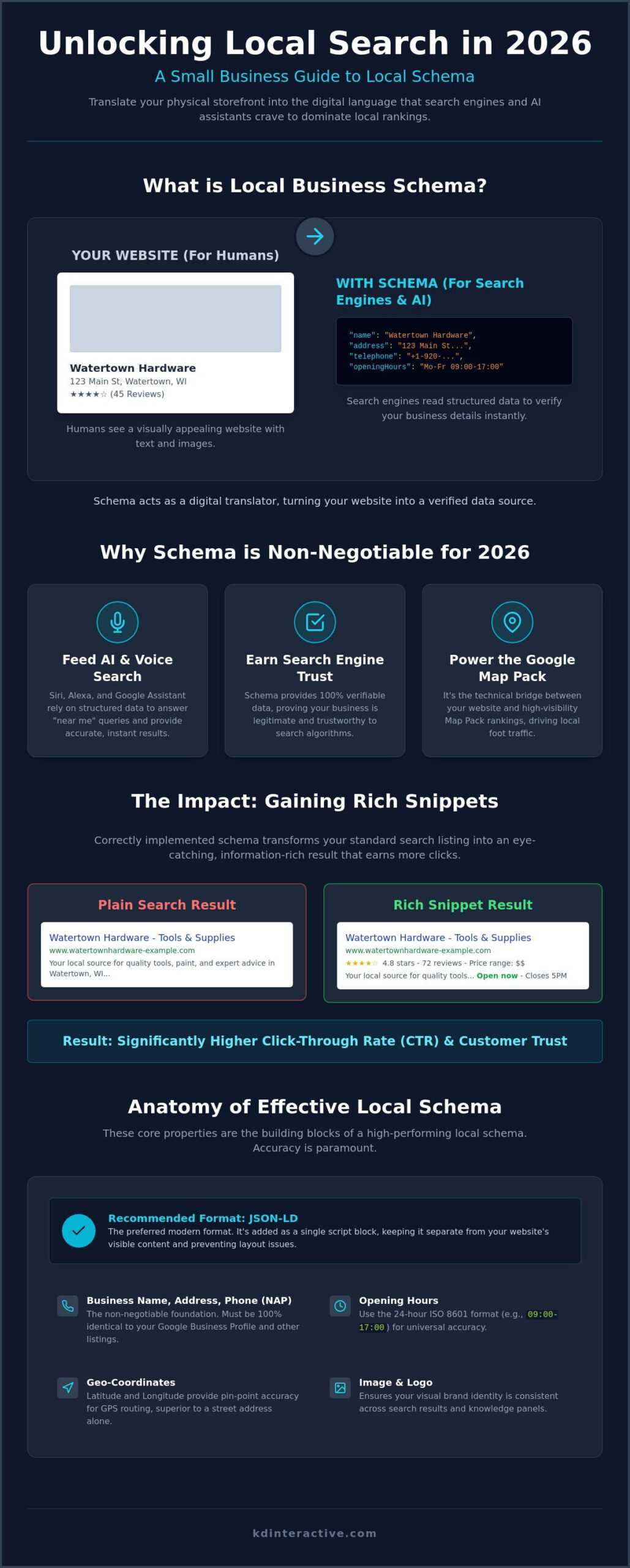
Local business schema is a specialized vocabulary of tags added to your website’s HTML code. Think of it as a digital translator for your business. While your human visitors see beautiful photos and catchy headlines on your site, search engines see structured data. This code translates your physical location into a language Google speaks fluently. In 2026, this translation is mandatory for any business in Watertown or Milwaukee that wants to be found in an increasingly crowded digital market. It turns your website into a verified data source rather than just a collection of text and images.
Why is 2026 the turning point for this technology? The rise of AI-driven local search has changed the rules of engagement. Search engines no longer simply index pages; they verify identities. They need to know with 100% certainty that your business is legitimate before recommending it to a user. This shift makes verified data a non-negotiable asset for expansion. This technology is a cornerstone of Local search engine optimisation, serving as the bridge between your website and the Google Map Pack. When you combine technical schema with creative google business profile post ideas, you build a digital presence that is both human-friendly and machine-readable.
The Impact on Rich Snippets and CTR
Rich snippets are the visual upgrades your search listing receives when schema is implemented correctly. These include gold star ratings, price ranges, and real-time “Open Now” indicators that appear directly on the search results page. These elements aren’t just for show. They have a massive psychological impact on local Wisconsin customers who are looking for immediate solutions. A listing with a 4.8-star rating and clear, verified operating hours will almost always earn the click over a plain, text-only result. For instance, a Madison-based service provider using structured data often sees a significantly higher click-through rate (CTR) than a competitor who leaves their data unverified. It’s about building trust before the customer even visits your site.
Feeding AI Assistants and Voice Search
Siri, Alexa, and Google Assistant don’t browse websites the same way humans do. They scan specifically for structured data to answer “near me” queries in a split second. If a driver in Milwaukee asks their phone for the nearest open hardware store, the AI assistant looks for specific schema tags to verify the shop’s current status and location. Schema acts as the primary source for AI local discovery by providing a direct, machine-readable verification of your business’s existence and offerings. Precise geo-coordinates within your code are equally vital for this process. These coordinates ensure that local routing is accurate, guiding customers in Watertown directly to your door without the frustration of navigation errors. Using schema alongside your google business profile post ideas ensures your business is ready for the future of search.
The Anatomy of Effective Local Schema: Key Properties
Building a digital presence that dominates Wisconsin search requires more than just a website; it requires a precise anatomical structure. While our previous section explored why this data matters for AI, we must now focus on the specific properties that make your code functional. The foundation of any local schema script is the “NAP” data. This non-negotiable trio consists of your Business Name, Address, and Phone Number. For businesses in Watertown or Milwaukee, this information must be an exact mirror of what appears on your physical signage and legal documents. Discrepancies here create friction that search engines penalize.
Accuracy extends to your operating hours as well. You should always use the 24-hour ISO 8601 format (e.g., 09:00 for 9 AM) to define your opening hours. This precision prevents customer frustration by ensuring Google displays your “Open” or “Closed” status correctly across all time zones. To further enhance your accuracy, we recommend following Google’s Local Business structured data guidelines when implementing these technical details. Beyond the basics, you should include several other critical properties:
- Geo-Coordinates: Including specific Latitude and Longitude is far superior to a street address alone. It provides the pin-point accuracy needed for GPS routing.
- Image and Logo: Defining these properties ensures your visual brand identity remains consistent in rich search results.
- Service Area: If you’re a service-area business in Madison without a traditional storefront, this property signals your reach to customers in specific zip codes.
Defining Your Specific Business Type
Specificity is a major ranking signal. While many entrepreneurs settle for the generic “LocalBusiness” tag, you’ll see better results by choosing a more specific subtype from the Schema.org hierarchy. Are you a “Restaurant,” a “Dentist,” or an “AutoRepair” shop? Selecting the most granular category tells Google exactly which niche you serve. For multi-location Wisconsin brands, it’s vital to create unique schema blocks for each branch. This prevents search engines from getting confused and ensures customers are routed to the nearest available location. If this technical heavy lifting feels daunting, our Local SEO services can handle the implementation for you.
The SameAs Property: Connecting Your Social Footprint
The “SameAs” property is a powerful tool for building brand authority. It allows you to link your website directly to your Facebook, LinkedIn, and Yelp profiles within the code itself. This property helps Google connect the dots, building a robust Knowledge Graph for your business. SameAs reduces identity fragmentation for local brands by explicitly telling search engines that your various digital profiles all belong to the same physical entity. When you use this property alongside your creative google business profile post ideas, you create a unified digital front. This synergy ensures that your google business profile post ideas are backed by a verified, structured identity that search engines trust implicitly.
JSON-LD vs. Microdata: Choosing the Right Format
Choosing the right format for your schema markup is the difference between a future-proof digital strategy and a technical headache. In the early days of structured data, Microdata was the standard approach. This method involves tagging individual HTML elements directly on your page. However, times have changed. For a Wisconsin business owner, managing Microdata is often a recipe for disaster. If you change your website theme or update a widget, you risk breaking the code that tells Google who you are. It’s a fragile system that requires constant monitoring.
JSON-LD is the modern, Google-recommended script that sits quietly in your website’s header. It’s a clean block of JavaScript that doesn’t interfere with your site’s visual design. According to Google’s official Local Business schema guide, this format is the preferred way to implement structured data. It’s significantly easier for small business owners to manage and update. When you have new google business profile post ideas or changes to your service area, you can update one script rather than hunting through dozens of HTML tags. It’s efficient, reliable, and keeps your data organized.
Why Google Prefers JSON-LD in 2026
Troubleshooting Common Format Errors
Even the best scripts can run into issues. The “Missing Comma” nightmare is the most common syntax mistake in JSON-LD. A single forgotten character can invalidate the entire script, making your business invisible to AI assistants. You should also watch out for “Zombie Schema.” This happens when outdated Microdata from an old theme lingers on your site, conflicting with your new JSON-LD. It creates data confusion that search engines hate. To avoid these pitfalls, we recommend using tools like the Rich Results Test to verify your code before it goes live. Ensuring your data is clean is just as important as the content you create for your customers in Madison and Watertown.
Step-by-Step Implementation for Small Businesses
Implementing local schema doesn’t require a degree in computer science. It’s a methodical process that rewards precision and attention to detail. You can start by using a schema generator tool to create your custom JSON-LD script. These tools act as a reliable template, ensuring your syntax is correct from the very first line. Once you have your template, customize the code with your specific Wisconsin location details. Ensure your NAP data exactly matches your physical storefront. If your shop is in Watertown, don’t use a Madison phone number by mistake. This consistency is just as important as your creative google business profile post ideas. While your posts engage human customers, this code engages the algorithms that rank your business in the Map Pack.
Inserting the script is the next hurdle for many entrepreneurs. For WordPress users, plugins like “Insert Headers and Footers” make this a simple copy-paste job. If you have a custom-built site, you’ll need to place the script between the head tags of your website. After installation, you must test the implementation immediately with the Google Rich Results Test. This ensures Google can actually read the data you’ve provided. Finally, keep an eye on the Enhancements report in your Google Search Console. This report will alert you to any 2026 format updates or errors that could impact your visibility.
No-Code Tools for Local Schema Generation
You don’t have to write a single line of code by hand. Several free schema generators are available in 2026 that handle the heavy lifting for you. For WordPress enthusiasts, automation plugins can handle much of the local SEO markup with just a few clicks. These tools are designed to bridge the gap between technical requirements and business operations. If you’re unsure if your current site is already running schema or if it’s outdated, our guide on web and seo services provides a clear roadmap for identifying and fixing existing errors.
Validating Your Work
Verification is the final, vital step in your implementation journey. Google’s Rich Results Test is your primary tool for ensuring your business is eligible for star ratings and live hours. You might also use the Schema Markup Validator for a broader technical check of your code’s structure. If Google reports that your schema is “Valid with warnings,” don’t panic. This usually means you’ve missed an optional field like a price range. However, you must re-test every time you change your business hours or physical address. Maintaining accurate data is the only way to stay ahead of the competition in Milwaukee and Madison. If this technical setup feels like a distraction from running your company, our Local SEO Services can manage the entire process for you.
Maximizing ROI with KD Interactive’s Local SEO Strategy
Schema markup is a powerful tool, but it’s only one piece of the local SEO puzzle. To truly dominate the Wisconsin market, your technical foundation must work in harmony with your broader local digital marketing efforts. While the code we’ve discussed ensures search engines can read your data, it doesn’t replace the need for high-quality content or active engagement. We handle the technical heavy lifting so you can focus on the creative side of your business. This includes developing effective google business profile post ideas that resonate with your neighbors in Watertown and Milwaukee. Technical accuracy combined with human-centric content is the secret to a high return on investment.
The Google Map Pack with AI Assistant
We offer a proprietary approach to local visibility that goes far beyond basic code. Our Google Map Pack with AI Assistant service is designed specifically for the needs of small businesses in Watertown, Milwaukee, and Madison. We don’t just add tags to your site; we integrate schema with an aggressive keyword strategy and strategic link building. This holistic method ensures your physical storefront is visible to both traditional searchers and the latest AI-driven voice assistants. This technology provides a perfect platform for your google business profile post ideas to reach the right audience at the right time. Having a local Wisconsin expert manage these complex systems means you never have to worry about broken scripts or outdated information.
Ready to Dominate Local Search?
Small businesses in Wisconsin can’t afford to ignore technical SEO in our competitive 2026 market. Your competitors are already using these tools to claim territory in the Google Map Pack. Waiting to implement these changes only gives them a larger head start. We believe in building trust through transparency and measurable results. It’s time to stop guessing and start growing with a professional assessment of your digital presence. This assessment identifies exactly where your data is failing and how to fix it immediately. Schedule your consultation with KD Interactive today! and let’s start turning your technical data into real-world revenue. Your success is our mission.
Claim Your Digital Territory in Wisconsin
Dominating the Wisconsin market in 2026 requires more than just a visible storefront; it requires a verified digital identity. By implementing JSON-LD schema, you translate your physical reality into data that search engines trust. This technical foundation works best when paired with active engagement, such as fresh google business profile post ideas, to capture both algorithmic and human attention. You now know that precise NAP data and specific business categories are the keys to unlocking rich snippets and voice search discovery.
As Wisconsin-based local SEO specialists, we understand the unique challenges faced by entrepreneurs in Watertown, Milwaukee, and Madison. Our Google Map Pack with AI Assistant technology provides data-driven results that move the needle for small businesses. You don’t have to tackle complex coding alone. We’re here to be your partner in professional achievement and market expansion. Get Your Free Website SEO Audit from Our Local Experts today to see how your site measures up. Your business deserves to be found, and we’re ready to help you lead the way.
Frequently Asked Questions
Does local business schema help with my Google Map Pack ranking?
Yes, local business schema is a significant signal for the Google Map Pack because it provides search engines with verified, machine-readable data about your location. When your website code explicitly confirms your address and service area, it builds the trust necessary to rank higher in Watertown and Milwaukee searches. It acts as a digital verification of your physical presence that search engines can’t ignore.
Can I have multiple local business schema types on one page?
You should typically stick to one specific LocalBusiness subtype per location page to avoid confusing search engines. If your Wisconsin business offers multiple distinct services, it’s better to use the most specific subtype available, such as “HVACBusiness” or “LegalService,” rather than cluttering a single page with multiple generic tags. This clarity helps Google categorize your business accurately for specific local queries.
How long does it take for schema changes to show up in Google search?
It usually takes between a few days and two weeks for changes to appear in search results. The exact timing depends on how often Googlebot crawls your site and processes the new structured data. You can speed up this process by requesting a manual recrawl through Google Search Console after you’ve updated your JSON-LD script to ensure your Madison location information is current.
Do I need to hire a developer to add schema to my WordPress site?
You don’t necessarily need a developer if you use no-code schema generators or dedicated SEO plugins. These tools allow you to input your data and automatically generate the necessary JSON-LD code for your site. However, if you have a complex site structure or existing technical errors, a professional assessment can ensure your implementation doesn’t conflict with other scripts or outdated Microdata.
What is the difference between Organization schema and LocalBusiness schema?
Organization schema describes a brand or company as a whole, while LocalBusiness schema is specific to a physical storefront or service area. For local SEO, the LocalBusiness tag is more effective because it includes geographic properties like latitude and longitude. This granular data is what powers your visibility in the Google Map Pack and helps AI assistants find your specific Wisconsin location.
Is schema markup a direct ranking factor in 2026?
Schema is an indirect ranking factor that significantly impacts your visibility by enabling rich snippets and verifying your entity status in the Knowledge Graph. In 2026, search engines and AI assistants rely on this structured data to provide “answer-first” results. While it might not be a weighted score in the traditional sense, it’s essential for being discovered in modern voice and AI searches.
How much does it cost to implement local business schema?
The cost of implementing schema varies based on whether you choose a DIY approach using free tools or hire a specialist for a managed solution. Many small businesses in Wisconsin find that investing in professional implementation saves time and prevents costly technical errors. It’s best to consult with a local expert to see what fits your specific business goals and technical requirements.
What happens if my schema information doesn’t match my Google Business Profile?
Mismatched information creates a trust gap that can lead to lower rankings and customer confusion. Google expects your Name, Address, and Phone number (NAP) to be identical across all platforms to verify your legitimacy. Keeping this data consistent is just as vital as your creative google business profile post ideas for maintaining a professional and reliable digital presence that customers can trust.