
A fast listing push isn’t the same as complete citation management. Local citation management covers four jobs: finding business mentions, checking listing consistency, submitting or updating listings, and reporting data drift. For multiple locations, manual citation building can take weeks per batch, while a platform’s initial push to connected directories can take hours. The right local citation management tools help organize those tasks, but the work still depends on accurate business details and the directories involved.
It’s understandable to want one system that keeps every location’s information accurate. Local citation management tools can help teams manage listings at scale, while professional support can handle initial research and cleanup. The right fit depends on how many locations need attention, whether listings already exist, and how much ongoing oversight your team can manage.
This guide explains what citation management involves, what affects the timeline for building citations across multiple locations, and how tools and professional support differ. You’ll also learn which capabilities to compare, how to assess costs without relying on a one-size-fits-all figure, and when local SEO support may be a practical next step.
Key Takeaways
- Audit existing profiles for duplicates, missing details, outdated information, and listings that haven’t been claimed before planning new citations.
- Set realistic timelines for multi-location work by accounting for listing volume, directory coverage, and the difference between an initial build and ongoing upkeep.
- Use one consistent business name, address, and phone format across locations to reduce mismatches and make listing updates easier to manage.
- Compare software and professional services by the work they cover, their reporting and update capabilities, and how well they fit your team’s needs.
What is local citation management?
Local citation management involves finding business listings, checking their accuracy, updating details, and tracking changes. In the United States, coverage varies by provider. Tools may support Google Business Profile, data aggregators, and niche directories.
Citation Audits and Unclaimed Listings
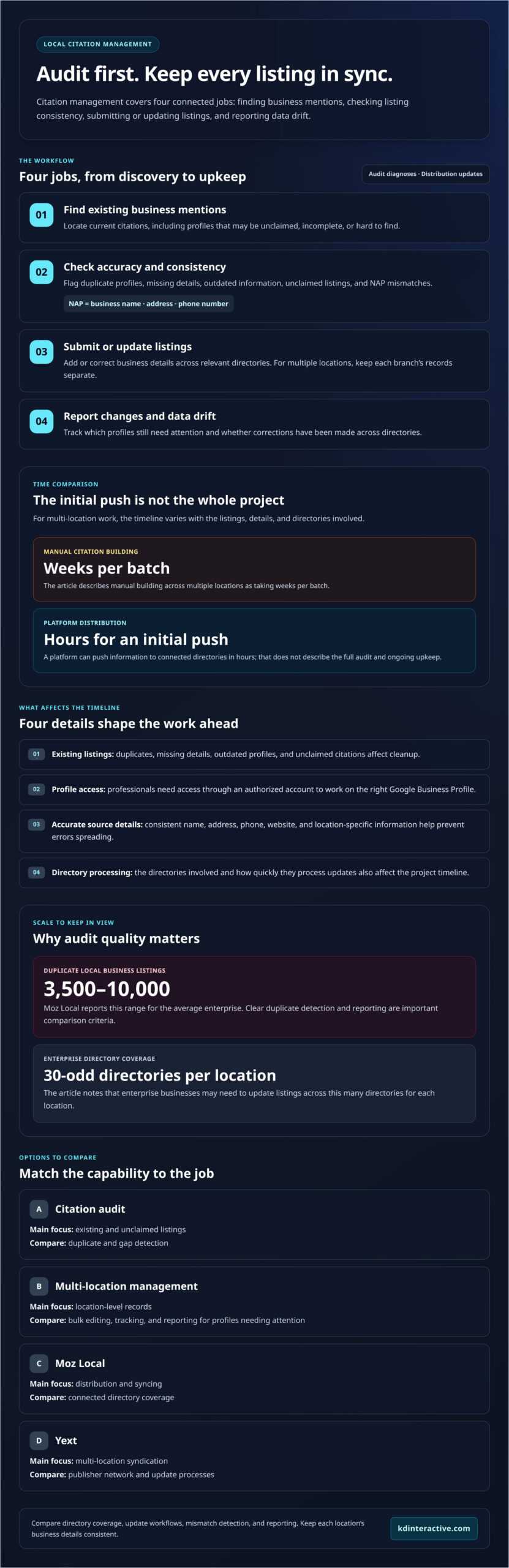
An audit uses a finder to locate existing citations, then flags duplicates, incomplete profiles, outdated details, and unclaimed listings. This differs from distribution: it diagnoses the current presence before citation building adds or updates listings. Moz Local reports that an average enterprise has between 3,500 and 10,000 duplicate local business listings. That makes audit quality and clear duplicate reporting important comparison criteria.
Listings Across Multiple Locations
For a business with several locations, management means organizing each location’s listing data and tracking its status across directories. A centralized workflow helps separate one branch’s address or phone update from another’s, reducing cross-location errors. Enterprise businesses may need to update listings across 30-odd directories for each location. Compare tools by whether they support bulk editing, location-level records, and reporting that identifies which profiles still need attention.
Listing Distribution and Syndication
Moz Local focuses on distributing and syncing business information with connected directories. Yext focuses on syndicating listing data across its publisher network. Both support distribution, but their destinations and workflows can differ. Before choosing, compare directory and publisher coverage, update processes, and reporting. A platform’s initial push to connected directories can take hours, while manual building may take weeks per batch.
NAP Mismatches and Duplicate Listings
NAP means name, address, and phone number. Consistent details help distinguish a legitimate location from another profile with conflicting information. Duplicate detection differs from syndication: it identifies conflicting records instead of distributing updates. Compare whether a tool flags variations for review and tracks corrections. For example, a changed phone number can leave one listing accurate while an older citation remains visible elsewhere.
| Option | Main focus | Compare |
|---|---|---|
| Citation audit | Existing and unclaimed listings | Duplicate and gap detection |
| Multi-location management | Location records | Bulk edits and tracking |
| Moz Local | Distribution and syncing | Connected directory coverage |
| Yext | Multi-location syndication | Publisher network and updates |
Choose based on your main priority: finding listing problems, managing branches, or distributing updates.
How long does citation building take for multiple locations?
For multiple locations, manual citation building can take weeks per batch, while a platform’s initial push to connected directories can take hours. The full project also depends on existing listings, profile access, accurate business information, and how quickly directories process updates.
Choose local citation management tools based on your business’s scale and workload. A small business may prioritize citation checks and simple updates; an agency may need bulk location management, client reporting, and repeatable workflows. Compare Google Business Profile support, directory coverage, mismatch detection, and data export. Strong rankings don’t replace complete, consistent profile information.
Compare BrightLocal, Whitespark, Semrush, and Yext by directory coverage, audit and tracking functions, multi-location workflows, and reporting. The best fit depends on whether you need to find citation gaps, support agency work, or syndicate business information across locations.
To connect a Google Business Profile, a professional needs accurate location details and access through an authorized account. Prepare the business name, address, phone number, website, and location-specific information. Then use Google’s access process to give the professional access to the right profile. Accurate source information helps prevent errors from spreading to other directories.
Google Business Profile is available at no cost in the United States, but that doesn’t cover professional citation work. Professional management costs depend on the number of locations, the condition of existing listings, directory coverage, and whether ongoing tracking is included. The fee is provided after a quote request, based on the project’s needs.
With complete location records and profile access, a professional can start by identifying existing listings, then prioritize corrections and new submissions. For businesses that need support coordinating local search work, local SEO planning can connect citation priorities with broader visibility goals.
Consistent name, address, and phone formatting
A local citation is a business reference in an online directory or another listing. Its core details are the business name, address, and phone number, often shortened to NAP. Consistency means using the same accurate information across relevant profiles. For example, a location shouldn’t have different phone numbers or conflicting addresses on Google Business Profile and directory listings.
Formatting differences can create practical cleanup work. In one example, a 12-location dental group found 47 NAP mismatches across 9 directories after a phone-system cutover. The group spent 4.0 hours reviewing mismatch rows, and 3 locations still showed a retired phone number in Google Business Profile. A mismatch dashboard helps professionals identify which listing needs correction and track its status.
The goal isn’t to force identical punctuation across platforms when their fields display details differently. Instead, the information should clearly identify the same location. A professional compares the name, street address, suite details, and phone number across profiles, then separates harmless formatting differences from conflicting facts. This helps focus corrections and avoids treating every variation as a duplicate.
Duplicate listings can split a location’s presence across records with old or inconsistent details. A citation audit helps distinguish the active profile from a duplicate and prioritize updates. In the dental group example, an audit 14 days after submitting updates still found 6 residual citation mismatches. Follow-up tracking matters because a submitted correction doesn’t necessarily mean every directory now displays the revised information.
Consistent NAP details give customers and search platforms clearer business information. This supports a dependable online presence, though it doesn’t guarantee rankings or visibility. For a business with several locations, keep a separate, accurate record for each branch. Make sure each location’s phone number and address remain attached to the correct profile when details are updated.
Citation management tools and services
Tools and professional services address different parts of citation work. For a new location, a citation checker can find existing listings, then a builder or management platform can fill gaps. Professional support can coordinate the initial build and cleanup, while software helps with later monitoring and updates. The useful question isn’t simply tool or expert: it’s which approach covers the work your local business needs.
Platforms can send business information to connected directories, reducing repetitive manual submissions. A platform’s initial push to connected directories can take hours, while manual building may take weeks per batch. Coverage still matters: smaller niche directories usually require manual submissions. Check that a tool’s directory list matches your business’s industry and locations rather than relying on a broad coverage claim.
Professional services add hands-on work where listings need research, correction, or careful handling. After business details change, a business may need to update more than 40 directories. A service can manage this broader correction process; software can help track statuses and maintain connected listings. The hybrid approach pairs an initial build and cleanup with a management tool for ongoing accuracy.
Small businesses can focus on finding existing citations, filling important gaps, and tracking essential updates. Agencies managing multiple businesses may need location-level records, bulk editing, and reports that show unresolved work. Compare directory coverage, duplicate detection, update workflows, and reporting. These criteria show whether a platform supports your actual workload or leaves important submissions for someone to handle manually.
A practical selection process starts with a citation audit, then matches the findings to the right delivery method. Use software when connected-directory updates and ongoing tracking are central; consider professional help when cleanup, research, and manual submissions dominate. For help aligning citation work with local visibility goals, get local SEO support.
KD Interactive: Local SEO Services
KD Interactive helps small businesses connect local search priorities with broader visibility through Local SEO Services. Turn to this support when citation work is one part of a wider need, such as identifying relevant searches or improving the information customers find about your business.
SEO Keyword Analysis helps shape search priorities, while Content Creation provides useful, locally relevant information for customers. Press Release Distribution can extend the reach of business news. These services complement citation planning, but they don’t replace a dedicated listing management platform when automated directory updates are your main need.
For a practical next step, outline the locations involved, the listing issues you’ve identified, and your wider visibility goals. This gives the discussion a clear focus without assuming every business needs the same approach. Contact KD Interactive to discuss your local SEO needs.
Build a Stronger Local Search Foundation
Treat citation management as an ongoing business information workflow, not a one-time software purchase. When locations, phone systems, or services change, someone needs to keep the information customers see accurate. The right local citation management tools can support that work, while professional guidance can connect listing priorities to broader local search goals.
Define what progress should look like: cleaner business information, stronger local visibility, or a more coordinated approach across locations. That focus helps shape a practical plan rather than adding tools without a clear purpose. KD Interactive’s Local SEO Services, Content Creation, and Press Release Distribution can support connected visibility efforts when they fit your priorities.
Contact KD Interactive about local citations to discuss a practical next step for your business. Clear priorities make it easier to move forward with confidence.
Frequently Asked Questions
Should a professional automate directory updates without a reviewer?
Automation can handle routine updates, but a reviewer should oversee exceptions and important changes. A new phone number, moved office, or duplicate profile can affect listings in different ways. A professional can review source details, confirm the correct location record, and check reported update statuses. This helps prevent outdated or conflicting business information from turning efficiency gains into widespread errors.
Should you hire a citation building service or use citation software?
Choose professional support when a project needs hands-on research, cleanup, or manual submissions to niche directories. Choose software when your team can manage routine tracking and updates across connected platforms. A business with few existing listings may need a different mix from an agency handling several clients. Both can work together: professionals address initial gaps, then a platform supports ongoing monitoring.
What are the pros and cons of this approach?
Citation software can make recurring updates easier to coordinate and provide a central view of listing activity. Its limits include directory coverage and the need to handle some niche submissions manually. Professional support brings focused research and cleanup, but ongoing work still needs a clear owner and process. The best approach depends on whether your main challenge is correcting listings or maintaining them over time.
What are local citation management tools for local SEO?
Local citation management tools are software platforms that help businesses find, organize, update, or monitor online listings. They can make information easier to manage across directories and other platforms. Their role is operational: they don’t replace a complete local search strategy or ensure rankings. For example, a business can use a tool to track whether revised hours appear consistently across connected listings.
What should you look for in local citation management tools in 2026?
Prioritize capabilities that match your workflow: duplicate and mismatch detection, relevant directory coverage, Google Business Profile support, bulk editing for multiple locations, and useful reporting or data exports. Consider whether the platform makes unresolved listing issues visible, not just whether it distributes information. A small business may value simple location tracking, while an agency may need efficient account and reporting workflows across clients.
How do professionals find and fix inconsistent local business citations?
Professionals start by gathering approved business details and locating existing profiles across search platforms and directories. They compare each listing with the correct location record, then classify differences as outdated information, formatting variation, or a possible duplicate. After submitting corrections or addressing duplicate records, they track affected listings and review remaining mismatches. This follow-through matters because directory updates may not appear uniformly.