
If your local search ranking has disappeared from Maps, that doesn’t automatically mean your business profile is gone. Local results can vary by searcher location and search wording, so one missing position isn’t enough to identify the cause. First, determine whether visibility has changed or the profile itself has a problem.
It’s unsettling when customers can’t find you where they used to, especially when Maps helps people discover your business. Look for patterns before assuming a cause: does the change appear across searches and locations, or only in a particular view?
This article explains how Maps rankings relate to navigation tools, reviews, and reactions, and what those signals can and can’t tell you about a drop. You’ll learn to distinguish a broader ranking change from a profile issue, which observations to track, and when local SEO analysis can help you decide what to address next.
Key Takeaways
- Compare the visibility change across searches and locations to help distinguish a broad ranking shift from a business profile issue.
- Track the same search terms from different areas so you can spot patterns instead of relying on one Maps result.
- Review your business information, citations, customer reviews, and relevant website content for areas that may need attention.
- When you need a structured plan to improve local visibility, SEO keyword analysis and Local SEO Services can help focus the next steps.
How can I tell if a local ranking drop is an algorithm update or a profile issue?
A missing Maps result alone can’t identify the cause. Google Maps results can change with the search phrase and the searcher’s location, so compare several searches before changing your business profile. If your local search ranking has disappeared for one phrase but remains visible for closely related searches, that suggests a narrower visibility change, not proof of a profile problem.
Start with the Google Business Profile dashboard. Look for a notice, a pending edit, inaccurate business details, or a profile status that needs attention. Then compare the dashboard with what customers see in Maps. For example, if your business hours are correct in the dashboard but an old version appears publicly, record the mismatch and investigate the profile before rewriting website content.
Use these checks to separate the likely causes:
- Compare searches: Try your business name, your main service, and a service paired with your city. A branded result appearing while a broad service search changes suggests the issue may affect discovery rather than the profile’s basic presence.
- Compare locations: Check Maps from the business area and from another nearby area. A result that changes by location can reflect local variation, rather than a site-wide disappearance.
- Check profile status: Review the Google Business Profile dashboard for warnings or changes. Confirm that the displayed name, address or service area, phone number, and hours match the details you intend customers to see.
- Review timing: Note when the change began and whether profile edits, website updates, or a wider visibility change happened around the same time. A timeline helps distinguish a single profile event from a broader fluctuation.
A broader ranking shift is more plausible when several businesses or service searches change together, while your profile remains accessible and accurate. A profile issue is more plausible when the listing itself is missing, marked unavailable, or displays incorrect information. These are clues, not a diagnosis: Maps visibility can vary by query and location, and timing alone doesn’t prove an algorithm update.
Compare Google Search Console data with your Maps observations. If organic website clicks and impressions remain steady while the Maps listing changes, focus first on the profile and local results. If both website and Maps visibility shift, examine website performance alongside the profile. Keep dated screenshots and log each search phrase, location, and result. This evidence makes a confusing drop easier to investigate.
Keep dated screenshots and notes alongside any technical evidence. The website owner identified server and database issues around October 22, including database connection failures and server-side rendering errors. Some URLs affected by server issues had October 22 as their last crawl date. Compare those records with the timing of the visibility change, but treat overlap as a clue to investigate rather than proof that the technical problems caused a Maps ranking drop. This helps keep profile checks and website diagnosis distinct.
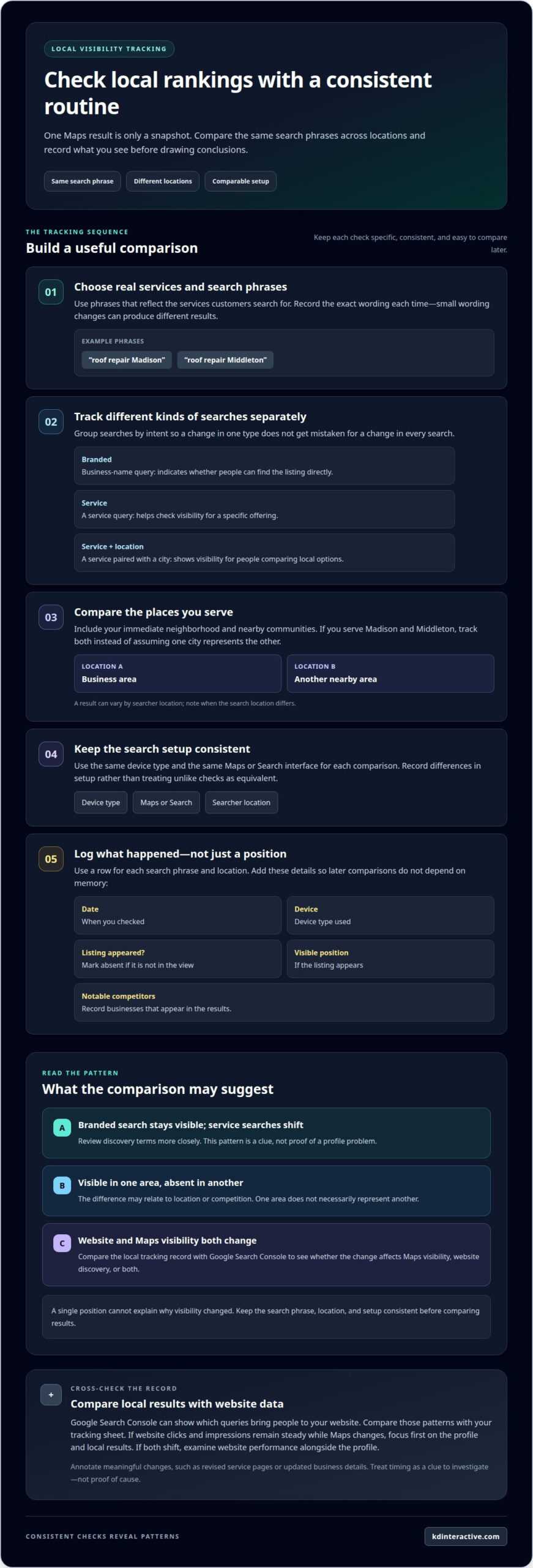
How do I check my local rankings across different locations and search terms?
Build a consistent tracking routine instead of treating one Maps result as a picture of your whole market. Choose the services customers search for, then pair each service with the places your business serves. For a Madison business, examples might include “roof repair Madison” and “roof repair Middleton.” Use phrases that reflect real services and customer language, not unrelated keywords.
Track branded and non-branded searches separately. A business-name query shows whether people can find your listing directly. A service-and-location query shows how visible you are to people comparing local options. Record the exact phrase each time. Small wording changes can produce different results, so don’t compare unlike queries as if they were equivalent.
Use a simple tracking sheet, with a row for each search phrase and location. Add the date, device, whether your listing appeared, its visible position, and any notable competitors. Mark a result absent if it doesn’t appear in the view you’re checking. This gives you a record to compare later, without relying on memory.
- Choose representative locations: Include your business’s immediate neighborhood and nearby communities you serve. If you serve Madison and Middleton, track both rather than assuming one city reflects the other.
- Keep the search setup consistent: Use the same device type and Maps or Search interface for each comparison. Note when the searcher’s location differs, since proximity can affect which businesses appear.
- Separate search intent: Track service terms, service-plus-city terms, and branded terms in different groups. A change limited to one group offers a more useful clue than a single overall ranking.
- Compare with website data: Google Search Console can show which queries bring people to your website. Compare those patterns with your local tracking sheet to see whether a change affects Maps visibility, website discovery, or both.
Look for patterns in your tracking sheet. If your business appears for a service in Madison but not Middleton, the difference may relate to location or competition. If a branded query remains visible while service searches shift, review discovery terms more closely. These observations guide your investigation, but a single position can’t explain why visibility changed.
Review the record regularly and annotate meaningful changes, such as a revised service page or updated business details. Consistent tracking makes comparisons more useful than frequent, unstructured checks. If you need help turning local query patterns into a practical visibility plan, consider a structured local visibility review.
How can I improve local rankings with citations, reviews, and on-page SEO?
Strengthen the signals customers and search engines use to understand your business. Keep business details accurate and connect your Google Business Profile to relevant website pages. For example, a Milwaukee plumber should make its service area and plumbing services clear across its profile, listings, and website.
Local citations are mentions of your business details in directories and other websites. Check important listings for consistency in your business name, address, phone number, and website. If a directory shows an old phone number but your Google Business Profile has the current one, update the listing. Prioritize relevant, trustworthy sources rather than creating profiles everywhere.
Reviews help people decide whether a business fits their needs. Ask customers for honest feedback after a completed service, and respond professionally to positive and critical comments. A reply can address a specific concern without sharing private customer details. Don’t offer rewards for positive reviews or pressure customers to change an honest review.
On-page SEO connects a searcher’s service need and location with useful website information. Give each core service a clear page, such as “emergency plumbing in Milwaukee,” and explain the work, service area, and next step. Use accurate headings. Avoid awkwardly repeating city names or publishing near-identical pages with only the location changed.
- Audit citations: Record the business details shown on your Google Business Profile and key directories. Correct outdated or conflicting entries.
- Improve review practices: Make it easy for customers to leave honest feedback, then respond in a timely, respectful manner.
- Match pages to intent: Connect each main service with a useful page that answers customer questions and describes relevant locations.
- Check page clarity: Confirm that titles, headings, contact details, and service descriptions match the business information customers see elsewhere.
These tasks work together, but they solve different problems. Accurate citations reduce confusion about business details; reviews provide customer perspectives; focused pages explain your services and locations. Prioritize the clearest mismatch first, then track local visibility for the relevant searches. Build a focused local visibility plan around consistent listings, credible reviews, and useful service pages.
Check that service pages are complete and accessible on mobile. Google recommends equivalent primary content on mobile and desktop; if a mobile page has less primary content, Google may understand it differently. Compare service descriptions, location information, and other primary content across both versions. Also check mobile indexing directives: a mobile page marked noindex may not be indexed by Google. These checks help ensure the page’s local information is available on mobile.
For a separate mobile URL configuration, Google’s example uses a screen-width breakpoint of 640 pixels in the desktop page’s alternate link. Sitemap processing can also be part of a technical review: Google processed the website’s two sitemap files on October 28, 2026, with the first reporting 50,000 discovered URLs. Keep these technical checks alongside citation, review, and page-quality work so that the business information you maintain is reflected in pages Google can access and understand.
KD Interactive: Local SEO Services
KD Interactive can help when Maps visibility remains uneven after you’ve reviewed your profile, search patterns, and website. Its Local SEO Services address local visibility through targeted SEO work, while SEO Keyword Analysis helps identify relevant search terms and locations. Content Creation supports useful pages that explain your services to local customers.
Turn to KD Interactive when you need a clear plan to improve your local search presence or when ongoing changes make it difficult to prioritize next steps. Press Release Distribution can also support visibility through relevant announcements. The work is tailored to your local search needs, rather than applying a one-size-fits-all fix.
Contact KD Interactive to discuss your local search visibility.
Turn the visibility drop into a focused next step
A change in Maps visibility can feel urgent, but reacting to every fluctuation can scatter your effort. Choose a priority: correct business information, strengthen a page that meets an important customer need, or understand which searches have changed. A focused action makes it easier to decide what deserves attention next.
If your local search ranking has disappeared, treat the change as a reason to make a considered decision, not to overhaul everything at once. Keep your observations organized, identify the business outcome that matters most, and let that goal guide your next steps. For a tailored plan, contact KD Interactive for a free consultation. Consistent, informed decisions give your local visibility strategy direction.
For support deciding on a practical path forward, contact KD Interactive about local search support. Your next step can be clear, measured, and aligned with the customers you want to reach.