
Why is that less qualified shop down the street consistently outranking you on Google Maps? It’s a frustrating reality for many Wisconsin business owners who watch their rivals capture the local 3-pack while their own phones stay silent. You know your service is superior, but Google’s algorithm sees something else. Performing a thorough local SEO competitive analysis is the only way to identify “trust gaps” where your competitors are failing, allowing you to step in and claim that market share.
We understand the pressure of feeling like you’re wasting time on marketing tactics that just don’t move the needle. Since over 70% of local searches now result in interactions with a Google Business Profile according to January 2026 data from The Dietz Group, you can’t afford to guess about your strategy. This guide promises to show you how to analyze your rivals to find exploitable weaknesses. We’ll walk you through a clear process to dominate the Map Pack, leverage our AI Assistant for deeper research, and ultimately drive more phone calls and walk-ins to your storefront.
Key Takeaways
- Learn how to distinguish between your physical neighbors and your “search competitors” to focus your energy on the rivals actually stealing your digital traffic.
- Master a 4-point framework for local SEO competitive analysis that uncovers exactly why your rivals are winning the Google Map Pack.
- Discover how to exploit “low-hanging fruit,” like missing citations and unoptimized profiles, to gain quick ranking wins in your specific Wisconsin market.
- See how an AI-powered assistant can accelerate your research, turning complex data into a clear list of competitor weaknesses you can dominate.
- Build a local content calendar that fills the information gaps your competitors have left open, positioning your brand as the primary regional authority.
What is Local SEO Competitive Analysis?
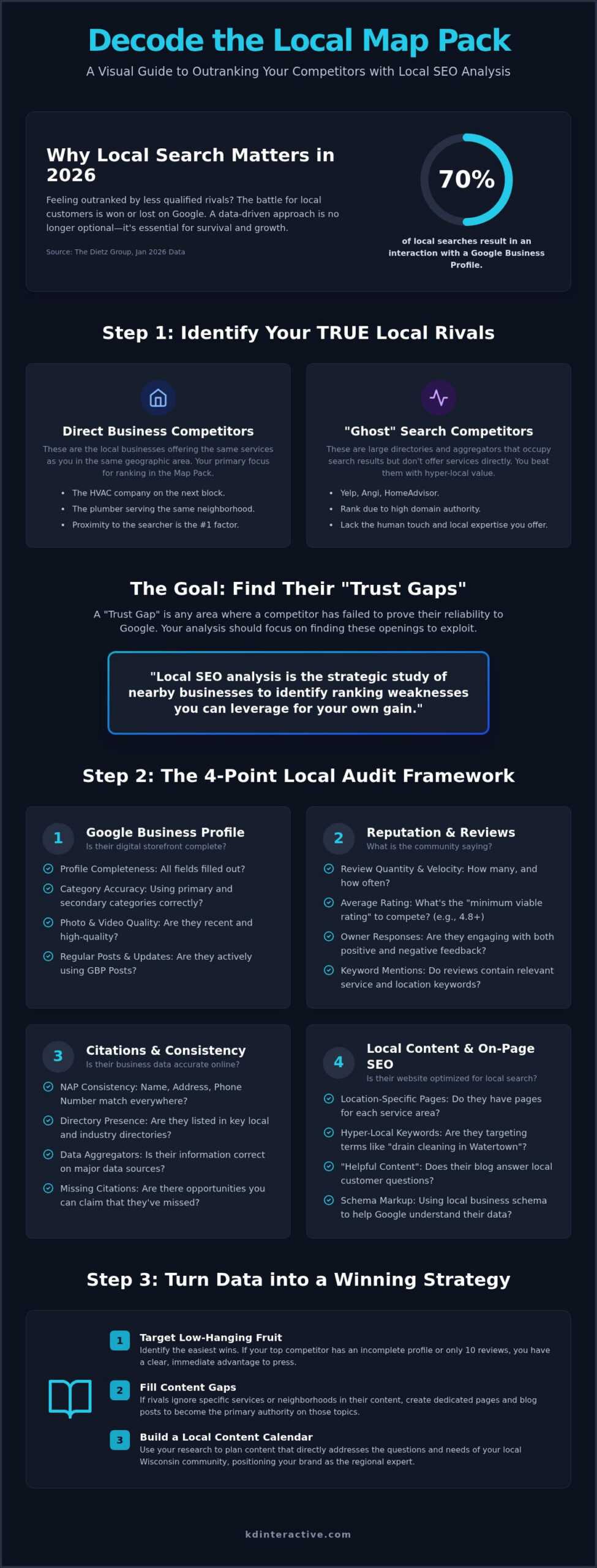
Local SEO competitive analysis is a systematic audit of the businesses vying for the same customers in your specific geographic area. It isn’t just about looking at a rival’s website. It’s about dissecting their entire digital footprint to see why Google favors them in the Map Pack. This process serves as the vital foundation for any effective local SEO services near me because it moves beyond theory into actionable, regional data.
There’s a massive difference between global SEO and the local “3-pack” rivalry. While global competition focuses on broad authority and massive backlink profiles, Local SEO is a battle of proximity, relevance, and local prominence. Your true rivals aren’t national chains with huge budgets; they’re the shops three blocks away that have better review velocity or more accurate directory listings. Our primary goal during this analysis is to identify “Trust Gaps.” These are specific areas where a competitor has failed to prove their reliability to Google, creating an opening for your business to step in and capture that traffic.
The Goal: Finding Your Competitive Advantage
Analysis helps you find the keyword opportunities your neighbors in Milwaukee or Madison are missing. You might discover that while everyone is fighting for a broad term like “plumber,” no one has optimized for “emergency drain cleaning in Watertown.” This research also uncovers the “minimum viable reputation” needed to rank. If the top three businesses all have 50 or more reviews and a 4.8 star rating, you know exactly what benchmark you need to hit to compete. Local SEO analysis is the strategic study of nearby businesses to identify ranking weaknesses.
Why 2026 Requires a Data-Driven Approach
The search environment in 2026 is vastly different than it was even two years ago. AI-driven results now prioritize “Helpful Content” signals that prove a business is an active, trusted part of its community. Guessing which keywords to use or how often to post to your profile doesn’t work for small enterprises anymore. Google’s AI-driven enforcement is now actively removing non-compliant reviews and punishing profiles with inconsistent data. You need a methodical approach that uses real-time data to stay ahead. By looking at what’s working for others right now, you can build a strategy that isn’t based on outdated jargon but on measurable local performance.
How to Identify Your True Local Rivals
Identifying your true rivals isn’t as simple as looking at the shop across the street. In the digital space, your competitors are often businesses you’ve never even heard of. A proper local SEO competitive analysis requires you to look at two distinct groups: direct business competitors and search competitors. While a direct rival sells the same HVAC or plumbing services you do, a search competitor like Yelp or Angi simply takes up valuable real estate on the results page. You can’t treat them the same way if you want to win.
Proximity is the most important factor in 2026. If you’re a business in Milwaukee, a competitor located 20 miles away in Waukesha is largely irrelevant to your local Map Pack rankings. Google prioritizes businesses closest to the searcher’s physical location. To see what’s actually happening, you must use Incognito mode or local rank trackers. These tools show you “clean” results without your personal search history biasing the data. Looking at businesses too far outside your immediate area will only lead to a misleading and ineffective strategy.
Proximity-Adjusted Search
The Map Pack changes on a block-by-block basis. To build a Winning Strategy, you need to test searches from different zip codes within your service area. A searcher in downtown Madison will see different results than someone in Sun Prairie. Identifying the market leader in each specific neighborhood allows you to tailor your content to the exact needs of those residents. If you want to see exactly who is winning in your neighborhood right now, our local SEO experts can help you map out your territory.
Analyzing the “Ghost Competitors”
We call directories “ghost competitors.” They rank well because of their massive authority, but they lack the human touch and local expertise you provide. You can outrank these giants by providing hyper-local value that they simply can’t match. This starts with getting your own digital front door in order. Knowing how do i setup a google business page is your first step toward claiming that space back from the aggregators. Once your profile is live, you can focus on the specific local signals that these national directories ignore, like community-specific posts and regional project galleries.
The 4-Point Local Audit Framework
Once you’ve identified your true rivals, you need a methodical way to dismantle their strategy. A comprehensive local SEO competitor analysis isn’t a surface-level glance at a homepage. It’s a deep dive into the four pillars that Google uses to determine who wins the Map Pack. We focus on these specific areas because they represent the “trust signals” that drive local revenue. If a competitor is outranking you, they’ve likely built a stronger foundation in one of these categories.
- Point 1: Google Business Profile (GBP) Optimization. We look at more than just the name and address. We analyze how often they post, the quality of their images, and whether they’re using every available feature to engage users.
- Point 2: On-Page Local Signals. Your website must speak the language of your city. This includes dedicated location pages, local keyword integration, and technical schema markup that tells search engines exactly where you operate.
- Point 3: Local Citation Consistency. Inconsistent Name, Address, and Phone Number (NAP) data is responsible for over 40% of local ranking declines. We audit where your rivals are listed and ensure your data is cleaner and more widespread.
- Point 4: Reputation and Review Sentiment. It’s not just about the star rating. We look at review velocity and what customers actually say to find service gaps you can exploit in your own marketing.
Auditing the Google Business Profile
Start by looking at your rival’s primary and secondary categories. Many businesses in Watertown or Milwaukee miss out on traffic because they haven’t selected the most relevant secondary categories that their competitors are using. Analyze their “Q&A” section. Are they answering customer questions quickly? High-quality, recent photos also signal to Google that a business is active and reliable. Approximately 15% of local ranking power comes from a well-managed GBP, making this the most critical part of your audit.
Content and Citation Gaps
Compare the depth of your competitor’s location pages to your own. If they have 500 words of helpful, neighborhood-specific content and you only have a map embed, they’ll win every time. We also identify local Wisconsin directories where they have a presence but you don’t. This might include regional chambers of commerce or industry-specific local listings. Building this foundation requires professional web and seo services to ensure your technical setup doesn’t hold you back. By filling these content and citation gaps, you stop guessing and start outperforming your rivals with data-backed precision.
Turning Competitive Data into a Winning Strategy
Gathering data is only half the battle. The real value of a local SEO competitive analysis lies in how you prioritize your next moves to capture market share. Many entrepreneurs feel overwhelmed by the volume of SEO tasks; however, the key is to focus on the actions that yield the fastest results. We recommend a phased approach that starts with stabilizing your foundation before moving into aggressive growth tactics. This methodical strategy ensures you aren’t just busy but are actually moving the needle on your revenue.
- Step 1: Prioritize “Low-Hanging Fruit.” Fix any glaring issues uncovered in your audit. This includes inconsistent NAP data or a partially completed Google Business Profile. These are quick wins that immediately improve your visibility.
- Step 2: Create a Local Content Calendar. Use the keyword gaps you identified to plan articles and guides that provide more value than your neighbors’ sites.
- Step 3: Launch a Local PR Campaign. Earn high-authority Wisconsin backlinks by sharing your business news with regional media outlets.
- Step 4: Implement a Review Acquisition Strategy. Close the “Reputation Gap” by consistently asking for feedback to match or exceed the review velocity of the market leaders.
- Step 5: Monitor and Adjust. Review your performance metrics monthly. The local landscape changes fast, and staying on top of the Map Pack requires constant refinement based on fresh data.
Building a Local Content Moat
Your competitors might have basic blog posts, but you can win by creating definitive local guides. If you operate in Watertown or Milwaukee, don’t just write about your services; write about how those services solve specific problems for residents in those neighborhoods. Service Area Pages are essential here. In 2026, Google’s “Helpful Content” signals prioritize human-first information that demonstrates real-world experience. By creating deep, localized content, you build a “moat” around your business that generic national competitors can’t cross. This level of detail proves to both Google and your customers that you’re the regional expert.
Earning Wisconsin-Specific Authority
Backlinks from local sources are worth their weight in gold for Map Pack rankings. While global SEO focuses on any high-authority link, local SEO thrives on regional relevance. Consider sponsoring a youth sports team in Madison or a community event in Milwaukee to earn a hyper-local link from their website. Another powerful differentiator is our Press Release Distribution service. We help you broadcast your milestones to Wisconsin-specific news sites, signaling to Google that your business is a prominent and trusted local entity. If you’re ready to stop guessing and start winning, explore our local SEO strategies to see how we can help you dominate your territory.
Dominating Your Market with KD Interactive’s Local SEO
Entrepreneurs in Wisconsin have enough on their plates without adding “SEO analyst” to their job descriptions. While DIY tools might seem appealing, the reality is that local SEO competitive analysis is a complex, moving target that requires constant attention. KD Interactive simplifies this process by providing the expert oversight and advanced technology needed to win your market. We don’t just hand you a list of data; we provide a clear path to increased visibility and professional achievement. Our goal is to position your brand as the dependable local authority your neighbors trust.
Our Google Map Pack service with an integrated AI Assistant is a game-changer for businesses in Milwaukee, Madison, and Watertown. Instead of manual guessing, our technology analyzes thousands of data points to find exactly where your rivals are slipping. This allows us to focus our efforts on the high-impact changes that actually drive more phone calls and walk-ins. We believe in building trust through transparent, revenue-driven results that prove our success is linked to your progress. You deserve a marketing partner that values your growth as much as you do.
AI-Powered Insights for Small Business
Our AI Assistant identifies competitor weaknesses in seconds, uncovering sentiment gaps in reviews or content deficiencies that humans might miss. This technology does the heavy lifting, but it’s backed by our methodical, data-driven team that handles the technical implementation. You get the benefit of cutting-edge tools without having to learn the software yourself. KD Interactive has helped Wisconsin firms grow through tailored local strategies since inception. By focusing on your specific territory, we ensure your marketing budget is spent on tactics that actually move the needle in your city.
Your Partner in Local Growth
We understand the challenges of running a smaller enterprise. You need a collaborator who acts as a dependable, regional expert rather than a distant national agency. Our Wisconsin-based team provides a home-field advantage because we know the regional landscape better than any national firm. We’re ready to assist you in reclaiming your market from less qualified rivals who are currently taking your customers. Our approach is grounded in empathy for the entrepreneur; we aim to be the reliable partner that helps you expand your footprint and achieve long-term success.
Stop letting your competitors dominate the local 3-pack while you wait for results that never come. We invite you to a professional assessment where we’ll look at your specific landscape and identify the exact trust gaps you can exploit today. It’s time to shift from confusion to confidence with a strategy built for the 2026 search environment. Get your custom Local SEO strategy from KD Interactive today!
Take Command of Your Local Market Today
The local digital landscape in 2026 moves faster than ever, but you don’t have to navigate it alone. By performing a thorough local SEO competitive analysis, you’ve already taken the first step toward reclaiming your territory from less qualified rivals. You now understand that winning the Map Pack isn’t about guessing; it’s about identifying specific trust gaps and filling them with high-quality, neighborhood-focused content. Each citation fixed and every review earned brings you closer to market leadership.
Whether you’re operating in Milwaukee, Madison, or Watertown, your business deserves a strategy that produces measurable revenue growth. Our Wisconsin-based local SEO experts are ready to help you implement the technical heavy lifting and AI-powered tactics discussed in this guide. We focus on AI-Powered Map Pack dominance to ensure you stay ahead of the curve. Don’t let your competitors continue to capture the leads that should be yours. It’s time to turn these insights into a professional achievement that secures your brand’s future.
Request Your Free Local SEO Competitive Audit and let us show you the proven results we can deliver for your small business. We’re excited to partner with you on this journey toward dominating your local market.
Frequently Asked Questions
How long does a local SEO competitive analysis take?
A comprehensive audit typically requires four to eight hours of focused research for most Wisconsin small businesses. This timeframe allows for a deep dive into rival Google Business Profiles, website content, and backlink profiles. While automated tools can gather data in seconds, the manual interpretation of that data is what creates a winning strategy for your specific market.
Do I need expensive software to analyze my local competitors?
You don’t need to invest in high-cost enterprise software to get started. Free resources like Google Maps, Incognito browser windows, and basic keyword research tools offer a wealth of information. However, professional local SEO services often use advanced AI-powered tools to identify hidden patterns and save you dozens of hours of manual labor in your research phase.
What is the most important factor in outranking a local rival?
Proximity to the searcher remains the most influential factor in the 2026 local search algorithm. Even if a rival has a better website, Google will often favor your business if you’re physically closer to the user. Beyond location, maintaining a high level of prominence through consistent reviews and accurate citations is what ultimately bridges the gap between you and the current market leader.
Can I outrank a competitor who has hundreds of more reviews than me?
You can definitely outrank a rival with more reviews by focusing on review velocity and recency. Google prioritizes how many new reviews you’ve received lately rather than just the total count. If your competitor hasn’t had a new review in months, your fresh, keyword-rich feedback from Milwaukee or Madison customers will signal to Google that your business is more active and relevant.
How often should I perform a competitive audit for my business?
A quarterly local SEO competitive analysis is the best way to ensure your strategy remains effective. The local market in Wisconsin changes quickly as new businesses open and existing ones update their tactics. Checking in every three months allows you to spot new trust gaps and adjust your content calendar before your rankings begin to slip.
What are the best local SEO tools for Wisconsin small businesses in 2026?
The most effective tools for 2026 combine Google’s own data with specialized analytical software. We recommend using the revamped GBP Insights dashboard for conversion tracking and local heatmaps to see where your visibility drops. For businesses in Watertown or Waukesha, our own AI Assistant provides a unique advantage by performing deeper competitive research faster than traditional DIY methods.
How do local press releases help beat my competitors?
Local press releases build regional authority and earn high-quality Wisconsin-based backlinks that national directories can’t replicate. When you distribute news through regional channels, you earn links from trusted local sources. These signals are far more valuable for local rankings than generic national directories because they prove your business is an active, authoritative member of your specific community.
Is it possible to outrank national brands in local search results?
Small businesses often outrank national brands by providing hyper-local content and more personalized engagement on their Google Business Profiles. While a national brand uses generic templates, you can create service area pages tailored to specific Milwaukee neighborhoods. By focusing on hyper-local value and active community engagement, you prove to Google that you’re the better choice for local searchers.