
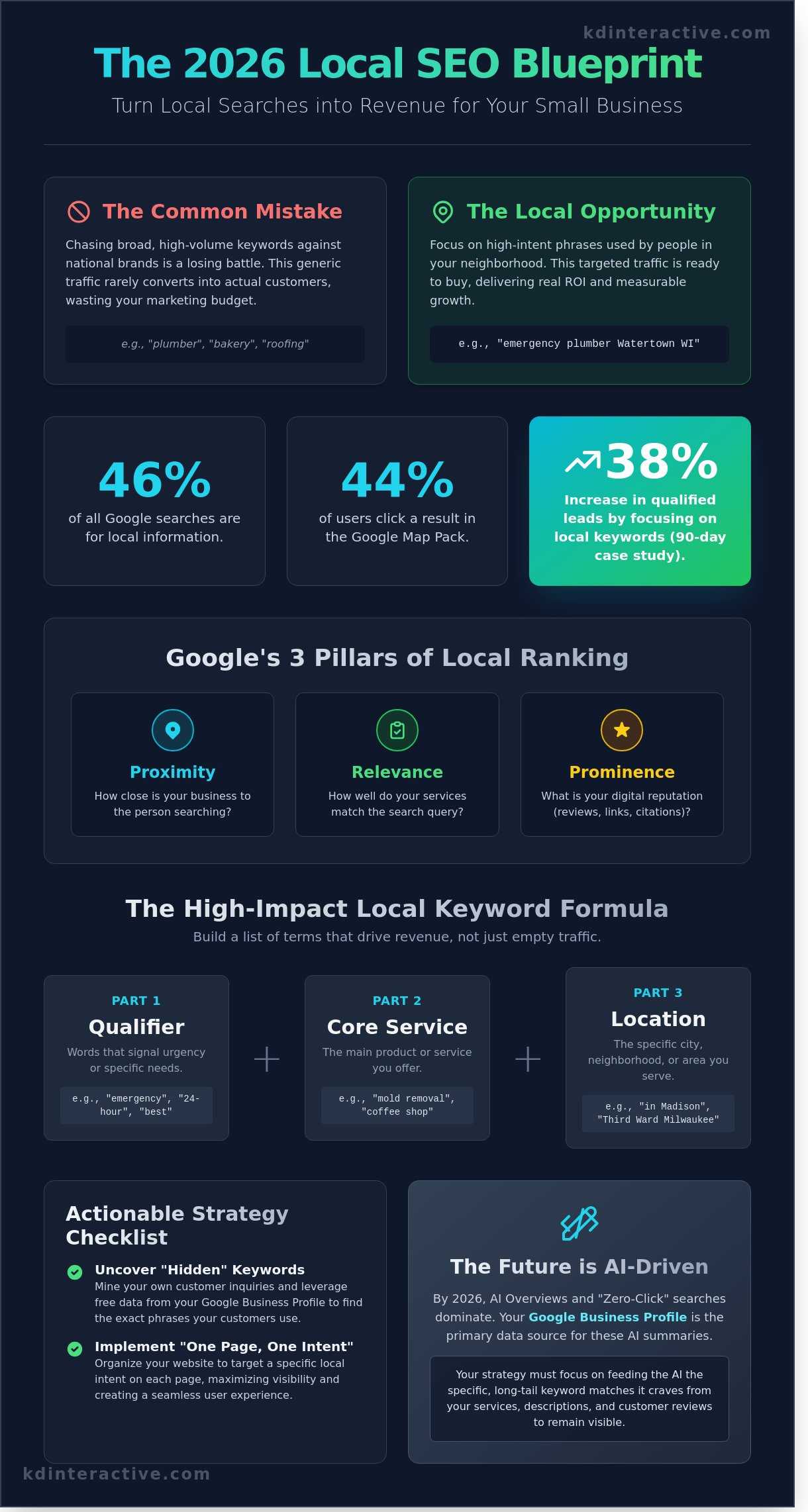
Why are you spending your hard earned marketing budget to rank for broad terms when 46% of all Google searches are looking for something right in their own neighborhood? It is a common mistake to chase high volume keywords that never turn into actual customers. You don’t need to compete with national brands and their massive advertising budgets to win. At KD Interactive, we understand small business because we are one. We know that a single lead from someone in Milwaukee or Madison is worth more than a thousand clicks from across the country. It is time to stop wasting money on generic traffic that doesn’t convert.
This 2026 local seo keyword research guide gives you the exact framework to identify high-intent search terms that drive local traffic and revenue to your storefront. We are going to show you how to cut through the confusing jargon and focus on what actually moves the needle for your bottom line. You will learn how to find the specific phrases your neighbors are using to find services today. We will walk you through the data driven steps to claim your spot at the top of search results and grow your business with confidence.
Key Takeaways
- Stop wasting your budget on broad search terms and learn how to identify the high-intent phrases that bring local customers directly to your door.
- Navigate the shift toward AI Overviews by mastering the three pillars of local ranking—proximity, relevance, and prominence.
- Use our proven three-part formula in this local seo keyword research guide to build a list of terms that drive actual revenue, not just empty traffic.
- Uncover “hidden” keywords by mining your own customer inquiries and leveraging free data from your Google Business Profile.
- Implement the “one page, one intent” rule to organize your website for maximum local visibility and a seamless user experience.
What is Local SEO Keyword Research and Why Does it Matter?
Local SEO keyword research is the tactical process of identifying the specific phrases and terms neighbors use when they need a product or service right now. It moves beyond generic industry terms to focus on geographic intent. To understand the broader impact of these strategies, it helps to look at the history and mechanics of Local search engine optimization, which prioritizes relevance to a user’s physical location. This local seo keyword research guide is designed to help you stop guessing and start appearing where your customers are actually looking.
We see small businesses fail when they try to compete for broad terms like “plumber” or “bakery.” You aren’t competing with every service provider in the country; you’re competing for the person typing “emergency plumber Watertown WI” into their phone at 2:00 AM. We understand small business, because we are one! We know that relevance beats search volume every single time. A keyword that gets 1,000 national searches but zero local intent won’t pay your bills. A hyper-local term with 20 searches might result in 10 immediate phone calls.
Mastering these keywords has a direct impact on your visibility in the Google Map Pack. Since 44% of users click on a result in the local 3-pack, your choice of keywords determines if you are the first call or an afterthought. When you align your content with local intent, your conversion rates naturally climb because you’re answering a specific, local need.
The Difference Between National and Local Search Intent
National keywords are typically used for research and general information. Local keywords are used for immediate action. By 2026, “near me” queries have evolved into highly specific neighborhood searches. Users no longer just want a “coffee shop”; they want a “coffee shop with outdoor seating in Third Ward Milwaukee.” These long-tail, localized phrases indicate a user who is ready to spend money. Targeting a lower search volume keyword often leads to a higher profit margin because the competition is lower and the intent is much higher.
How Local Keywords Drive High-Converting Traffic
The psychological state of a local searcher is unique. They are usually in the “bottom of the funnel,” meaning they are ready to buy or book an appointment immediately. They aren’t browsing for ideas; they’re looking for a solution. For example, we worked with a Wisconsin restoration client who shifted their focus from general “mold removal” to “mold remediation services in Madison.” This simple shift in their local seo keyword research guide implementation led to a 38% increase in qualified lead flow within the first 90 days. This approach is a cornerstone of effective local digital marketing. By speaking the language of your specific community, you build immediate trust and drive measurable growth.
Decoding How Google Understands Local Intent in 2026
Google’s search algorithm has evolved from a simple directory into a sophisticated predictive engine. By 2026, the focus has shifted entirely toward AI Overviews. These AI-generated summaries appear at the very top of the search results, often pushing traditional blue links far down the page. To win in this environment, your local seo keyword research guide must focus on feeding the AI the specific data points it craves. Google now prioritizes “Zero-Click” searches, where the user finds their answer directly on the search results page without ever visiting a website. If your keyword strategy doesn’t satisfy the AI’s need for immediate information, your business remains invisible.
Understanding local intent requires a grasp of the three pillars of local ranking: proximity, relevance, and prominence. Proximity is how close your business is to the searcher. Relevance is how well your business profile matches the specific query. Prominence is your business’s digital reputation, built through reviews and local citations. Google distinguishes between implicit and explicit local intent. If a user in Milwaukee searches for “pizza,” Google uses GPS data to provide implicit local results. If they search for “pizza in Madison,” they are providing explicit intent. Both require different optimization tactics to ensure you capture the lead.
The Role of AI Overviews and the Google Map Pack
AI Overviews pick the “best” local businesses by analyzing long-tail keyword matches found in your customer reviews and service descriptions. Your Google Business Profile is the primary data source for these AI summaries in 2026. It’s not enough to just list your services; you must use the language your customers use. Before you can dominate these rankings, you need a solid foundation. You should first learn how to set up a google business page to ensure the AI has access to your most accurate business data. We’ve seen that businesses with complete, keyword-rich profiles see a 35% higher inclusion rate in AI-generated local recommendations.
Identifying ‘Near Me’ vs. Specific Geographic Queries
The “near me” modifier is now an automatic part of Google’s processing. Because mobile devices track location data so accurately, users often omit the phrase entirely. However, you should still optimize for specific city, county, and neighborhood names for desktop users and people planning future trips. We are also seeing a massive rise in landmark-based searches. A search for a “lawyer near Miller Park” or “coffee shop near the State Capitol” is becoming more common than zip code searches. To capture this traffic, you need a step-by-step local keyword research strategy that includes these local landmarks and neighborhood identifiers. This level of specificity tells Google exactly where you operate within the Wisconsin landscape.
At KD Interactive, we understand the struggle of keeping up with these constant algorithm shifts. We’ve helped hundreds of Wisconsin small businesses navigate these changes to find real growth. If you want to see how your current strategy stacks up, contact us for a local SEO audit and let’s start growing your visibility together.
The 3-Part Framework for High-Impact Local Keywords
Success in local search isn’t about ranking for every possible term. It’s about ranking for the right ones. We see many business owners waste their budget on broad terms that bring traffic from three states away. That doesn’t help your bottom line. To dominate your neighborhood, you need a precise formula: [Core Service] + [Geo-Modifier] + [Intent Modifier]. This local seo keyword research guide helps you filter out the noise so you only pay for clicks that turn into customers.
Why does this framework matter? It prevents you from bidding on useless, high-volume traffic that never converts. A retail store in Milwaukee doesn’t need traffic from Seattle. A plumber in Madison doesn’t need someone looking for “how to fix a pipe” DIY videos. By following this structure, you ensure every keyword you target has a direct path to a sale. We focus on pragmatic, results-oriented selection because we know that “cool” keywords don’t pay the bills. Growth does.
Core Service Keywords: What Do You Actually Do?
Your seed keywords are the foundation of your strategy. For a local plumber, a seed keyword acts as the primary anchor for your digital presence, identifying a core service like “sump pump repair” before any location or price details are added. Don’t get distracted by industry jargon. While you might call yourself an “HVAC system specialist,” your customer is typing “furnace technician” or “AC fixing” into Google at 2:00 AM. Brainstorming synonyms is vital. Retailers should focus on product categories, while Service Area Businesses (SABs) must focus on the specific problems they solve on-site.
Geo-Modifiers: Beyond Just City Names
Most people stop at the city name. If you only target “Milwaukee,” you’re missing out on hyper-local intent. Recent data indicates that 46% of all Google searches have local intent, and many of those are neighborhood-specific. You can capture this by using names like the Third Ward, the East Side, or Bay View. If you serve a wider region in Wisconsin, include county-level keywords like “Waukesha County” or “Dane County” to catch regional service providers. Landmarks and “near me” modifiers act as high-intent signals that tell Google exactly where your customers are standing.
Intent Modifiers: Catching Customers at the Right Moment
- Transactional Modifiers: Terms like “best,” “price,” or “affordable” signal a customer is comparing options.
- Urgency Modifiers: Words such as “emergency,” “24/7,” or “fast” identify pain points that require immediate hiring.
- Availability Modifiers: Using “open now” or “near me” targets the mobile user who is ready to walk through your door.
Identifying these “pain point” keywords is the secret to a successful local seo keyword research guide. We understand small business, because we are one! We know that a lead today is worth more than a thousand informational views. By combining your core service with a specific Wisconsin neighborhood and an urgency modifier, you create a keyword that is almost guaranteed to convert. This methodical approach ensures your marketing budget is an investment in your success, not a shot in the dark.
Step-by-Step: How to Perform Your Own Local Keyword Research
You don’t need a massive budget to find the phrases that drive revenue. Start with the data you already own. Your inbox is a goldmine for this local seo keyword research guide. Look at the last 50 emails from your customers. If 12 people asked about “emergency furnace repair in Watertown,” you just found a high-intent keyword that your competitors might be overlooking.
We understand small business because we are one. We know you need results that show up in your bank account, not just on a spreadsheet. Use the following steps to build a list that helps you dominate your specific Wisconsin service area.
Mining Your Google Business Profile and Search Console
Your Google Business Profile (GBP) Insights show exactly which phrases triggered your Map Pack listing over the last 30 days. This is direct feedback from your neighborhood. Look for “hidden gems” in Google Search Console (GSC). These are keywords where your site currently sits on page 2. A few small tweaks to your content can often push these into the top three spots where 68% of clicks happen.
To export your performance data, click the ‘Export’ button at the top right of the Google Search Console dashboard. Choose your preferred format like CSV or Excel to begin your offline analysis.
The Neighborhood Deep Dive: A Wisconsin Strategy
Generic keywords are too expensive and hard to win. Instead, ground your strategy in local landmarks. If you are a realtor in Madison, “homes for sale near the State Capitol” is more valuable than just “Madison homes.” Milwaukee businesses should target phrases like “plumbing services in the Third Ward” or “roofing near Lake Michigan.” These specific locations signal to Google that you are a true local authority.
Use the “People Also Ask” section on Google to find specific concerns. If you see “How much does snow removal cost in Milwaukee?” appearing frequently, create a dedicated page answering that question. This builds trust before the customer even calls you. Aim to win these 10 local keyword types for every service area:
- [Service] in [City]
- [Service] near [Landmark]
- Best [Service] in [County]
- Affordable [Service] [City]
- Emergency [Service] [Zip Code]
- [Service] for [Local Property Type]
- How to find a [Service] in [City]
- [City] [Service] reviews
- Licensed [Service] near me
- 24 hour [Service] [City]
Before you commit, validate the difficulty. Search for your target phrase and look at the top three results. If the leaders are national directories with thousands of reviews, it will be a long climb. If the top results are local competitors with 15 to 30 reviews, you can realistically outrank them within 90 days by following a structured plan. Success in local search is about being the most relevant answer in your specific corner of Wisconsin.
Ready to see how your business stacks up against the local competition? Get Your FREE Consultation and let us build your customized growth roadmap.
From Keyword List to Revenue: Implementing Your Strategy
Turning a spreadsheet of terms into actual profit requires a disciplined approach. You shouldn’t just sprinkle words across your site and hope for the best. The most successful local businesses follow the “one page, one intent” rule. This means every page on your site serves a specific purpose for a specific searcher. If a potential customer searches for “emergency furnace repair in Waukesha,” they shouldn’t land on a generic homepage. They need a dedicated service page that addresses their crisis immediately. This local seo keyword research guide has shown you how to find the terms, but implementation is where the revenue is won.
Placement matters as much as the words themselves. Weave your primary keywords into H1 headers, meta descriptions, and the first 100 words of your body copy. Keep it natural. Google’s 2026 algorithms prioritize helpfulness over keyword density. A blog post titled “How to Prep Your Car for a Milwaukee Winter” wins because it provides genuine local value while signaling your geographic expertise to search engines. Recent data from 2025 shows that localized content receives a 45 percent higher engagement rate than generic industry tips.
Mapping Keywords to Your Local Landing Pages
If your business serves multiple areas, you need dedicated pages for each major city. Creating a “Service Areas” section with unique content for Madison, Milwaukee, and Green Bay is essential for ranking in those specific regions. Avoid the temptation to copy and paste the same text while just swapping the city name. Google recognizes this as thin content. Instead, mention local landmarks or specific neighborhood challenges. If you need help building these high-converting pages, our web and seo services provide the technical framework to ensure your site structure supports your growth goals.
How KD Interactive Automates Your Local Dominance
We understand small business, because we are one. You don’t have time to spend forty hours a week staring at search consoles and algorithm updates. That’s why we developed our “Google Map Pack with AI Assistant” to streamline your keyword execution. This tool ensures your business appears exactly where local customers are looking. Professional keyword analysis is the foundation of our local seo services near me, moving you beyond guesswork and into data-driven results.
We handle the complex technical details and the constant shifts in search trends. Our team ensures your local seo keyword research guide strategy stays ahead of the competition while you focus on running your company. Your success is our success. We are ready to help you dominate your neighborhood and reach your revenue goals. Let’s get to work on boosting your visibility today.
Take Control of Your Neighborhood Search Results
Success in 2026 requires more than just guessing what your neighbors type into a search bar. You now have the framework to decode local intent and turn those searches into actual foot traffic. Statistics from Google show that 76% of people who search for something nearby on their smartphone visit a related business within a single day. By following this local seo keyword research guide, you’re positioning your brand to be the first choice when those high-intent searches happen in Milwaukee, Madison, or anywhere across the state.
We’re Wisconsin’s local SEO specialists who understand the daily hurdles of running a company. We understand small business because we are one. Our approach isn’t about vanity metrics. We focus on data-backed results that drive measurable phone calls. It’s time to stop leaving your visibility to chance and start using a strategy tailored to your specific community. We’re ready to help you grow and outpace the competition with a personal touch that national agencies can’t match.
Get Your FREE Local SEO Keyword Audit Today!
Your business deserves to be seen by the people right outside your door. Let’s start building your local legacy together today.
Frequently Asked Questions
How many local keywords should I target at once?
You should target 5 to 10 primary keywords per location page to keep your strategy focused and effective. Focusing on a small group of high-intent phrases prevents you from diluting your authority. We recommend a 70% focus on your core services and 30% on long-tail variations. This approach helps small businesses in Milwaukee or Madison dominate their specific niche without overextending their marketing budget.
What is the best free tool for local keyword research in 2026?
Google Keyword Planner remains the top free tool because it pulls data directly from 91% of the search engine market. It allows you to filter search volumes by specific zip codes or city boundaries. This precision is vital for our local seo keyword research guide because it shows exactly what your neighbors are searching for. It’s the same data-driven approach we use to help Wisconsin businesses grow.
Do I need to include my city name in every single keyword?
No, you don’t need a city name in every keyword because Google uses GPS data to determine user intent. About 46% of all Google searches have local intent even without a location modifier. You should optimize for “plumber near me” alongside “plumber in Milwaukee.” This variety ensures you capture customers who are searching both with and without specific location tags. It makes your content feel more natural.
How long does it take to rank for a new local keyword?
You can expect to see initial movement in search results within 60 to 90 days of implementing your strategy. A 2024 Ahrefs study found that only 5.7% of newly published pages reach the top 10 within a year. However, local markets in Wisconsin often move faster than national ones. Consistent updates and localized content help speed up this timeline, allowing your small business to see results and grow sooner.
Is ‘near me’ still a keyword I should put in my website text?
You don’t need to force the phrase “near me” into your website copy because Google’s algorithm automatically connects your business location to the searcher. Instead, focus on clear address information in your footer and metadata. Since 2022, search engines have prioritized “proximity to searcher” as a top ranking factor. Use natural language that mentions your service areas to help customers find your shop in cities like Madison or Green Bay.
Can I rank for keywords in a city where I don’t have a physical office?
Yes, you can rank in neighboring cities by creating dedicated service area pages that highlight your work in those specific locations. While you won’t usually appear in the Map Pack without a physical address, you can capture organic search traffic. We’ve seen Wisconsin service providers increase their reach by 40% using this method. It’s a proven way to grow your footprint without the overhead of a second office.
What is a ‘Geo-modifier’ and why is it important for small businesses?
A geo-modifier is a specific location added to a search term, such as “Milwaukee” or “Shorewood.” These modifiers are essential because they filter out national competition and connect you with local buyers. For a small business, using these terms in your local seo keyword research guide strategy is the fastest way to boost visibility. It ensures you aren’t competing with giant corporations, but rather winning your own neighborhood.
How do I know if a keyword is too competitive for my small business?
Check the Keyword Difficulty score in your research tool; anything above a 50 is often too difficult for a new local site. You should also look at the current top 10 results. If the first page is filled with national directories like Yelp or Forbes, it’s a sign to pivot to a more specific long-tail keyword. We understand small business, because we are one, and we always focus on winnable, results-oriented terms.