
Only 33% of consumers bought coffee from a coffee shop at least weekly in 2026, down from 51% in 2024, according to Drive Research. For Madison cafés, that makes every nearby search and every reason to return count. Effective marketing for coffee shops in madison isn’t about trying every channel. It’s about helping the right local customers discover your café and making it easy for them to choose you again.
If you’re juggling a tight budget, nearby competition, and changing customer habits, it can be hard to tell which marketing efforts bring people through the door. A focused plan links visibility and trust to specific customer actions, so you can spend your time on marketing that serves a clear purpose.
This guide shows you how to shape a plan around your café’s audience and Madison trade area. You’ll learn how local search helps customers find your coffee shop, how useful content and a strong reputation build confidence, and how to track whether marketing supports visits, orders, and repeat business. The goal is practical: turn neighborhood interest into lasting customer relationships.
Key Takeaways
- Build marketing for coffee shops in madison around nearby customers’ needs and the café’s actual trade area.
- Choose channels by purpose: prioritize local discovery, then use storytelling and community connections where they fit your audience and capacity.
- Stand out with a clear café offer, accurate online details, and a consistent customer experience instead of trying to post everywhere.
- Use a manageable 90-day sequence to set a baseline, strengthen discovery information, publish useful content, and review what’s working.
- Connect keyword research, local SEO, reputation management, and analytics to the café’s goals so marketing activity is easier to assess.
Why Madison Coffee Shop Marketing Starts With Local Discovery
Coffee-shop marketing is the coordinated work of attracting, serving, and retaining local customers who are a good fit for your café. It starts before someone walks in. A nearby search can introduce your shop, accurate details and reviews can build confidence, and clear menu or atmosphere information can help a customer decide. The in-person experience then gives them a reason to return. Each touchpoint should make the next step easier.
That’s the practical value of Local store marketing: connecting a physical business with people around it through relevant online and offline activity. In Madison, a café’s trade area depends on its location, customer routines, and reasons for visiting. State Street, Capitol Square, Monroe Street, and Willy Street are useful examples, but they don’t represent interchangeable audiences. Focus on the neighborhoods your café can realistically serve.
What Madison customers may search for before choosing a café
Some searches show an immediate need, such as “coffee near me.” Others reflect a plan: someone may be looking for brunch, a place to work, or a café to meet a friend. Make the decision straightforward with current location and hours, clear menu details, accessibility information, and an accurate sense of the atmosphere. Prioritize details that matter to your actual customers, whether they’re nearby residents, students, workers, or visitors.
Search results, reviews, and your own content work best when they answer the same customer’s questions. A person finds your café, checks whether it’s open and what’s on the menu, reads feedback, then visits. If the experience matches what they found online, trust has a stronger foundation. That connected approach is more useful than treating every post, review, and listing as a separate task.
How to define a café’s local marketing goal
Choose one primary business outcome before selecting tactics: more local discovery, first visits, catering inquiries, or repeat visits. Then decide which customer actions would signal progress, such as calls, direction requests, inquiries, or returning customers. A clear goal helps you focus limited time and assess whether your marketing supports the business. For broader channel context, see this small-business digital marketing guide.
Local café marketing helps nearby customers discover your shop, trust what they find, and take an action that supports your business. That’s a useful foundation for marketing for coffee shops in madison: match your message and channels to the people and trade area you actually serve.
How to Choose Marketing Channels for a Madison Coffee Shop
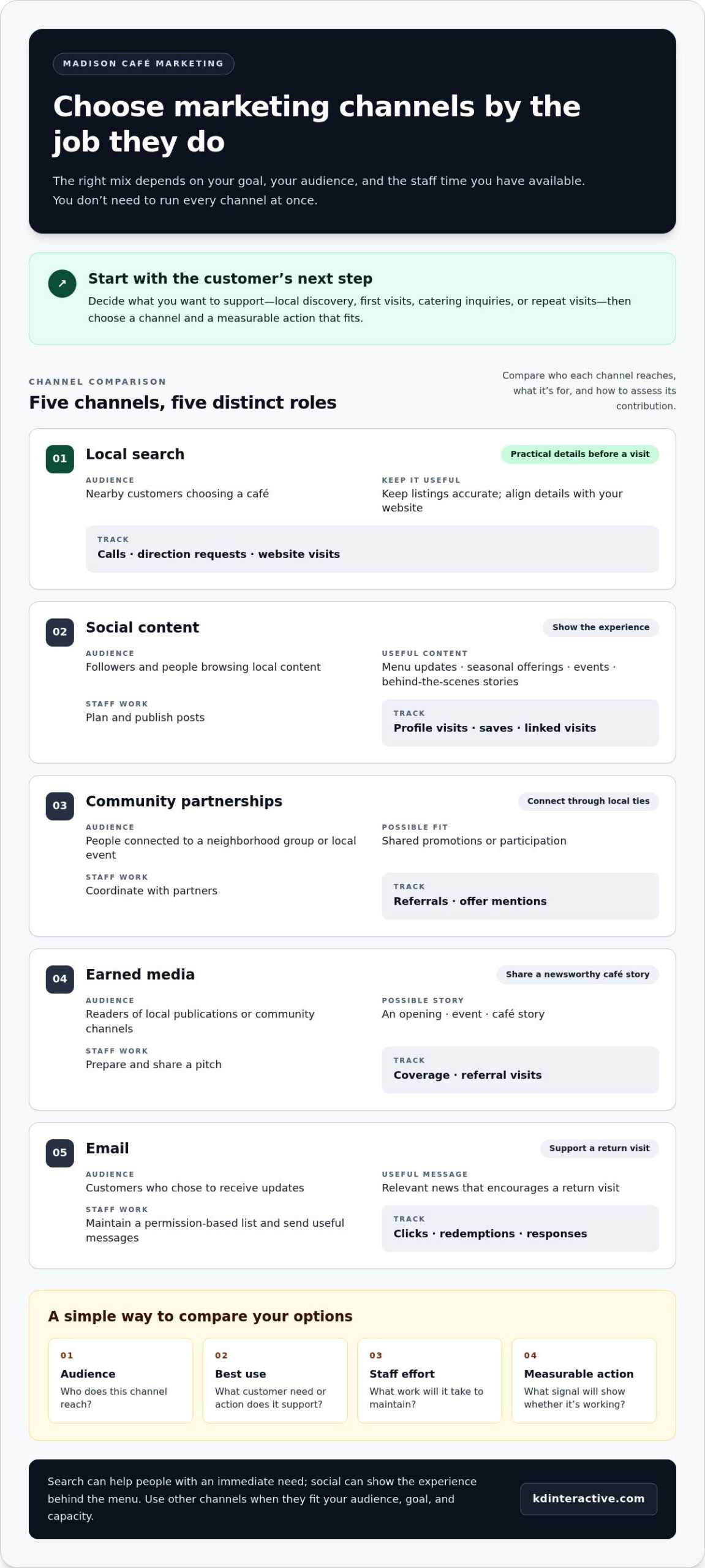
Choose channels by the job they need to do, not by how often other cafés use them. Local search helps people ready to choose a nearby café. Social content can show what makes your menu and atmosphere distinctive. Community partnerships and earned media can introduce your shop to new local audiences, while email can support repeat visits when you have relevant updates to share. For marketing for coffee shops in madison, the right mix depends on your goal, audience, and available staff time.
When local search should be a café’s priority
Prioritize local search when customers need practical details before deciding: your location, hours, menu, directions, or current business information. A complete, accurate Google Business Profile helps people find those details in local search and on Maps. Keep the profile consistent with your website and update it when key information changes. For step-by-step setup guidance, use this Google Business Page setup guide.
To compare channels, make a simple table with four columns: audience, best use, staff effort, and measurable next action. Fill it in for your café. For example:
- Local search: Nearby customers; location and business details; keep listings accurate; track calls, direction requests, or website visits.
- Social content: Followers and people browsing local content; menu updates, seasonal offerings, events, or behind-the-scenes stories; plan and publish posts; track profile visits, saves, or linked visits.
- Community partnerships: People connected to a neighborhood group or local event; shared promotions or participation; coordinate with partners; track referrals or offer mentions.
- Earned media: Readers of local publications or community channels; a newsworthy opening, event, or café story; prepare and share a pitch; track coverage and referral visits.
- Email: Customers who have chosen to receive updates; relevant news that encourages a return visit; maintain a permission-based list and send useful messages; track clicks, redemptions, or responses.
How to balance search, social media, and repeat-customer marketing
Search often serves an immediate need, while social is better suited to showing the experience behind the menu. Use email when you can offer relevant updates and manage the list with permission. You don’t need to run every channel at once. Set a goal and a way to measure the next customer action, then develop a marketing plan that fits your capacity. If local discovery is a priority, explore local SEO support for a café-focused strategy.
How Madison Cafés Can Stand Out Without Marketing Everywhere
A small café doesn’t need to post on every platform or promote itself to all of Madison to compete. Spreading limited time across too many channels can leave basic details outdated and messages inconsistent. A focused neighborhood strategy starts with a clear reason to visit, accurate information, and a customer experience that matches what the café promises. For marketing for coffee shops in madison, relevance matters more than sheer volume.
| Approach | Pros | Cons |
|---|---|---|
| Broad promotion | Can introduce the café to varied audiences and create more opportunities to share updates. | Requires more time and coordination; messages can become generic, and some activity may reach people outside the café’s trade area. |
| Focused neighborhood strategy | Concentrates effort on likely customers, keeps information and messaging consistent, and makes it easier to connect activity with a business goal. | Requires choices about whom to prioritize and which channels best reach them. |
Build a café message around real customer reasons to visit
Start with what’s true and distinctive about your shop: a menu focus, service style, atmosphere, or shop-specific event. Describe the people you want to reach, such as nearby residents looking for a casual meetup spot or workers seeking a comfortable place to take a break. Not every Madison resident is a prospective customer. Industry resources like the National Coffee Association’s coffee industry market research can inform your understanding of broader consumer preferences, while conversations with your own customers add neighborhood context.
Use a consistent, clear description across your website, business profile, menu, and social pages. Keep it current, especially when hours, offerings, or events change. Consistency helps customers know what to expect before they arrive.
Use reviews and café content to build local trust
Invite honest feedback without offering incentives or pressuring customers to leave positive reviews. Respond professionally to praise and criticism. If the same question or concern comes up repeatedly, treat it as a useful signal: clarify the relevant detail in your business information or create content that answers it.
Useful content doesn’t need to be elaborate. Answer practical questions about what’s on the menu, where to find the shop, when it’s open, and what the experience is like. A recognizable local position comes from delivering a clear, consistent reason to choose your café. Be known for what you genuinely offer, not an unsupported claim that you’re “the best.”
A 90-Day Marketing Plan for a Madison Coffee Shop
A useful marketing plan doesn’t require a café to change everything at once. This 90-day sequence gives you time to understand your starting point, improve the details customers rely on, publish helpful updates, and review what people do next. Adapt the work to your staffing, seasonal schedule, audience, and actual trade area. The goal is a clearer process, not a guaranteed ranking, visit count, or revenue result.
Days 1-30: Set the baseline and fix essential information
Start by checking the information customers see before they visit. Make sure your business name, address, hours, contact details, menu links, and photos are accurate and consistent across your website and business profiles. Record the metrics you can access before making larger changes, such as profile actions and website visits.
Ask staff to note the questions customers commonly ask. Are people checking whether a menu item is available, where the entrance is, or whether the café has seating? Prioritize clear online answers to those questions. This establishes a practical baseline and addresses friction customers already experience.
Days 31-90: Publish, measure, and refine
Choose a repeatable schedule for useful café updates that fits the team’s workload. A menu change, event detail, or answer to a common customer question can each become a timely update. Consistency matters more than choosing a publishing pace the café can’t maintain. For related planning principles, see this local digital marketing guide.
Review results at regular intervals. Track available profile actions, website visits, calls, direction requests, catering or other inquiries, and indicators of repeat visits, such as loyalty activity if the café already records it. Compare similar time periods where possible, and note relevant changes such as a seasonal menu, event, altered hours, or staffing constraints.
These measures can reveal patterns, but they don’t prove that one marketing change caused a particular outcome or predict future results. Use them to ask better questions: Did customers take the action you intended? Did a key detail reduce confusion? What should you continue, adjust, or pause?
A focused approach to marketing for coffee shops in madison should fit the business behind it. Use what you learn to shape the next cycle around your café’s goals and local audience.
How a Wisconsin Local SEO Partner Can Support Madison Coffee Shop Marketing
A local SEO strategy should reflect the café’s goals, audience, and service area. A shop aiming to attract nearby walk-ins has different priorities from one focused on catering inquiries or repeat visits. For marketing for coffee shops in madison, connect how customers search with useful business information and actions the café can measure.
What a tailored café local SEO plan can address
Keyword research can identify the phrases local customers use when looking for a café, a specific menu offering, or a place to work. Those insights help shape on-page optimization and useful website content around the shop’s real menu, location, and audience. First, make sure essential pages and business information are accurate. Then build out content that answers customer questions and supports the café’s priorities.
Link building can strengthen a site’s local relevance through appropriate references from other websites. Analytics tracking helps monitor relevant actions, such as website visits, calls, direction requests, and inquiries, where measurement is available. Reviewing those signals with the business owner keeps the strategy grounded in customer behavior rather than assumptions.
Trust also matters in local discovery. Reputation management can include monitoring reviews and responding professionally, helping the café address feedback and keep customer-facing information useful. KD Interactive also offers a Google Map Pack with AI Assistant. It supports a local visibility strategy without promising a particular placement or result.
How to take the next step with KD Interactive
Bring three points into a strategy discussion: the customer action you want to encourage, the Madison neighborhoods or trade area you serve, and the marketing challenge that’s taking the most time. That context helps align keyword research, local SEO, content, reputation management, and analytics with your café’s needs. KD Interactive tailors local search and content work to each small business rather than relying on a one-size-fits-all plan.
Discuss local marketing for your Madison coffee shop with KD Interactive and shape a strategy around your goals and service area.
Turn Local Interest Into Your Next Growth Step
Strong marketing for coffee shops in madison doesn’t require a presence on every platform. Start with the customers and neighborhoods your café serves, make accurate information easy to find, and choose marketing activity that supports a clear goal. Review customer actions over time, then adjust your approach to fit your café’s priorities and capacity.
KD Interactive provides local SEO for small businesses, connecting keyword research, content creation, analytics tracking, and reputation management with business goals. The Google Map Pack with AI Assistant is another offering designed to support local visibility.
Ready to focus your next steps? Discuss a local SEO strategy for your Madison coffee shop and build a plan around your audience, service area, and business goals.
Frequently Asked Questions
How can I market a coffee shop in Madison?
Start by helping nearby customers find accurate, useful information about your café, then give them clear reasons to visit and return. Keep your Google Business Profile and website details current, including hours, location, and menu. Choose a few channels that fit your audience and staff capacity, such as local search, social content, or community partnerships. Track actions like calls, direction requests, inquiries, and repeat visits where available.
Is local SEO worth it for a coffee shop?
Local SEO can be worthwhile if customers search online for nearby coffee, cafés, or specific amenities before choosing where to go. It helps make essential business information easier to find and supports a consistent presence across search results and your website. Its value depends on your goals and how well you maintain the information. Measure relevant actions over time, but don’t treat visibility as a guarantee of visits or revenue.
How do I get my Madison coffee shop on Google Maps?
Create or claim your Google Business Profile and provide accurate business details, including your café’s name, address, hours, contact information, and website or menu link. Add current photos and update the profile when important details change. Consistency between the profile and your website helps customers verify what they find. Review available profile actions over time, such as calls or direction requests, to understand how people interact with the listing.
What should a coffee shop post on social media?
Share updates that help customers decide whether and when to visit. Useful posts might feature a menu change, seasonal offering, event, or behind-the-scenes look at the café. Include practical details when relevant, such as dates or current hours, and make sure they match the information elsewhere online. Choose a manageable posting rhythm your team can maintain. Notice which posts prompt questions, saves, profile visits, or other meaningful actions.
How can a small Madison café compete with larger coffee brands?
Focus on what your café genuinely offers and the customers it can serve well. A clear menu focus, distinctive atmosphere, personal service, or neighborhood event can give people a specific reason to choose your shop. Keep your online descriptions accurate and consistent, and respond professionally to customer feedback. You don’t need to market to every Madison resident or use every channel. Concentrate effort on the audience and trade area that fit your business.
How do I measure whether coffee shop marketing is working?
Choose a business goal first, then track actions related to it. Depending on your priorities, useful measures may include profile actions, website visits, calls, direction requests, catering inquiries, or repeat-customer indicators. Record a baseline and compare results over time, noting seasonal shifts, events, or other changes that could affect activity. These measures can reveal patterns, but they don’t prove that one marketing task caused a result or predict what will happen next.