
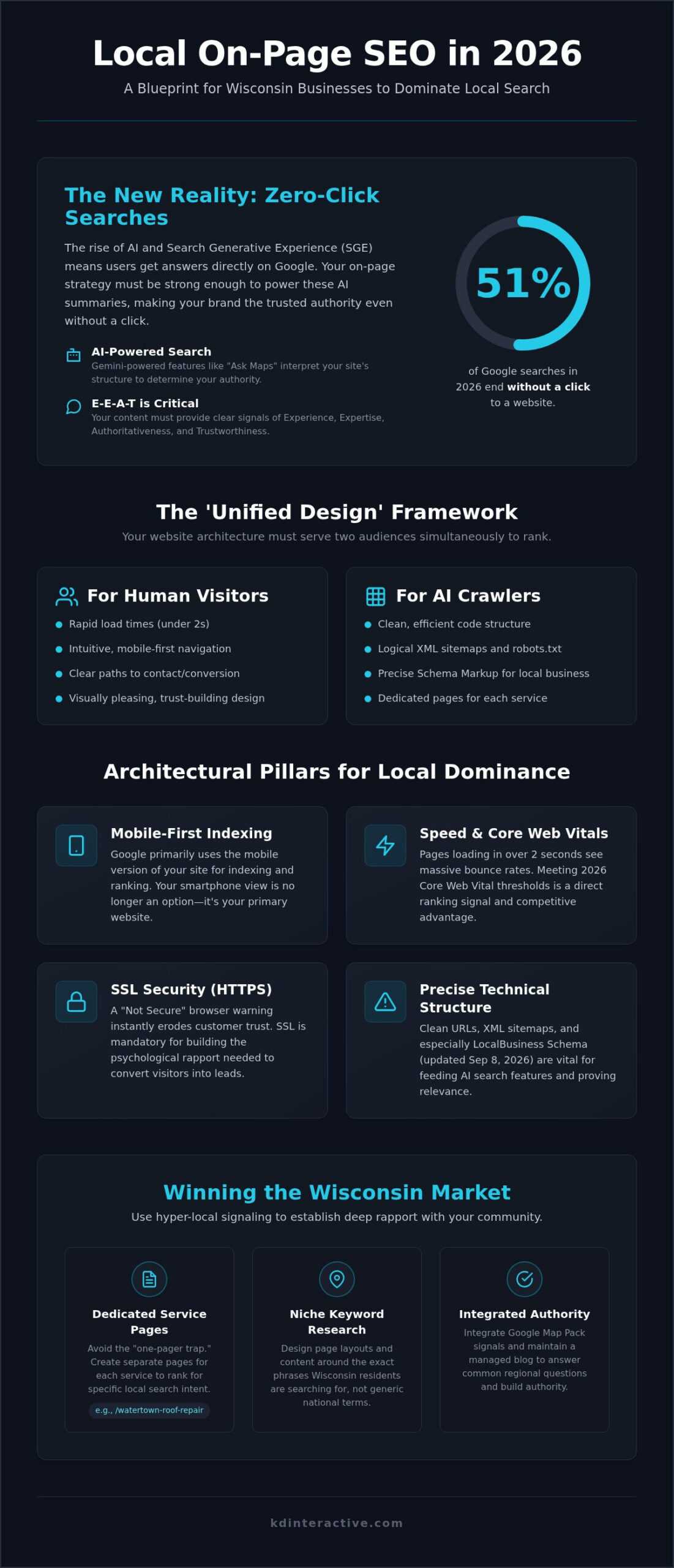
Did you know that over 51% of Google searches in 2026 now end without a single click to a website? For a Wisconsin business owner, that statistic feels like a punch to the gut. This shift makes mastering on-page seo for local businesses more than just a digital chore. It’s the difference between being a ghost and being the top choice in Watertown or Milwaukee.
You’ve likely felt the frustration of watching national agencies promise the moon while your local leads dry up. It’s normal to feel confused by “Ask Maps” and the AI search trends that changed everything this past March. We’re here to cut through that noise. This guide will show you how to build a website architecture that doesn’t just sit there, but actively dominates Wisconsin search results and turns skeptical visitors into loyal customers. We will break down the 2026 Core Update, explore the new Gemini-powered “Ask Maps” ecosystem, and provide a data-driven blueprint for your local success.
Key Takeaways
- Understand the “Unified Design” framework to ensure your website serves both human visitors and AI search crawlers effectively in the 2026 landscape.
- Identify the critical architectural pillars, including mobile-first indexing and updated speed standards, that keep your site ahead of national competitors.
- Master the specifics of on-page seo for local businesses by using hyper-local signaling to establish deep rapport with customers across Wisconsin.
- Follow an actionable checklist to implement Local Business Schema and niche-specific keyword research for immediate visibility gains.
- Learn how integrating a Google Map Pack with an AI Assistant can streamline your lead generation and turn search performance into tangible business expansion.
What is On-Page SEO for Local Businesses in 2026?
On-page SEO used to be a simple checklist of keywords and meta tags. In 2026, it has evolved into a ‘Unified Design’ framework where your website’s architecture serves both human visitors and AI crawlers simultaneously. It’s no longer enough to just ‘have a site.’ You need a platform that functions as a customer-finding machine. This evolution is a core component of Local search engine optimization, focusing on the specific technical and content elements that prove your relevance to a local community.
For Wisconsin small businesses, ‘Search-First’ design is mandatory. Whether you’re a contractor in Watertown or a boutique in Milwaukee, your digital footprint must be built to be found. The cost of an invisible website is steep; every day you aren’t appearing in local results, you’re handing market share to competitors who’ve prioritized their digital foundations. We treat on-page seo for local businesses as the pragmatic starting point for all growth strategies.
Beyond Aesthetics: Why ‘Pretty’ Isn’t Enough
A visually stunning website doesn’t guarantee a single lead. In fact, many ‘pretty’ sites fail because they’re weighed down by slow scripts and heavy, unoptimized images that kill your rankings. Google’s 2026 algorithm places immense weight on User Experience (UX) and speed. Our approach focuses on ‘Conversion-Centric Design.’ This means we prioritize:
- Rapid load times that meet the latest 2026 Core Web Vital thresholds.
- Intuitive navigation that leads users directly to a phone call or contact form.
- Clean code that allows search bots to index your service pages without friction.
The 2026 Search Landscape: AI and SGE
The way people search has changed. With the rise of Search Generative Experience (SGE) and AI-powered tools like ‘Ask Maps,’ bots now ‘view’ and interpret your website structure to see if you’re a trusted authority. This makes on-page seo for local businesses even more critical. You must provide clear signals of Experience, Expertise, Authoritativeness, and Trustworthiness (E-E-A-T) to win.
Preparing for ‘zero-click’ searches is a reality in 2026. Since many users get their answers directly from the search results page, your on-page content must be authoritative enough to feed those AI summaries. This ensures that even if they don’t click through immediately, your brand remains the primary source of truth in the Wisconsin market.
The Architectural Pillars of a High-Ranking Local Site
Your site’s architecture is the foundation of your lead generation. If it’s poorly built, Google’s 2026 AI bots will bypass you for a competitor with a cleaner structure. Mastering on-page seo for local businesses starts with understanding that your smartphone view is now your primary website. Mobile-first indexing is no longer a suggestion; it’s a requirement for ranking in Wisconsin.
Speed acts as a massive competitive advantage. In 2026, users expect instant responses. If your pages take more than a couple of seconds to load, your bounce rate will spike, signaling to Google that your site isn’t helpful. These Local On-Page SEO Tips highlight how technical health directly impacts your visibility in the Wisconsin market. Meeting Core Web Vital thresholds ensures you stay ahead of slower, outdated competitor sites.
SSL certificates are also mandatory for local success. A “Not Secure” warning in a browser is a fast way to lose a local customer’s trust before they even read your headline. Secure sites build the psychological rapport necessary for a visitor to become a lead.
Technical Structure for Local Dominance
Your bot’s roadmap consists of your XML sitemap and robots.txt file. These documents tell search engines exactly which parts of your site to prioritize. Schema markup is equally vital. Following the September 8, 2026, update to LocalBusiness structured data, you must provide precise details about your location and services. This data feeds Gemini-powered features like “Ask Maps,” making it even more critical for on-page seo for local businesses to provide accurate, structured information. Clean URL structures also help. Instead of generic links, use descriptive paths like /watertown-roof-repair to signal your regional relevance immediately.
Content-First Design Framework
Many entrepreneurs fall into the “one-pager trap,” where they list every service on a single page. This is a mistake. To rank for specific local intent, you need dedicated pages for each core service. This allows you to design layouts around primary keywords that match what Wisconsin residents are actually searching for. Integrating a managed blog further builds your authority by answering common regional questions. If you’re unsure where to start, our team can help you design search-first websites that prioritize both speed and local conversion.
Local Signaling: Winning the Wisconsin Market
National agencies often treat on-page seo for local businesses like a factory assembly line. They swap out city names in generic templates but miss the soul of the community. In Wisconsin, that approach doesn’t fly. Whether you’re operating in Milwaukee, Madison, or Watertown, your customers look for signals that you’re actually part of the neighborhood. This regional identity creates what we call the “Wisconsin Advantage,” a level of rapport that national competitors simply can’t replicate.
Disconnected agencies don’t understand the difference between the Third Ward and the East Side. They don’t know the local challenges your customers face. Pragmatic business owners know that trust is the shortest path to a sale. By prioritizing local context, you don’t just rank higher; you drive higher conversion rates because your message resonates with the person behind the screen. We’ve seen that regional expertise consistently outperforms generic, high-volume strategies every time.
Understanding the Regional Customer Journey
Midwest consumers search differently. They aren’t just looking for a service; they’re looking for a neighbor they can trust. Incorporating local landmarks like the Rock River or specific community references into your copy does more than help search bots. It builds immediate rapport. When a visitor sees you understand their specific geography, they feel more comfortable reaching out. Building trust through shared regional identity and history is a methodical way to stand out in a crowded digital market. It shows you’re invested in the community, not just the transaction.
The DIY Builder Trap
Many entrepreneurs start with closed-source website builders because the initial setup seems easy. However, these platforms often impose a “hidden tax” on your growth. They limit your ability to implement the advanced schema and technical tweaks required for 2026 search performance. Owning your data and platform is critical for long-term expansion. You need the flexibility to pivot as search trends shift without being locked into a proprietary system. For a deeper look at how to structure your digital presence, check out our guide on Web and SEO services. We focus on building assets you own, ensuring your Wisconsin firm stays visible and competitive for the long haul.
Checklist: Your 2026 Local On-Page SEO Strategy
Turning your website into a lead generation machine requires a methodical approach. While we have discussed the importance of regional signaling, this checklist provides the practical steps for on-page seo for local businesses. Follow these five steps to ensure your Wisconsin firm remains competitive in the 2026 search landscape.
- Step 1: Conduct niche-specific local keyword research. Don’t just target broad terms. Focus on “service + city” combinations, such as “emergency furnace repair Watertown,” to capture high-intent local traffic.
- Step 2: Implement Local Business Schema. Use the updated September 8, 2026, Google documentation for
LocalBusinessstructured data. This feeds the Gemini-powered “Ask Maps” feature with accurate data about your services and hours. - Step 3: Optimize images for speed and accessibility. Research shows that profiles with quality photos generate 40% more direction requests. Ensure your images are compressed for speed and include alt text that references your local service area.
- Step 4: Audit your mobile UX. Your ‘on-the-go’ customers have no patience for tiny buttons or overlapping text. Test your site on multiple devices to ensure a seamless experience.
- Step 5: Design high-contrast Calls to Action (CTAs). Use bold colors for your “Book Now” or “Get a Quote” buttons. They must stand out clearly against your background to guide users toward a conversion.
Navigation and Internal Linking
Accessibility is the cornerstone of local search success. We recommend the ‘Three-Click Rule’; a user should be able to find any core service or contact information within three clicks of landing on your home page. Strategic internal linking helps distribute authority from your high-traffic pages to your specific service pages. This creates a logical hierarchy that AI bots can easily map. It ensures that both humans and search engines understand the full scope of what you offer in the Wisconsin market.
Mobile Optimization for Local Leads
Mobile users are often looking for immediate solutions. Integrating click-to-call buttons and interactive map features is no longer optional. In 2026, responsive design is the baseline, but adaptive design often provides a faster, more tailored experience for smartphone users. Don’t forget the basics. It is vital to include your local contact information, including your physical address and phone number, clearly in the footer of every page. This provides a constant trust signal to both users and search crawlers. Ready to turn your site into a top performer? Explore our local SEO packages to start your growth journey today.
How KD Interactive Builds Search-First Websites
At KD Interactive, we don’t believe in digital brochures. We build customer-finding machines. Our ‘Unified Design’ process is a pragmatic, results-oriented methodology that treats your website as a living asset. Unlike ‘one-and-done’ builds that become obsolete in months, we provide the ongoing support necessary to navigate the shifting 2026 search landscape. We integrate our specialized Google Map Pack with AI Assistant directly into your digital footprint. This tool doesn’t just display your location; it uses Gemini-powered technology to answer customer queries in real-time. It pulls data from your reviews and website to secure leads while you’re focused on running your business.
Mastering on-page seo for local businesses requires more than a simple checklist. It demands a regional partner who understands the Wisconsin landscape better than national firms. Our methodical strategies are designed to turn website visitors into loyal customers through transparency and individualized attention. We prioritize data-driven outcomes and performance tracking to ensure every design choice serves your bottom line.
A Data-Driven Approach to Wisconsin Growth
We start every project with methodical niche keyword analysis. We don’t guess what your customers are searching for in Milwaukee or Watertown; we use performance tracking to prove it. This data dictates your site architecture, ensuring that every page serves a specific purpose in your sales funnel. We align our success with your progress, treating our partnership as a collaboration. You can explore the full scope of our methodology in our guide to Local SEO Services. By focusing on measurable outcomes, we help Wisconsin firms achieve professional achievement through increased visibility.
Managing Reputation through Smart Design
Your reputation is your most valuable asset in a local market. We integrate real-time reviews and testimonials directly into your user interface to build immediate trust. This transparency is a core part of on-page seo for local businesses. We also provide interactive value-add tools that give visitors a tangible reason to engage with your brand. These tools reinforce our data-driven approach and provide immediate value to your potential customers. They act as a signature of our commitment to your growth. Don’t leave your digital visibility to chance. Contact KD Interactive for a professional assessment today and let’s build a strategy tailored to your specific regional needs.
Secure Your Wisconsin Growth for 2026 and Beyond
Building a high-ranking digital presence today isn’t about luck; it’s about architectural precision. You now have the framework to transform your website from a passive brochure into a results-oriented machine that captures local intent. By prioritizing mobile-first indexing and the latest schema standards, you ensure that your business remains visible to both human customers and the newest AI search bots. Leaning into your regional identity in Milwaukee, Madison, or Watertown provides the “Wisconsin Advantage” that national competitors simply can’t replicate.
Effective on-page seo for local businesses is a continuous journey of data-driven refinement. We are here to serve as your regional partner, providing AI-powered Google Map Pack solutions and strategies built on measurable performance. As trusted Wisconsin SEO experts, we understand that our success is inextricably linked to your professional achievement. Don’t let your firm get lost in the noise of a crowded search landscape.
Scale your local visibility with KD Interactive today! We provide the methodical, data-driven results that small businesses need to dominate their niche. Let’s start building your search-first future together.
Frequently Asked Questions
How much does an SEO-friendly website design cost for a small business?
An SEO-friendly website design is a strategic investment rather than a flat cost. The price depends on your industry’s competitiveness and the number of service pages required to dominate your local market. We focus on local SEO packages that integrate high-performance architecture and our Google Map Pack with AI Assistant. Investing in search-first design ensures your digital presence works as a lead generation tool for your Wisconsin firm.
Can I make my existing website SEO-friendly without a full redesign?
You can absolutely improve your current site’s performance without a total overhaul. We start by conducting an SEO keyword analysis to identify gaps in your existing content. By implementing Local Business Schema and refining on-page seo for local businesses, we help Google’s AI bots understand your relevance. This methodical approach allows you to see measurable improvements in visibility while preserving your existing brand assets and digital history.
How long does it take for a new SEO-friendly website to rank on Google?
Most businesses begin to see measurable shifts in search visibility within three to six months. However, the exact timeline depends on your local competition in Watertown or Milwaukee and the technical health of your starting point. Google’s 2026 updates prioritize consistency and trust, so results build over time. We focus on data-driven local strategies that create a sustainable foundation for growth rather than temporary hacks or overnight promises.
Do I really need a blog for my local small business website?
A blog is essential for demonstrating your local expertise and building trust with Wisconsin consumers. Our managed content creation services help you answer regional questions that potential leads are actually asking. Regular updates signal to search engines that your site is active and authoritative. By sharing local insights and project highlights, you prove your Expertise, which is a critical ranking factor in the 2026 search landscape and AI search results.
What is the difference between web design and on-page SEO?
Web design focuses on the visual aesthetics and user interface of your site. In contrast, on-page seo for local businesses involves optimizing the specific elements that help search engines index and rank those pages. This includes technical markers like schema markup, keyword placement, and site speed. At KD Interactive, we use a ‘Unified Design’ framework to ensure these two disciplines work together to turn visitors into loyal customers.
Is WordPress the best platform for local business SEO in 2026?
WordPress remains a top-tier choice for local SEO because of its open-source flexibility and powerful technical capabilities. It allows for the deep customization required to implement advanced Local Business Schema and manage high-performance content. Unlike closed-source builders, WordPress gives you full ownership of your data. This platform supports the methodical, data-driven strategies we use to help Wisconsin firms expand their digital footprint and reach more customers.
How often should I update my website for SEO purposes?
You should review your website’s performance and content at least once a month. In 2026, an inactive digital presence can see a drop in visibility after just 30 days. Regular updates to your blog, service pages, and technical structure keep your site fresh for search crawlers. Consistent activity signals to Google that your business is operational and committed to providing accurate information to your community in Wisconsin.
Why is local SEO more important than national SEO for my Wisconsin business?
Local SEO targets the customers who are most likely to walk through your door or call your office. For a Wisconsin firm, appearing in the Google Map Pack for a nearby search is more valuable than ranking nationally for a generic term. Local searchers have higher intent and convert at a much faster rate. We prioritize regional expertise to ensure you dominate your specific territory and build lasting rapport.