
76% of people who conduct a “near me” search on their smartphone visit a business within 24 hours. As an entrepreneur, you know that missing out on that traffic feels like being invisible in your own neighborhood. It’s frustrating to see potential leads go to competitors simply because their digital footprint looks more active than yours. You don’t need a massive national budget or a degree in computer science to fix this. You just need a strategy that respects your time and targets the people right outside your door.
Understanding how to rank for “near me” searches in 2026 requires a shift in perspective. Google has moved away from old authority metrics toward popularity signals like real-time engagement and recent activity. In this guide, we provide the data-driven strategies necessary to dominate local search and capture customers exactly when they’re looking for your services. We’ll walk you through the 30-day freshness rule, the impact of pseudonymous reviews, and a manageable local SEO checklist designed to put you in the top 3 of the Google Map Pack.
Key Takeaways
- Stop using outdated keyword-stuffing tactics and start treating “near me” as a proximity intent signal rather than a literal phrase for your website footer.
- Discover the exact framework for how to rank for “near me” searches by balancing physical proximity with high-value local relevance.
- Master the 2026 Google Business Profile updates, including precise category selection and AI-driven engagement tools, to secure your spot in the Map Pack.
- Build high-converting location pages and structured data that bridge the gap between your website and local search algorithms.
- Leverage advanced tools like the Google Map Pack with AI Assistant to identify local market gaps and scale your visibility faster than national competitors.
The ‘Near Me’ Myth: Why Keyword Stuffing No Longer Works
Many entrepreneurs believe that to show up when a customer searches for a local service, they must literally include the phrase “near me” on every page of their website. This is a persistent myth. In 2026, Google treats these queries as proximity-based intent signals rather than literal search terms. Proximity intent is the search engine’s ability to match user location with service relevance without literal keyword matches. If you’ve been wondering how to rank for “near me” searches, the answer isn’t found in repetitive text. It’s found in the data you provide to search engines about where you operate and what you do.
Adding a phrase like “Plumber Near Me” to your website footer is a 2015 tactic that often triggers spam filters today. Google uses sophisticated tools, including GPS data, IP addresses, and past search history, to determine a user’s location. When a resident in Watertown or Madison searches for a local provider, the algorithm already knows which businesses are physically close. Focus on providing clear, accurate location data rather than trying to trick the system with outdated tricks. This evolution is a core part of modern Local search engine optimization, where relevance and proximity outweigh simple keyword repetition.
Intent vs. Literal Matching
Google is incredibly smart. When a user searches for “pizza,” the search engine automatically interprets this as a request for “pizza near me.” This is the power of semantic search. The algorithm understands the context of the query based on the user’s current environment. This is why your business name should never include “near me” or other stuffed keywords. In 2026, Google requires business names on your profile to match your legal, registered trading name exactly. AI scanners now flag keyword-stuffed titles and category mismatches. Naming your company “Best Milwaukee Landscaper Near Me” won’t help you rank. It will likely lead to a suspended profile and a loss of trust with your local audience.
The Rise of Zero-Click Local Searches
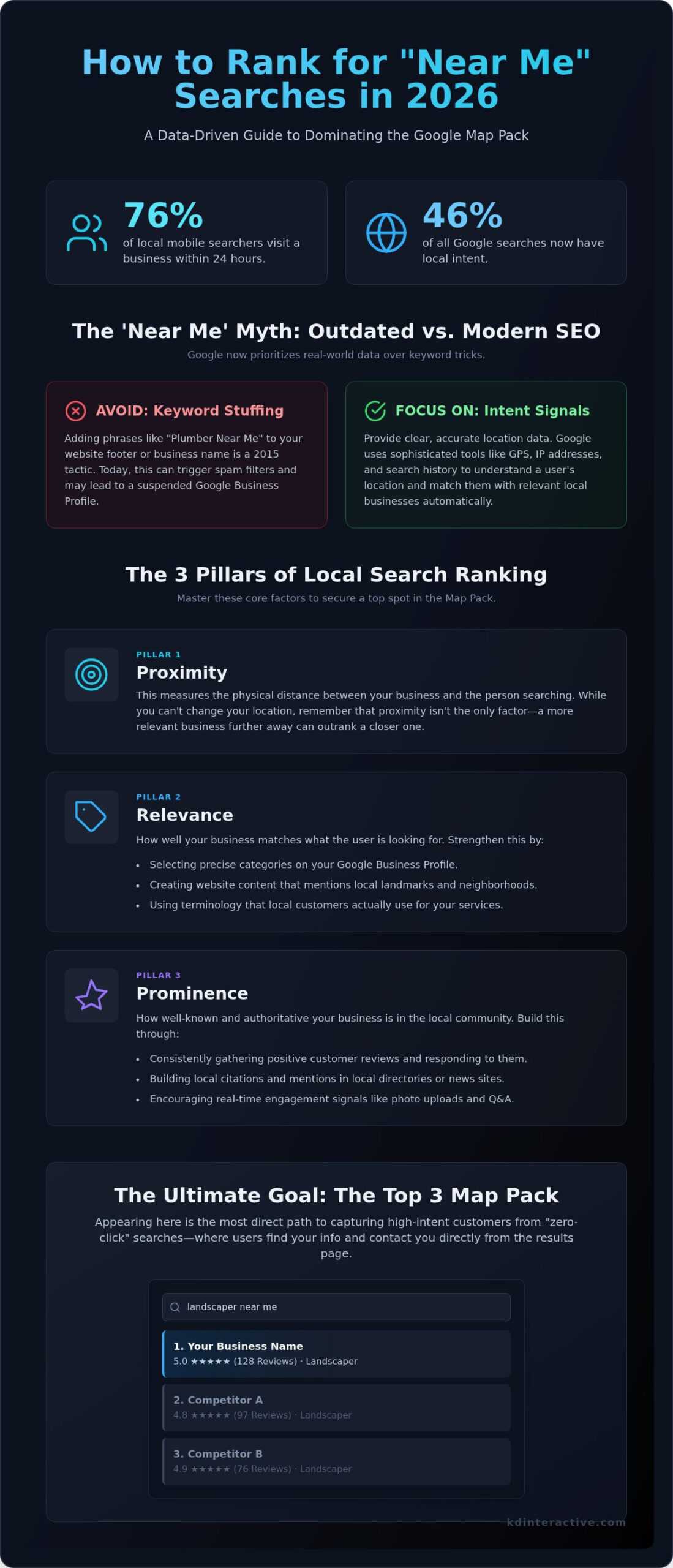
Data shows that 46% of all Google searches now have local intent. A significant portion of these are “zero-click” searches. This means the user finds your phone number, hours, or address directly on the search results page without ever clicking through to your website. The Map Pack has become the primary gateway for local commerce. At KD Interactive, we help small businesses in regions like Milwaukee and Watertown capture these high-intent users through our Google Map Pack with AI Assistant. This tool helps you maintain the “liveness” that 2026 algorithms demand. Since 76% of people who conduct a local search visit a business within 24 hours, appearing in that top 3 spot is the most direct path to professional achievement and local market leadership.
The Three Pillars of Local Search Ranking
Google relies on three core pillars to determine local rankings: proximity, relevance, and prominence. While you cannot change your physical location, you have significant control over how relevant and prominent your business appears to the algorithm. These factors work in tandem to decide which business earns the top spot in the Map Pack. If you want to understand how to rank for “near me” searches, you must treat these pillars as a cohesive strategy rather than isolated tasks. Proximity acts as your anchor, but relevance and prominence are the engines that drive your visibility forward.
Proximity is often the most rigid factor. It measures how close your business is to the person searching. Google uses this to ensure results are physically convenient for the user. However, proximity alone isn’t enough to win. A business two blocks away might lose to a business five blocks away if the latter provides better evidence of relevance and authority. This is where the “entrepreneurial struggle” meets opportunity. By outperforming larger, national competitors in relevance and prominence, your local expertise becomes your greatest ranking asset.
Maximising Relevance Through Local Content
Relevance is about how well your business matches what the user is looking for. To build this, your website content must go beyond generic descriptions. Mention local landmarks like the Milwaukee Art Museum or neighborhoods like the Third Ward to signal your deep roots in the community. Use the specific terminology that locals in Watertown or Madison actually use when discussing your services. If your team is stretched thin, leveraging KD Interactive’s content creation services can help you build this local relevance through methodical, data-driven storytelling that speaks directly to your neighbors.
Building Prominence with Local Authority
Your Google Business Profile (GBP) is the foundation of local visibility. In 2026, GBP signals represent 32% of all local ranking factors, making it the most influential element in your digital strategy. It’s the primary way to show Google you’re relevant to your community. To understand how to rank for “near me” searches, you must treat your profile as a living asset rather than a “set it and forget it” task. Start by ensuring your business name exactly matches your legal trading name, as Google’s AI now flags keyword-stuffed titles. Precise category selection is equally critical; choosing the most specific primary category tells the algorithm exactly which local problems you solve.
Freshness is a key ranking signal this year. Data shows a measurable drop in visibility for profiles that haven’t been updated in 30 days. Maintain a high-frequency posting schedule to share local updates, holiday hours, or community events in Milwaukee or Madison. Use the “Products” and “Services” tabs to feed the relevance engine with specific details about your offerings. This ensures that when someone in Watertown looks for your specialty, Google has the data to confirm you’re the right match. By keeping your profile active, you satisfy the algorithm’s demand for “liveness” and real-time engagement.
The Power of Google Reviews
Reviews are the heartbeat of your profile’s popularity. While a 5-star rating is great, Google’s 2026 algorithm prioritizes review velocity and diversity. This means a steady stream of new reviews is more valuable than a high volume of old ones. 87% of consumers read these reviews before visiting a local business. You should respond to every review, including pseudonymous ones, to signal activity to the algorithm. If you’re starting from scratch, follow our Google Business Page setup guide to get the technical foundation right before launching a proactive review campaign.
Visual Content and Geo-Tagging
Implementing Local Business Schema is one of the most effective ways to speak directly to search engines. This structured data tells Google your exact address, service area, and business hours in a format it can easily digest. When you combine this with meta titles and descriptions optimized for local click-through rates, you create a powerful signal of relevance. A title like “Expert Landscaping in Watertown | Jefferson County’s Top-Rated Service” is far more effective than a generic brand name alone. It tells the user exactly what you do and where you do it before they even click.
The Anatomy of a Perfect Location Page
A high-converting location page shouldn’t feel like a cookie-cutter template. It needs to provide value to the local resident while checking specific SEO boxes. These pages are the secret weapon for anyone learning how to rank for “near me” searches across multiple service areas. Every location page should include:
- An embedded Google Map to verify your physical location.
- Consistent NAP (Name, Address, Phone) data that matches your business profile exactly.
- Local testimonials and case studies from customers in specific regional areas, such as Watertown or Jefferson County.
- Specific mentions of local landmarks or community hubs to reinforce geographic relevance.
Mobile Optimization and Core Web Vitals
Since most “near me” searches happen on smartphones while people are on the go, mobile performance is critical. Page speed often serves as the tie-breaker in competitive local markets where multiple businesses have similar proximity. If your site takes too long to load, potential leads will bounce back to the search results before they ever see your offer. You can find detailed guidance on managing these technical requirements in our web and SEO services guide. Ensure your “Click-to-Call” buttons are prominent and easy to find. A busy professional in Milwaukee doesn’t want to hunt for a contact form; they want to reach you with a single tap. By focusing on these mobile-first details, you capture high-intent traffic exactly when it’s ready to convert.
Scaling Local Growth with AI-Powered SEO
Scaling a small business doesn’t require a massive marketing department or a national budget. It requires the right tools to identify opportunities before your competitors do. Our Google Map Pack with AI Assistant is built to bridge this gap for local entrepreneurs. This tool analyzes search patterns in real-time to find local keyword gaps that others miss. While national agencies focus on broad terms, we look for the specific ways people in Milwaukee or Watertown are searching for help right now. This data-driven precision is the most effective way to understand how to rank for “near me” searches without wasting your marketing spend.
Reputation management is another area where AI provides a significant advantage. 87% of consumers read online reviews before visiting a local business. Our system automates the tracking of this feedback, ensuring that no customer inquiry or review goes unanswered. This consistent activity signals “liveness” to Google’s algorithm, which is a critical ranking factor in 2026. We take a collaborator approach to your growth. Your success in Madison or Watertown is the only metric that defines our own achievement. We don’t just provide a service; we align our strategies with your specific professional goals.
The Future of Local Search in 2026
Search is changing rapidly. AI Overviews now appear for 23% of all Google searches, and this number is growing. These AI-led search results prioritize businesses that maintain deep, accurate data profiles. 56% of businesses haven’t yet adapted their local strategy for AI search, which gives you a massive window of opportunity. Pragmatic SEO is about focusing on these high-impact changes rather than speculating on every minor algorithm update. It’s about doing the work that drives calls today. You can start this process now by choosing to get your custom Local SEO package from KD Interactive.
Measurable Outcomes and Transparency
Results matter more than rankings. We focus on revenue-driving metrics like phone calls, direction requests, and actual website visits. Vanity rankings look good on paper, but they don’t pay the bills. Our methodical approach involves monthly data-driven strategy adjustments. We track how users interact with your profile and website, then refine your content to match those behaviors. This transparency ensures you always know exactly where your marketing dollars are going. We’re here to help you dominate your regional market with strategies that are as grounded and hardworking as the businesses we serve.
Dominate Your Local Market Today
Dominating local search in 2026 is no longer about tricking an algorithm; it’s about demonstrating real-world activity through a “live” digital profile. You’ve learned that proximity is just the starting point. To truly win, you must maintain a high-frequency update schedule and leverage AI tools to capture high-intent customers. Mastering how to rank for “near me” searches is a manageable process when you focus on data-driven popularity signals over outdated keyword stuffing.
We understand the entrepreneurial struggle because we share it. Our team specializes in Wisconsin small business growth, providing the regional expertise you need to outperform national competitors. We include the Google Map Pack with AI Assistant in our strategies to ensure you stay ahead of shifting search behaviors. With transparent, results-oriented reporting, you’ll always have a clear view of your progress and lead generation.
Scale your local visibility with KD Interactive’s Local SEO Services and start capturing the customers right outside your door. Your professional achievement is our priority, and we’re ready to build your local authority together.
Frequently Asked Questions
Do I need a physical office to rank for ‘near me’ searches in a specific city?
No, you don’t need a physical storefront to rank. Service Area Businesses (SABs) can set a specific service radius in their Google Business Profile. Google rewards businesses that prove their presence through local content and reviews. This is a common part of learning how to rank for “near me” searches when you operate out of a home office or a mobile unit. We help entrepreneurs in Wisconsin define these areas to ensure they appear for relevant local queries.
How long does it take to see results from local SEO?
You should expect to see measurable movement in local rankings within three to six months. SEO is a long term investment that requires consistent activity. Factors like review velocity and profile updates influence this timeline. If your market in Milwaukee or Madison is highly competitive, it may take longer to secure a top spot in the Map Pack. We focus on pragmatic, data driven progress that leads to sustainable growth and professional achievement.
Is it better to have one big website or multiple location-specific sites?
It is generally better to have one authoritative website with dedicated location pages. Managing multiple sites splits your domain authority and makes it harder to compete with established brands. A single site allows you to consolidate your backlink power while using specific pages to target cities like Watertown or Jefferson County. This structure provides a clearer path for search engines to understand your regional expertise and service coverage without confusing your local audience.
How many Google reviews do I need to beat my local competitors?
There is no magic number of reviews required to win. You need to focus on having more recent and high quality reviews than your direct local competitors. Review velocity, or how often you receive new feedback, is a critical signal for the 2026 algorithm. 87% of consumers read these reviews before making a choice. We specialize in reputation management to help you maintain a steady lead over others in your territory while building deep trust.
What is the difference between local SEO and organic SEO?
Local SEO focuses on appearing in the Google Map Pack and proximity based results. Organic SEO targets the traditional blue links that appear below the maps. While they overlap, local strategies prioritize your Google Business Profile and geographic relevance. Understanding how to rank for “near me” searches is the core of a local strategy. Organic SEO is broader and focuses on the overall authority of your website content on a national or even global scale.
Does social media activity help my ‘near me’ rankings?
Can I rank for ‘near me’ if my business is home-based?
Yes, home based businesses can rank effectively for local searches. You must set up your Google Business Profile as a Service Area Business to hide your residential address while still showing your service territory. This allows you to compete for customers in areas like Milwaukee or Madison without needing a commercial storefront. Proving your “liveness” through regular updates and local photos remains the most important factor for visibility in 2026. We support home based entrepreneurs in navigating these technical steps.
How much should a small business spend on local SEO services?
Your budget should depend on the level of competition in your specific market and your desired growth speed. Local SEO is an investment in your company’s future visibility and lead generation. We offer tailored packages that focus on revenue driving metrics rather than vanity rankings. Every dollar spent should align with a clear strategy for professional achievement. We provide transparent reporting to show exactly how your investment turns into local growth and increased phone calls.