
As a small business owner, do you ever feel like your marketing agency is speaking a completely different language? You have a million things to do-deciphering a long list of confusing seo definitions and acronyms shouldn’t be one of them. It’s easy to feel overwhelmed by technical jargon when all you want to do is make smart, confident decisions to grow your local business. This confusion can leave you wondering if you’re truly getting value or just being sold on empty promises.
We understand that struggle because we’re a small business, too. That’s why we created this straightforward, no-fluff glossary. We’re cutting through the noise to give you plain-English explanations for the essential SEO terms that actually matter. Our goal is simple: to empower you with a working knowledge of SEO so you can have intelligent conversations with any provider, understand exactly how they plan to help you, and get back to focusing on what you do best-running your company.
Key Takeaways
- Learn how search engines like Google find and rank your business, putting you in front of more potential customers.
- Master the key elements on your own website that you can control to clearly signal your services and expertise.
- Discover the critical Local SEO terms that put your business on the map for customers searching in your immediate area.
- This guide clarifies essential seo definitions so you can confidently track your marketing performance and prove your ROI.
The Fundamentals: How Search Engines See Your Business
Before we can compare Local and Organic SEO, we need to establish a solid foundation. Think of Google as the world’s largest library, with a mission to provide the most relevant, helpful answer for every question. If your website is a book in that library, SEO is the strategy that gets it off a dusty back shelf and onto the main display where customers can find it. To succeed, you first need to understand a few fundamental seo definitions that govern how this digital library works.
Search Engine Optimization (SEO)
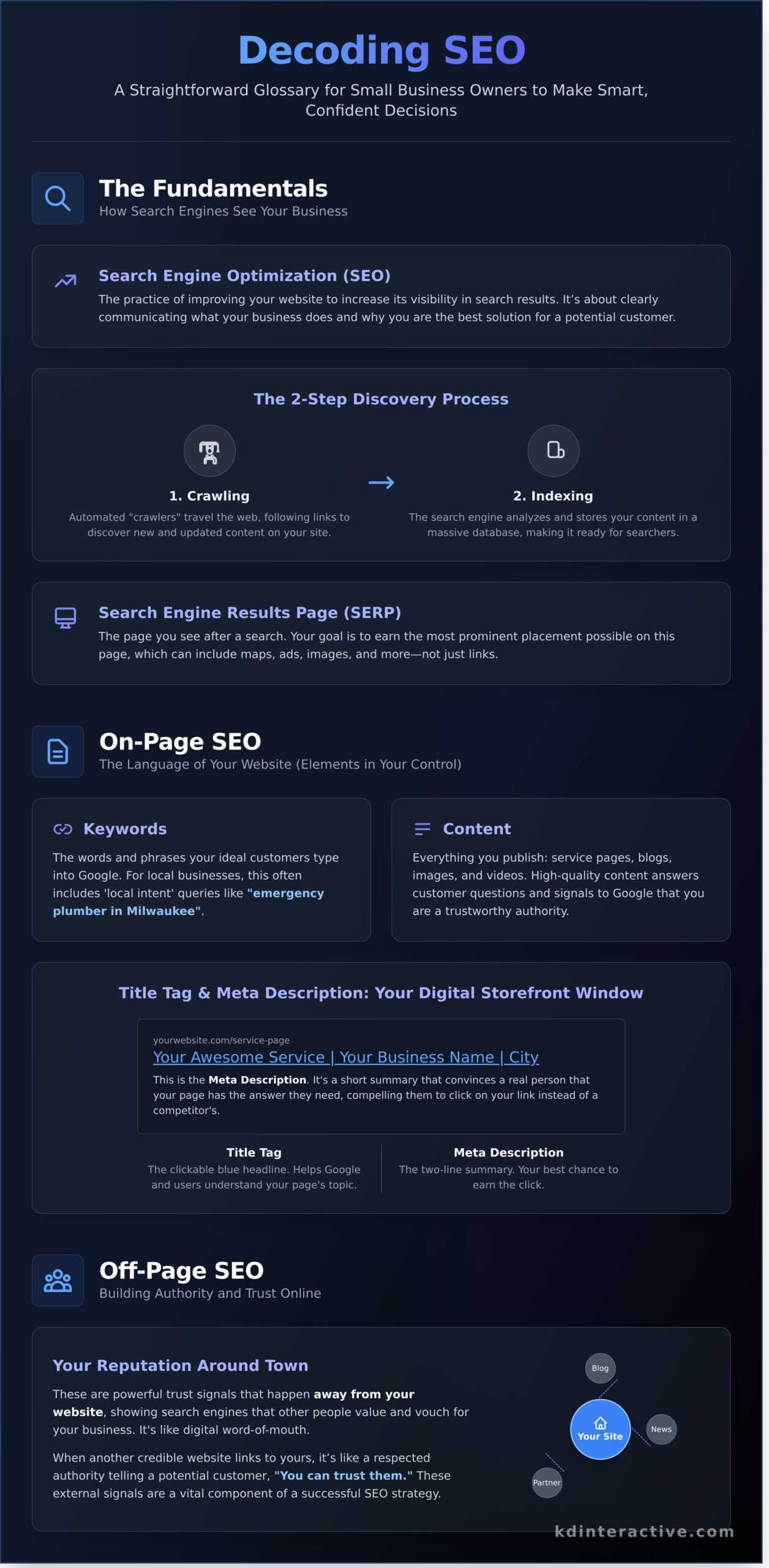
At its core, Search Engine Optimization (SEO) is the results-driven practice of improving your website to increase its visibility in search engine results. It’s not about secret tricks; it’s about clearly communicating to Google what your business does and why you are the best solution for a potential customer’s search. For a local business in Milwaukee or Madison, this is non-negotiable. Without a solid SEO strategy, you are essentially invisible to the hundreds of local customers searching for your services every single day.
Crawling & Indexing
So, how does Google discover your website in the first place? It uses a two-step process that forms the technical backbone of all search. Understanding these two seo definitions is key:
- Crawling: Search engines use automated programs called “crawlers” (or “spiders”) that constantly travel the web, following links from page to page to discover new and updated content.
- Indexing: Once a crawler finds a page, the search engine analyzes its content-text, images, and videos-and stores a copy in a massive database called the “index.” This is the library’s master catalog, where your website is categorized and made ready for searchers.
Search Engine Results Page (SERP)
The SERP is the page you see after you type a search query and hit “Enter.” This is the digital storefront where businesses compete for attention. A modern SERP is much more than a simple list of links; it’s a dynamic page that can include a local map pack, paid ads, image carousels, and question-and-answer boxes. Your primary goal in any SEO campaign is to earn the most prominent placement possible on this page. The higher your business appears, the more clicks, calls, and customers you will attract.
On-Page SEO: The Language of Your Website
If off-page SEO is about your reputation around the web, on-page SEO is all about what you say on your own turf. These are the elements entirely within your control on your website-from the words you use to the way you structure your pages. Getting these core seo definitions right is the first step in a results-oriented strategy. Think of these elements as the essential building blocks for understanding SEO basics; getting them right is non-negotiable. Good on-page SEO makes it crystal clear to both search engines and potential customers exactly what your business does and why you’re the best choice.
Keywords
Keywords are the foundation. They are simply the words and phrases your ideal customers type into Google when they need your services. For a local business, this often includes ‘local intent’-queries like “emergency plumber in Milwaukee” or “best fish fry near me.” Choosing the right keywords ensures you show up for the searches that actually grow your business, connecting you directly with customers who are ready to buy.
Title Tag & Meta Description
Ever notice the clickable blue headline in a Google search result? That’s the Title Tag. The short, two-line summary underneath it is the Meta Description. These two pieces of text are your digital storefront window. They don’t just help Google understand your page’s topic; they are your first and best chance to convince a real person that your page has the answer they need, compelling them to click on your link instead of a competitor’s.
Content
Content is more than just text. It includes everything you publish to connect with your audience: your service pages, blog posts, images, and videos. The primary goal of your content is to answer your customers’ questions thoroughly and demonstrate your expertise. High-quality, helpful content doesn’t just satisfy users; it signals to Google that you are a trustworthy authority in your field, boosting your credibility and your rankings over time. For instance, a company specializing in high-tech equipment, like Drone Doctor LLC, can demonstrate expertise through detailed product pages, video tutorials on drone maintenance, or blog posts reviewing new models.
Off-Page SEO: Building Authority and Trust Online
If on-page SEO is how you manage your own storefront, then off-page SEO is your reputation around town. These are the powerful trust signals that happen away from your website, showing search engines like Google that other people value and vouch for your business. Think of it as digital word-of-mouth. When another credible website links to yours, it’s like a respected local business owner telling a potential customer, “You can trust them.” These external signals are a vital component of any successful Search Engine Optimization (SEO) strategy, helping Google understand your website’s relevance and authority in the real world.
Backlinks (or Inbound Links)
A backlink is simply a link from another website to your website. In the world of SEO, these are the ultimate currency of trust. Each backlink acts as a ‘vote of confidence’ or a digital referral from another site. When a reputable source links to your content, they are essentially telling Google that your page is a valuable resource. This is a major factor in how Google determines your site’s authority, and understanding their impact is fundamental to many core seo definitions of online credibility.
Link Building
Link building is the strategic process of actively acquiring new, high-quality backlinks to your website. This isn’t about getting as many links as possible; it’s about earning them from the right places. Effective link building strategies for a local business might include:
- Sponsoring a local charity event and getting a link from their website.
- Creating a helpful guide for your community that local bloggers or news sites want to share.
- Joining your local Chamber of Commerce to get listed in their directory.
Remember, one quality link from a trusted, relevant website is worth more than a hundred low-quality links from spammy sites.
Domain Authority (DA)
You might hear the term Domain Authority (or DA) mentioned in SEO discussions. This is a predictive score, ranging from 1 to 100, developed by the SEO software company Moz. It aims to predict how well a website will rank on search engine result pages. It’s important to know that DA is a third-party metric, not a ranking factor used by Google. While it’s a useful tool for competitive analysis-allowing you to gauge your site’s linking profile against your competitors-it should not be your primary goal. Focus on building real-world trust and earning quality links, and your authority will grow naturally.
Local SEO: Terms That Put Your Business on the Map
For any business with a physical storefront or a defined service area-from a Milwaukee bakery to a Madison plumbing company-this is the most critical set of seo definitions you need to know. These terms are the building blocks for attracting customers right in your neighborhood. Understanding them is the first step to showing up on Google Maps and in the local searches that drive real-world traffic to your door.
Google Business Profile (GBP)
Think of your Google Business Profile as your free digital storefront on Google. It’s the detailed listing that appears in Google Maps and local search results, complete with your hours, address, phone number, photos, and customer reviews. Why does it matter? It is, without a doubt, the single most important tool for local SEO success. A fully optimized GBP is your foundation for getting found by local customers ready to buy.
Local Pack / Map Pack
The Local Pack (or Map Pack) is the highly visible box that appears at the very top of Google’s results for local queries, featuring a map and three business listings. Because of its prime position, it earns a massive number of clicks. Getting your business into this coveted space isn’t just for vanity; it directly translates into more phone calls, website clicks, and foot traffic from customers in your immediate area.
NAP & Citations
Consistency is key in local SEO, and it all starts with your NAP and citations. These core concepts are crucial for building trust with search engines.
- NAP: This is the acronym for your business’s core information: Name, Address, and Phone number.
- Citations: A citation is any online mention of your NAP on other websites, such as Yelp, the Better Business Bureau, or local business directories.
When your NAP is identical across every citation online, it sends a powerful signal to Google that your business information is accurate and reliable, boosting your chances of ranking higher in local search results.
Mastering these local SEO fundamentals is the key to connecting with customers in your community. This is our specialty. Let us help you dominate local search.
Measuring Success: How to Know if SEO is Working
SEO isn’t a “set it and forget it” strategy; it’s a measurable investment designed to grow your business. The best part about a well-executed SEO campaign is that its success is not a mystery. It produces clear, trackable data that shows you exactly what’s working. Beyond the basic seo definitions, understanding a few key metrics is all it takes to see the direct return on your investment and learn what your customers are truly looking for.
For a small business, tracking shouldn’t be complicated. We focus on the data that directly impacts your bottom line. Here are the three most important metrics that tell the story of your SEO success.
Organic Traffic
Organic traffic includes every visitor who finds your website through a search engine like Google without clicking on a paid ad. This is the traffic you earn through high-quality content and smart SEO. A steady increase in organic traffic is the number one indicator that your SEO efforts are paying off and that more potential customers are discovering your business.
Rankings
Your ranking is your website’s position in the search results for a specific keyword. If a potential customer in Milwaukee searches for “plumber near me,” does your business show up? The goal is always to rank on the first page, ideally in the top three spots, because that’s where the vast majority of clicks happen. Higher rankings directly translate to more visibility, more traffic, and more authority in your industry.
Conversion
This is the metric that truly matters. A conversion happens when a visitor takes a specific, desired action on your website. This is the moment a visitor turns into a lead or a customer. Conversions are the ultimate goal of SEO, and they can include actions like:
- Filling out a contact form
- Calling your business directly from the website
- Signing up for a newsletter
- Making a purchase online
While traffic and rankings are vital, conversions are what generate revenue and prove that your SEO strategy is delivering real-world results. Understanding these core seo definitions and metrics empowers you to make smarter decisions for your business. Need help turning your website data into a growth plan? The team at KD Interactive is here to help.
From Definitions to Dominance: Your Next Step in SEO
Congratulations on taking a huge step toward mastering your online presence. By understanding how search engines work, what on-page and off-page SEO entail, and the importance of local search, you’re no longer in the dark. Having these essential seo definitions in your toolkit is the foundation for making informed, powerful decisions that can genuinely impact your bottom line. You now speak the language of digital growth.
But knowledge is only half the battle; the other half is execution. We understand small business, because we are one! We know you’re busy running your company, and you need a partner who can translate these concepts into a transparent, results-driven strategy. As local SEO experts, we are dedicated to helping Wisconsin businesses increase their visibility and connect with more customers.
Tired of the jargon and ready to focus on results? Let’s build a customized plan that works for you. Your journey to the top of the search results starts with a simple conversation. Get Your FREE Consultation today!
Frequently Asked SEO Questions
What is the difference between SEO and SEM?
This is one of the most common seo definitions people ask about. Search Engine Optimization (SEO) is the practice of increasing your website’s visibility in organic, or unpaid, search engine results. Search Engine Marketing (SEM) is a broader marketing discipline that includes SEO as well as paid advertising methods like Pay-Per-Click (PPC). Essentially, SEO is about earning traffic over time, while SEM can also involve buying traffic for more immediate results.
How long does it take for SEO to start working?
SEO is a long-term investment in your business’s growth, not an overnight fix. While you may see some initial positive movement in rankings within 3 to 6 months, more significant and stable results typically take 6 to 12 months. The exact timeline depends on factors like your industry’s competitiveness and the current state of your website. Consistency is the key to achieving sustainable visibility and increasing traffic from qualified customers who are looking for you.
What is ‘keyword stuffing’ and why is it a bad practice?
Keyword stuffing is an outdated and penalized tactic of unnaturally loading a webpage with keywords to manipulate its ranking. For example, writing “best Milwaukee plumber, Milwaukee plumber for hire, top plumber in Milwaukee” in a single sentence. This practice creates a terrible experience for your visitors and can cause Google to demote or even remove your site from search results. Modern, effective SEO focuses on creating high-quality, helpful content that uses keywords naturally.
Is there a difference between on-page, off-page, and technical SEO?
Yes, these are the three main pillars of a comprehensive SEO strategy. On-page SEO involves optimizing the content on your actual website, like your page titles, text, and images. Off-page SEO refers to actions taken off your site to build its authority, primarily through earning backlinks from other reputable websites. Technical SEO ensures your website’s foundation is strong, focusing on elements like site speed, mobile-friendliness, and secure connections to improve user experience.
Do I need a blog on my small business website for SEO?
Absolutely. A blog is one of the most effective tools for boosting your SEO performance. Each blog post is a new opportunity for your site to rank for relevant keywords, answer your customers’ questions, and establish your authority in your industry. Regularly publishing fresh, valuable content signals to search engines that your site is active and relevant, which can significantly improve your rankings and attract more organic traffic over time.
What is E-E-A-T and why does it matter for my business?
E-E-A-T stands for Experience, Expertise, Authoritativeness, and Trustworthiness. It’s a set of signals Google uses to evaluate the quality and credibility of a webpage and its creator. For your business, this means proving you are a reliable expert in your field. You can demonstrate strong E-E-A-T through detailed case studies, positive customer reviews, and author bios that showcase your real-world experience. Building trust with users and search engines is critical for long-term success.