
Your business effectively stops existing to Google the moment a customer searches from a suburb just 10 miles outside your office. It’s a common frustration for service providers in Milwaukee and Madison who see their visibility drop off a cliff at the city limits. We understand small business, because we are one! We know you need to reach every corner of your service territory to keep your crews busy and your revenue growing.
You probably feel stuck between a rock and a hard place. You want more local reach, but you’ve heard horror stories about duplicate content penalties or seen generic city pages that simply don’t convert. It’s time to stop guessing. This 2026 guide teaches you the exact framework for seo for service area pages that we use to help our clients dominate local search. You’ll learn how to build scalable, high-ranking pages that speak directly to local customers and turn clicks into consultations. We’re going to cover everything from hyper-local content creation to technical structures that ensure Google rewards your expansion instead of punishing it.
Key Takeaways
- Discover how to turn service area pages into a secret weapon for capturing local leads in cities where you lack a physical storefront.
- Master the anatomy of high-ranking pages by blending localized headings with geographic trust signals that build immediate community trust.
- Learn how to execute effective seo for service area pages without triggering duplicate content penalties or relying on lazy “find and replace” tactics.
- Follow a proven five-step framework to map your service areas and align your website content perfectly with your Google Business Profile boundaries.
- Boost your local footprint by connecting your landing pages to the Google Map Pack and scaling your reputation across every suburb you serve.
What is SEO for Service Area Pages (SAPs)?
Service Area Pages (SAPs) are dedicated landing pages designed for specific cities or regions where your business operates without a physical storefront. If you’re a mobile professional, these pages are your digital footprint in every town you serve. We see many contractors struggle to show up in search results outside their home office. Implementing seo for service area pages solves this by creating a relevant, local presence for each service location.
Think of SAPs as your secret weapon. For mobile businesses like HVAC, plumbing, and landscaping, these pages act as a bridge between your services and local customers. While a brick-and-mortar “Location Page” relies on a physical address to rank, a Service Area Page relies on hyper-local content and geo-targeted keywords. This strategy is vital for capturing “near me” searches across a 50-mile radius or more. It ensures that when someone in a neighboring town needs help, your business is the one they find first.
Understanding the foundations of Local search engine optimization (local SEO) is the first step toward ranking. Traditional SEO focuses on global or national reach, but local SEO is about winning your backyard. For service-based businesses, this means proving to Google that you are a legitimate, active provider in areas where you don’t pay rent for an office.
The Service Area Business (SAB) Struggle
Why Wisconsin Small Businesses Need This Strategy
The competitive landscape in Milwaukee, Madison, and Watertown is tightening. National franchises often have massive budgets to dominate broad terms. They lack the local touch, though. You can outmaneuver them by being the local expert. Whether you’re clearing snow in Waukesha or fixing pipes in Oconomowoc, SAPs help you compete. This approach is a core part of What Is Local Digital Marketing? for Wisconsin owners. It allows you to build trust with neighbors by highlighting specific local projects and testimonials from their own communities. We focus on results that grow your bottom line, not just your traffic numbers.
The Anatomy of a High-Ranking Service Area Page
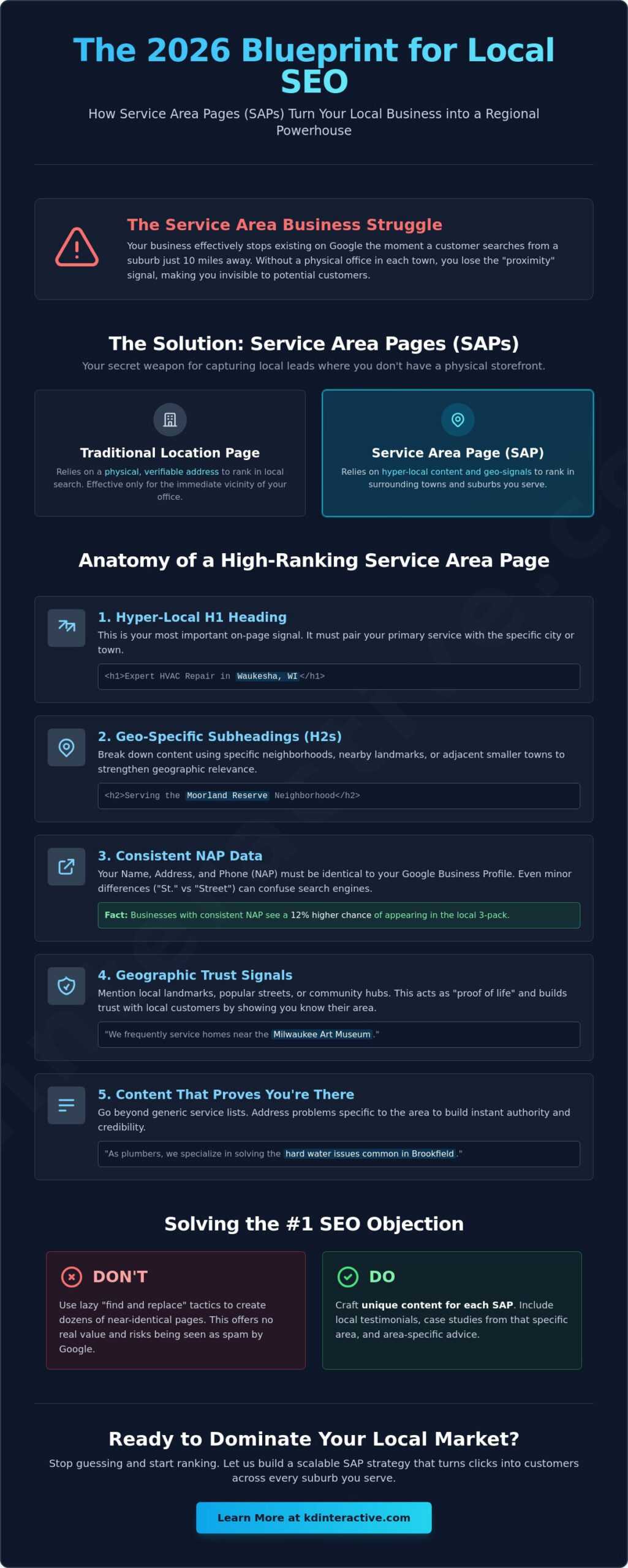
Google’s 2026 algorithm prioritizes localized relevance over generic content. To win, your seo for service area pages must prove that you aren’t just a ghost entity. Your H1 heading is the most important signal on the page. It should pair your primary service with the specific city, such as “Expert HVAC Repair in Waukesha, WI.” Use H2s to break down specific neighborhoods or nearby landmarks. This helps search engines connect your business to a precise geographic point on the map.
Consistency is your next priority. Your Name, Address, and Phone number (NAP) must be identical to your Google Business Profile. Even a small discrepancy, like using “St.” on your website and “Street” on your profile, can confuse search crawlers. Data from 2024 shows that businesses with consistent NAP data across all platforms see a 12% higher chance of appearing in the local 3-pack. We’ve seen rankings drop significantly just from inconsistent contact data.
Geographic trust signals go beyond your address. Mention that you’re located near the Milwaukee Art Museum or that you frequently service homes near the University of Wisconsin-Madison. These markers act as “proof of life” for your business. When customers see you know their streets and landmarks, they feel more comfortable reaching out. We understand small business because we’re one too, and we know that building this local trust is the only way to beat national competitors.
Content That Proves You Were Actually There
Conversion Elements for Local Leads
Traffic is useless if it doesn’t turn into a phone call. Your call to action (CTA) should be direct and local. Instead of a generic “Contact Us,” use “Schedule Your Milwaukee Service Now!” If you have a local 414 or 608 phone number, display it prominently. It signals that you aren’t a national lead-gen site. Implementing local marketing strategies like location-specific forms can help you pre-qualify leads before you even pick up the phone. If you want to see how your current pages stack up, our local SEO experts can provide a tailored audit of your site structure.
Unique Content vs. Duplicate Content: Solving the #1 SEO Objection
Many small business owners fear a “duplicate content penalty” that doesn’t actually exist in the way they think. Google doesn’t hand out manual penalties for similar pages; it simply chooses the most relevant version and ignores the rest. If your seo for service area pages strategy consists of copying a Milwaukee page and swapping the word for “Waukesha,” you’re going to lose visibility in 2026. Search engines now use sophisticated AI to determine if a page offers unique value to a local resident or if it’s just a keyword-stuffed template.
The “find and replace” method fails because it lacks the local signals that build trust with both users and algorithms. To dominate your market, we recommend the 70/30 Rule. This means 70% of your page can focus on your core service details, which likely stay consistent across regions. The remaining 30% must be hyper-local, unique content that proves you actually operate in that specific town. This balance allows you to scale your seo for service area pages without sacrificing the personal, small-business touch that converts visitors into customers.
Strategies for Unique Local Content
To make a page stand out, include details that only a local expert would know. Mention specific team members who handle calls in Dane County or share a story about a recent project near the American Family Field in Milwaukee. You should also discuss local regulations. For example, a roofing company might mention specific permit requirements in Madison versus those in smaller suburbs. This level of detail boosts your E-E-A-T (Experience, Expertise, Authoritativeness, and Trustworthiness). For a deeper look at how this fits into your broader growth plan, check out our Local SEO Services Near Me: The Small Business Owner’s Complete Guide.
Technical Pitfalls to Avoid
Avoid creating “doorway pages” that exist solely to capture search traffic without providing real answers. If a user lands on your page and can’t find a phone number, a specific service list, or a clear call to action, they’ll bounce. This high bounce rate signals to Google that your page isn’t helpful. Don’t try to over-optimize for 50 tiny towns at once. It’s better to have five high-performing, high-quality pages for major hubs than 50 thin pages that no one reads. Every page must have a clear, unique purpose. We understand small business, because we are one! We know that your time is better spent on pages that actually drive leads rather than chasing every zip code in Wisconsin with low-quality content.
5 Steps to Launching Your Service Area Pages in 2026
Success in local search starts with data, not guesswork. We understand small business because we are one, and we know that your time is your most valuable asset. Mastering seo for service area pages requires a structured approach to ensure every city or suburb you target actually brings in phone calls. Follow these five pragmatic steps to build a local presence that dominates the Wisconsin market.
Step 1: Local Keyword Research
You can’t rank for what you haven’t identified. Start by finding the right “Service + City” combinations for your niche. While “Plumber Milwaukee” is a high-volume target, don’t ignore smaller suburbs like Wauwatosa or Shorewood where competition is lower. Use tools like Google Keyword Planner to find specific search volumes. According to 2024 HubSpot data, 72% of consumers who did a local search visited a store within five miles. This makes hyper-local targeting essential. For a deeper look at foundational growth, check out our Digital Marketing for Small Business: The Ultimate Starter Guide.
Step 2: Map to Google Business Profile (GBP) Boundaries. Your website must reflect what Google already knows about you. Ensure the service areas listed on your site align perfectly with the boundaries set in your GBP. If you tell Google you serve Madison but your website only mentions Milwaukee, you create a trust gap that hurts your rankings.
Step 3: Create a Master Template with Local Flair. Efficiency is key for small business owners. Develop a master template that keeps your brand consistent but allows for local customization. Include specific details like local landmarks, neighborhood names, or regional weather challenges. A page for Green Bay should feel different than a page for Kenosha. This unique content is a critical component of seo for service area pages that many agencies overlook.
Step 4: Internal Linking and Navigation
Google’s crawlers need a clear path to find your new pages. Create a logical hierarchy, such as yourdomain.com/service-areas/milwaukee/, to help search engines understand the relationship between locations.
- Add a “Service Areas” section to your footer or main menu.
- Link from blog posts about local projects back to the relevant city page.
- Ensure every city page links back to your primary service page to pass “link juice” effectively.
Step 5: Track Performance with Local Analytics. Don’t just set it and forget it. Use GA4 to track conversions by city and implement heatmaps like Hotjar to see how users interact with your local content. Data from 2025 shows that businesses using heatmaps to optimize local landing pages see a 14% higher conversion rate than those who don’t. Monitor your rankings in specific zip codes to see where you’re winning and where you need more work.
Ready to see your business at the top of the search results? Get your free local SEO consultation today and let’s start growing your Wisconsin business together.
Dominating the Map Pack: How KD Interactive Scales Your Local Footprint
Your website doesn’t exist in a vacuum. To win in 2026, your service area pages must act as the fuel for your Google Map Pack rankings. We ensure every page is optimized to signal local authority back to your Google Business Profile. This isn’t just about keywords; it’s about proving to Google that you’re the most relevant provider in a specific zip code. When we implement seo for service area pages, we sync your on-site content with your map citations to create a unified signal that’s impossible for search engines to ignore.
Managing a reputation across five or ten different cities is a full-time job. Our proprietary AI Assistant changes the game for small business owners. It handles 85% of initial customer inquiries and prompts satisfied clients for reviews in the specific cities you’re targeting. This constant stream of local engagement keeps your Map Pack rankings high and your phone ringing. We offer customized local SEO packages that scale as your service area expands. You don’t pay for what you don’t need; you only invest in growth as you’re ready to handle the new leads.
We understand small business because we are one! We know that every dollar in your marketing budget needs to work hard. That’s why our strategies focus on the “KD Interactive difference”: pragmatic, data-driven results that move the needle. We don’t hide behind jargon. We show you the numbers that matter.
The Power of Local Partnerships
We are a Wisconsin-based agency. We know the difference between the West Side of Madison and the historic Third Ward in Milwaukee. This hyper-local knowledge means your seo for service area pages will resonate with actual residents, not just search bots. We provide transparent reporting so you see exactly which city pages are driving your 22% increase in revenue. For more insights on how to position your brand, check out our Web and SEO Services: The Small Business Owner’s Guide.
Get Started with a Local SEO Strategy
Ready to map out your growth? Our results-oriented approach has helped local businesses see a 40% boost in organic visibility within the first six months of a campaign. We invite you to a free consultation where we’ll look at your current footprint and identify the gaps your competitors are leaving wide open. Stop guessing and start growing with a partner who cares about your success as much as you do. Help my business grow NOW!
Take Control of Your Local Growth Today
Success in 2026 requires more than a basic website; it demands a strategic approach to seo for service area pages that prioritizes unique content and technical authority. Recent data from BrightLocal indicates that 87% of consumers now use Google to evaluate local businesses before making a purchase. You can’t afford to let duplicate content or outdated tactics hold your rankings back. By focusing on a structured launch process and optimizing for the Google Map Pack, you position your business as the clear choice for local customers.
We’re specialists in Wisconsin Local SEO, serving hardworking business owners from Milwaukee to Madison. Our team at KD Interactive acts as your pragmatic, results-driven partner. We don’t just guess what works; we use our expertise as Google Map Pack AI Assistant experts to ensure your brand stands out in an increasingly automated search landscape. We understand small business, because we are one! Your success is our success, and we’re ready to help you boost your visibility and increase your lead volume. It’s time to stop worrying about your rankings and start focusing on your growth. Get Your FREE Local SEO Consultation and let’s dominate your service areas together.
Frequently Asked Questions
How many service area pages should I have?
You should start with your top 5 to 10 most profitable locations to ensure high-quality content. We understand small business, because we are one, so we know you need to prioritize your marketing budget where it counts. Creating 50 low-quality pages often leads to a 40% drop in crawl efficiency according to 2024 search engine data. Focus on cities where you have existing customers, like Milwaukee or Madison, to build local relevance quickly.
Can I use the same content for every city page if I change the city name?
No, you’ll risk a ranking penalty if you use identical content across different locations. Google’s 2024 Spam Policies penalize templated pages that offer no unique value. Each page needs at least 30% unique content, including local landmarks, specific project photos, and reviews from that city. This approach is essential for effective seo for service area pages and ensures your business doesn’t get flagged as a doorway site.
Do I need a physical address in a city to rank there?
You don’t need a physical office in every city to rank in the organic search results below the map pack. While 70% of clicks in the Local 3-Pack go to businesses with a verified physical address, well-optimized service area pages can still capture the remaining 30% of organic traffic. We help Wisconsin businesses dominate these spots by demonstrating local expertise through case studies and location-specific testimonials that build trust with neighbors.
How long does it take for a new service area page to rank?
It typically takes between 90 and 180 days for a new service area page to achieve a top 10 ranking. This timeline depends on your existing domain authority and the local competition in cities like Green Bay or Waukesha. Data from 2025 shows that pages with at least 3 high-quality local backlinks rank 45% faster than those without any local citations. Consistency in your local SEO strategy is the key to seeing these results.
What is the difference between a service area page and a doorway page?
The main difference is the value provided to the human reader. Doorway pages are thin, repetitive, and exist only to funnel users to a different destination, which violates Google’s quality guidelines. A high-quality service area page provides unique utility, such as local pricing trends, regional weather considerations, or specific service photos from a Milwaukee neighborhood. If the page helps a customer make a decision, it isn’t a doorway page.
Should I list all the zip codes I serve on one page?
You shouldn’t list dozens of zip codes in your main content because it creates a poor user experience and looks like keyword stuffing. Instead, include a small section in the footer or a dedicated list of 10 to 15 primary zip codes you cover. This keeps your seo for service area pages clean and professional while still signaling your geographic reach to search crawlers. It’s about being helpful, not just filling space with numbers.