
What if a negative review could show prospective customers that your business listens and follows through? A critical comment can feel like it speaks for your whole business, especially when you’re unsure what to say publicly or whether the complaint is fair. But turning a negative review into a positive doesn’t mean persuading someone to change their rating. It means understanding the concern, responding calmly, and offering a fair path to resolution.
You can’t control how every customer feels, but you can control how you respond. A thoughtful, professional reply can help keep a complaint from escalating and show future customers that you take feedback seriously. It also protects your credibility by avoiding arguments, pressure, or attempts to influence reviews.
This guide explains how to assess negative feedback, distinguish a genuine concern from inaccurate or abusive content, and write a respectful public response. You’ll also learn when to move the conversation to a private channel, how to follow up, and how to use feedback to improve your process. The goal is a better customer relationship and a stronger public impression, built on accountability rather than persuasion.
Key Takeaways
- Identify whether the complaint points to a fixable service issue, a misunderstanding, inaccurate details, or abusive content before choosing how to respond.
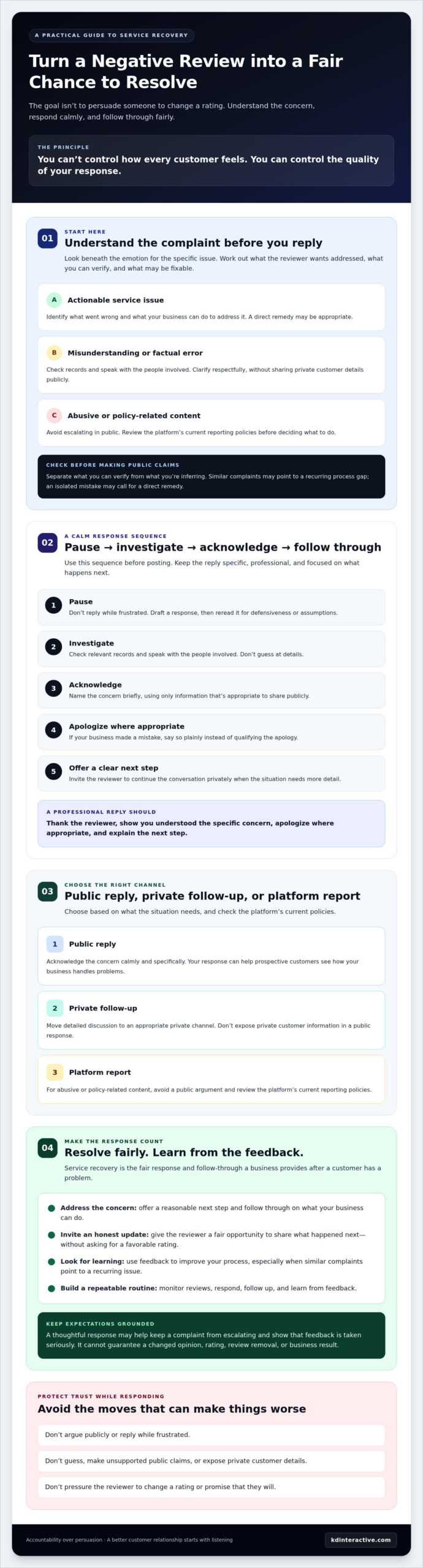
- Use a calm sequence: pause, investigate, acknowledge the concern, apologize where appropriate, and offer a clear next step.
- Choose a public reply, private follow-up, or platform report based on what the situation needs, and check the platform’s current policies.
- Turn a negative review into an opportunity to resolve the issue fairly and invite an honest update, without asking for a favorable rating.
- Build a repeatable process for monitoring, responding, following up, and learning from feedback. Seek professional support if reviews become difficult to manage consistently.
Turning a Negative Review into a Positive Starts with Understanding the Complaint
Before writing a reply, work out what the reviewer wants your business to address. The goal isn’t to secure a higher rating. It’s to understand what went wrong, respond fairly, and take responsibility for your part. That approach supports a credible local presence, where prospective customers may read your responses while comparing businesses. Reputation management is about shaping how people perceive an organization, and a thoughtful review response is one visible part of that work.
Service recovery is the fair response and follow-through a business provides after a customer has a problem. It may improve the customer’s experience, but it doesn’t guarantee that the reviewer will change their opinion or rating.
What is the reviewer really asking the business to address?
Look for the specific issue beneath the emotion. Is the reviewer describing a delayed appointment, a confusing charge, an interaction with a staff member, or a result that didn’t meet expectations? Identifying the issue helps you decide what to investigate and what you may be able to fix.
Separate what you can verify from what you’re inferring. Check relevant records and speak with the people involved before making public claims. For example, a reviewer may say a scheduled service never happened, while your records show that a visit took place but didn’t resolve the problem. Don’t share private customer details in a public reply. Acknowledge the concern and invite the person to discuss specifics through an appropriate private channel.
Then consider whether the review describes an isolated mistake or a gap in your usual process. One missed appointment may call for a direct remedy. Similar complaints about scheduling may point to a recurring issue worth addressing.
Can every negative review be turned into a positive?
No. You can control the quality of your response and the fairness of your follow-through, but not another person’s opinion. Turning a negative review into a positive means creating a fair opportunity for resolution, not promising a rating change, review removal, or business result.
A reviewer may leave their original post unchanged even after you’ve addressed the concern. Your response can still help prospective customers assess how your business handles problems. A calm, specific reply that accepts responsibility where appropriate and offers a reasonable next step shows care without arguing or pressuring the customer.
- Actionable complaint: Identify the service issue and what you can do to address it.
- Misunderstanding or factual error: Check the facts, then clarify respectfully without exposing private information.
- Abusive or policy-related content: Avoid escalating in public and review the platform’s current reporting policies before taking action.
How to Respond to a Negative Review Without Making It Worse
A strong public response is calm, specific, and focused on what happens next. It speaks to two audiences: the reviewer, who wants acknowledgment, and prospective customers, who may be watching to see how your business handles a problem. Use this sequence before posting:
- Pause. Don’t reply while frustrated. Draft a response, then reread it for defensiveness or assumptions.
- Investigate. Check relevant records and speak with the people involved. Don’t guess at details.
- Acknowledge. Name the concern briefly, using only information that’s appropriate to share publicly.
- Apologize where appropriate. If your business made a mistake, say so plainly instead of qualifying the apology.
- Offer follow-up. Explain the next step and invite the reviewer to continue the conversation privately.
What should a professional response to a bad review include?
Thank the reviewer for raising the issue, then show that you understood the specific concern. “We’re sorry to hear this” may sound polite, but it doesn’t show that you’ve read the complaint. Harvard Business Review’s The Right Way to Respond offers additional perspective on handling negative feedback constructively.
For example: “Thanks for letting us know your appointment started later than scheduled. We’re sorry for the delay. We’d like to look into what happened and discuss next steps. Please contact our team through the contact details on our profile.” Use a follow-up route your business can manage, and make sure the details you provide are accurate.
A useful reply principle: acknowledge the experience, state the next step, and invite private follow-up. This shows prospective customers that you’re taking the concern seriously without turning the review into a public argument.
What should you avoid saying in a public reply?
Keep payment details, contact information, private records, and sensitive allegations out of your response. Don’t argue point by point, blame the customer, or disclose information to prove your side. Even if the complaint includes an error, correct it briefly and respectfully, then offer to discuss details privately.
Avoid generic copy-and-paste apologies that could fit any complaint. Don’t offer a discount, gift, or other incentive in exchange for changing or removing a review. That can undermine trust and make the exchange look like an attempt to influence feedback. A consistent approach to monitoring and replying can help small businesses keep responses thoughtful. Businesses seeking support can explore review response support as part of that ongoing process.
Compare Your Options: Public Reply, Private Follow-Up, or Platform Report
Choose the response route based on what the review needs, not how uncomfortable it feels to see it online. Most service complaints call for a calm public reply and a genuine attempt to resolve the issue. A private conversation can handle details that don’t belong in public, while a platform report is appropriate only when you can point to a possible policy violation. These options can be used together.
| Option | Best used when | What to do |
|---|---|---|
| Public reply | The reviewer describes a service problem or unmet expectation. | Acknowledge the concern and offer a reasonable next step without sharing private details. |
| Private follow-up | Resolving the issue requires account information, personal circumstances, or detailed troubleshooting. | Invite the reviewer to contact you through an appropriate private channel, then track the contact attempt and agreed actions. |
| Platform report | You identify a specific concern that may violate the platform’s review policies. | Check the current policy and reporting process, then submit a factual report without expecting a particular outcome. |
When should you take the conversation offline?
Move the discussion to a private channel when you need information that could identify the customer, reveal payment or account details, or expose sensitive circumstances. Don’t ask the reviewer to post those details publicly. Leave a brief reply so other readers can see that you’ve offered follow-up, such as: “We’d like to look into this with you. Please contact us through the details on our profile.”
Record the contact attempt, what the business agreed to do, and whether the next step was completed in your usual workflow. This makes the resolution easier to track, especially if more than one staff member may handle the issue.
When is reporting a review appropriate?
A low rating or an opinion you disagree with isn’t, by itself, a reason to report a review. Compare the specific content with the platform’s current rules and report only a clear, policy-based concern. If a review combines a service complaint with questionable content, respond to the legitimate service issue separately rather than using a report to avoid criticism.
Google Business Profile and other platforms can update their policies and reporting processes. Check the current guidance before requesting removal, and don’t promise a reviewer or your team that a report will succeed. Turning a negative review into a positive depends on fair follow-through, not on suppressing criticism.
Follow Up Fairly and Prevent the Same Review Problem from Recurring
A response is only the start of service recovery. Follow through on what you offered, then check whether the same issue could affect another customer. This makes turning a negative review into a positive a practical improvement process, not just a public reply.
- Investigate: Confirm what happened and identify any information still missing.
- Contact the customer: Use an appropriate private channel to discuss details and agree on a next step.
- Deliver the agreed remedy: Complete the action you committed to, and tell the customer if circumstances change.
- Document the lesson: Record the issue, resolution, and any process change in your usual business workflow.
How do you invite a reviewer to reconsider their feedback ethically?
Resolve the concern first. If you follow up afterward, make the request optional and ask for an honest update about the experience, not a higher score, positive wording, or removal of the original review. For example: “We’ve completed the agreed follow-up. If you’d like to update your review to reflect your experience, you’re welcome to do so.” Don’t contact the customer repeatedly or make a remedy conditional on an update. Check the platform’s current rules on review requests and incentives before asking, since policies can differ and change.
How can negative feedback improve the customer experience?
Look for patterns across reviews instead of treating each complaint as an isolated event. Track themes by issue type, location, service stage, and response time. If several customers mention confusion during booking, for instance, review the instructions and assign someone to improve them. Give each practical change an owner and due date, then check that it was completed.
Public reviews can help reveal what customers experience at different points in their local search and service journey. A Google Business Profile setup guide can help businesses understand the profile where customers may encounter and leave reviews. Review themes are useful operational feedback, but a single reply or process change doesn’t guarantee improved search rankings.
For small businesses in Wisconsin, reviewing feedback regularly can make it easier to spot recurring concerns and keep follow-up consistent. If monitoring and responding to reviews is difficult to maintain, get support with review monitoring and responses as part of a more consistent reputation management process.
When Reputation Management Support Can Help Turn Reviews into Better Outcomes
Some businesses can manage reviews internally with a clear process and enough time to monitor feedback, respond thoughtfully, and follow through on customer concerns. Support may be useful when reviews appear across multiple platforms, responses are inconsistent, or staff aren’t sure who should handle an issue. The goal of turning a negative review into a positive remains fair resolution, not a guaranteed rating change or business result.
Before seeking help, consider whether your team has a reliable way to notice new reviews, decide who drafts and approves replies, and track what happens after a customer is contacted. If those steps regularly fall through, consistent monitoring and response support may help make review management easier to maintain.
What should a small business look for in reputation-management support?
Ask how reviews are monitored, who approves public responses, and how urgent or sensitive concerns are escalated. Look for clear reporting that separates response activity, such as reviews monitored and replies posted, from outcomes the provider can’t control, such as a customer changing a review. The approach should fit your business, your customers, and your capacity to complete any promised follow-up.
KD Interactive provides review monitoring and response support for small businesses, alongside local SEO services. This can help make review management a consistent process rather than a one-time reply, while leaving customer outcomes and platform decisions outside anyone’s control.
How can review management support local visibility in Wisconsin?
Reviews are one part of a local business’s public presence. Clear, useful responses can help customers understand how your business handles feedback, while accurate business information makes it easier for people to recognize and contact you. In Wisconsin, a local business can consider review management alongside broader local SEO work without assuming that a single reply will improve rankings.
For more context, consult a local SEO services guide when reviewing how reputation management fits into a broader visibility strategy. Keep the focus on practices you can manage: accurate information, thoughtful responses, and follow-through on customer concerns.
If your Wisconsin small business needs a consistent approach, Explore local SEO and reputation management support. You can also Discuss a practical reputation-management plan based on your review-management needs.
Build Trust With a Consistent Review Response Process
Turning a negative review into a positive starts with understanding the customer’s concern, responding calmly, and following through on a fair next step. You can’t control whether someone changes their rating, but you can show prospective customers that your business listens and takes feedback seriously.
Make review management an ongoing process: track recurring concerns, address practical service gaps, and keep public replies respectful and privacy-conscious. When your team needs help staying consistent, KD Interactive offers review monitoring and response support as part of its broader local SEO services.
Talk with KD Interactive about reputation management to discuss an approach that fits your business. Each thoughtful response is a chance to learn, improve, and build trust over time.
Frequently Asked Questions
Can you turn a negative review into a positive one?
You can improve the customer’s experience, but you can’t control whether they change their review or opinion. Turning a negative review into a positive means understanding the concern, offering a fair way to address it, and following through. For example, if a customer reports a missed appointment, investigate what happened and agree on a practical next step. A thoughtful resolution may build trust with the reviewer and future readers, even if the original review stays unchanged.
How should a business respond to a bad review?
Respond calmly, acknowledge the specific concern, and offer a clear next step. First, check the relevant facts so your reply doesn’t rely on assumptions. Thank the reviewer for raising the issue, apologize if your business made a mistake, and invite them to continue the discussion privately if you need more detail. Keep the public response concise and respectful. Don’t argue, blame the customer, or share private records to defend your position.
Should I reply publicly or contact the reviewer privately?
For most service complaints, use both: post a brief public reply to acknowledge the concern, then move detailed troubleshooting or sensitive information to a private channel. Your public response is also read by prospective customers, so make it clear that you’re willing to follow up. Don’t ask the reviewer to disclose account, payment, or personal information publicly. Keep a record of the contact attempt and any next steps your business agrees to complete.
Can I ask a customer to change or remove a negative review?
You can invite a customer to share an honest update after you’ve addressed the concern, but don’t pressure them to change or remove their review. Never make a remedy conditional on an update, ask for a specific rating, or offer an incentive in exchange for altering feedback. Check the review platform’s current policies before making any request, since rules differ. The priority is resolving the experience fairly, not securing a more favorable public rating.
What if a negative review is false or violates platform rules?
Check the details you can verify, then respond calmly if a brief clarification would help readers. Don’t reveal private information to prove your position. If the review appears to violate the platform’s policies, compare it with the current rules and report the specific concern through the platform’s process. A low rating or criticism alone doesn’t establish a policy violation. Reporting a review doesn’t guarantee that the platform will remove it.
How quickly should a business respond to a negative review?
Respond promptly, but take time to verify the complaint before posting. A quick, careful acknowledgment can reassure the reviewer that the concern has been seen, while an inaccurate or defensive reply can escalate the exchange. If you need more time to investigate, say that you’re looking into the issue and explain how you’ll follow up. Set a regular routine for checking review platforms so feedback doesn’t go unnoticed.
Do negative reviews hurt local SEO rankings?
A negative review doesn’t automatically determine local search rankings, and one reply can’t guarantee a ranking change. Reviews are part of your public local presence, where potential customers may compare businesses and assess how you handle feedback. Keep your business information accurate, respond professionally, and address recurring service issues. KD Interactive includes reputation management in its broader local SEO services, with review monitoring and response support as part of an ongoing process.