The most effective dog groomer marketing ideas aren’t always about posting more. They make it easier for nearby dog owners to find your salon, trust your services, and book. When inquiries are uneven and your schedule is already full of grooming appointments, it can be hard to know which channels deserve your time.
You’re looking for practical options, not another list of tasks. Marketing works best as a connected local booking journey: help people discover your business, give them useful reasons to feel confident choosing you, and make it easy for first-time customers to return.
This guide covers 12 ideas, from improving your local search presence and building a trustworthy review profile to sharing useful content, creating community partnerships, and encouraging repeat visits. You’ll see which tactics support discovery, which help turn interest into bookings, and how to track inquiries, appointments, and returning clients without making marketing a second full-time job.
Key Takeaways
- Match each marketing activity to a customer journey stage, from local discovery to a repeat appointment.
- Choose dog groomer marketing ideas that fit your audience and available time, and define a result you can track.
- Use reviews, grooming photos, referrals, and community relationships to help potential clients assess your salon.
- Start with one goal, test two relevant tactics, and record inquiry and booking trends.
- Consider professional local marketing support when limited capacity or unclear results make it difficult to improve visibility consistently.
Why dog groomer marketing ideas should lead from local discovery to bookings
Dog grooming marketing is the ongoing work of helping nearby dog owners discover your salon, understand its services, book an appointment, and return. It’s more than a one-off social media promotion. A post might catch someone’s attention, but effective marketing connects that moment to useful information, a clear way to inquire, and an experience that encourages another visit.
Think of the customer journey as a series of decisions: an owner needs grooming, searches nearby, compares salons, chooses a service, books, and later decides whether to return. Each step has a different job. Local search supports discovery; service details and reviews help owners evaluate the fit; a straightforward booking path turns interest into an appointment.
This is where Local Search Engine Optimization comes in. It focuses on making a business visible to people searching within a relevant geographic area. For a grooming salon, the goal isn’t simply to get more views. It’s to connect local visibility with suitable inquiries and appointments.
A full calendar can feel reassuring, but it doesn’t tell the whole story. Track qualified inquiries, appointment requests, new clients, and repeat bookings alongside completed appointments. These measures help show whether your marketing is reaching owners who need your services and whether first visits lead to lasting client relationships. Record a starting point before making changes so you can compare results over time.
What makes marketing different for a local dog grooming business?
Local owners often weigh trust, proximity, availability, and service fit together. Someone might search for breed-specific grooming, a puppy’s first visit, or a salon close to home with appointment times that suit their schedule. Clear, accurate information helps people decide whether your salon fits their dog and practical needs.
Promote the services you provide and can accommodate. If your schedule is full or a service isn’t a fit, don’t create an expectation your team can’t meet. Honest descriptions attract better-matched inquiries and make booking conversations more useful for both the owner and the salon.
How to choose marketing ideas without doing everything
Start with one business need, then choose activities that support it. The most useful dog groomer marketing ideas are the ones you can maintain and assess, not simply the ones that look popular. Match each activity to a clear goal:
- Discovery: Help more nearby dog owners find the salon.
- Conversion: Give interested owners the information and confidence to inquire or book.
- Retention: Make it easier for existing clients to schedule another visit.
- Referrals: Encourage satisfied clients and local connections to recommend the salon.
Choose activities that fit your time, appointment capacity, and customers’ preferred ways to find and contact you. Start with a small mix, such as one discovery activity and one retention activity. Record inquiries and bookings associated with each, then adjust before adding more. A focused plan is easier to sustain between appointments and gives you clearer evidence about what deserves attention.
Dog groomer marketing ideas for getting found in local searches
Local visibility starts with clear, consistent information. If an owner finds your salon but can’t tell where you’re located, what services you offer, or how to book, uncertainty can interrupt the path from search to inquiry. These four ideas help nearby owners find useful information and give you practical ways to assess your efforts.
Make your profile and service pages work together
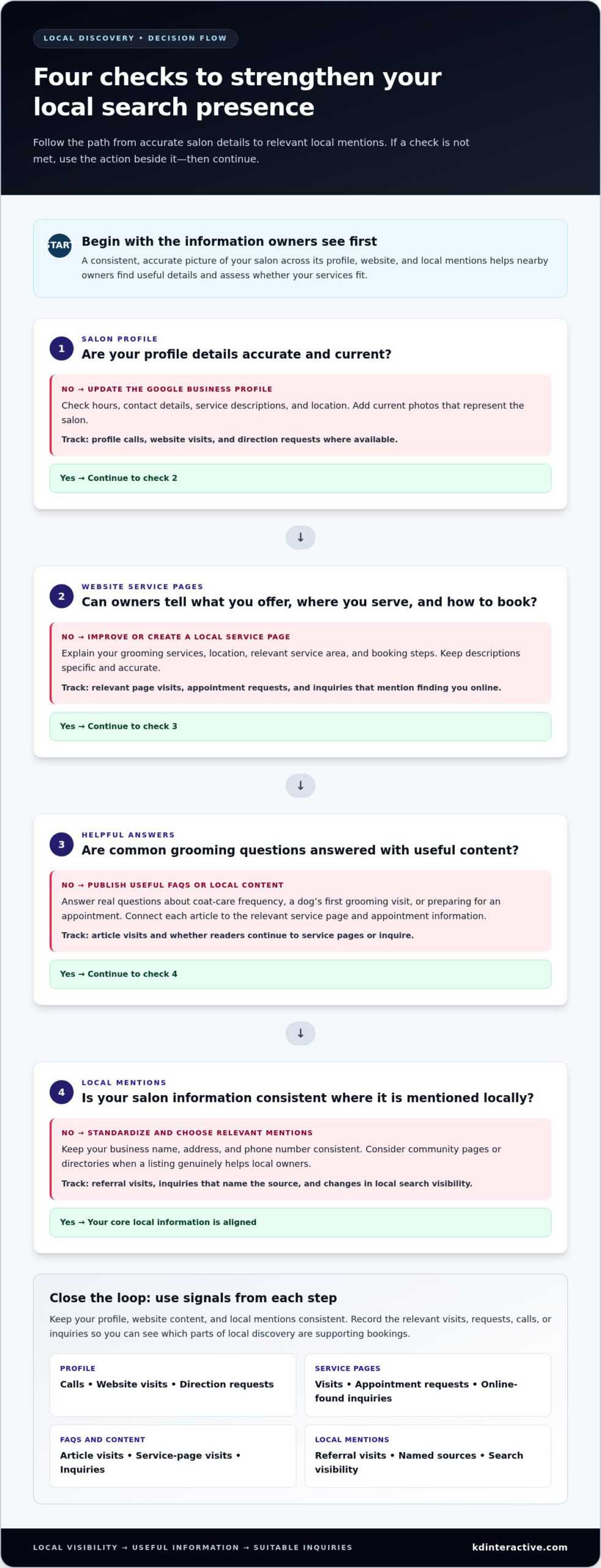
1. Strengthen your Google Business Profile. This is useful for salons aiming to appear in local discovery searches. Check your hours, contact details, service descriptions, and location for accuracy, then add current photos that represent the salon. Track profile calls, website visits, and direction requests where available. “How to Set Up a Google Business Page: A Step-by-Step Guide” offers a starting point.
2. Improve your local service pages. If your website doesn’t clearly explain what you do or where you serve, create or update a page with your grooming services, location, relevant service area, and booking steps. Keep descriptions specific and accurate so owners can assess the fit quickly. Track relevant page visits, appointment requests, and inquiries that mention finding you online.
Answer questions and strengthen local relevance
3. Publish useful FAQs and local content. This suits groomers who can share helpful guidance but have limited time for frequent social posts. Answer real customer questions about coat-care frequency, first grooming visits, or preparing a dog for an appointment. Link each article to the relevant service page and a clear next step, such as how to request an appointment. “Local SEO Services Near Me: The Small Business Owner’s Complete Guide” provides broader context for building a local search strategy. Track article visits and whether readers continue to service pages or inquire.
4. Build relevant local mentions. Start by making sure your business name, address, and phone number are consistent wherever your salon is mentioned. Look for relevant community pages or directories where a listing genuinely helps local owners. Track referral visits, inquiries that name the source, and changes in local search visibility.
These steps work best when your profile, website content, and local mentions reinforce the same accurate picture of your salon. The U.S. Bureau of Labor Statistics on Pet Care Services explores productivity and technology in the industry, highlighting how digital information can support the way pet care businesses connect with customers.
Start with the gap that creates the most friction for local owners, and track a simple signal before adding another task. For tailored help improving local search visibility and connecting it to grooming inquiries, explore local SEO support for your grooming business.
Dog groomer marketing ideas that build trust and stand out
Dog owners want to feel confident about who will care for their pet. Reviews, grooming photos, referrals, and local partnerships can each reduce uncertainty, but they work in different ways. The strongest dog groomer marketing ideas help prospective clients assess whether your services fit their needs, rather than simply collecting likes or views.
| Idea | Audience fit | Effort | Customer journey stage | Trackable outcome |
|---|---|---|---|---|
| Review requests | Owners comparing salons | Low, when included in a consistent follow-up routine | Evaluation | New reviews and inquiries mentioning reviews |
| Before-and-after content | Visual learners and owners assessing your work | Moderate, with permission and a simple capture process | Discovery and evaluation | Relevant profile or page visits and inquiries |
| Client referrals | Satisfied clients connected to local dog owners | Low, with a clear, easy-to-share prompt | Discovery and conversion | Inquiries that identify a client referral |
| Community partnerships | Owners reached through local pet organizations | Moderate, depending on coordination | Discovery and trust | Partner-referred inquiries and bookings |
| Helpful social posts | Owners looking for grooming guidance or a feel for your salon | Low to moderate, depending on the format | Discovery and evaluation | Inquiries that mention a social post |
| Rebooking prompts | Existing clients ready to plan another visit | Low, when included in the appointment follow-up | Retention | Repeat appointment requests |
| Service-specific FAQs | Owners with questions about a particular grooming service | Moderate, with answers based on common client questions | Evaluation | Service-page visits and related inquiries |
| Clear booking steps | Owners who are ready to contact the salon | Low, once contact details and next steps are clear | Conversion | Appointment requests and completed bookings |
Build social proof with reviews, referrals, and customer stories
After a completed appointment, invite the client to leave an honest review in a polite, consistent way. Don’t offer an incentive, ask only happy clients, or pressure anyone to use specific wording or mention staff. Authentic reviews help prospective customers assess whether a salon’s service and client experience fit their needs. Thank reviewers and respond calmly to concerns, acknowledge the feedback, and offer an appropriate next step without sharing private details. A referral prompt can be simple: “If you know a local dog owner looking for grooming, please feel free to share our details.”
Use visual content and local partnerships to show your work
Short transformation clips, coat-care tips, and behind-the-scenes moments can show your approach more clearly than a promotional claim. Get the client’s permission before taking or sharing a pet’s photo, and don’t reveal identifying details without consent. Present results honestly, without suggesting every dog will have the same outcome. For community reach, consider relevant collaborations with pet retailers, trainers, or rescue organizations.
Make the content useful and the partnership relevant. A coat-care tip can answer a common question, while a local partner can introduce your salon to owners seeking pet-related support. Keep the focus on the relationship and useful information, not promotion alone.
Use social posts to answer questions or show what an appointment involves, rather than posting just to fill the feed. After a visit, make the next step clear for clients who want to book again. Measure outcomes tied to business activity: record inquiries that mention a review, post, referral, or partner, then note whether they become appointments. Likes show that content attracted attention, but don’t reveal on their own whether local owners contacted or booked your salon.
Turn dog groomer marketing ideas into a repeatable booking plan
A simple tracking routine helps you see which marketing activities lead to inquiries and appointments without turning your grooming business into a data project. Choose one outcome to improve, test a manageable pair of tactics, and record what happens. The goal is a clear next step, not perfect attribution.
- Choose one goal. Decide whether the priority is more qualified inquiries, first appointments, or repeat visits. A specific goal makes it easier to choose relevant activities and assess whether they help.
- Select two suitable ideas. Pair tactics that support the same goal, such as improving a service page and publishing a related local article to encourage inquiries. Keep the workload realistic for your time and appointment capacity.
- Set a baseline. Before making changes, note your current calls, form inquiries, appointment requests, new clients, and repeat visits where available. Record profile interactions separately. Use the same tracking method during the test so the comparison stays useful.
- Review results and adjust. Look at the number and quality of inquiries, plus how many become appointments. Keep what appears to help, refine weak points, and choose the next small test.
Build a practical first-month marketing test
Use the month to put your plan into practice. In week one, check that your business profile and service pages are accurate, then follow the booking path as if you were a new customer. Note missing details or steps that make it harder to inquire. During weeks two and three, publish one useful piece of local content and invite clients to share honest feedback after completed appointments. In week four, compare inquiries and bookings with your baseline, then choose what to test next.
For more small-business planning ideas, Digital Marketing for Small Business: The Ultimate Starter Guide can help you consider how different activities fit together. Keep your own test focused: you’re learning which changes make it easier for local dog owners to take the next step.
Measure what helps the grooming business grow
Separate visibility signals, such as profile interactions or service-page visits, from business outcomes, such as inquiries, completed appointments, and repeat visits. Visibility shows whether people are finding your information; bookings show whether that attention is translating into business. Neither measure tells the whole story on its own.
Make attribution easy for clients and staff. Ask, “How did you hear about us?” and record the answer using consistent options, such as search, referral, social media, or a local partner. If inquiries are strong but bookings lag, review whether service details, next steps, or appointment information are clear. If first visits aren’t leading to repeat appointments, look at the follow-up experience and how clients can rebook. Use analytics and inquiry patterns to refine local topics, service pages, and targeting instead of adding tactics without a clear reason.
Want a more structured way to connect local visibility with measurable inquiries and bookings? Build a tailored local marketing strategy.
When a dog groomer should get help with local marketing
Marketing often slips when appointments, client care, and daily business tasks fill the schedule. Outside support can help if your salon has limited time to maintain its online presence, local visibility is inconsistent, or it’s difficult to tell which activities bring qualified inquiries. The right support should make marketing more manageable and connect the work to useful measures, not add another set of unclear tasks.
Doing it yourself can work well when you have time to learn, create content, and review results regularly. Professional support brings focused expertise and a consistent process. Consider how each option fits your situation:
| Area | DIY execution | Professional support |
|---|---|---|
| Time | You handle planning and updates alongside salon work. | Some research, content, and optimization tasks can be supported externally. |
| Expertise | You build knowledge as you work through local search and content decisions. | Specialists apply local SEO and keyword research experience to the strategy. |
| Consistency | Progress can pause during busy periods. | A defined process can help maintain ongoing activity. |
| Measurement | You choose and monitor the signals yourself. | Analytics tracking can connect activity with visibility and inquiries. |
What professional local marketing support can cover
Keyword research can identify the local service searches dog owners use and reveal topics your website could address. On-page optimization and tailored content can make service pages clearer and more relevant to nearby searches. Reputation management supports review monitoring and responses, while analytics tracking helps you assess activity and identify areas to improve. These elements work together instead of treating each marketing task as a separate effort.
Choose a focused strategy for your salon’s goals
Start by naming the main business need: stronger local visibility, more qualified inquiries, or better follow-through with existing clients. Then shape the strategy around your location, services, audience, and capacity. A salon with strong awareness but few inquiries may need clearer service information; one with steady inquiries but limited capacity may prioritize the services it wants to fill.
Set reporting expectations before work begins. Agree on the activities to track and the outcomes that matter, such as local search visibility, calls, form inquiries, appointment requests, or repeat visits. Rankings can vary, so reporting should focus on transparent activity and measurable trends rather than guaranteed positions. This makes it easier to assess progress and adjust priorities.
Effective dog groomer marketing ideas should fit your salon’s goals and available time. KD Interactive supports small businesses with local SEO, keyword research, content creation, reputation management, and analytics tracking. Talk with KD Interactive about local marketing growth and discuss a focused approach for your grooming business.
Make your next marketing step count
You don’t need to launch every idea at once. Choose one improvement that fits your salon’s capacity, give it a clear purpose, and decide what result would make you continue. A steady, measured approach makes dog groomer marketing ideas easier to manage while helping you build stronger connections with local dog owners.
If planning and tracking keep slipping behind client work, outside guidance can turn scattered tasks into a focused local strategy. KD Interactive can tailor support around your visibility goals, customer education, and the signals that matter to your grooming business.
Talk with KD Interactive about local marketing growth. Start with a practical next step, then build from what you learn. Your next wave of local clients can begin with a plan that works for you.
Frequently Asked Questions
What is the best marketing strategy for a dog grooming business?
The best strategy addresses your salon’s biggest current gap. If local owners aren’t finding you, focus first on search visibility. If people inquire but don’t book, check whether your service details and next steps answer their concerns. If new clients rarely return, make rebooking part of the client experience. Choose dog groomer marketing ideas that match the problem, then review results before adding more.
How can a dog groomer get more customers locally?
Make it easy for nearby owners to recognize that your salon fits their needs. Use the same business name and contact details across your website and relevant local directories, and describe services in language customers might use, such as “small-dog haircut” or “puppy’s first grooming visit.” Add helpful details about what to expect at an appointment. This clarity can attract better-matched inquiries, not just general attention.
Is social media effective marketing for dog groomers?
Yes. Social media can help dog owners discover your work and get a feel for your salon’s approach. It’s most useful when posts answer a customer question or give people a clear reason to inquire, rather than simply filling the feed. Use captions to explain what a service involves, and respond to comments or messages with an appropriate next step. Track inquiries from social channels to assess their value.
How often should a dog grooming business post on social media?
Post at a pace you can maintain without disrupting client care. A useful starting point is one post each week, then adjust based on your available time and whether followers engage or inquire. Prepare a few simple themes, such as service explanations, common coat-care questions, or salon updates, so you’re not creating from scratch each time. A consistent, relevant presence is more practical than an ambitious schedule that quickly stops.
How can dog groomers get more online reviews?
Ask every client for honest feedback after their appointment, using a brief, neutral request in person or on a printed follow-up card. Make the review destination easy to find, but don’t offer rewards, pressure clients, or ask only people you expect to be happy. That keeps the process fair and in line with Google’s review policies. Thank clients for sharing feedback and address concerns professionally without revealing personal details.
What should a dog grooming website include to attract clients?
A useful website should quickly answer practical questions: where the salon is, what grooming services it provides, how to request an appointment, and what information an owner should have ready. Include clear contact details, mobile-friendly navigation, and guidance on preparing a dog for a visit. If certain services suit particular coat types or dog sizes, explain that plainly. Helpful specifics make it easier for visitors to decide what to do next.
How can a dog groomer measure whether marketing is working?
Track the path from first contact to completed appointment. Record where inquiries came from, whether they matched your services, how many became bookings, and whether those clients returned. Use a simple spreadsheet or booking notes with consistent source labels, such as search, social media, or referral. Compare results over similar periods and consider your appointment capacity. More inquiries aren’t necessarily better if they don’t lead to suitable bookings.