
What if the SEO plan with the biggest ranking promises isn’t the one that helps nearby patients find your practice? Choosing doctor’s office seo services is less about chasing position reports and more about choosing work that fits your location, priorities, and capacity to manage marketing.
You should expect more than a keyword list or monthly traffic chart. Look for a clear scope of work, relevant local-search priorities, and reporting that connects visibility to useful actions such as calls and appointment inquiries. For a medical practice, accurate, trustworthy information matters as much as reach.
This guide explains how to compare service scope and agency fit, assess work such as keyword research, content creation, reputation management, and Google Map Pack visibility, and measure progress without relying on rankings alone. You’ll also find practical ways to prepare your team and review reporting without adding unnecessary complexity to a busy practice schedule.
Key Takeaways
- Compare doctor’s office seo services by the work included and how it fits your practice, not by ranking promises alone.
- Assess how research, website improvements, useful content, local presence, and measurement support your visibility goals.
- Look for reporting that connects search performance with meaningful patient-intent actions, such as calls and appointment inquiries.
- Define priority specialties, service areas, and desired patient actions before setting your SEO priorities.
- Use a tailored local SEO strategy to coordinate keyword research, content, reputation management, and performance tracking.
Why Doctor’s Office SEO Services Matter for Local Patient Discovery
Doctor’s office SEO is the ongoing work of improving a practice’s visibility in relevant searches through its website, local presence, and reputation. The goal is to make accurate, useful information easier for nearby people to find when they’re looking for a provider or service. Search engine optimization (SEO) includes practices that help search engines understand and present web pages. A local strategy also considers where a practice serves and what prospective patients need to know.
That distinction matters. A general increase in website traffic doesn’t necessarily mean more visibility for searches relevant to a practice. Effective doctor’s office seo services focus on relevance: the right location, provider, specialty, or service, supported by clear information that helps people decide what to do next.
Which searches can help patients find a doctor’s office?
Search wording can reveal different needs, but it doesn’t guarantee that someone is ready to book. A location-focused query, such as “family doctor near Madison,” suggests that geography matters. A specialty search, such as “dermatologist in Green Bay,” narrows the type of care sought. A provider-name search may come from someone who has heard about a clinician and wants the practice’s official information.
Service-related searches add another layer. Someone might look for a practice that offers a particular service or treatment. The right page topic depends on what the practice provides, where it serves patients, and how patients describe their needs. Keyword research helps identify relevant language; clear, accurate website content helps searchers understand whether the practice may be a fit. Treat a query as a signal of interest, not proof of intent or an appointment.
What SEO can, and cannot, promise a medical practice
SEO is ongoing work, not an instant ranking fix. A strategy can include concrete deliverables such as researching relevant searches, improving website pages, developing helpful content, strengthening local information, and tracking performance. Those activities are within the practice’s and its marketing team’s control. Search engines determine how results appear and can change their systems; patients decide whether to visit, call, or book.
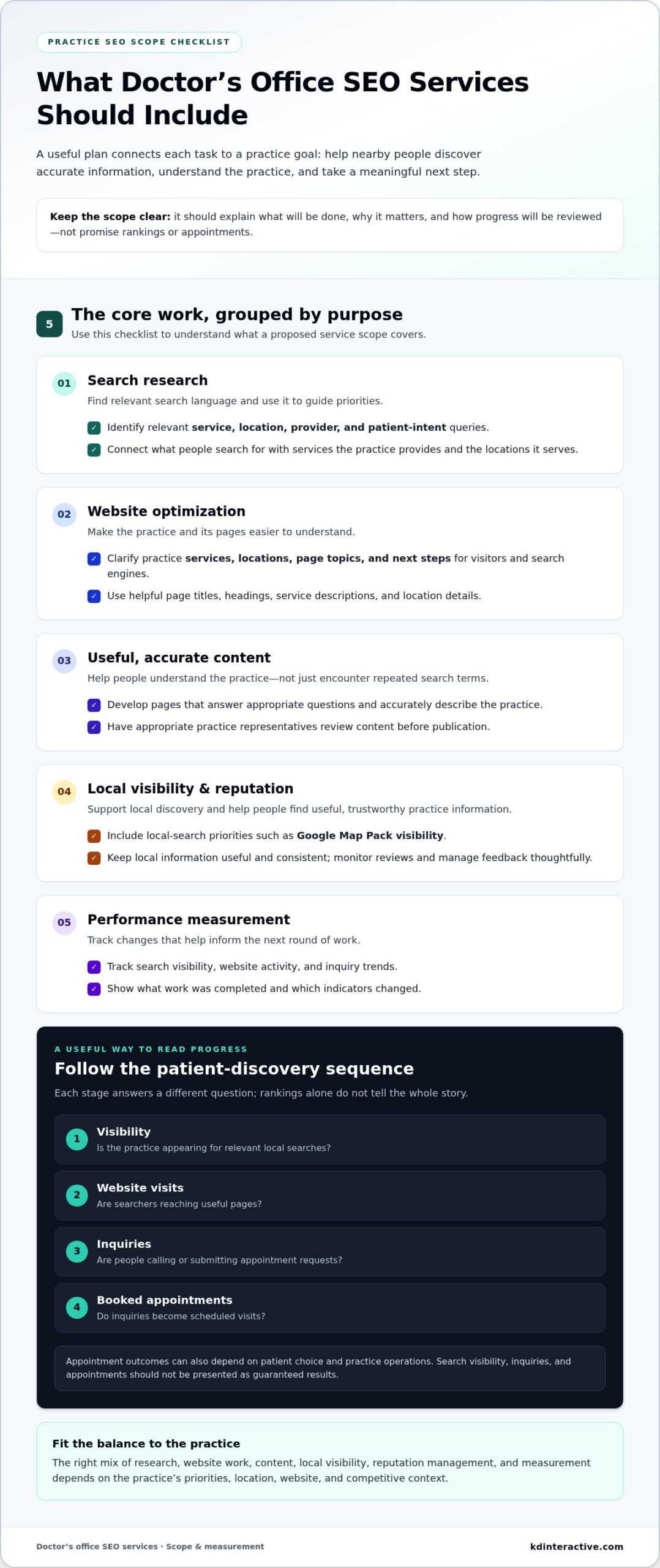
Measure progress as a sequence, rather than relying on a single ranking:
- Visibility: Is the practice appearing for relevant local searches?
- Website visits: Are searchers reaching useful pages?
- Inquiries: Are people taking actions such as calling or submitting an appointment request?
- Booked appointments: Do inquiries become scheduled visits?
These stages answer different questions. Visibility indicates whether people can discover the practice; visits and inquiries offer closer signals of interest. Appointment outcomes can also depend on factors beyond SEO, including patient choice and practice operations. Clear reporting should show what work was completed and which indicators changed, without presenting rankings, inquiries, or appointments as guaranteed results.
What Doctor’s Office SEO Services Should Include
A useful SEO plan connects each task to a practice goal. Research identifies what nearby people search for; website and content updates help them understand the practice; local and reputation work support discovery and trust; measurement shows what is changing. The right balance depends on the practice’s priorities, location, website, and competitive context. A standard checklist may miss those differences.
At their core, doctor’s office seo services combine search research, website improvements, useful content, local visibility, reputation management, and performance measurement. These activities create a clear work plan, not a promise of rankings or appointments. A practical scope should explain what will be done, why it matters, and how progress will be reviewed.
- Research: Identify relevant service, location, provider, and patient-intent queries to guide priorities.
- Website optimization: Clarify practice services, locations, page topics, and next steps so visitors and search engines can understand the site.
- Content creation: Develop useful pages that answer appropriate questions and accurately describe the practice.
- Local presence and reputation: Keep local information useful and consistent, and monitor public feedback as part of building trust.
- Measurement: Track search visibility, website activity, and inquiry trends to inform the next round of work.
Local visibility, website improvements, and practice content
Keyword research should connect real search language with services the practice provides and the locations it serves. A query about a specialty in a nearby city may call for a different page focus than a search for a named provider. On-page updates can make those relationships clear through useful page titles, headings, service descriptions, location details, and straightforward next steps.
Content should serve patients, not simply repeat search terms. Pages need accurate, clear information and should be reviewed by appropriate practice representatives before publication. For more ideas on local, content, and link-building work, Officite outlines 11 effective SEO strategies specifically tailored for medical practices. The right mix still depends on each practice’s needs.
Reputation management and performance tracking
Reputation work includes monitoring reviews and managing feedback thoughtfully. Reviews can influence how people perceive a practice, so responses should be handled with care and should not expose private information. A clear process helps the practice notice recurring feedback and keep public-facing communication professional.
Analytics tracking should show whether relevant searches are bringing visibility, whether visitors reach useful pages, and whether they take measurable actions such as calling or submitting an inquiry. Those actions are not the same as confirmed appointments. Unless reliable attribution connects an inquiry to a booked visit, reports should label it accurately rather than claim an appointment outcome.
For Wisconsin practices, local SEO planning can bring keyword research, on-page work, content, reputation management, and tracking into a tailored strategy. Clear priorities keep the work focused instead of turning it into a one-size-fits-all checklist.
How to Compare Doctor’s Office SEO Services and Agencies
Proposals can sound similar while covering very different work. Compare the strategy behind the tasks, how progress will be communicated, and whether the plan fits your practice’s services, locations, website condition, and available staff time. A tailored plan explains why particular searches matter and how the work supports your priorities, rather than applying the same checklist to every practice.
Use this framework to compare scope side by side:
Strategy: Does keyword research connect search intent with the services you provide and the locations you serve?
Deliverables: Are specific tasks defined, such as page updates, content development, local profile work, or reputation management?
Reporting: Will reports separate search visibility, website actions, inquiries, and booked visits rather than blending them into one success claim?
Communication: Are progress updates, decision points, and responsibilities clear enough for your team to stay involved without taking on unnecessary coordination?
Content review: Is there a clear process for practice representatives to review content for accuracy before publication?
Questions to ask about strategy, deliverables, and reporting
Ask how the proposed keywords relate to your actual services and target locations. A useful strategy explains why a search topic matters to your practice, which page or local asset supports it, and what work is planned. Request deliverables in plain language, with enough detail to understand what will be completed and how often progress will be discussed.
Reporting should connect activity to a clear decision. For example, if a service page attracts visits but few inquiries, the report should identify that pattern without assuming why it happened. Ask how the plan can adapt when data changes, practice priorities shift, or staff capacity limits content review. The answers help show whether the process is collaborative and flexible.
How to assess claims, timelines, and patient outcomes
Be cautious of guaranteed rankings or fixed patient-growth claims. Search results depend on factors outside any agency’s control, and patients decide whether to take the next step. A credible plan sets measurable goals and explains the starting point, planned work, and review process, while recognizing that competition and website condition affect progress.
Keep outcomes distinct: visibility shows whether people can find the practice, inquiries indicate actions such as calls or requests, and booked visits reflect a later stage. Appointment claims require reliable attribution that connects an inquiry to a booked visit; otherwise, reports should avoid presenting inquiries as confirmed patients.
Decision rule: Choose doctor’s office seo services based on transparent, relevant work and measurements you can interpret, not promises alone. A sound proposal makes clear what the team will do, how the practice contributes, and how results will inform the next steps.
Prepare Your Practice to Get More from SEO Services
A focused start helps an SEO team understand what matters to your practice and keeps marketing work manageable alongside daily operations. Before work begins, gather the information and decisions that will shape the strategy. These steps also make progress easier to review and practice details easier to keep accurate.
- Set a clear priority. Decide what you want search visibility to support, such as awareness of a particular specialty, more visibility in a defined community, or increased use of a preferred appointment-request option. Choose a priority to guide early work instead of trying to promote every service at once.
- List your services and providers. Note which services or specialties are priorities, the providers associated with them, and any distinctions patients should understand. Include the exact names your practice uses and flag details that need review. This helps keyword research and website updates reflect what the practice actually offers.
- Define locations and audiences. Record office locations and the communities each serves. Clarify whether patients typically choose a location, provider, or specialty first. A clear service-area picture helps shape local search priorities and reduces the risk of website content implying that the practice serves places it doesn’t.
- Choose patient actions to track. Decide which website actions matter, such as phone calls or appointment-request submissions. These can show whether searchers are taking a next step. Keep them distinct from confirmed visits unless your own records reliably connect inquiries with booked appointments.
- Organize access securely. Identify who can provide appropriate access to the website, analytics, and business profile. Use secure account-sharing processes and grant only the access needed for the work. Don’t send patient information or sensitive records as routine marketing materials; share practice information relevant to the SEO project instead.
Accurate business-profile details are another useful starting point. Confirm that the practice name, address, phone number, hours, and relevant services are current, and assign someone to maintain them. Consistent details give people a clearer picture of the practice before they decide whether to visit its website or get in touch.
Plan practice content and review workflows
Choose a practice representative to review service descriptions and any content that calls for clinical accuracy. Agree on who drafts, reviews, and approves pages or updates, and how feedback will be shared. A defined process prevents avoidable delays while keeping published information aligned with the practice. Assign someone to provide profile updates, too, so changes to locations or services can be reflected accurately.
With goals, locations, account access, and review responsibilities organized, you’ll have a practical foundation for doctor’s office seo services. Discuss a tailored local SEO strategy with KD Interactive to connect those priorities with focused search work.
How KD Interactive Can Support a Doctor’s Office SEO Strategy
A useful local SEO strategy starts with a practice’s priorities, not a preset package. KD Interactive provides local SEO services for businesses in Wisconsin, connecting keyword research, website improvements, content, reputation management, and analytics tracking. For a doctor’s office, the work can focus on the services and locations the practice wants to make easier to find, with clear deliverables and agreed ways to review progress.
A tailored local SEO mix for practice goals
Start with the practice’s priority services, providers, and target locations. Keyword research can identify relevant search language; on-page optimization can make related website pages clearer; and content creation can provide useful information for practice representatives to review for accuracy. Reputation management supports a consistent, thoughtful approach to public feedback, while analytics tracking helps show how visibility and website activity change over time.
These pieces work best when they reinforce one another. If a practice prioritizes a particular service in a specific Wisconsin community, research can guide which page or content needs attention. Website updates can clarify what the practice offers and where, while performance tracking can show whether searchers reach relevant pages and take actions such as calling or submitting an inquiry. Those actions are useful indicators, not a promise of booked visits.
KD Interactive also offers a Google Map Pack with AI Assistant as a local-search component. It can be considered alongside other work to support local visibility, without promising a particular placement or result. The appropriate mix depends on the practice’s goals, website, location, and competitive context.
Discuss goals, scope, and next steps with KD Interactive
To make an initial strategy discussion productive, bring a short list of priority services and locations, plus the patient actions that matter most to the practice. Identify who can review website content and which team member can coordinate access to relevant website, analytics, and business-profile accounts. This gives the discussion practical boundaries and keeps coordination manageable.
Agree on the work to be completed and the indicators to track. Reporting can follow measures such as search visibility, visits to relevant pages, and inquiry activity. Keep each measure distinct, and treat appointments as confirmed only when reliable practice records connect them to an inquiry or marketing activity. Clear reporting makes it easier to understand what has changed and where the strategy may need adjustment.
Ready to connect your practice’s priorities with a focused local plan? Discuss a tailored local SEO strategy with KD Interactive and outline the services, locations, and meaningful inquiry actions that should guide the work.
Make Your Next SEO Move Deliberate
The strongest next step isn’t trying to improve everything at once. Choose one priority that matters to your practice, then use it to guide a focused conversation about scope, resources, and how progress will be reviewed. That clarity helps doctor’s office seo services fit naturally into your team’s workload and keeps decisions grounded in useful evidence.
As your needs change, revisit the strategy. A new service priority, shift in local competition, or change to your website may call for different work. Keep the plan flexible, the goals understandable, and expectations realistic. Consistent, thoughtful improvements give your practice a stronger foundation for local discovery over time.
Ready to plan your next step? Discuss a tailored local SEO strategy with KD Interactive and move forward with a plan shaped around your practice. Start with one clear priority.
Frequently Asked Questions
What do doctor’s office SEO services include?
Doctor’s office SEO services can include keyword research, website improvements, relevant content, local search work, reputation management, and analytics tracking. The right mix depends on what the practice wants to prioritize and the condition of its website. For example, a practice adding a service may need clear supporting website information before promoting it in search. Look for specific deliverables, assigned responsibilities, and a clear way to document completed work.
How long does SEO take to work for a doctor’s office?
There’s no universal timeline for SEO results. A practice with outdated pages may need foundational updates before performance changes become clear, while local competition and website condition also shape progress. Set review points with the SEO team and look for trends across reports, rather than judging the work from a short-term ranking change. Early search visibility is different from inquiries, and inquiries are different from booked appointments.
Can SEO help a doctor’s office attract more local patients?
SEO can help a practice appear in relevant local searches and give searchers clearer information about its services. Whether that leads to inquiries or visits also depends on the person’s needs, competing options, and the experience of contacting the practice. For a more useful picture, compare search visibility with actions such as calls or appointment requests. Don’t treat a change in rankings alone as proof that patient numbers have increased.
How much do doctor’s office SEO services cost?
The cost of SEO services depends on the scope of work, practice goals, target locations, website needs, and level of ongoing support. A proposal should explain what work is included, how it will be measured, and which tasks are tailored to the practice. Compare proposals by deliverables and reporting, not price alone. A lower fee may cover a different scope, so make sure you’re comparing similar work before deciding.
Does a doctor’s office need a Google Business Profile for local SEO?
A Google Business Profile can help an eligible practice display business and location information in Google Search and Maps. Keeping details such as the practice name, address, phone number, hours, and services accurate helps avoid confusion for people looking for the office. Features and eligibility can change, so refer to current Google guidance. A profile can support local discovery, but it can’t ensure a specific search placement or patient response.
What should a medical practice measure when hiring an SEO agency?
Measure whether the work is improving relevant discovery and encouraging useful next steps. Reports might track visibility for relevant searches, visits to key service pages, calls, and appointment-request actions. Agree on how each action is counted and who can access the reporting before work starts. If the practice wants to connect SEO activity to booked visits, its own records need to reliably link inquiries with appointments.
Is healthcare SEO different from general local SEO?
Healthcare SEO shares core local-search activities with other industries, but practice content needs careful attention to accuracy because it concerns health services and patient choices. For example, a page describing a service should reflect the practice’s actual offering and be reviewed by an appropriate practice representative. Marketing guidance isn’t clinical or legal advice. Build a review process that fits the practice, and keep published information clear, relevant, and dependable.