
What if your next blog post answered a question a Wisconsin customer is already asking? The best local blog ideas for small business aren’t generic tips. They connect what you know to the needs, seasons, places, and decisions that matter to customers in your community. Finding fresh topics while running a business can be a challenge, especially when you’re unsure which posts will help people find you or take the next step.
This guide shares 25 practical blog ideas for Wisconsin small businesses, from seasonal advice and local guides to customer FAQs and behind-the-scenes stories. You’ll also get a straightforward way to choose topics based on customer needs and business goals, then plan, publish, and review your posts without making content another full-time job. Each idea can help you create useful content with a clear local angle and connect blog planning to stronger search visibility. Whether you’re starting from scratch or refreshing an existing blog, you’ll leave with a manageable plan for turning local knowledge into content customers can use.
Key Takeaways
- Discover local blog ideas for small business that connect your expertise with Wisconsin customers’ questions and community interests.
- Adapt topic prompts to your industry, service area, and audience instead of copying them word for word.
- Use a simple scoring approach to prioritize ideas by customer relevance, local fit, business value, and effort.
- Build a sustainable publishing routine around the time and resources you actually have.
- Connect useful local content with keyword research and on-page SEO, then track how it performs.
Why Local Blog Ideas Help Small Businesses Connect With Wisconsin Customers
Small business owners don’t usually lack expertise. They lack spare hours to turn that expertise into useful, specific blog topics. A local blog idea starts with a real customer question and connects it to the business’s actual service area. For example, you could explain how a seasonal change affects customers in a Wisconsin community or answer a question people often ask before choosing a service.
This focus gives general expertise a practical local angle. A broad guide to preparing for colder weather becomes more relevant when it explains how the season affects the services you provide and the customers you serve. Content marketing is built around creating useful material for an audience; local blogging applies that principle to the needs and context of nearby customers. It can support visibility and build trust over time, but no blog post can guarantee search rankings or inquiries.
What makes a blog topic genuinely local?
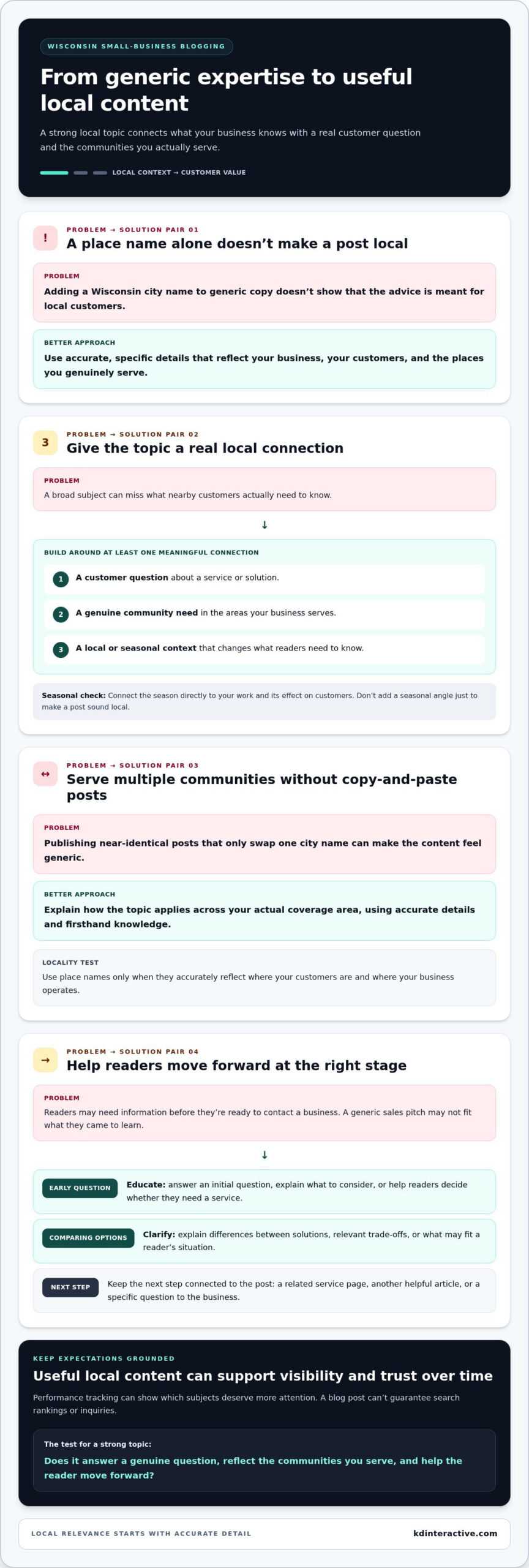
A city name alone doesn’t make generic copy local. Strong local topics draw on at least one meaningful connection:
- A question customers ask about a service or solution.
- A genuine need in the communities the business serves.
- A local or seasonal context that changes what readers need to know.
Use Wisconsin place names only when they accurately reflect where your customers are and where your business operates. If you serve several communities, explain how the topic applies across your coverage area instead of publishing near-identical posts that only swap one city name for another. Specific, accurate details help readers see that the advice is meant for them.
How local posts support the customer journey
Customers often look for information before they’re ready to contact a business. An educational post can answer an early question, explain what to consider, and help a reader decide whether they need a particular service. Later, a practical comparison can clarify the differences between solutions, explain relevant trade-offs, or help readers choose what fits their situation.
Give each post a sensible next step. Readers might explore a related service page, read another helpful article, or contact the business with a specific question. Keep that next step connected to the information in the post rather than adding a generic sales pitch.
For owners looking for local blog ideas for small business, this customer-first approach makes planning more focused. Choose topics that answer genuine questions, reflect the communities you serve, and help readers move forward. Useful, locally grounded content gives people a reason to trust your expertise, while performance tracking can show which subjects deserve more attention.
Local Blog Ideas for Small Business: Topics Wisconsin Customers Can Use
A useful topic bank starts with what customers ask, what’s distinctive about your service area, and what your business can explain well. Treat the prompts below as starting points, not copy-and-paste headlines. Make them specific to your services, customer questions, and Wisconsin locations where those details accurately reflect your coverage. A seasonal angle should connect directly to your work, not appear just to make a post sound local.
Educational posts that answer local customer questions
Turn recurring questions into clear explainers, preparation guides, and troubleshooting advice. Choose a seasonal subject only when the season changes what customers need from your business. These first nine ideas can suit a range of industries:
- What should customers know before they book or buy?
- How can someone prepare for your service?
- What common issue can customers troubleshoot themselves?
- How can customers maintain or care for what they purchased?
- Which signs suggest it’s time to seek professional help?
- What should customers expect during the process?
- How does a Wisconsin winter, spring, summer, or fall affect your service?
- What questions should customers ask before making a decision?
- What local conditions may change how customers use your product or service?
Community and service-area stories with real value
Local relevance comes from accurate detail, not a place name added to generic copy. Focus on your real service area and write guides customers can use. A community profile or collaboration is most useful when it reflects genuine experience or participation. For Wisconsin business-planning resources, the Wisconsin Small Business Development Center (SBDC) offers a locally relevant starting point for entrepreneurs.
- A guide to using your service in the communities you serve
- How to choose an option based on a customer’s needs
- A seasonal maintenance or preparation checklist
- Common questions from customers in your service area
- A profile of a local partner you’ve genuinely worked with
- A community guide tied directly to your products or services
- What customers in Milwaukee, Madison, Watertown, or another area should know, if you serve them
- A local process explained using accurate, firsthand knowledge
Decision-stage topics that support inquiries
Help readers compare options fairly. Explain differences without making unsupported claims about competitors. Use these final eight prompts to address practical concerns and offer a next step that matches the reader’s readiness:
- Which service option fits different customer needs?
- What’s the difference between two common approaches?
- What information helps you prepare for a customer’s project?
- What factors can affect timing?
- What happens from the first inquiry through completion?
- What should customers consider when comparing solutions?
- What does a typical service process involve?
- What’s the best next step for someone who’s ready to proceed?
Choose prompts that connect customer questions to a real business goal. If planning and writing take time away from daily work, managed blog content support can help turn relevant ideas into a consistent content plan.
How to Choose Blog Topics That Are Worth Your Small Business’s Time
You don’t need to publish every week or write about every aspect of your business. A small number of well-chosen posts can serve customers better than a long list of rushed articles. To decide what deserves attention first, compare each idea against four criteria: customer relevance, local fit, business value, and production effort.
Give each criterion a simple rating, such as low, medium, or high. Prioritize topics with strong customer relevance, a genuine local connection, and a clear link to your business goals. Use effort as a practical check: if a topic needs research, interviews, or visuals you can’t reasonably provide now, save it for later or narrow its scope.
Prioritize customer questions and business relevance
Start with what customers already ask. Review questions from calls, consultations, reviews, and everyday conversations, then group similar questions into themes. A broad awareness topic may help someone understand a problem; a specific question about a service or process may signal that they’re closer to taking action. Both can be useful, but prioritize topics that match your expertise and support a real business goal.
Apply the same four criteria to every type of article. An educational explainer may score highly for customer relevance, while a community story may have stronger local fit. A decision-stage comparison may offer more direct business value. Using consistent criteria makes it easier to compare ideas without assuming every post needs to generate an immediate inquiry.
Use local keyword research without forcing city names
Pay attention to the words customers use to describe their needs, services, and locations. Keyword research can help you compare those phrases with how people search, then shape a title and article around natural wording. Add a city or regional term only when it accurately reflects your service coverage and reads naturally. For broader context, see this guide to local SEO services near me.
Local inspiration doesn’t need to come from guesswork. Browse Wisconsin business success stories for examples of business-focused themes, then adapt the general subject to your customers and expertise rather than repeating someone else’s story.
Balance opportunity with realistic effort
Before choosing a topic, estimate what it will take to produce an accurate, useful article. Will you need an expert interview, original visuals, or research to explain the subject well? A narrower article grounded in knowledge you can support may be more useful than a broad piece that stays vague. Check your existing posts, too. Avoid repeating the same answer unless the new article adds a distinct audience, question, or perspective.
Choose a manageable first group of strong topics, then review their performance after publication. This keeps your plan realistic and gives you evidence to guide your next choices. The best local blog ideas for small business are not simply the easiest to write; they balance customer needs, Wisconsin relevance, business value, and the effort you can sustain.
Turn Wisconsin Blog Ideas Into a Manageable Publishing Plan
A simple workflow keeps useful ideas from getting lost in a notes app. Collect customer questions, choose topics that support your priorities, assign someone to prepare and review each post, publish it, and then check how it performs. The right cadence depends on the time and content resources you have. A thoughtful post at a sustainable pace is more practical than a frequent schedule that’s hard to maintain.
For broader channel planning, use this small business digital marketing starter guide to consider how blog content fits with your other marketing activity.
Build a practical local content calendar
Plan around customer needs, relevant seasonal patterns, and accurate details about the Wisconsin communities you serve. For each article, record:
- Audience: Who needs this information?
- Purpose: What question or business goal does it support?
- Owner: Who will draft, review, and publish it?
- Target query: What phrase might a customer use to find it?
- Next step: What should a reader do after getting the answer?
Keep the calendar flexible. Customer questions and business priorities can change, so revisit planned topics before drafting rather than treating every date as fixed.
Publish clearly and connect related resources
Make each post easy to scan with descriptive headings, concise answers, and examples that reflect your actual work and service area. Give the article a clear next step, such as exploring a related service or getting in touch with a question. Link to relevant pages where they add context, not simply to increase the number of links. A well-maintained Google Business Profile is another important part of local visibility.
Share published articles through channels your customers use and where the topic fits. A practical service guide may work well in a relevant social post; repeatedly sharing unrelated content adds little value. Small businesses that need support managing ideas, writing, and publishing can get help with blog content and management.
Review performance and refresh useful posts
Use available analytics to review search visibility, page engagement, inquiries, and conversions where they can be measured. Look for patterns: Are readers finding the page through relevant searches? Do they continue to a related resource or take the next step? These signals can help you decide whether to update the article, improve its links, or develop a related topic.
Refresh details that have become outdated and revise sections that no longer answer the customer’s question clearly. Treat measurement as a learning process. Results can guide better content decisions, but no publishing plan guarantees a particular ranking, traffic increase, or conversion rate. A steady, realistic routine gives your local blog ideas for small business a better chance to become useful resources over time.
Make Local Blog Ideas Part of a Stronger Wisconsin SEO Strategy
A blog works best as part of a broader local SEO plan, not as a replacement for one. Useful posts can complement keyword research, on-page SEO, service pages, and reputation management by answering questions customers have before choosing a business. Give each article a clear audience, accurate local details, and a relevant next step. For more context on how these pieces support local visibility, read this local digital marketing guide.
Connect blog content with local search foundations
Coordinate each post with the services you provide and the Wisconsin communities you genuinely serve. If an article explains a customer problem, link to a related service page when it helps readers take the next step. Use local details carefully, and keep your business information consistent across your website and other profiles. Blog content can strengthen a wider SEO effort, but it doesn’t replace accurate business details, service pages, or ongoing reputation management.
Choose a content process that fits your capacity
Owners can draft articles internally when they have the time and subject expertise. Start with a customer question, gather accurate answers from the people who know the work, and edit for clarity before publishing. This simple process keeps posts grounded in real business knowledge.
If writing and scheduling keep slipping behind daily priorities, managed blog writing can provide a steadier process. KD Interactive works with Wisconsin businesses on tailored content creation and blog management, alongside local SEO work that includes keyword research and analytics tracking. The focus is useful content aligned with your business and customers, not a promise of specific rankings or leads.
Take the next step with a focused content plan
Put the approach into practice with one small, measurable content test:
- Choose one recurring customer question.
- Pair it with one accurate local angle that matters to your audience.
- Assign an owner, purpose, and publishing date.
- Decide what to review, such as relevant search visibility, page engagement, or inquiries.
Use what you learn to refine the next article rather than assuming every topic will perform the same way. Strong local blog ideas for small business connect customer needs to your real expertise and fit into a broader Wisconsin SEO strategy.
KD Interactive’s local SEO and content services can help you build a practical plan for your business.
Put Your Wisconsin Content Plan Into Action
Strong local blog ideas for small business start with real customer questions and a genuine connection to the communities you serve. Choose topics that support your business goals, fit the time and expertise you have, and give readers a useful next step. Then review how each post performs and use what you learn to shape future content.
You don’t have to manage every part of the process alone. KD Interactive provides Wisconsin-focused local SEO services, along with tailored content creation and blog management to help small businesses keep their strategy moving. The focus is relevant topics, practical planning, and measurable performance, not promised rankings or leads.
Start with one customer question and one locally relevant angle. Ready to build a practical content plan for your business? Explore KD Interactive’s local SEO and content support. Every useful post is a step toward clearer visibility and stronger connections with Wisconsin customers.
Frequently Asked Questions
What should a small business write about on its blog?
Write about questions customers ask, services you provide, and decisions they need to make. Useful subjects include preparation guides, explanations of your process, common troubleshooting tips, and comparisons between relevant solutions. Add local context only when it helps readers, such as explaining how a seasonal need affects your service area. Choose topics you can answer accurately and connect each post to a relevant next step.
Do blog posts help a small business get found locally?
Yes, helpful blog posts can support local visibility by answering questions people search for and reinforcing your expertise. They work best alongside accurate business information, relevant service pages, keyword research, and reputation management. A post should reflect the business’s actual services and coverage area, not just repeat a city name. Blogging can contribute to search visibility, but it doesn’t guarantee rankings, traffic, or customer inquiries.
How often should a small business publish blog posts?
Publish at a pace your business can sustain while maintaining useful, accurate content. There’s no universal schedule that fits every small business. Consider how much time you have for choosing a topic, gathering information, writing, reviewing, and promoting each post. A slower, steady cadence may work better than frequent publishing that becomes difficult to maintain. Review your plan periodically and adjust it as resources and priorities change.
What are some hyperlocal blog topics for a small business?
Hyperlocal topics connect your expertise to the customers and communities you genuinely serve. Consider a guide to using or maintaining your service locally, answers to questions you hear from nearby customers, or a seasonal checklist tied to your work. You could also cover a local collaboration or community resource if you have firsthand knowledge. Use place names such as Milwaukee or Madison only when they accurately describe your service area.
How do I find local blog topics customers are searching for?
Start with the questions customers ask in calls, consultations, reviews, and everyday conversations. Then use keyword research to explore how people phrase those needs and whether they include a location or service term. Compare possible topics by customer relevance, local fit, business value, and effort. This helps you choose a useful subject and natural wording without forcing city names into every headline or paragraph.
Can a small business blog attract customers without posting every week?
Yes. A business can publish less often and still create useful resources for potential customers. Focus on answering questions clearly, adding accurate local details, and connecting each post to a relevant service or next step. A manageable schedule also leaves time to review and update existing articles. Consistency matters more than following an arbitrary weekly target, though no publishing frequency can guarantee customer inquiries.
How can I measure whether my local blog posts are working?
Review available analytics for relevant search visibility, visits to each page, reader engagement, and inquiries or conversions where they can be tracked. Consider whether the visitors and search terms match the audience you intended to reach. If a post attracts attention but doesn’t help readers proceed, improve its content or next step. Use these observations to guide updates and future topics, rather than treating any single metric as a guarantee of success.