
A new website won’t rank locally on keywords alone. To understand how to rank a new website locally, focus on Google’s three primary factors: relevance, distance, and prominence. Your site needs to match what nearby customers are searching for, while accurate business information and a credible online reputation help strengthen local visibility.
A polished website can support local visibility, but Google’s Map Pack and organic results depend on more than design. This guide explains how the main ranking factors work and what a new business can do to build a strong local presence. You’ll learn how to create useful service pages, optimize a Google Business Profile, invite and respond to customer reviews, and improve mobile performance. The aim is a clear, consistent foundation that helps search engines and potential customers understand what you offer and where you serve.
Key Takeaways
- Build service pages that clearly connect what your business offers with the places it serves.
- Keep your Google Business Profile complete and make business contact details consistent across online listings.
- Make it easy for customers to leave honest reviews, then respond with care to both positive and critical feedback.
- Strengthen local visibility by aligning relevance, distance, and prominence across your website and online presence.
How a local SEO professional helps businesses earn and respond to customer reviews
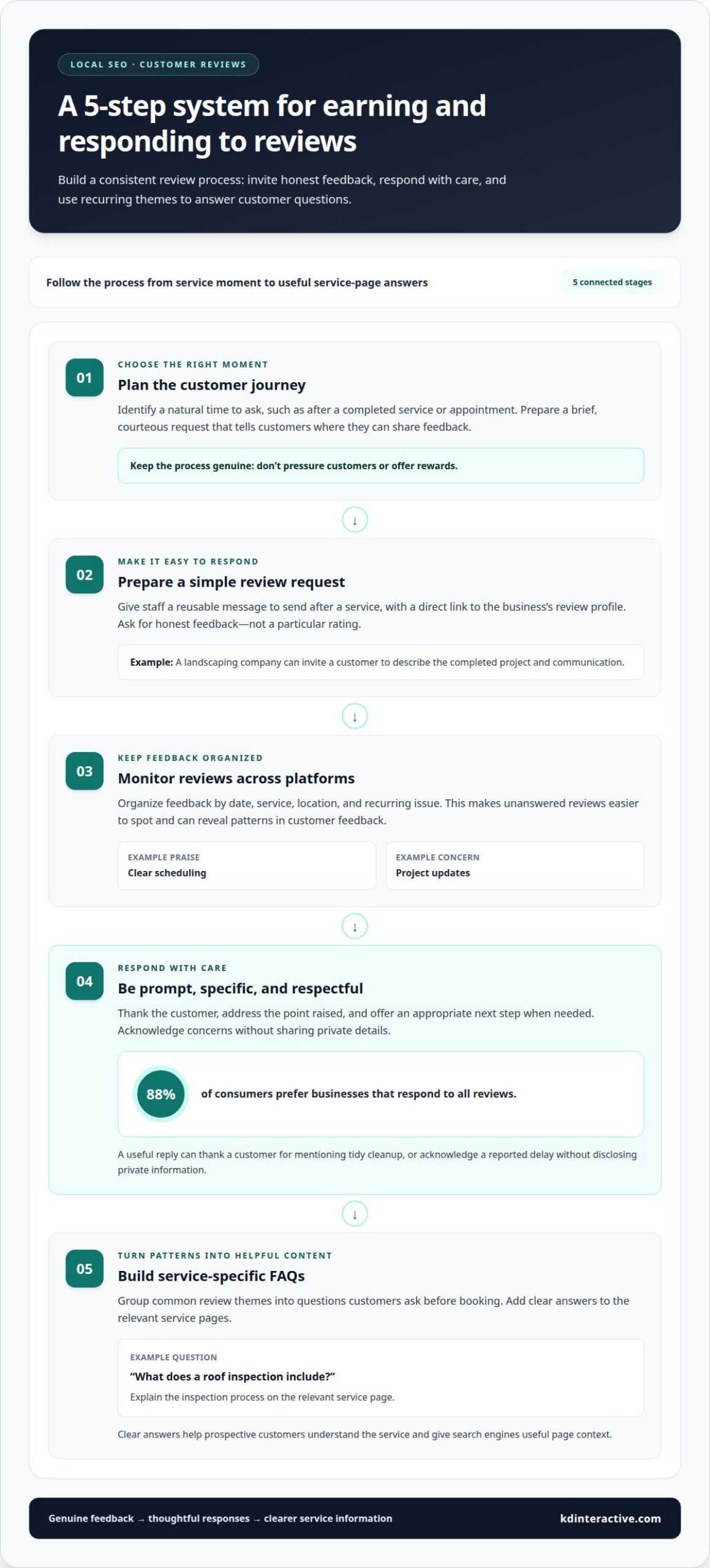
- Plan the customer journey before requesting reviews. Identify a natural moment, such as after a completed service or appointment, and create a brief, courteous request that tells customers where they can share feedback. A consistent process helps a new business gather genuine reviews without pressuring customers or offering rewards.
- Make the request easy to act on. Prepare a reusable message for staff to send after a service, with a direct link to the business’s review profile. For example, a landscaping company could invite a customer to describe the completed project and communication. Ask for honest feedback, not a particular rating.
- Monitor reviews on the platforms customers use. Organize feedback by date, service, location, and recurring issue. This record can reveal patterns, such as praise for clear scheduling or concerns about project updates. It also makes unanswered reviews easier to spot, so public feedback doesn’t go unnoticed.
- Respond promptly with specific, respectful language. A useful reply thanks the customer, addresses the point raised, and offers an appropriate next step when needed. For instance, a contractor could thank a customer for mentioning tidy cleanup. If a review describes a delay, acknowledge the concern without sharing private details. 88% of consumers prefer businesses that respond to all reviews.
- Turn recurring feedback into service-specific FAQs. Group common review themes into questions customers ask before booking, then add clear answers to relevant service pages. If customers often ask what a roof inspection includes, explain the inspection process. These details help prospective customers understand the service and give search engines useful page context.
What is the best way for a local SEO professional to optimize a Google Business Profile?
Keep the Google Business Profile aligned with the website and the business’s actual operations. Accurate details give Google and local customers a consistent picture of the services offered and the locations served.
Have a Professional Set Up and Optimize the Business Profile
Step 1: Ask a professional to review the claimed profile against the business’s actual name, services, contact details, and website. The profile should describe the real local business, not add search keywords to its name or imply services it doesn’t provide. Select accurate categories and complete relevant fields so customers can understand what the business does before contacting it.
Have a Professional Configure Service-Area Visibility
Step 2: For a service-area business, have a professional configure the areas it genuinely serves. If customers aren’t served at the business address, keep that address hidden rather than displaying a virtual or misleading location. A plumber, for example, can describe the communities served without suggesting customers can visit a storefront.
- Keep listings consistent. Check that the business name, address, and phone number match across the website and online directories. When a phone number or address changes, update the profile and other listings to prevent conflicting details.
- Use structured data that reflects the business. Choose the LocalBusiness schema type that best fits the organization, and include accurate information already visible on the website. For example, a service company can mark up its name, phone number, and service details. Schema describes the page; it doesn’t guarantee a higher position.
- Review AI-generated website content before publishing. Check every service description, location reference, phone number, and business detail for accuracy. Replace generic copy with distinct, useful explanations, such as the repairs the company handles. Don’t publish duplicate pages for different towns or claim to serve areas outside the business’s actual reach.
What ranking factors does Google use for local search results?
Google’s primary local ranking factors are relevance, distance, and prominence. Common risks include inaccurate business details, misleading service claims, and review manipulation. Keep information truthful to protect customer trust and local visibility.
- Make relevance clear. Google assesses how well a business matches a searcher’s query. Align each service page with a specific offering and the details customers need. For example, a furnace repair page should explain that service rather than rely on broad home-improvement wording. Clear, useful content helps connect the business with relevant searches.
- Account for distance. Google considers the distance between the searcher and the business, or the location included in the query. A business may therefore appear differently to people searching from different neighborhoods. Don’t treat one citywide result as proof of visibility everywhere. Distance is a ranking factor a website cannot remove.
- Build prominence with credible signals. Prominence includes reviews, online presence, mentions on reputable sites, and business listings. Build a consistent footprint with useful pages, accurate directory profiles, and genuine customer feedback. Avoid shortcuts such as fabricated reviews or misleading claims, which can damage trust and the business’s local reputation.
- Track rankings across locations. Record performance for relevant searches within the business’s actual service area. Compare the same terms across locations, such as “plumber” in Madison and nearby communities. Track organic website results separately from Google’s local feature, since each shows a different aspect of visibility. Review ranking changes alongside calls, inquiries, and page engagement.
- Measure progress over a realistic timeline. Local SEO takes consistent effort, and results depend on competition and industry. Monitor changes regularly and connect ranking movement with updates to service pages, listings, and reputation. A brief fluctuation doesn’t show the full trend, so compare performance over time before changing strategy.
Google local pack and organic visibility
- Plan for both types of visibility. Google’s Local Pack displays three businesses, while organic results can feature relevant website pages. The placements serve different needs: the Pack highlights local options, and organic listings can take searchers to detailed service information. A key part of how to rank a new website locally is building visibility in both, rather than relying on a Pack appearance alone.
- Give each core service a useful destination. Publish a dedicated page for each service, with a clear description, practical details, and relevant local context. For example, a roofing company can explain roof inspections on one page and roof repairs on another. Focused pages make it easier for search engines to match the business with specific service searches.
- Make local relevance visible in the content. Include details that help people decide whether the business fits their needs. A Madison electrician might explain the electrical work offered in Madison, rather than repeat the city name without context. Keep each location page distinct, accurate, and focused on services actually available there.
- Connect the website and business profile. Use consistent service names and business details across the profile and relevant website pages. Direct profile visitors to the page that best answers their likely need, such as a specific repair service. This creates a clear path from a local search result to useful information and a next step.
- Track Pack and organic performance separately. To understand how to rank a new website locally, record which searches lead to profile views, website visits, calls, or inquiries. Compare results by service and location, then improve pages that attract impressions but few meaningful visits. A business can appear in organic results without entering the three-business Pack, so assess both placements when reviewing visibility.
For a coordinated plan across local listings and service pages, strengthen your local search visibility.
KD Interactive: Local SEO Services
KD Interactive helps small businesses turn local search priorities into a coordinated SEO plan. If a new website needs clearer keyword targeting, useful service-page content, or stronger local visibility, KD Interactive’s Local SEO Services can address those needs with tailored work.
SEO Keyword Analysis helps identify relevant search terms and guide page planning. Content Creation supports useful pages that explain services and local relevance. Press Release Distribution can strengthen a broader online presence when a business has news worth sharing. These services support businesses that need help aligning website content with local search goals.
Contact KD Interactive to discuss your local SEO needs.
Turn local visibility into a lasting growth plan
A practical approach to how to rank a new website locally starts with a clear business goal. Decide what counts as a valuable inquiry, such as a booking request or a call about a specific service. Use that goal to guide website updates and assess whether search visibility is attracting the right customers.
Local SEO is an ongoing process, not a launch-day checklist. As your services, customer questions, and business priorities change, your website can evolve too. A focused review can show where your next effort matters most, whether that means improving a key page or making the path from search result to inquiry clearer.
KD Interactive can help shape that next stage around your business priorities. Discuss your local SEO goals with KD Interactive and take a considered next step toward reaching nearby customers.
Frequently Asked Questions
How do Google reviews impact local SEO, and how many do I need?
Google reviews can strengthen a business’s prominence and help prospective customers decide whether it meets their needs. No universal review count guarantees a particular ranking. A newer business can invite genuine feedback after completed work and make review requests part of regular customer follow-up. A smaller set of relevant, authentic reviews is more useful than an inflated count.
Should I create separate website pages for each of my business locations?
Create separate location pages when each location has distinct, useful information for customers. For example, a clinic with offices in two towns can give each office its own page with its address, contact details, services, and practical visit information. Avoid copying one template and changing only the town name. If a business has one location serving nearby communities, useful service-area content may be a better fit.
What is local SEO?
Local SEO helps a business appear in search results relevant to nearby customers. It connects the business’s services and geographic presence with what people are looking for. For example, someone searching for a nearby appliance repair company needs clear service information and a practical way to contact the business. Local visibility helps customers discover and evaluate their options.
What is local search engine optimization (local SEO)?
Local search engine optimization is another name for local SEO. It helps people find businesses through searches with geographic intent, such as “bike repair near me” or “accountant in Milwaukee.” The work can involve the website, local listings, and public reputation. A strong approach connects search visibility with the information customers need before choosing a business.
What is the Local Pack, and how can a local SEO professional help a business rank in it?
The Local Pack is a Google search feature that displays three businesses for a local query. Assess whether the business’s profile and website clearly describe its services and location, then prioritize improvements based on gaps and customer needs. For example, a search for “emergency plumber” calls for accurate details about the business’s actual services, not just broad location wording.
How does a local SEO professional set up and optimize a Google Business Profile for a new local business?
Start by gathering the business’s correct name, contact details, hours, service descriptions, and website information. Use these details to establish or update the profile, then review it for accuracy and completeness. For example, a new bakery should clearly state its actual opening hours and ordering options. The profile should describe the real business, not include claims made solely to attract searches.