
More keywords don’t automatically mean more visibility. The answer to how to improve my business’s online visibility is a focused SEO strategy that helps search engines understand your services and gives local customers useful, relevant pages to find. That means researching the terms people use, creating clear pages for your core services, and keeping your local business information consistent.
It’s understandable to want a quick lift in search results, but effective SEO takes coordinated, ongoing work. A professional can assess your website and local search presence, then prioritize changes that matter to your business and customers. This guide explains how keyword research, service-page content, local SEO, and performance tracking work together to improve visibility. You’ll also learn what information helps shape a tailored strategy and when expert support can make the process more focused and manageable.
Key Takeaways
- Publish useful, consistent blog content that addresses the questions your prospective customers actually have.
- Use keyword research to align service pages with customer intent and the locations your business serves.
- Make content clear and conversational so it can respond to meaning-based and voice searches.
- Organize related pages into topic clusters, using specific search phrases to build depth around your services.
1. Consistent, high-quality blogging
Consistent blogging builds a useful library of answers around your business’s services. Businesses that regularly publish content generate 67% more leads. A steady schedule also gives prospective customers more chances to discover relevant information. Quality matters: each post should address a real customer need, not simply fill a calendar. For example, a Wisconsin plumber could publish a guide explaining signs of a leaking water heater, then describe when repairs may be needed.
SEO professionals can build a blog plan around customer questions, core services, and local relevance. They can group ideas into a manageable publishing schedule and create distinct articles rather than repeating the same advice. For example, a post about choosing a furnace size should explain useful decision factors and link naturally to relevant heating services. Clear titles, descriptive headings, and concise answers help readers understand each page. Regular updates keep details accurate as services, seasons, or customer concerns change.
How can SEO professionals use social media to increase a business’s online visibility? They can share useful blog posts on platforms such as Facebook and Instagram, adapting the message and image for each audience. Social posts can introduce an article to people who may not yet know the business, while links let interested readers find the full answer on its website.
Consistency matters more than trying to publish everywhere at once. A professional can focus on suitable channels, coordinate posts with new articles, and track which topics attract visits, calls, or form submissions. If a guide about seasonal roof inspections draws relevant inquiries, for example, that response can inform future content. Performance data can also reveal pages that need clearer explanations or stronger links to related services. The result is a focused publishing process built around reader needs, not a pile of disconnected posts.
2. SEO and keyword research
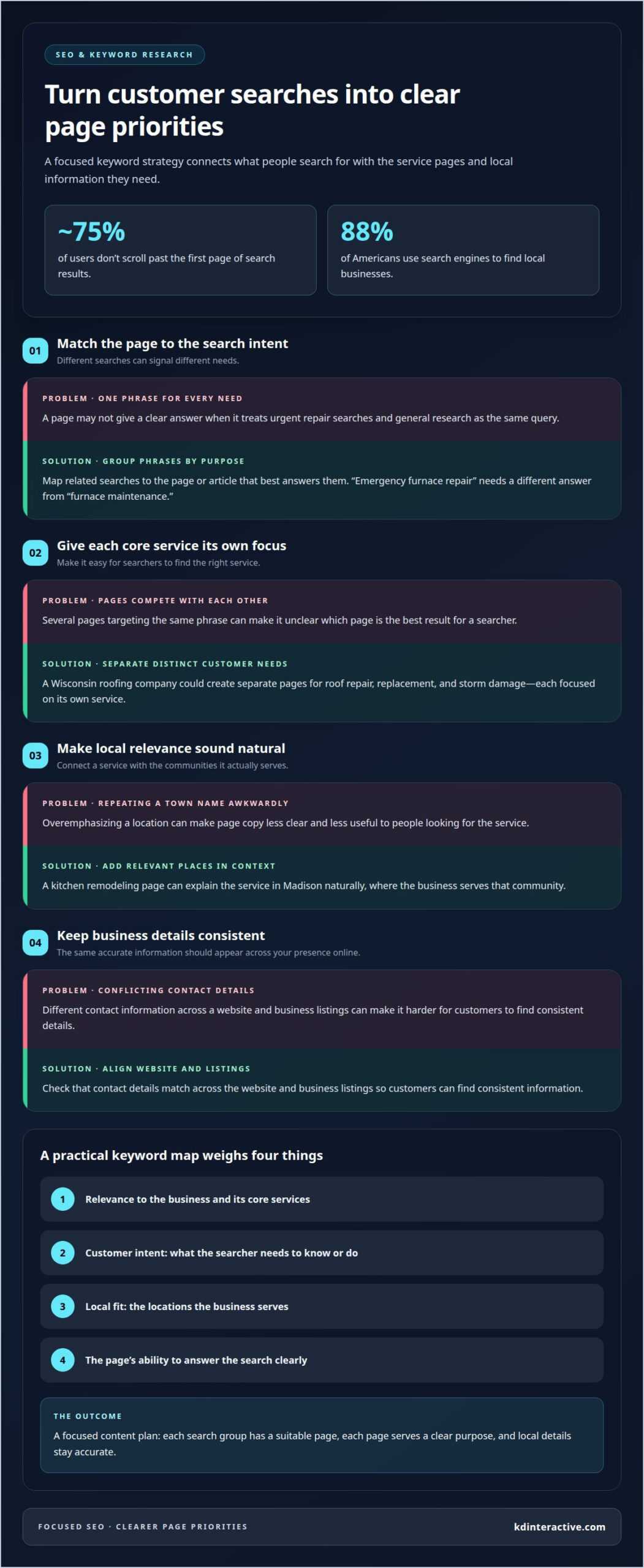
Keyword research connects the language customers use with the pages a business needs. An SEO professional starts by identifying core services, target locations, and questions prospective customers ask. For example, a Wisconsin roofing company may need separate pages for roof repair, replacement, and storm damage. Each page can focus on a distinct customer need instead of competing with other pages on the same site. Approximately 75% of users don’t scroll past the first page of search results, so relevant, well-structured pages matter.
Search intent helps determine which keyword belongs on each page. Someone searching for “emergency furnace repair” needs a different answer from someone researching furnace maintenance. A professional groups related phrases by purpose, then maps each group to the most suitable page or article. This helps prevent multiple pages from targeting the same phrase without giving searchers a clear best result. For a business owner wondering, “I need to know how to improve my business’s online visibility,” a focused keyword map turns a broad concern into clear content priorities.
Local targeting adds another layer. A professional can give each core service its own page and include relevant town names naturally, where the business serves those communities. For example, a kitchen remodeling page can explain the service in Madison without awkwardly repeating the city name. Contact details should also match across the website and business listings, helping customers find consistent information. In the United States, 88% of Americans use search engines to find local businesses.
Keyword research is not just a list of popular phrases. A professional weighs relevance, customer intent, local fit, and each page’s ability to answer the query. SEO keyword analysis can help turn those findings into a practical content plan. The resulting plan should answer the owner’s question, “How can I improve my business’s online visibility?” Professionals can then assess which pages attract relevant visits and refine content where the focus needs improvement.
3. Semantic search and voice search
Semantic search considers the meaning behind a query, not just matching words. Someone might ask Google, “Who can fix a leaking roof near Madison?” A useful page should clearly explain the roof repair services offered, the location served, and how customers can request help. Conversational wording also matters for voice search, since people often phrase spoken requests as complete questions. SEO professionals can organize concise answers under clear headings and connect them to relevant service information.
For local visibility, SEO professionals can improve a Google Business Profile by completing its details, choosing accurate categories, listing services, and adding authentic photos. They also align the profile with the business’s actual services and service area, so searchers get useful information. A complete profile gives people practical details when comparing nearby options, while consistent business information connects the listing with the website.
A professional SEO strategy can support reviews by encouraging a business to request feedback after a completed job and respond personally. Courteous, relevant replies show customers that the business listens, while genuine reviews can help prospective customers assess local services. Reviews add context to a local presence, but they are not a guaranteed route to higher rankings. For example, a Madison contractor can respond to feedback about a completed repair without sharing private customer details.
Google Search Console helps professionals review search queries, impressions, clicks, and the pages appearing in results. Google Analytics can show how visitors use a website, including whether they reach contact forms or complete other tracked actions. Together, these tools connect search visibility with website engagement. Common risks include keyword stuffing, duplicate service pages, inaccurate Google Business Profile details, and inconsistent business names or phone numbers across listings. These issues can confuse both search engines and customers. A professional review can prioritize fixes and make the site’s meaning clearer, including for people using voice queries.
4. Topic clusters and long-tail keywords
A topic cluster organizes related pages around one central service or subject. For example, a Milwaukee landscaping company could build a main page about landscape design, supported by pages on garden planning, native plants, and seasonal maintenance. Each supporting page should answer a distinct customer question. Clear internal links connect those pages to the main service page, helping visitors move from research to relevant services.
Long-tail keywords are specific phrases that reveal what a searcher needs. “Landscaper” is broad, while “native plant garden design in Milwaukee” signals both a service and a location. An SEO professional can group these phrases by intent, then assign each group to the page best suited to answer it. A service page should explain the service, while an informational article can address a related planning question. This structure helps prevent multiple pages from targeting the same purpose.
Build a useful cluster around a clear subject and a realistic content plan. A professional identifies the central service, maps related customer questions, and checks which existing pages already answer them. For a tree-care company, supporting topics might include pruning, storm-damaged branches, and tree health assessments. Each page needs original detail, a clear focus, and links to closely related pages. Repeating nearly identical text across several neighborhood pages makes the site less clear for readers.
Performance data can guide the next refinement. If a page attracts visitors searching for “low-maintenance garden design,” its content may need to explain plant choices, upkeep, and the design service more clearly. If two pages appear to answer the same query, the SEO professional can clarify their separate roles or consolidate overlapping content. That keeps the cluster useful rather than sprawling. For a structured keyword plan, request SEO keyword analysis to connect customer search intent with relevant pages and content.
KD Interactive
KD Interactive helps small businesses turn SEO priorities into a coordinated visibility strategy. When search performance feels fragmented, its Local SEO Services, keyword research, and content creation can bring the work together around the services customers need. This is a practical next step if your business needs help setting priorities, strengthening its local search presence, or creating relevant pages without relying on disconnected tactics. Press Release & Distribution can also support broader communications as part of an overall visibility plan. The right starting point depends on your business, service area, and current online presence. Contact KD Interactive to discuss your SEO needs.
Make your next SEO move count
Strong visibility grows from decisions that fit your business, customers, and service area. Knowing how to improve my business’s online visibility starts with choosing a clear priority and aligning the work with the customers you want to reach. That priority might be strengthening local discovery, creating content for a service customers are researching, or supporting a broader announcement.
KD Interactive offers Local SEO Services, Content Creation, and Press Release & Distribution to support different visibility needs. The right starting point depends on your goals and the gaps in your current approach. A focused discussion can turn those needs into a practical direction without treating every tactic as equally urgent.
Ready to plan your next step? Start a conversation with KD Interactive about your SEO priorities and move forward with a strategy shaped around your business.
Frequently Asked Questions
How Does SEO Work to Help Increase Online Visibility?
SEO helps search engines discover, understand, and present relevant business pages in response to customer searches. Professionals assess whether important pages can be indexed, whether their content matches search intent, and whether the website guides visitors toward useful next steps. They then monitor search impressions, clicks, and meaningful actions, such as calls or form submissions, to identify where the strategy needs refinement.
What are the most effective professional strategies to improve a small business’s online visibility?
The strongest strategy prioritizes the services and customers that matter most to the business. An SEO professional can align relevant landing pages with local searches, make contact options easy to find, and assess whether website visits lead to inquiries. For example, a home repair business may prioritize its most in-demand service page before expanding into supporting topics. This keeps limited marketing resources focused on clear business goals.
How can an SEO professional improve a business’s website SEO and rankings on Google?
An SEO professional can audit a website’s structure, identify pages that search engines struggle to access, and improve page titles and descriptions so each page has a distinct purpose. They can also strengthen navigation by linking related pages where visitors need more detail. For example, a service page can link to a relevant project guide. These changes make the site easier to understand and use.
What local SEO strategies help professionals get businesses into Google Maps results?
Professionals can strengthen a business’s Google Maps presence by aligning its profile details with its website and actual services. Accurate service areas, current hours, relevant categories, and clear location information help customers understand where the business operates. They can also review customer feedback and track profile interactions, such as calls or direction requests, to see whether local searchers are engaging.
How often should a business publish content to improve search visibility?
Publish on a schedule the business can sustain while keeping content accurate and useful. The right cadence depends on available subject expertise, customer questions, and how quickly services or seasonal information change. A professional can plan upcoming articles and revisit older pages when details become outdated. For example, a landscaping business may refresh a spring service guide before customers begin planning outdoor projects.