
What good is expanding into a Wisconsin community if local customers don’t know you serve them? Learning how to announce a new service area means more than posting a quick update. Your message needs to explain what’s changing, reassure existing customers about the service they already receive, and make it easy for people in the new area to find accurate information.
It’s understandable to wonder what to say and where to share it. A clear, consistent announcement can reach current customers while strengthening local visibility among prospective ones. In this guide, you’ll learn how to define the area and available services, choose practical announcement channels, and keep your website, business listings, and other public information aligned.
You’ll also see how Wisconsin businesses can use local keyword research, relevant content, and analytics tracking to support an expansion and measure whether it brings qualified visits and inquiries. KD Interactive helps small and multi-location businesses build tailored local SEO strategies, so each location’s online presence can reflect the communities it serves. With a thoughtful plan, your expansion can be easier to understand, easier to discover, and simpler to evaluate over time.
Key Takeaways
- Define the locations you can serve reliably, and distinguish geographic expansion from a new branch or service launch.
- Learn how to announce a new service area with a concise message that names the locations, available services, customer benefit, and next step.
- Match each channel to its purpose, from website updates and Google Business Profile information to press releases.
- Use a sample announcement structure and adapt it without making unsupported claims about your business.
- Assess local response by tracking relevant inquiries and conversions separately from longer-term organic visibility.
What Does It Mean to Announce a New Service Area in Wisconsin?
A service-area announcement tells people that an established business now serves additional geographic locations. The business itself is not new, and its core offering may not have changed. What’s changed is where customers can access its existing services. For example, a Wisconsin business that already serves customers in Madison might announce that it now covers specific communities near Green Bay. Name the communities you can genuinely serve, rather than implying a new location or wider reach than your business can support.
That distinction matters. Launching a new service, introducing a product, opening a branch, and expanding geographic coverage are separate business updates. Customers need to know whether they can now get the same service where they live, not mistake the announcement for a new offering or a nearby storefront. Clear wording builds trust and helps prospective customers decide whether to get in touch.
A thoughtful announcement is one part of a broader Marketing Strategy. It can raise awareness, but publication alone doesn’t guarantee search visibility, inquiries, or new customers. Those outcomes depend on factors beyond the announcement, including whether local information is accurate and easy to find. Treat the message as a clear signal of your expansion, then assess the response over time.
Which details should a service-area announcement clarify?
Make the coverage specific enough for someone to recognize their community. Name the newly served city, region, or area instead of relying on a broad phrase such as “throughout Wisconsin.” Then explain which existing services are available there and give readers a practical next step, such as visiting the relevant service page or contacting your business through its usual channel.
- Location: Identify the communities now served.
- Service: State which existing offerings are available in those places.
- Next step: Tell interested customers how to learn more or make an inquiry.
Keep the wording consistent wherever it appears. If coverage applies to some communities in a region but not all, name the specific places you can serve. This precision reduces confusion for customers and helps your business avoid creating expectations it can’t meet.
Who should receive the announcement first?
Start with the people who already know your business: existing customers and referral partners. They can understand the expansion in context and may know someone in the newly served area. Next, reach local prospects who are actively looking for the services you provide. The emphasis can shift by audience, even when the core facts stay the same.
- Current customers and partners: Explain where coverage is expanding and whether the change affects their existing service.
- Local prospects: Lead with the locations served, the relevant services, and a clear way to inquire.
Be precise about how you operate in the new area. If you travel to customers or serve them remotely, say so plainly. Don’t imply that you have a physical office, storefront, or branch in a community unless that’s accurate. This distinction helps Wisconsin customers understand what to expect before they reach out.
Prepare Your Wisconsin Service-Area Expansion Before You Announce It
A credible announcement starts with operational clarity. Before naming a Wisconsin community, make sure your business can deliver its existing services there reliably. Consider travel or delivery logistics, staff capacity, scheduling, and any differences in how customers in that area will receive the service. Announce coverage you can stand behind, not an ambitious map that creates expectations your team can’t meet.
Then decide which locations deserve attention first. Customer requests, referral patterns, and practical coverage can help you prioritize. The U.S. Small Business Administration’s Market Research and Competitive Analysis for Business Expansion offers a framework for assessing demand before committing resources. Use that research alongside what your business can genuinely serve, so the announcement reflects both local interest and operational reality.
How should you choose which locations to name?
Choose specific cities or communities that match your actual coverage. A broad claim such as “serving all of Wisconsin” may leave customers unsure whether you reach their town. If your expansion covers selected communities near a larger region, name those communities directly. Use the same place names in the announcement and supporting business information, including your website and relevant listings. Consistent wording makes the coverage easier to understand.
Before publishing, prepare a short internal reference with the approved locations, available services, customer benefit, and the right way to inquire. Anyone updating your website, listings, or customer communications can use it as a reliable source. It also helps prevent one channel from implying wider coverage or different services than another.
What should you prepare for local search visibility?
Review your existing website copy and business information for accuracy. Update relevant descriptions so they explain where the business serves customers and which services are available there. Avoid creating location pages that simply repeat the same text with different place names. Useful local content should answer real customer questions and clearly connect the service to the community.
Local keyword research can help identify how people search for your existing services in each Wisconsin location. A phrase customers use in one city may differ from the wording they use elsewhere, so research first and create content around relevant terms rather than guessing. For broader context on building a local visibility plan, KD Interactive’s local SEO services guide explains how local search optimization supports businesses.
Review current Google Business Profile guidance before changing service-area information. Google’s profile rules can affect how eligible businesses represent their coverage, so don’t assume that adding a new area means adding a new address. Keep your profile details aligned with how your business actually serves customers.
With the locations, service details, and customer instructions agreed on, your team can prepare an announcement that’s both clear and consistent. If you’re building local visibility for a Wisconsin expansion, KD Interactive’s local SEO support can help connect keyword research and content planning to your coverage goals.
Choose the Right Channels to Announce Your New Service Area
Each channel reaches people in a different context. A coordinated plan helps existing customers hear the news directly while giving local prospects a reliable place to learn what’s available. Keep the core facts consistent across channels, but tailor the message to the audience and the channel’s purpose. Copying the same announcement everywhere can feel repetitive and may leave useful questions unanswered.
Use your website as the detailed reference point, then use other channels to bring the right audiences to it. Google Business Profile setup guidance can provide context for managing your business profile. General business administration resources, such as USAGov Business Resources, can also help you find government information relevant to operating a business.
When should you use email, website content, or a press release?
Choose a channel based on whom you need to reach and what they need to know. Direct email can tell existing customers and relevant business contacts about the expansion, with emphasis on what’s changing for them. Website content can give prospective customers a lasting place to check coverage, available services, and how to inquire. A press release may suit an expansion with broader local interest or a meaningful community angle.
- Email: Share a personal, direct update with current customers and referral partners.
- Website: Explain the expanded coverage in enough detail for new visitors to understand whether it applies to them.
- Press release: Present the news for local media and community audiences when wider awareness is a useful goal.
Adapt the opening and emphasis for each channel. An email might begin by reassuring current customers that their existing service continues, while a website update can lead with the locations now served. A press release can explain the local significance. In every version, preserve the same location names, service descriptions, and inquiry instructions.
How can Google Business Profile support the announcement?
A profile update can help keep business information aligned with the expansion, but it should be handled carefully. Review current Google Business Profile guidance before changing service-area details, since platform requirements can change. Describe only the coverage your business actually provides, and make sure the information fits the way you serve customers.
If the change is geographic coverage only, don’t represent it as a new storefront or address. Keep the profile consistent with your website and other public details. A mismatch, such as naming a community in one place but implying a physical branch there elsewhere, can create confusion and undermine trust. Treat the website as the fuller explanation and the profile as an accurate summary.
Before publishing, compare each channel against a single approved set of details: locations, services, customer benefit, and next step. This simple review makes it easier for Wisconsin customers to recognize the same expansion wherever they encounter it. For support aligning local search information and content with your coverage plans, KD Interactive’s local SEO support can help shape a Wisconsin-focused approach.
Write and Roll Out a Clear Service-Area Announcement
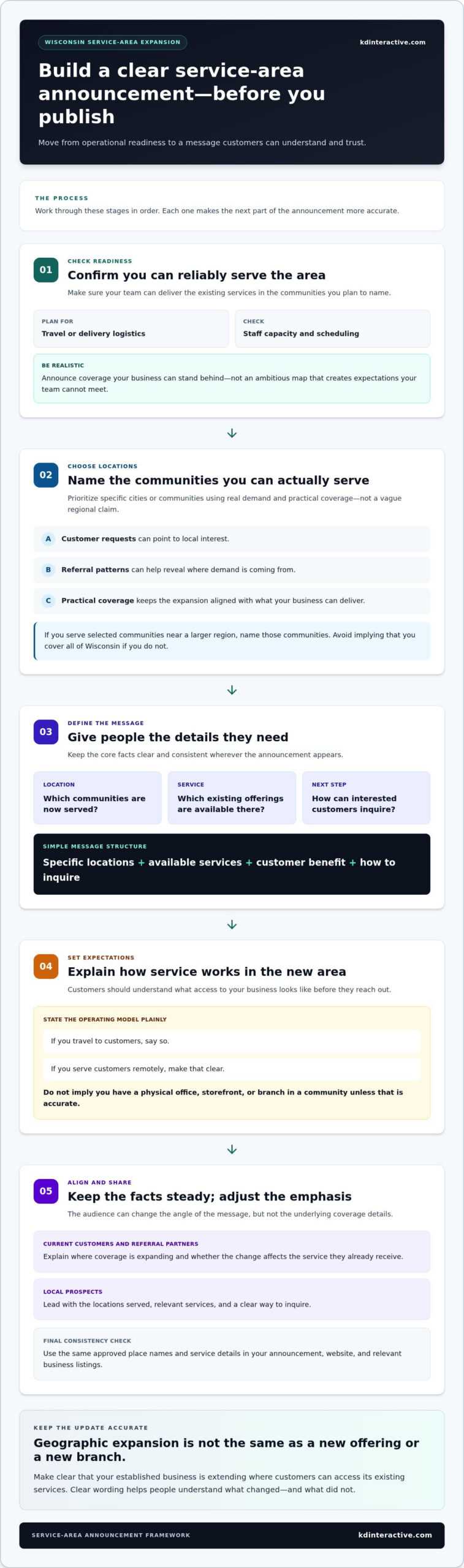
A strong announcement answers five questions in a practical order: What’s changing? Where can customers now get service? Which services are available there? Why might this matter to them? What should they do next? This sequence keeps the message focused and makes it easier to adapt for a website update, customer email, or press release.
For how to announce a new service area, start with the approved location and service details, then write one clear core message. Avoid promises about response times, results, or coverage beyond what your business can deliver. A benefit can be straightforward: customers in the named communities can now access a service they previously had to look elsewhere to find.
What should the announcement message say?
Lead with the expansion and name the newly served locations. Describe the relevant existing services in customer-friendly terms, then close with one useful next step. A direct action, such as contacting your business to discuss service in their location, is clearer than several competing calls to action. Keep the wording factual and specific.
Use this adaptable sample as a starting point. Replace every bracket with accurate details before publishing:
Now serving [new city or communities]: [Business name] now provides [existing service or services] to customers in [specific locations]. If you’re in one of these areas and need [customer-focused description of the service], [contact the business or visit the relevant page] to learn more.
Read the draft as a customer would. Can someone quickly tell whether their community is included, what they can request, and how to take the next step? If not, simplify or clarify the copy.
How can you adapt the message for different audiences?
Keep the core facts unchanged, but shift the introduction to fit the reader. Existing customers may want reassurance about how their current service is affected. Referral partners need a concise explanation of who can now be referred. New-area prospects need the location, available service, and inquiry instructions up front. These differences make each version more relevant without creating conflicting claims.
For example, a customer-facing note can say, “We’re extending [service] to [locations], while continuing to serve our current customers.” A prospect-facing version can begin, “[Service] is now available to customers in [locations].” Use only the version that accurately describes the business.
Coordinate the rollout so people who click through from an announcement find matching information. Update the relevant website content and business profile details in line with current platform guidance, then publish the announcement using the same location names and coverage descriptions. Before release, check links, contact instructions, and service details across each destination. This review helps avoid sending prospective customers to outdated or contradictory information.
For Wisconsin businesses aligning local content with an expansion, work with KD Interactive on local SEO to support a consistent, location-aware rollout.
Measure Local Response and Strengthen Your Wisconsin Visibility
After the announcement goes live, look beyond likes and shares. The useful question is whether people in the newly served area are finding your business and taking relevant next steps. Set a baseline before publication, then review the same measures afterward. This makes it easier to distinguish an initial response to the announcement from changes that build through ongoing local search work.
Which signals can show whether the announcement reached local customers?
Track a mix of direct customer feedback and website activity. Keep records of where inquiries come from, and ask new customers how they heard about your business. When practical, note the location they’re asking about and the service they need. These details can reveal whether the announcement is reaching the intended Wisconsin communities, even when a customer doesn’t mention a specific channel.
- Inquiries: Record relevant calls, messages, and requests, including the customer’s location and how they found you when available.
- Website traffic: Review visits to pages related to the announcement or the newly served areas.
- User behavior: Observe whether visitors engage with service information or move toward contact details.
- Conversions: Track meaningful actions, such as a service inquiry, rather than treating every page view as a lead.
Compare results over time and avoid crediting every increase or drop to one announcement. Seasonality, other marketing activity, and changes in customer demand may also affect performance. Separate short-term engagement, such as visits after a campaign, from longer-term organic visibility, which develops through ongoing search optimization. A clear reporting period and consistent measures make the comparison more useful.
How can local SEO support a new service area over time?
Once the initial announcement is out, local SEO can help keep your expanded coverage visible and understandable. Keyword research can identify how people search for your existing services in particular Wisconsin communities. That insight can guide content creation and on-page optimization, helping your website describe relevant services and locations accurately instead of relying on broad, repetitive claims.
KD Interactive takes a tailored approach to local SEO for small and multi-location businesses in Wisconsin. Its work can connect local keyword analysis, useful content, and analytics tracking so you can assess visibility, traffic, and conversions as your presence develops. Transparent communication helps keep the strategy aligned with your actual coverage and business priorities.
SEO takes time, so don’t judge the long-term effort solely by the first days after publication. Improvements may occur in 3-6 months, with full results in 6-12 months. These timeframes aren’t a promise of rankings or specific outcomes. Use them as context while tracking performance, reviewing local inquiries, and refining your approach based on what the data shows.
A clear measurement plan turns how to announce a new service area into an ongoing growth process: communicate accurately, observe local response, and strengthen the information customers use to find and evaluate your business.
Turn Your Wisconsin Expansion Into a Stronger Local Presence
Your next step is to make the expansion part of a consistent, ongoing presence in the communities you serve. A clear announcement opens the conversation; relevant local content and careful tracking help you learn what resonates and where to focus next. That’s a practical way to approach how to announce a new service area without treating publication as the finish line.
KD Interactive brings Wisconsin-focused local SEO knowledge and a tailored, non-cookie-cutter approach to businesses building local visibility. Transparent communication and analytics tracking help keep the work connected to your goals and make it easier to assess progress. Client testimonials include Carl Anden of Anden Business Systems, David Alecock of Link It Call Center, and Mike Yenser of Y’s Way Flooring.
Ready to plan your next step? Schedule your FREE Consultation with KD Interactive and discuss a local SEO approach shaped around your Wisconsin business. Your expansion can become a thoughtful next chapter in reaching the customers you’re ready to serve.
Frequently Asked Questions
How do you announce that your business now serves a new area?
To decide how to announce a new service area, coordinate a public update with the places customers already look for your business. Publish a clear website notice, share a direct message with relevant customers and partners, and update applicable business listings. For example, a home-service business could add a notice to its service page and share it with referral partners who work in the newly covered community. Keep a copy of the final details for future updates.
What should a new service-area announcement include?
Include the business name, the specific communities being added, the existing services available there, and a useful next step. Add a brief customer benefit, such as easier access to a service in their community, without promising a particular result. If coverage begins on a particular date, state it clearly. Before sending or publishing, check that the contact details work and that the named locations match the business’s actual coverage.
Should I announce a new service area to existing customers first?
Usually, yes. Giving existing customers and referral partners a direct update helps them understand the expansion and answer questions from people they refer. It also lets you clarify whether anything about their current service is changing. You don’t need to make the announcement exclusive or delay public updates for long. Plan the timing so the website and other public information are ready when the broader announcement reaches prospective customers.
Do I need a separate website page for every service area?
No. A separate page for every town isn’t automatically useful. Start with a clear coverage page or service-area section that lists the communities you genuinely serve. Create an individual location page only when you can provide distinct, helpful information for that place, such as locally relevant service details or answers to common customer questions. Avoid pages that merely swap one city name for another, since they offer little value to visitors.
Should I update my Google Business Profile when my service area changes?
Review your Google Business Profile when your coverage changes, and follow Google’s current guidance before editing service-area details. The right profile setup depends on how your business serves customers and the platform’s eligibility rules. Keep public information accurate and consistent with your website. Don’t add a location or address simply to represent a community you serve if there isn’t a real business location there.
How can I announce a service-area expansion without implying I opened a new location?
Use wording such as “now serving customers in [community]” or “service coverage now includes [location].” Avoid phrases like “our new [city] office” or “visit our [city] location” unless a physical branch has actually opened. If customers are served at their own locations or remotely, explain that briefly. Clear phrasing prevents people from expecting a storefront, local office, or in-person visit that doesn’t exist.
How long does local SEO take to support visibility in a new service area?
Local SEO improvements may take 3-6 months, with full results typically taking 6-12 months. The timeline can vary with competition and industry, and it isn’t a guarantee of rankings or a specific position in search results. KD Interactive uses local SEO work such as keyword research, content creation, and analytics tracking to support Wisconsin businesses as they build visibility. Track progress over time rather than judging it from the first few days.
How can I measure whether a new service-area announcement is working?
Track whether the announcement brings relevant attention and action, not just views. Review traffic to the related website page, calls or inquiries from the newly served locations, and completed actions such as a request for service information. Ask new customers how they heard about you, and record their answers consistently. Compare these signals with your pre-announcement baseline, while recognizing that other marketing activity or seasonal demand can affect results.