What if your grand opening gets plenty of online attention, but nearby customers still don’t show up? That’s the gap a good campaign needs to close. Marketing a grand opening event online isn’t just about posting an announcement. It’s about helping local people discover the event, understand why they might attend, and find the details they need to plan a visit.
Social posts can spread the word, but it’s not always clear which channels deserve your time or how to reach people near your new location. A practical plan connects local search visibility with clear, consistent event information, helping potential guests move from discovering your business to considering a visit.
This guide shows you how to build that path. You’ll learn how to prepare your Google Business Profile, make event details easy to find and share, choose online channels that fit your audience, and track signs of interest. Google Business Profiles can become visible 90 days before opening, giving you a useful window to introduce your business before the doors open. With a focused plan, you can make it easier for people to find the information they need before opening day.
Key Takeaways
- Set one measurable goal for marketing a grand opening event online, then shape your campaign around the action you want nearby customers to take.
- Make it easier for local customers to find your business by keeping location details accurate and connecting them with clear event information.
- Plan content around what guests need to know, from the initial announcement to practical details, reminders, and a post-event thank-you.
- Use a flexible campaign sequence to prepare, announce, remind, cover the event, and review what generated interest and visits.
- Build on opening-day visibility with local SEO, tailored content, and performance tracking that support your business beyond the event.
Start your online grand opening marketing with a clear local plan
Opening a business takes focus. You’re managing the space, staff, inventory, and final preparations while also trying to get the word out. A simple local plan can make promotion more manageable: decide who you want to reach, what you want them to do, and which details they’ll need to take that step.
Start with one primary campaign goal. Awareness means introducing the business to people who may not know it exists. Event responses show stated interest, while visits focus on people coming through the door. You might also track calls, direction requests, or visits to an event page. Choose the action that best reflects success for this opening, then use it to guide your messages and measurement.
Local search deserves a place in that plan: 46% of all Google searches have local intent, according to Digital Applied. Local search engine optimization (local SEO) helps explain how business information and local relevance can support discovery. Visibility alone, however, doesn’t guarantee attendance.
Choose the local customers your grand opening should reach
Define your audience by location and need, rather than assuming everyone nearby is a likely customer. A new café might focus on residents and workers looking for a convenient place to eat; a home services business might reach households in the communities it actually serves. For a Wisconsin business, identify the relevant city, nearby neighborhoods, or service communities based on realistic customer travel and your operating area.
Keep awareness and attendance goals distinct. An introductory post can explain what the business offers, while an event reminder can focus on the date, location, and reason to stop by. Giving each piece of content a clear purpose helps it speak to the right person without suggesting that every local resident is a prospect.
Prepare the essential details before promoting the event
Before publishing, align the business name, street address, opening date, hours, and event information wherever customers may find them. Small inconsistencies can leave people unsure which location or date is correct. Prepare one clear destination, such as an event page on your website, where visitors can see the details, get directions, and understand what to do next.
- State the business name and full location clearly.
- List the opening date, event hours, and any relevant access details.
- Describe the opening-day activity accurately, without implying an offer that isn’t planned.
- Give visitors one clear action, such as viewing directions or saving the event details.
If you’re planning an opening activity, explain what guests can expect in plain language. Mention a demonstration, tasting, or short introduction only if it’s actually part of the event. Don’t add discounts or giveaways to make a promotion sound more compelling. Accurate, consistent details help nearby customers decide whether to visit and make your campaign easier to share and assess.
Make your grand opening easy to find in local search
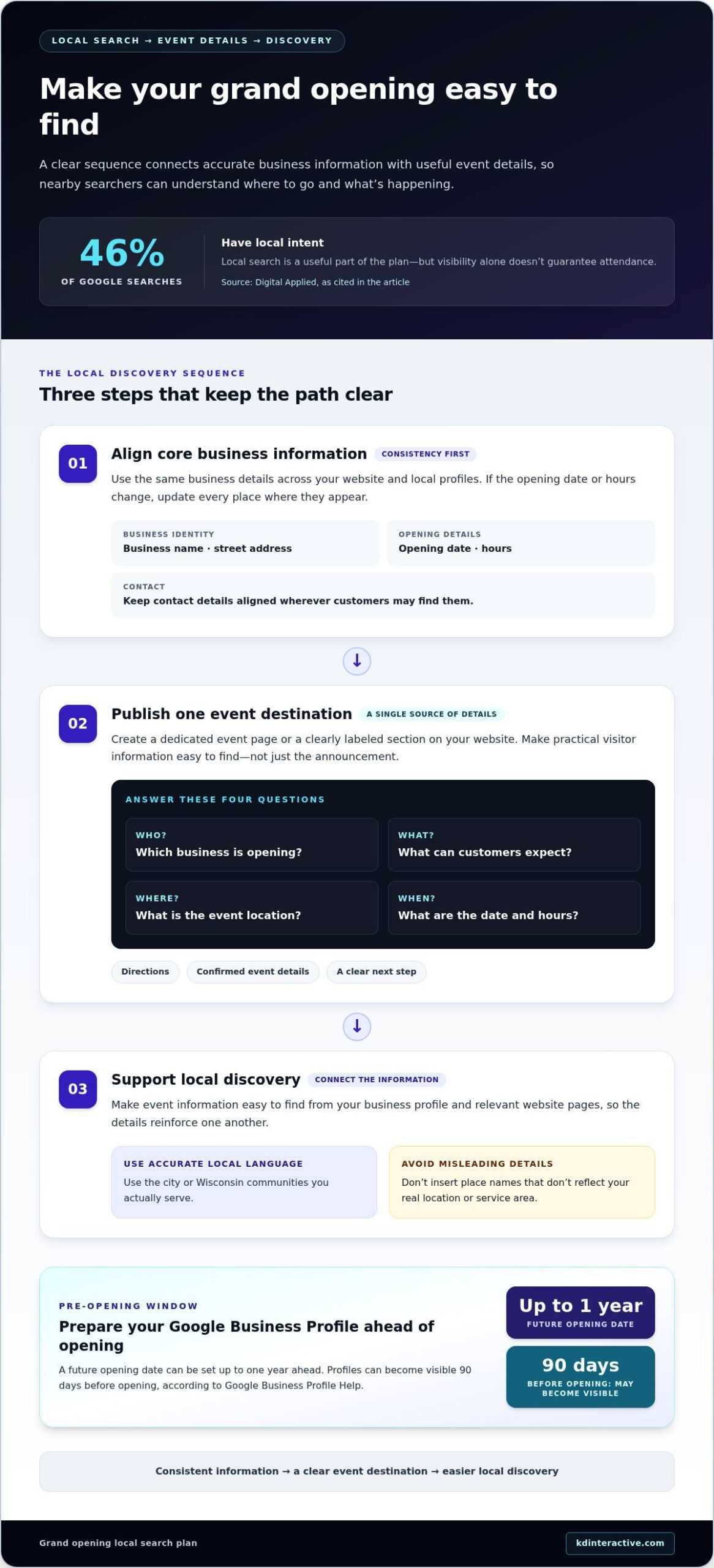
Local discovery works best when business information, event details, and search listings reinforce one another. A practical sequence keeps the path clear: establish accurate business information, publish a useful event destination, then connect those details to places where nearby customers search. This helps people understand where the new business is and what’s happening, without promising a particular ranking or turnout.
- Align core business information. Use the same business name, address, opening date, hours, and contact details across your website and local profiles.
- Publish an event destination. Give customers one page or clearly marked website section with the event’s date, location, details, directions, and next step.
- Support discovery. Make the event information easy to find from your business profile and relevant website pages.
Align your website and local business information
Consistency prevents a basic but costly source of confusion: a customer sees one address in a search listing and another on the event page. Check your website’s contact page, homepage, event details, and local business profile together. If the opening date or hours change, update every place where those details appear.
Give the event a dedicated page or a clearly labeled section on an existing page. Include practical visitor information, not just an announcement. Use local phrases where they accurately describe the business, such as the city or Wisconsin communities it serves. Avoid inserting place names that don’t reflect the real location or service area. For a step-by-step walkthrough of creating a profile, use this Google Business Page setup guide.
Help nearby searchers understand the event
A clear event description answers four questions quickly: who is opening, what customers can expect, where the event is, and when it takes place. For example, a new shop could state its business name, street address, opening hours, and the products or services visitors will find there. Keep the description focused on confirmed details, and make the next action obvious, such as viewing directions or visiting the event page.
Google Business Profiles can be prepared with a future opening date up to one year ahead and become visible 90 days before opening, according to Google Business Profile Help. Use that pre-opening window to ensure the profile matches the website and to share accurate updates. Add photos only when they represent the actual business or location. Directions should lead customers to the right entrance or address, not a temporary or misleading point.
These steps connect an event announcement with the ongoing work of local SEO services, where relevant business information and useful content support local discovery over time. If your Wisconsin business needs a coordinated approach to search visibility, explore how KD Interactive supports local SEO.
Promote your grand opening online with useful, shareable content
A single announcement can introduce your event, but it can’t answer every question a potential guest may have. Someone who sees the first post might still need the address, opening hours, or a reminder closer to the date. Each update should add useful information rather than repeat the same invitation. For marketing a grand opening event online, a clear content sequence gives people more than one helpful way to discover and understand the event.
Build a simple pre-opening content sequence
Start by introducing the business and its local purpose. Explain what you offer, who you serve, and why you chose the community. Then publish the event announcement with the key details in a scannable format that people can save or share. Include the date, hours, location, and a clear next step, such as viewing directions or visiting the event page.
After the announcement, use updates to answer practical questions and keep information visible. A reminder can restate the hours and address. A short behind-the-scenes update might show the space taking shape or introduce a service, but share it only if it’s authentic, relevant, and manageable alongside opening preparations. You don’t need to post constantly. A useful update is more valuable than frequent posts with no new information.
On opening day, share a concise update confirming that the event is underway or pointing visitors to the entrance, if that information is useful. Afterward, thank guests and community members, then share a brief, genuine recap. This closes the loop and keeps your online presence active beyond the announcement.
- Awareness: Introduce the business, its purpose, and the community it serves.
- Event details: Make the date, location, hours, and activity easy to scan.
- Reminder: Repeat essential logistics and clarify what visitors can expect.
- Follow-up: Thank attendees and acknowledge local support.
Adapt event content to the channels you already use
Use your website, business listing, and existing social channels to share the same core facts. Adapt the format to each channel, but keep the business name, event date, address, and hours consistent. For example, a short social post can direct people to the event page for full information. This gives each channel a role without creating conflicting versions of the event details.
Local partners and community organizations may also help share accurate details with people interested in the area or business. Offer a concise description and a link to the main event destination so the information stays clear as it travels. Prioritize relevant local connections instead of assuming every partner has the same audience.
For a wider view of how channels can work together, use this small-business digital marketing starter guide. Choose a manageable mix that fits your audience and capacity, then review which updates prompt meaningful interest. If you want support connecting useful content with local search visibility, explore KD Interactive’s local SEO support.
Schedule and measure your online grand opening campaign
A campaign calendar helps keep promotion moving while you handle opening preparations. There’s no single lead time that suits every business. Build the schedule around your event, audience, available content, and the time you can realistically set aside. Marketing a grand opening event online isn’t about filling every day with posts. It’s about sharing the right information at useful moments, then learning from the response.
Plan the work in five stages: prepare the core information and tracking; announce the opening; remind people with timely, practical updates; cover the event with accurate updates; and review performance afterward. Set a purpose for each activity so you can tell whether it supports awareness, event interest, visits, or another defined goal.
Create a campaign calendar around the opening date
For each planned update, note its purpose, channel, owner, and publication date. A small business might schedule an introduction first, a full event announcement next, and reminders that answer specific questions as opening day approaches. Choose dates based on how your customers make plans and the nature of the event, not a generic countdown formula.
Keep reminders useful. One could highlight the event hours; another could clarify parking, directions, or what visitors can expect. Assign someone to check details before publishing and to update the website, business listing, and relevant channels if plans change. A shared calendar or task list can help prevent conflicting information from lingering online.
Review performance and capture lessons after opening
Measure the signals that connect to your original goal. Depending on the campaign, these may include event-page visits, event responses, calls, requests for directions, inquiries, or people who mention seeing an announcement. Compare these indicators with one another and with the goal you set, rather than treating any single number as proof of attendance.
- Page visits: Show whether people reached the event or business information.
- Responses and inquiries: Indicate stated interest or requests for more details.
- Calls and direction requests: Suggest that some searchers are considering a visit.
- In-person feedback: Ask guests how they heard about the opening, and record their answers.
Analytics can reveal patterns, such as which page received more visits or when interest increased. They can’t prove that every visit, call, or attendee came from one particular post. People may encounter several updates, search for the business separately, or hear about it from someone else. Treat the data as useful evidence, not perfect attribution.
After the event, record what drew attention, which questions came up, and where customers found the business. Use those observations to improve ongoing local content and reputation management. A thoughtful review helps carry useful lessons into future promotions and everyday visibility. To discuss how local search performance and measurement can support your Wisconsin business, talk with KD Interactive about local visibility.
Use KD Interactive’s local SEO expertise to support your opening
A grand opening introduces your business to the community, but local visibility needs to continue after the event. Customers may find you weeks or months later while searching for a product, service, or business in their Wisconsin community. Connecting opening promotion with ongoing local SEO helps your business remain discoverable beyond launch day.
Connect event visibility with longer-term local search work
KD Interactive uses keyword research to understand how people search for businesses like yours in the areas you serve. Those insights can guide relevant website pages and event-related content, using local phrases naturally when they accurately describe your business. On-page optimization helps align page content with its purpose, while content creation gives potential customers helpful information about your services, location, and community presence.
Analytics tracking provides a practical way to monitor performance over time. Depending on the campaign and available data, that can include search rankings, website traffic, user behavior, and conversions. These signals help show what people are finding and how they interact with your online information. They inform decisions, but they don’t establish that one specific post caused a visit or guarantee future rankings.
Reputation management also matters beyond opening day. As customers begin sharing feedback, thoughtful attention to your online reputation can help keep your business information and customer engagement part of an ongoing local presence. The opening is one important campaign moment, not the whole visibility strategy.
Choose a collaborative next step with KD Interactive
Local businesses don’t all need the same plan. A single-location shop in one Wisconsin community has different priorities from a business serving customers across several areas. KD Interactive takes a tailored approach, bringing keyword research, on-page optimization, content creation, analytics tracking, and reputation management into a plan shaped around your business and goals.
Clear communication is part of that process. During a FREE Consultation, explain what you’re opening, what you want the campaign to achieve, and which Wisconsin communities you serve. The conversation can help identify practical next steps for connecting opening-day visibility with longer-term local search work. Recommendations are tailored to your situation, with transparent communication and a focus on useful priorities, not guaranteed rankings or attendance.
Your opening is a chance to begin building a lasting connection with local customers. Give that first campaign a stronger foundation by planning for what comes after the event, too. Schedule a FREE Consultation.
Build on your opening and keep growing locally
Your grand opening is a starting point, not a finish line. The connections and search visibility you build around launch can support the next stage of your business as local customers learn what you offer. Choose a next step you can sustain, guided by clear priorities and a plan that fits your Wisconsin business.
Marketing a grand opening event online can be part of a broader local growth strategy. KD Interactive brings Wisconsin-focused local SEO knowledge, customized recommendations, transparent communication, and a collaborative approach to helping businesses strengthen their online presence. Keep moving forward with a partner who can help you assess what comes next without promising a particular ranking or outcome.
Schedule a FREE Consultation with KD Interactive and start planning your next step. Your opening is a milestone, and your local growth story is just beginning.
Frequently Asked Questions
How early should I market a grand opening event online?
Start once your opening date, location, and event plans are reliable enough to share. The right lead time depends on your business, how complex the event is, and how your audience makes plans. Treat the first announcement as an introduction, then use later updates to answer new questions or remind people of useful details. If hours or directions change, update your website and online listings promptly so customers don’t see conflicting information.
Can I market a grand opening online without paid ads?
Yes. You can build awareness through your website, accurate local business information, organic posts on channels you already use, community partners, and event details that are easy to share. Choose only the channels you can keep updated rather than trying to be everywhere. For example, direct a social post to your event page for full information. Track responses and inquiries to learn what attracted attention, without assuming those signals guarantee attendance.
What should I include on a grand opening event page?
Include the business name, street address, opening date, hours, what visitors can expect, directions, and a clear next step. Keep the layout easy to scan on a phone, since customers may check details while making plans or traveling. Add photos only if they accurately represent the real business or event. A well-organized page also gives community partners one dependable link to share, reducing the chance that partial or outdated details spread.
How can a new business get local customers to notice its grand opening?
Make the event easy to understand wherever a nearby customer encounters it. Keep your local business information aligned with your event page, share useful updates through channels you already use, and invite relevant community partners to pass along the details. Local discovery grows from accurate, relevant information, not a single announcement. Strong local SEO foundations can help customers connect your business with its real location and services, but no particular placement or turnout is assured.
What happens if people see my grand opening posts but do not attend?
Online engagement and in-person attendance are different signals, so low turnout alone doesn’t explain what happened. Review whether the audience was relevant and local, whether the event details were easy to understand, and whether the next step was clear. Compare available page visits, inquiries, and event responses, then consider asking attendees how they heard about the opening. Use those observations to adjust future messaging rather than attributing the outcome to one post.
Should I keep marketing my business online after the grand opening?
Yes. The opening introduces your business, but customers will continue searching for its location and services afterward. Keep business information accurate, publish useful content that reflects what you offer, and pay attention to reviews and search performance as your online presence develops. KD Interactive supports Wisconsin businesses with local SEO, content creation, analytics tracking, and reputation management, helping owners build visibility beyond the launch campaign through a tailored, ongoing approach.